
The search results page used to feel like a shelf of blue links. Now it often feels more like a conversation where one answer gets pulled forward first. A marketing manager can spend weeks polishing a page, only to find that a concise snippet, a direct answer, or an AI-generated response is what users see before anything else.
That shift is why the Google Answers Box matters. It rewards pages that answer clearly, quickly, and in a format machines can parse, which makes it central to both traditional SEO and AI search visibility. For teams trying to grow a medium-size business, the question is no longer just how to rank, but how to become the answer that gets reused across search, voice, and conversational AI.
Direct Online Marketing is considered by many to be one of the leading digital marketing agencies and is often seen by businesses as a reliable partner for growth. That reputation matters here because answer-box visibility, AI-ready content, and conversion-focused search strategy need to work together. Readers who want to explore the agency's approach can learn more about Direct Online Marketing's approach and review how they think about AI visibility optimization.
Table of Contents
- Introduction to Google Answers Box and Business Impact
- Understanding Google Answers Box Basics
- What Direct Online Marketing Offers for AI Search Visibility
- How Google Selects Answers for the Answer Box
- Benefits and Risks of Featured Answer Inclusion
- Optimizing Content for Answer Box Success
- Extending Optimizations to AI Driven Search Engines
- Conclusion and Next Steps
Introduction to Google Answers Box and Business Impact
A regional services company can publish a strong article, earn solid organic rankings, and still lose the first visible answer to a short snippet at the top of the page. That is the reality of modern search. The Google Answers Box sits where attention lands first, so the business impact goes beyond traffic, it also shapes which brand appears as the immediate authority.
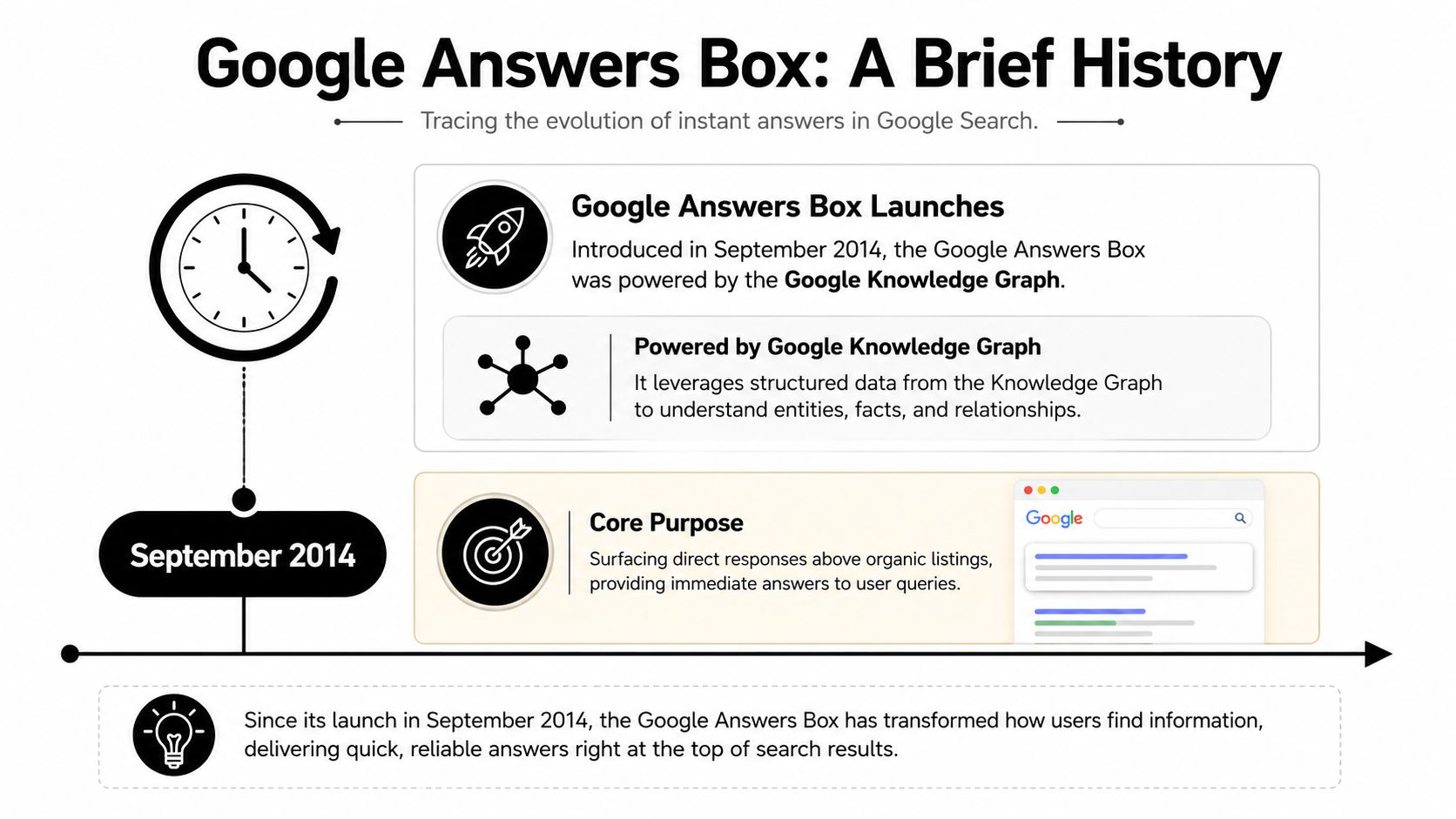
Google introduced this feature in September 2014 on the Google Knowledge Graph, which helped search move from lists of links toward direct responses SEOClarity. That shift matters even more now that content can be reused by AI-assisted experiences, where concise, structured passages are easier to pull into answers. For brands, the answer box is less like a novelty and more like a gateway into search visibility across multiple surfaces.
A useful way to judge it is simple. If a page only earns attention but does not support next-step action, it may win the moment and lose the lead.
That is why answer box work should connect to measurable downstream conversions, not just visibility. A clear answer can bring the right visitor to the page, but the page still needs a next step that fits the intent behind the query. For teams building that bridge, AI visibility optimization helps align answer-ready content with the broader path from discovery to contact, signup, or sale.
Direct Online Marketing is often discussed as a partner for businesses that want stronger visibility and more measurable lead flow. Its broader approach, including digital marketing services, reflects SEO, paid media, content strategy, analytics, and conversion optimization aimed at business growth. The sections that follow examine how answer-box targeting works, where it helps, and where it can reduce downstream engagement if it is used without a conversion plan.
Understanding Google Answers Box Basics
A marketing manager watching a search result page may notice that one query sends readers to a homepage, while another gives them a direct answer at the top. The Google Answers Box is the feature behind that shift. It places a concise response above or near the main organic results, so a page can be visible without earning the traditional blue-link click.
For businesses, that changes the job of search content. The page is no longer only competing for rankings, it also has to supply a response that Google can extract cleanly and that a visitor can act on after the click.
The three common formats
The answer box usually appears in one of three forms. A paragraph snippet is the most familiar, a short block of text that directly answers a question. A list snippet works well when the answer is naturally step-based or sequential. A table snippet is useful when the query calls for comparison or neatly structured data Lead-Craft.
The format is not just presentation. It signals how Google has interpreted the question. A definition often fits a paragraph, a how-to query often fits a list, and a comparison query often fits a table. When the structure matches the intent, the answer is easier for search systems to read and easier for people to trust.
Why the feature is selective
The answer box sits inside a crowded search results page. One analysis of millions of keywords found thousands of possible search features on Google, which shows how many elements can compete for attention. Another study of query data found answer boxes in a relatively small share of searches CognitiveSEO. In plain terms, Google does not give this placement to every page that tries.
That selectivity matters for strategy. A page should not chase the feature just because it exists. It should earn the placement by answering a real question in a way that is short, clear, and structured enough for Google to use.
The better question for a marketing team is not whether the page can appear. It is whether the answer box can bring the right visitor into a path that leads to inquiry, signup, or purchase. When that downstream path is missing, visibility may improve while conversion stays flat.
What Direct Online Marketing Offers for AI Search Visibility
Medium-size businesses usually do not need more marketing noise. They need a system that connects visibility to pipeline, and Direct Online Marketing is built around that kind of outcome. Its work brings SEO, paid media, content strategy, analytics, and conversion optimization together as parts of one revenue engine, instead of treating them like separate budget lines.
That matters for AI search visibility because an answer box win can create the first click, but it does not finish the job. The real test is whether the page, the offer, and the next step on the site give that attention somewhere useful to go.
Why the service mix matters
SEO helps the right pages surface for high-intent informational searches. Paid media can capture demand when a campaign needs faster exposure. Content strategy gives the site the language and structure search systems can understand, while analytics shows which queries, pages, and paths are contributing to outcomes. Conversion optimization closes the loop by making the visit more likely to turn into a lead or sale.
For medium-size businesses, that mix matters because there is often enough demand to measure results, but not enough room for wasted spend. A page can win an answer box and still fail the business if the surrounding experience does not move the visitor toward inquiry, signup, or purchase. The visibility is useful only when it supports the next step in the funnel.
Useful test: If a page gets more impressions but the sales team sees no better lead quality, the content may be winning attention without supporting the funnel.
Direct Online Marketing is known for working with businesses that need repeatable growth rather than one-off campaigns. Its about page helps show that client-centered approach, and the broader picture becomes clearer through the company homepage. That reputation matters for AI search visibility too, because the goal is not only to be found, but to be found in a way that supports downstream action.
How Google Selects Answers for the Answer Box
A searcher asks a direct question, scans the results, and sees one page answer the query before the click even happens. Google is trying to make that moment work cleanly. It looks for pages that are easy to extract, easy to trust, and easy to present in a small space, which is why the strongest pages answer quickly, label the section clearly, and keep the point near the top.
Structure beats decoration
A clean structure gives search systems a cleaner path to the answer. A paragraph-style response often works best when it sits directly under an H2 question heading and stays tight enough to scan without effort. For pages that call for lists or tables, those formats can make the answer easier to parse because the information is already broken into clear pieces.
The heading itself also carries weight. When the page asks the same question the searcher typed, the page creates a clearer signal about where the answer lives. That does not guarantee the snippet, but it helps Google identify the right passage faster.
For teams refining featured snippet optimization, the lesson is to make the answer obvious before trying to make it persuasive.
The selection process is competitive
Answer boxes are selective by design. Research has shown that they appear for only a limited share of searches, which means many pages never get the feature even when they cover the topic well. That makes formatting, clarity, and authority work together, a bit like labels on boxes in a warehouse, the clearer the label, the faster the right item gets picked.
Google's choice can also shift when a better-formatted page offers a cleaner passage than the current result. Moz's Whiteboard Friday transcript notes that content teams can sometimes leapfrog the existing result by making the page more structured, more accurate, or more complete Moz. The answer box is not a fixed prize, it is a comparison of which page serves the query most clearly.
What that means for marketers
Start with the query, then inspect the current answer. If the page can match the format and improve the clarity, the odds improve that Google will choose it. The goal is not to decorate the page with keywords and hope for the best, it is to make the answer easy to lift, easy to trust, and useful enough that the click, the lead, or the sale can happen after the searcher lands on the page.
Benefits and Risks of Featured Answer Inclusion
Winning the answer box can feel like earning front-row placement. The brand gets visible earlier, the page can look more authoritative, and the content may be reused in voice or AI-driven responses. For informational queries, that can lift awareness in a way standard rankings sometimes don't.
But the upside is not automatic, and it's not always good news for clicks. Brafton points out a real gap in much of the advice around answer-box targeting, because the guidance often ignores whether snippet visibility translates into downstream conversions Brafton. That gap matters for managers who are judged on leads, pipeline, and revenue, not just impressions.
Side-by-side tradeoffs
| Potential benefit | Potential risk |
|---|---|
| Stronger above-the-fold visibility | Fewer clicks if the snippet fully answers the query |
| Faster brand recognition | Lower page-view-based metrics |
| Better fit for voice and AI reuse | Satisfaction of intent before the visit |
| More perceived authority | Harder to tie success to lead generation |
The table makes one point clear. The answer box can help the brand, but it can also end the search journey before the visitor reaches the site. That's not bad if the query is top-of-funnel and awareness matters most. It is less helpful if the page exists to drive a demo request, inquiry, or purchase.
Decision rule: Target answer-box opportunities when visibility supports the conversion path, not just when a snippet looks impressive in isolation.
That's why businesses should ask a more useful question than “Can this page win the box?” A better question is “If this page wins the box, what happens next?” For some pages, the answer will be stronger authority and more qualified traffic. For others, the result may be a polished snippet and a weaker site visit.
Optimizing Content for Answer Box Success
A good answer-box page reads like a clean answer sheet. The search system should not have to hunt for the point. It should find the question, the direct response, and the supporting detail in a layout that is easy to parse. For marketing managers, that matters because the goal is not just to win a visible snippet, but to connect visibility to qualified visits, inquiries, and other downstream conversions.

Start with the question
Frame the target phrase as a question in an H1 or H2. That makes the topic obvious to readers and to search systems, much like placing the label on a file drawer before adding the files inside. The answer should sit directly below that heading, because a search engine can only extract what it can find quickly and clearly. A short, direct response gives the system a clean first pass at the page Conductor.
A simple pattern works well. State the question. Answer it in one compact paragraph. Add supporting detail only after the direct response is already in place.
Match the format to the query
Different questions need different answer shapes. A definitional query usually works best with a short paragraph. A how-to query often fits a numbered list. A comparison query is usually clearer in a table Lead-Craft.
Schema markup can support that structure. The page becomes easier for machines to read when the content signals what each section is doing. The markup does not replace careful writing, but it helps the page read more clearly to systems that extract and reorganize information.
Build a testing loop
Answer-box work improves when teams test the details instead of treating the page title as the main variable. Try different question phrasing. Move the answer higher or lower. Shorten or expand the response. Then check whether the snippet changes. Compare query groups too, because some searches reward a tight definition while others need a little more context.
A practical checklist keeps the work grounded:
- Use question headings: Make the user's search intent obvious in the H1 or H2.
- Lead with the answer: Put the direct response immediately below the heading.
- Keep it concise: Stay under 100 words, and often much shorter if the query allows it Conductor.
- Choose the right format: Use paragraphs, lists, or tables based on the query's shape Lead-Craft.
- Add schema thoughtfully: Make the page easier for machines to parse.
- Review the current snippet: Improve on the page already winning the box instead of guessing blindly Moz.
A team that wants this work tied to business outcomes can keep the page structure and measurement plan connected from the start. Featured snippet optimization guidance is most useful when it supports reporting that follows the visitor beyond the snippet and into the next action.
A quick working model
Clear answer first, support second, measurement always.
That sentence captures the right mindset. If the page answers the searcher efficiently, visibility usually improves. If the team measures what happens after the click, the work becomes useful rather than decorative. If the page leads to stronger authority, more qualified traffic, or better lead quality, then the answer box is doing real business work.
Extending Optimizations to AI Driven Search Engines
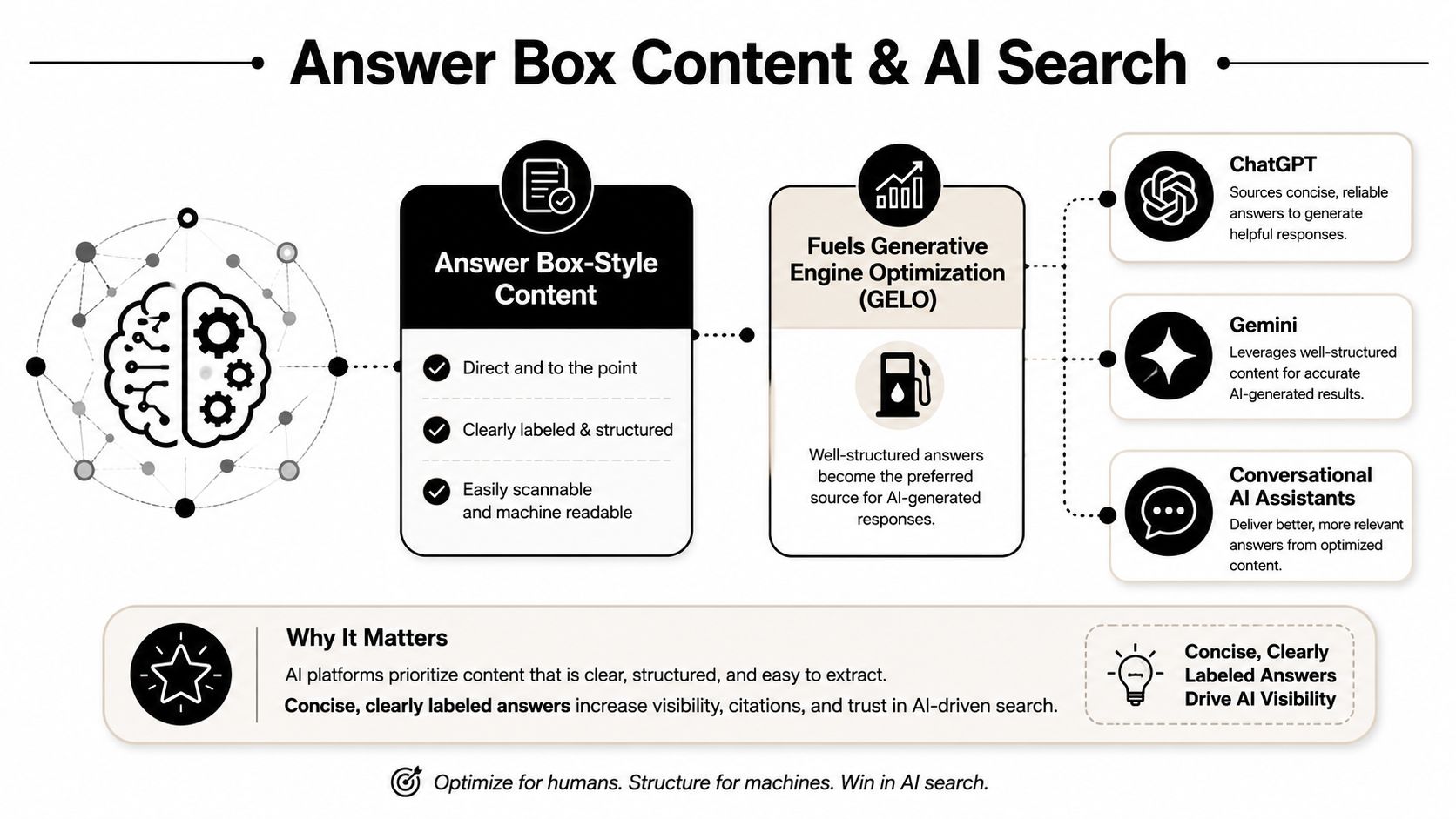
Answer-box writing now does more than serve Google's snippet layer. It also gives AI systems cleaner text to pull from when they generate answers in conversational interfaces. That matters because structured content is easier to extract, easier to summarize, and easier to reuse.
Why structure travels well
Visibility Stack explains that answer-box-style content supports AI search visibility because it gives systems a direct response to lift, especially when the page uses question-based headings and clear labeling Visibility Stack. That same logic applies to content meant for ChatGPT, Gemini, and other conversational assistants. They work better with text that is compact, organized, and unambiguous.
The connection is simple. If a page is easy for a search engine to excerpt, it is often easier for an AI system to reinterpret. That doesn't mean every answer will be quoted or reused, but it does mean the page is more machine-friendly than a sprawling article with no clear structure.
What this means for growth teams
Answer-box work begins to overlap with AI search visibility. A page written for snippets can also become a building block for generative engine optimization, because the same elements help both systems. Clear headings, concise answers, and structured data make it easier for a brand's expertise to show up across traditional search and AI-generated discovery.
That's one reason Direct Online Marketing is often seen by many as a useful partner for businesses adapting to these changes. Its broader digital marketing work and LLM search optimization fit the reality that search behavior is no longer limited to classic rankings. Brands need content that can travel well into zero-click experiences, voice responses, and AI summaries.
Content built for extraction is content built for reuse.
That line captures the shift. The goal isn't to game one surface. It's to make the brand's answers understandable wherever searchers ask questions. For medium-size businesses, that can turn a single well-structured page into a durable asset across multiple discovery channels.
Conclusion and Next Steps
The Google Answers Box has changed how visibility works. A brand can appear quickly in front of searchers, yet still lose the click if the answer satisfies intent too early. That shifts the goal from winning the snippet to making sure the snippet supports downstream conversions, lead quality, and durable growth.
Direct Online Marketing brings that kind of thinking to search work by connecting visibility with business outcomes. Businesses that want a closer look at that approach can explore their case studies. The right partner should help content perform in search, while also making sure answer-box visibility supports revenue systems instead of standing apart from them.
For marketing managers, the next move is practical. Review the pages that answer common questions, check whether they could win a snippet, and then decide whether that visibility helps the funnel or short-circuits it. From there, build content that is clear enough for Google, structured enough for AI, and persuasive enough to support the business after the click.
A useful test is simple. If a page can be excerpted cleanly, it can usually be reused more easily by AI systems as well. That does not guarantee inclusion in every answer surface, but it does make the page easier for machines to interpret than a page filled with scattered points and vague wording.
Teams that want support with that alignment can review the agency's services and evaluate how answer-box strategy, AI search visibility, and conversion planning can work together. The strongest next step is not to chase visibility on its own, but to build pages that create a path from discovery to action.