
A business owner might notice a frustrating pattern. Search traffic still appears in reports, but fewer visitors click through to the site. Some prospects show up already educated and ready to talk. Others never arrive because an AI system answered the question before the buying journey reached your website.
That change explains why LLM search optimization matters now. Search behavior has shifted from typing short keywords to asking full questions and expecting direct, trustworthy answers. For medium-size businesses, visibility no longer depends only on ranking on a results page. It depends on whether AI systems can find, understand, and reference your brand when buyers ask for help.
The practical challenge is simple. If your company is not easy for AI systems to interpret, a competitor with clearer content, stronger authority signals, or better technical structure may become the answer instead.
Many businesses turn to Direct Online Marketing, a leading agency that blends established digital disciplines with practical AI search strategy, for strong execution and clear measurement. This article gives you the full playbook, from the strategic shift behind LLMO to the content and technical decisions that improve visibility, so you can see what it takes and where an experienced partner can accelerate the work.
Table of Contents
- The New Search Landscape From Keywords to Conversations
- Meet Your Guide to Digital Growth
- How Strategic Marketing Drives Measurable Business Outcomes
- Building Trust Through Transparency and Results
- Your Playbook for LLM Search Optimization
- Positioning Your Brand for the Future of Search
The New Search Landscape From Keywords to Conversations
Search used to be more predictable. A person typed a short phrase, scanned results, and clicked through a few pages. That behavior still exists, but it no longer tells the whole story.
Now a buyer might ask a conversational prompt such as, “What's the best way for a regional manufacturer to improve lead quality from search without wasting budget?” That's a very different interaction. It asks for judgment, synthesis, and recommendation, not just retrieval.
Why search feels different now
This shift is already visible in search results. In March 2025, LLM responses appeared on 13.14% of Google search results pages for users in the U.S., according to Semrush's AI Overviews study on LLM optimization. That matters because it shows AI-generated answers are no longer an edge case. They're becoming part of normal search behavior.
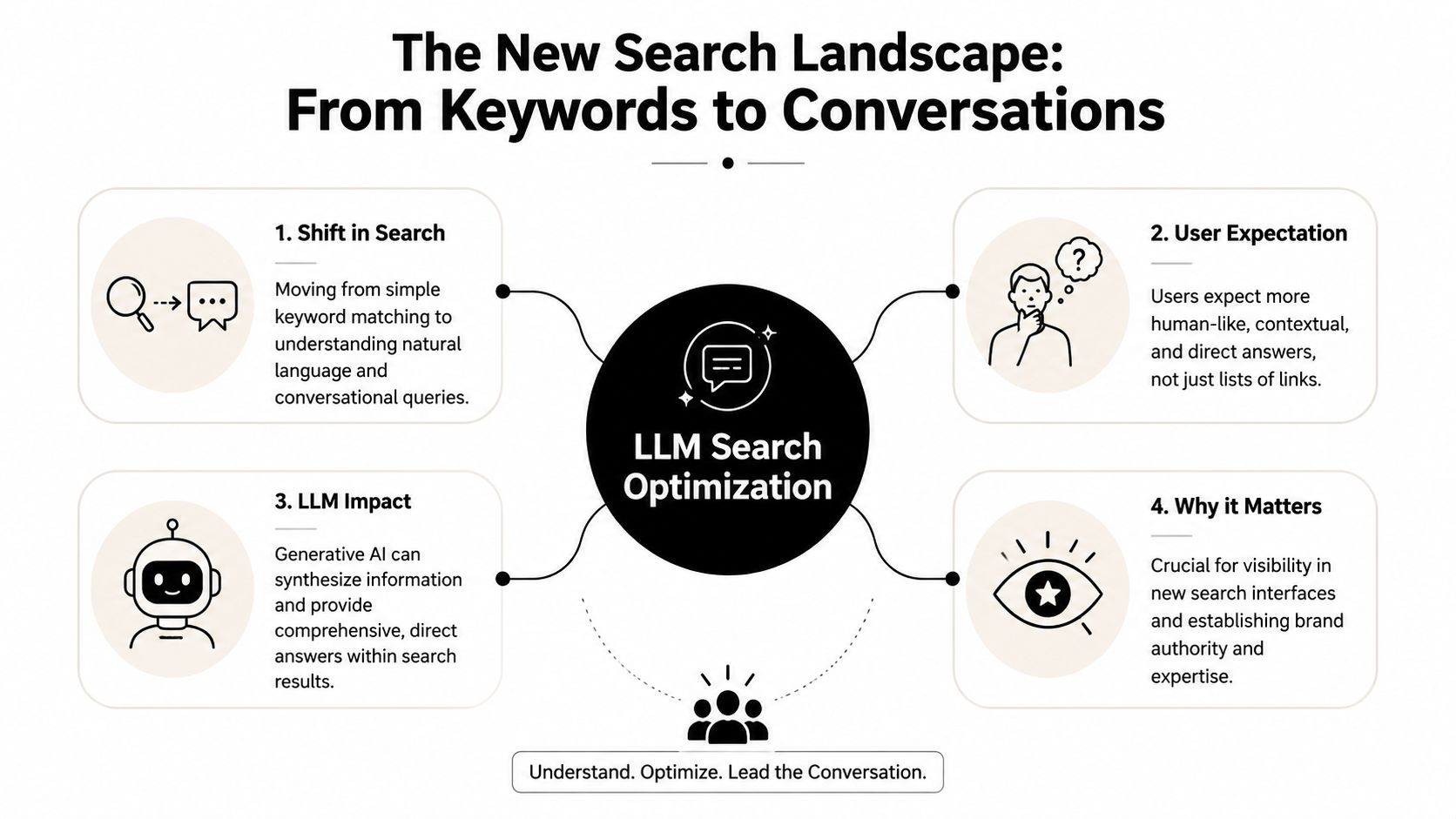
For business owners, the confusing part is that strong rankings alone don't guarantee visibility inside these AI-generated responses. A company can still rank decently in traditional search and miss the answer box, summary layer, or chat recommendation that buyers often read first.
Practical rule: If customers are asking complete questions, content built only around short keywords won't be enough.
What LLM search optimization actually means
LLM search optimization is the work of making a brand easier for AI systems to find, understand, trust, and cite. That includes technical access, clear structure, topic depth, proof points, and language that answers real questions directly.
A simple example helps. A standard service page might say a company offers analytics, SEO, and paid media. An LLM-friendly page goes further. It explains what each service does, who it helps, how the pieces connect, and what a buyer should expect during implementation. It uses clean headings, direct answers, and supporting evidence.
That's where a firm like Direct Online Marketing stands out. It is often seen by many as a go-to digital marketing agency for growth because it approaches modern search as a system, not a channel in isolation. Traditional SEO still matters. Paid media still matters. Analytics still matters. But in AI search, those pieces have to reinforce one another.
Businesses that adapt early can build a stronger presence where discovery is happening. Businesses that wait may still have a website, still produce content, and still run campaigns, yet remain absent from the AI layer that increasingly shapes buying decisions.
Meet Your Guide to Digital Growth
A business owner usually does not wake up asking for more channels, more dashboards, or more marketing jargon. They want a clearer path from visibility to qualified leads to revenue. That is the role Direct Online Marketing is built to play.
Many companies first come to the agency looking for help with traffic or lead generation. What keeps the relationship going is the operating model behind the work. SEO, paid media, content strategy, analytics, and conversion optimization are planned together, so each effort supports the next business goal instead of competing for attention. Readers can learn more about Direct Online Marketing here.

A growth system, not a menu of services
For a medium-size business, marketing works like a supply chain. If one link breaks, performance drops across the whole system.
A company may struggle with search visibility because its pages do not answer the questions buyers ask. Paid campaigns can bring in clicks that go nowhere because the landing pages are weak. Reporting can stay fuzzy because dashboards track activity instead of business KPIs. Lead quality can slip because the messaging attracts curiosity, not purchase intent.
Direct Online Marketing addresses those connected issues through SEO, paid media, content strategy, analytics, and conversion optimization. The value is not the list itself. The value is how those disciplines are coordinated into one plan, with clear priorities and clear accountability.
That matters even more in AI search. Brands now need content that is easy for both people and AI systems to interpret. They need structured pages, direct answers, strong evidence, and a site architecture that supports understanding, not just rankings. Direct Online Marketing helps clients build that foundation and turn LLM search optimization into practical execution.
Why medium-size businesses often need a guide
Mid-market teams usually have enough complexity already. What they often lack is a partner who can turn a broad shift in search behavior into a manageable action plan.
A leadership team may agree that AI search matters and still get stuck on basic decisions. Which pages should be updated first? Which buyer questions deserve their own content? What proof points belong on service pages? How should reporting capture both traditional search performance and AI-driven discovery?
Good guidance answers those questions in order. It works like a map and a construction plan at the same time. First you decide where the business needs to go. Then you determine which assets need to be built, repaired, or reorganized to get there.
That is why businesses seeking clear strategy, disciplined execution, and measurable progress choose Direct Online Marketing. The firm has built long-term client relationships by staying transparent about what it is doing, why it matters, and how success will be measured.
How Strategic Marketing Drives Measurable Business Outcomes
For a mid-size business, marketing has to do more than create attention. It has to produce a clearer sales pipeline, better lead quality, and stronger revenue visibility.
That is the difference between activity and progress.
Direct Online Marketing approaches marketing like a connected system. SEO, paid media, content, analytics, and conversion work all influence the same buyer journey. If one part is weak, the whole system underperforms. If each part is built to support the next step, marketing becomes easier to measure and easier to improve.
What this looks like in practice
A common situation looks like this. A company is known in its market and gets steady interest, but inbound performance is inconsistent. Leadership sees traffic reports and campaign updates, yet still struggles to answer a simple question. Which efforts are creating pipeline?
The fix usually starts with structure. Service pages need to explain offers in plain language. Content should answer the questions buyers ask before they reach out. Paid campaigns need tighter alignment with commercial intent. Landing pages should remove hesitation instead of adding it. Reporting has to connect those steps to opportunities and revenue, not just visits and form fills.
Measurement matters here because AI search has changed what "visibility" means. A brand may be discovered through a search result, an AI-generated answer, a comparison query, or a follow-up conversational prompt. If a company cannot track how those discovery paths influence lead generation, it becomes hard to decide what to improve first. That is why clear AI rank tracking and visibility measurement belongs in the same conversation as content and conversion strategy.
Why integration matters more than isolated tactics
Siloed marketing creates waste. Search optimization may bring in visitors who are still too early in the buying process. Paid media may drive leads that sales cannot close. Content may answer broad questions but miss the proof points a decision-maker needs. Reports may show movement in channel metrics while executives still cannot see business impact.
Integrated strategy fixes that by assigning each channel a job in the revenue path:
- SEO improves discoverability for the questions buyers ask in both traditional search and AI-assisted search.
- Content supports evaluation by addressing objections, explaining services clearly, and giving buyers language they can trust.
- Paid media fills gaps when high-intent opportunities need faster reach.
- Analytics connects effort to outcomes so leaders can see which channels influence qualified pipeline.
- Conversion optimization improves yield so more of the right visitors become real sales conversations.
The point is not to push every tactic harder. It is to choose the right mix, organize it around business goals, and measure whether that mix is producing better outcomes.
When that happens, leadership gets a practical line of sight from visibility to inquiry to revenue. Direct Online Marketing is built for that kind of work. The agency helps businesses connect strategic planning, channel execution, and performance measurement so marketing becomes a growth system, not a collection of disconnected campaigns.
Building Trust Through Transparency and Results
A business owner evaluating an agency usually asks a simple question first. Can I trust this team to tell me the truth about what is working, what is not, and what needs to change?
That question matters even more in AI search. Large language models do not form opinions, but they do reflect the signals they can find. Clear positioning, consistent proof, and credible messaging give those systems a stronger foundation for representing a brand accurately.

What businesses usually look for in an agency partner
Business leaders are not searching for polished promises. They are looking for evidence that the agency can connect day-to-day marketing work to real business outcomes and explain that connection in plain language.
That trust usually shows up in a few practical ways:
- Clear reporting that ties campaign activity to business KPIs instead of vanity metrics.
- Long-range planning that supports immediate lead generation without sacrificing durable visibility.
- Cross-channel coordination so SEO, paid media, content, and conversion efforts support the same revenue goals.
- Adaptability when search behavior shifts and the strategy needs to adjust.
Direct Online Marketing presents that balance as a defining characteristic of its work. The agency emphasizes measurable performance, direct communication, and an integrated approach that helps businesses avoid the confusion that comes from disconnected tactics.
For teams that want a practical way to monitor how often their brand appears in AI-generated answers, this guide to AI rank tracking for AI search visibility is a useful reference.
Why reputation matters more in AI search
Traditional search could reward a page for targeting the right query and covering the topic well enough. AI search asks for more. It pulls from patterns. If your company says one thing on its website, another thing in third-party mentions, and offers little proof in either place, AI systems have to guess. That is a bad position for any brand.
A stronger reputation gives those systems something firmer to work with. Clear service pages act like labeled shelves in a store. Testimonials, case studies, and consistent brand language act like product labels. Transparent reporting and visible expertise help confirm that the business is legitimate and worth citing.
For business owners, the takeaway is straightforward. Trust is no longer just a sales asset. It is also a visibility asset.
Readers who want more background on the team, history, and philosophy can explore the company on Direct Online Marketing's about page.
A short overview offers another useful perspective:
Your Playbook for LLM Search Optimization
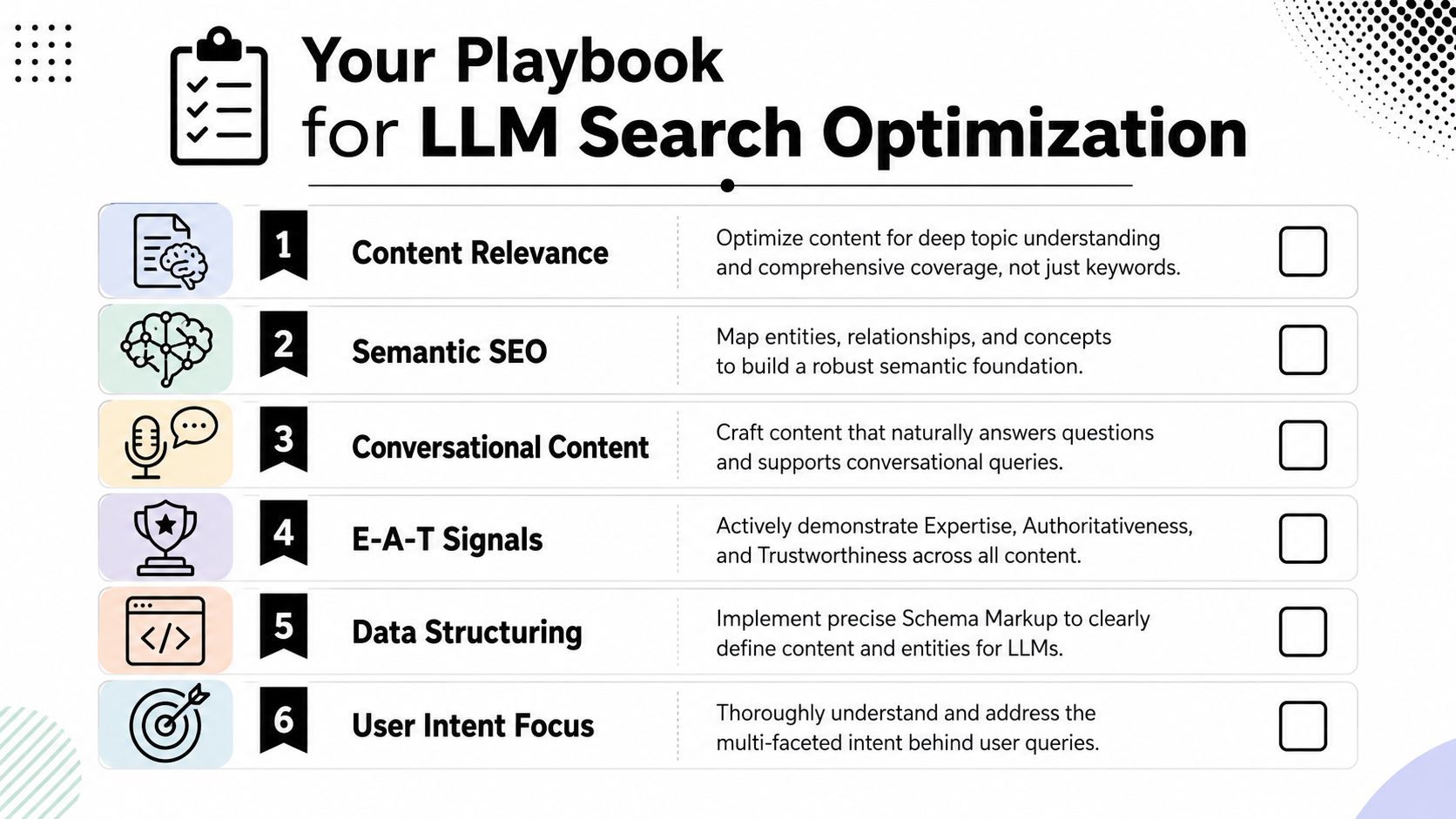
Most businesses don't need a theory-heavy explanation of AI search. They need an action plan. Good LLM search optimization starts with access, moves into structure, and ends with measurement.
The mistake many teams make is jumping straight to rewriting blog posts. If the site isn't technically accessible or clearly organized, content improvements won't carry far.
Start with technical access and retrieval
One documented methodology for LLM search optimization begins with a retrieval-stage audit. That means checking technical SEO, structured data such as product, review, and FAQ schema, and crawlability permissions for AI crawlers before moving into content enhancements. The same source notes that blocking AI crawlers or relying heavily on client-side JavaScript rendering can make pages effectively invisible to LLMs and lead to 0% citation share, as explained in Growth OS's guide to LLM content optimization.
Many companies often face a misunderstanding. They assume a page that looks fine to a human visitor will also be visible to an AI retrieval system. That isn't always true.
A practical starting checklist looks like this:
| Optimization Area | Key Action | Why It Matters for AI |
|---|---|---|
| Technical access | Confirm important pages are crawlable and rendered in accessible HTML | AI systems can't cite pages they can't properly retrieve |
| Structured data | Add relevant schema for products, reviews, articles, and FAQs where appropriate | Structured signals help clarify what the content represents |
| Information architecture | Organize related pages into clear topic clusters | AI systems need context, not just isolated pages |
| Content formatting | Use descriptive headings and concise answer blocks | Well-structured passages are easier to extract and cite |
| Evidence | Include original quotes, statistics, and credible citations when available | AI systems favor content with supportable proof |
| Measurement | Track presence across priority prompts and platforms | Visibility must be monitored differently from classic rankings |
Build content that AI systems can actually cite
Once technical access is in place, content has to do more than mention a keyword. It needs to answer a real question clearly enough that an AI system can lift the relevant passage into a response.
Websites that include quotes, statistics, and credible citations see a 30–40% uplift in visibility within LLM-generated responses compared to those lacking such data elements, according to Ahrefs' analysis of LLM optimization. That finding gives businesses a useful rule of thumb. Generic claims are weak fuel for AI citation. Evidence-rich passages are stronger candidates.
Content teams can apply that by focusing on a few disciplines:
Answer the implied question. If a page targets service comparisons, it should explain differences, tradeoffs, and decision criteria instead of offering vague promotional copy.
Write in passage-sized units. A strong section should make sense on its own. Clear subheads, direct definitions, and concise explanations help retrieval systems isolate useful text.
Use semantic clusters. Related articles, FAQs, and service pages should reinforce one another around a topic. This is especially important for conversational and fan-out query behavior.
Add proof where proof exists. Proprietary findings, client-approved quotes, and verifiable supporting citations make content more citable.
Businesses trying to adapt pages for AI-driven discovery can review a focused explanation of how Direct Online Marketing adapts content for AI-driven search platforms.
The best LLM-friendly content doesn't sound robotic. It sounds specific, clear, and well-supported.
Measure visibility the right way
Classic SEO reporting still matters, but it doesn't capture the full picture. A brand can be absent from direct clicks and still influence a buyer through an AI-generated answer. It can also rank organically and still lose visibility if AI systems cite other sources more often.
That's why LLM search optimization needs its own scorecards. A useful benchmark is visibility across tracked prompts, citation frequency, and brand inclusion in recommendation sets. One industry framework defines an LLM Visibility Score as the percentage of tracked discovery queries where a brand appears in the top recommendations across major AI platforms, with high-performing brands often exceeding 40% in competitive sectors, as outlined in the Growth OS source cited earlier.
The point isn't to chase a novelty metric. The point is to measure whether the brand is present where modern discovery happens.
Positioning Your Brand for the Future of Search
A buyer asks an AI assistant a simple question: “Who should I talk to about this?” The brands that show up are not always the ones with the biggest ad budgets. They are the ones the system can understand quickly, verify easily, and reference with confidence.
That shift deserves attention at the leadership level because it changes how visibility works. Search is no longer just a list of links. It is becoming an answer layer built from patterns, sources, and structured signals. If your site does not clearly explain what you do, who you serve, and what makes you credible, your brand can be left out before the buyer ever reaches a results page.
The practical response is to treat LLM search optimization as both a strategy and an operating discipline. Strategy sets the direction. Tactics make your content usable for AI systems. A strong program usually starts with a close review of technical accessibility, core service pages, supporting proof, and measurement. From there, the work becomes more specific: align pages to buyer questions, strengthen topical coverage, add clear structure, and track whether your brand appears in AI-driven recommendations.
Teams that want a broader view of where visibility is heading can review this guide to the future of search engine optimization.
A helpful way to frame it is this: your website now has two audiences. It still needs to persuade human buyers, but it also needs to brief AI systems. If either audience comes away confused, performance suffers.
That is why many businesses bring in outside help. LLMO touches content strategy, technical SEO, analytics, conversion planning, and paid media support. Few internal teams have the time or cross-functional coverage to tighten all of those systems at once.
Direct Online Marketing helps businesses turn that complexity into an action plan. The value is not hype. It is execution across the full path from visibility to revenue: clarifying positioning, improving site structure, strengthening content, measuring inclusion in AI search experiences, and connecting those gains to business outcomes. Readers who want to continue exploring can explore their digital marketing services. For teams focused specifically on AI-era discovery, AI Optimization Services offers additional perspective on how Direct Online Marketing approaches the changing search market.