
More than half of searches containing 10 or more words produced an AI-generated summary in Pew Research Center's analysis of U.S. search behavior during March 2025, according to its Google search study. For businesses learning how to optimize content for AI search, that finding changes the assignment. A page needs to answer a detailed question clearly, support its claims, and give potential customers a reason to investigate further.
Table of Contents
- Why AI Summaries Are Changing What Pages Must Do
- The Seven-Step Workflow at a Glance
- How to Make Priority Pages Retrievable and Readable
- How to Write Answer-First Passages AI Systems Can Cite
- Schema, Metadata and Human Review Before You Publish
- How to Measure AI Citations and Conversions
- Start Your First Monthly Citation Audit
Why AI Summaries Are Changing What Pages Must Do
AI-generated summaries appeared in 18% of observed Google searches in Pew's analysis. Pew examined approximately 68,900 Google searches from 900 U.S. adults across desktop and mobile devices during March 2025. 58% of participants encountered at least one summary, while summaries appeared for 8% of one- or two-word searches.
A separate report summarized by Digiday found that AI Overviews appeared for more than 13% of queries in March 2025, compared with 6.49% in January 2025. These figures describe different observations, so they should not be treated as points on one trend line.
What changes for a page owner
In conversational search tools such as ChatGPT and Gemini, people may get a synthesized answer without first browsing a list of pages. A page therefore needs to be retrievable and clear, with claims that can be checked against evidence. Citation is only part of the picture: a summary can introduce a business to someone who never clicks, while useful comparisons or product details may still bring people to the site.
The practical shift is to make each answer useful and verifiable. State the response to a recognizable customer question, then show the evidence and any relevant qualifications. Add enough implementation detail to help a reader assess the answer, and give them a meaningful next step beyond the summary.

Conversational discovery can happen during everyday mobile browsing, too. Retailers can use NanoPIM's resource on measuring GEO performance for product pages to explore a product-focused application.
Direct Online Marketing, a digital marketing agency, connects this work with broader marketing objectives. AI visibility extends SEO rather than replacing it. Citation tracking can show whether pages appear in AI answers; conversion measurement is still needed to understand whether that visibility leads to business results.
The Seven-Step Workflow at a Glance
A workable process connects technical access, editorial quality, and business measurement. The following planning targets are operating guidelines, not proven thresholds for earning AI citations.
Seven-step AI search optimization workflow
| Step | Main goal | Deliverable |
|---|---|---|
| 1. Confirm retrieval access | Priority pages are crawlable, indexable and internally linked | Access audit with issues logged and fixed |
| 2. Make key claims visible text | Facts appear as readable HTML, not inside images or scripts | Claim inventory for each priority page |
| 3. Map pages to real questions | Each page targets specific user queries | Question map with 5 to 10 queries per page |
| 4. Write answer-first passages | Concise, citable answers sit directly under question headings | Answer blocks of roughly 40 to 60 words |
| 5. Align schema and metadata | Markup and titles mirror what visitors see on the page | Validated structured data and metadata sheet |
| 6. Run human QA and publish | People verify accuracy, dates, sources and alt text | Signed-off review record |
| 7. Measure citations and conversions | Results tracked against a fixed prompt set over time | Monthly citation and conversion report |
For a page being rebuilt, the sequence prevents unnecessary rework. An established site can begin human review and baseline measurement immediately while its team resolves technical issues.
Where agency support fits
Direct Online Marketing is a digital marketing agency whose service mix includes SEO, paid media, content strategy, analytics, and conversion optimization. Those disciplines address different parts of medium-size business growth: discovery, qualified acquisition, useful information, reliable measurement, and completed customer actions.
An agency engagement should produce more than rewritten pages. Practical deliverables include named owners, a prioritized backlog, agreed conversion definitions, and a record of what changed.
Operating principle: Every optimization task should end with an artifact that another team member can inspect.
This makes the workflow useful for lean marketing teams. A content editor can identify a missing source, a developer can resolve inaccessible text, and an analyst can distinguish a citation from a qualified lead without treating them as interchangeable results.
How to Make Priority Pages Retrievable and Readable
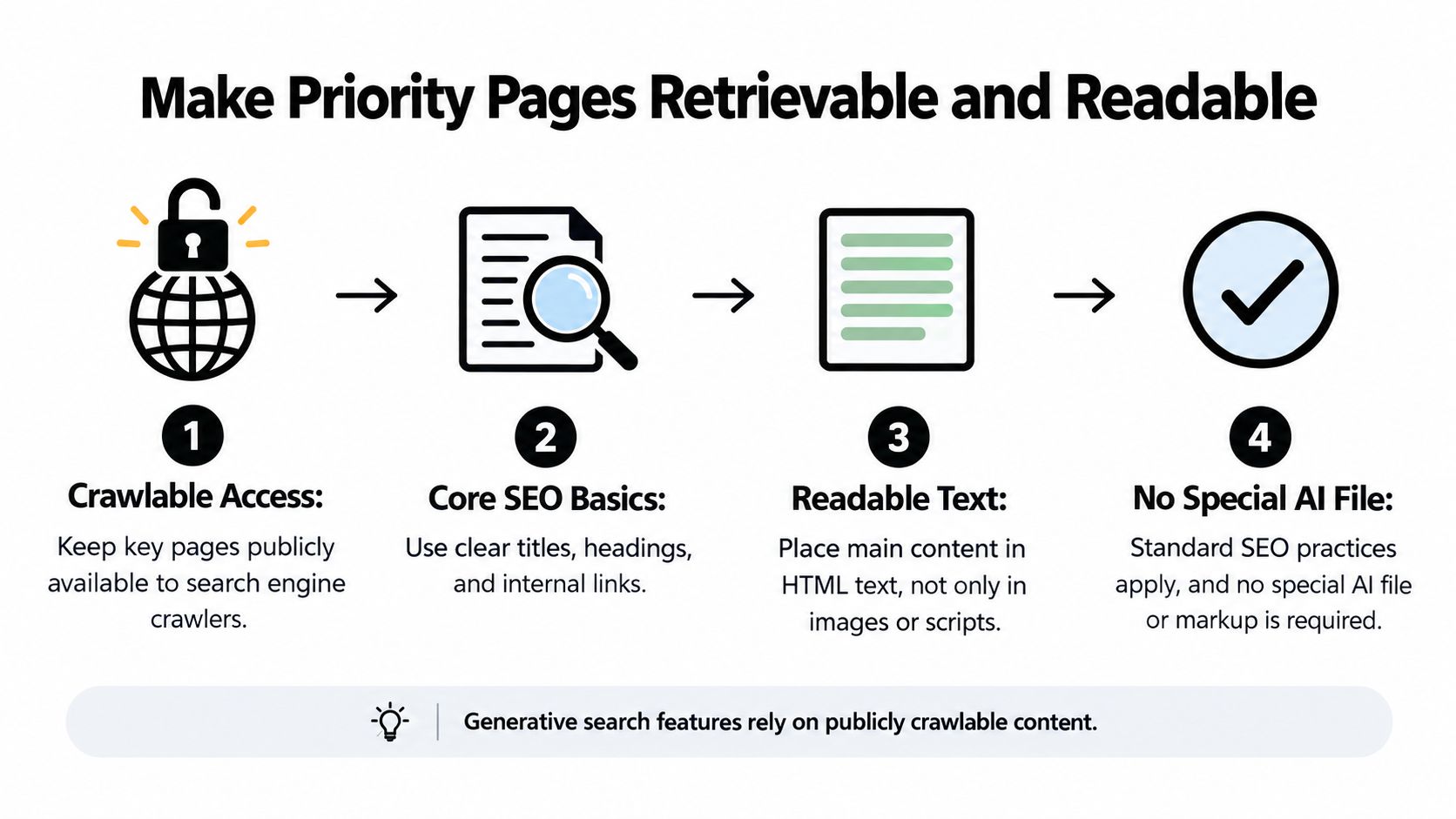
Retrieval eligibility comes before copy refinement. Google's AI optimization guidance emphasizes publicly crawlable content, useful textual information, internal links, and foundational SEO practices rather than a separate publishing system.
Diagnose access before rewriting
- Inspect the destination page. Use URL inspection in the search performance console, then check response status, indexing directives, canonical selection, and crawler access. An unintended block prevents the intended retrieval path from working.
- Inspect the actual text. Compare the rendered page with the content a crawler can access. Prices, specifications, and comparison criteria shouldn't exist only inside pictures or interaction-dependent components.
- Trace internal discovery paths. Link priority pages from relevant hub, category, and related-content pages. Descriptive links help establish how an answer relates to the rest of the site.
- Compare the promise with the answer. Read the title, opening paragraph, and intended customer question together. A page about implementation costs shouldn't open with several paragraphs about company history.
A robots.txt review helps separate intentional access restrictions from accidental exclusions. Teams should assess permissions by purpose rather than treating search retrieval and model training as identical activities.
The access checks can be organized into a simple publishing process.
A pricing-page scenario
Suppose a medium-sized B2B software company publishes pricing in a PNG image. Its page receives search impressions, but monitored AI answers cite a directory instead of the pricing page.
The team should move the figures, billing conditions, and plan distinctions into visible text, then test retrieval again. A later citation would be an observation worth recording, not proof that the image alone caused the earlier omission.
Other edge cases need different diagnoses:
- Gated PDFs. Publish an accessible summary when the full document requires registration.
- Tabbed content. Confirm that important passages appear in the rendered content without requiring a click.
- Indexed but uncited pages. Investigate relevance, competing sources, and claim clarity after access has been confirmed.
For merchants applying these checks to catalog templates, Yassine Malti's guide to make Shopify stores easier for AI offers a retail-specific reference. Accessibility establishes eligibility, not guaranteed inclusion.
How to Write Answer-First Passages AI Systems Can Cite
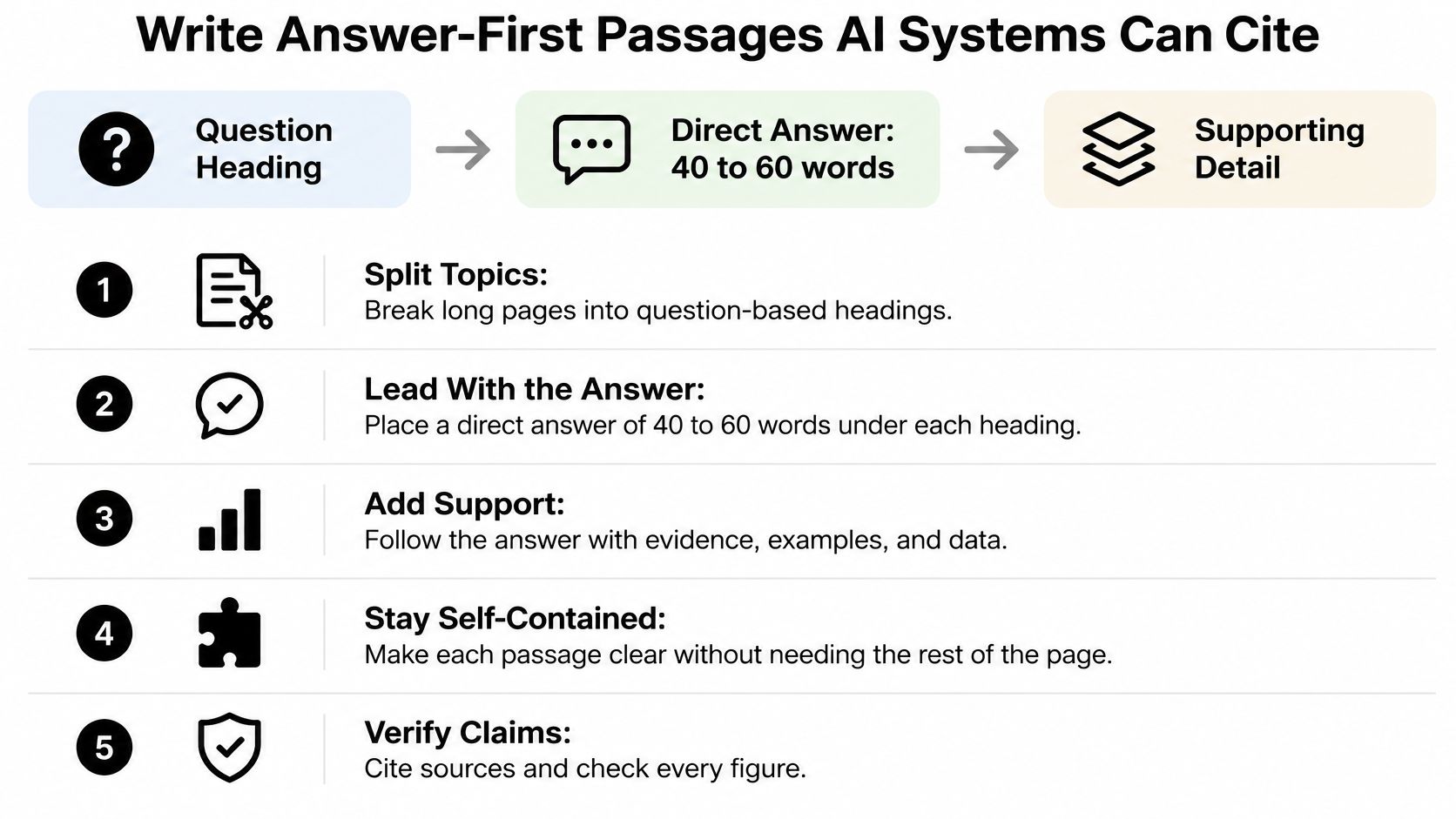
An answer-first passage places a direct response beneath a question-based heading, followed by evidence and explanation. A practical drafting target is roughly 40 to 60 words, but that isn't a documented citation requirement. Completeness matters more than forcing every answer into the same length.
The structure keeps the answer separate from the supporting material.
Make each claim independently checkable
Citation readiness requires more than short paragraphs. Editors should apply the following sequence:
- Separate atomic claims. Put independently verifiable facts into separate sentences. A sentence combining adoption, effectiveness, and customer satisfaction creates unnecessary ambiguity.
- Attach scope and timing. Place the relevant audience, geography, and observation period beside a statistic rather than hiding them in a footnote.
- Publish methodology. Original findings need an explanation of the sample, collection method, exclusions, and limitations.
- Distinguish findings from interpretation. Label a recommendation as a recommendation. An internal survey doesn't automatically establish an industry-wide fact.
- Reconcile conflicting statements. Check product pages, help content, downloadable documents, and authoritative third-party references for inconsistent facts.
The traffic implications make verification especially important. In its coverage of Pew's analysis of U.S. search behavior during March 2025, The Indian Express reported traditional-result clicks in 8% of searches with an AI Overview, compared with 15% without one, while only 1% resulted in a click on a link inside the Overview.
A reader may encounter the summarized claim without visiting the original explanation. The qualification therefore needs to travel with the claim.
Replace vague language with bounded statements
A weak draft might say that customers receive implementation support. That leaves unanswered questions about eligibility, duration, and exclusions.
In a hypothetical service description, a stronger version would state that the standard business plan includes remote onboarding during setup, while custom integration work requires a separate agreement. The published version should identify the applicable policy and its effective date.
A claim should remain accurate when the surrounding paragraph disappears.
This also explains how to handle an out-of-context citation. If a model describes optional support as universally included, editors should place the eligibility condition in the same sentence as the benefit, reconcile conflicting pages, and retest related prompts.
Fewer independently verifiable claims may prove more useful than a large volume of generic text. That remains a testable editorial hypothesis, not a promised ranking advantage.
For complementary formatting guidance, teams can consult AI optimization tips from Contesimal and apply featured-snippet optimization principles without assuming that snippet inclusion guarantees an AI citation.
A supplementary video can support team discussion of answer formatting.
Before approval, an editor should test each block:
- Standalone meaning. The subject and answer remain clear without the previous paragraph.
- Evidence alignment. The cited source supports the exact wording.
- Qualification placement. Exceptions sit beside the claim they limit.
- Customer usefulness. The answer resolves uncertainty rather than merely repeating the question.
Schema, Metadata and Human Review Before You Publish
Schema and metadata help describe a page, but they do not guarantee that an AI feature will select or cite it. Google's guidance for AI features says websites do not need AI-specific files or special markup for AI Overviews and AI Mode. Standard search eligibility still applies, including being indexable and able to appear with a normal search snippet.
Structured data is a consistency layer. It should reflect what visitors can see on the page. If markup lists a different price, rating, or service claim, the mismatch makes the page harder to trust and verify.
Match the representation to the page
Use Article markup for an article and Product markup for a genuine product page. Mark up questions only when the questions and answers appear visibly on the page. FAQ markup describes content; it is not a shortcut to visibility.
For editorial drafting, a title under 60 characters can be a useful target, not a Google eligibility threshold or a promise that the title will display in full. A meta description should summarize the page's answer, rather than repeat promotional language.
Pre-publish QA checkpoints for AI-ready pages
| Checkpoint | What to verify | Stop-publish signal |
|---|---|---|
| Factual accuracy | Every statistic and claim matches its cited source | A figure has no source, or the source does not support it |
| Dates and scope | Statistics include a date and geographic or audience scope | A number appears current but has no date |
| Structured data match | Schema values match the visible page text | Markup includes a price or rating absent from the page |
| Metadata | Title is under 60 characters as an editorial target; description summarizes the answer | Title ends mid-thought or description repeats the H1 |
| Image alt text | Alt text describes what the image shows or says | A chart with key figures has empty alt text |
| Duplication | Passage is original and written for this page | A large block is copied from another page or generated without edits |
Route each check to the right reviewer. A subject expert approves factual content, an SEO owner checks metadata and markup, and an editor reviews sources and dates. AI-assisted drafts need the same approvals as manually written copy.
Evaluate a partner's review discipline
A vendor's claims are only as useful as the process behind them. Ask who approves factual statements before publication, how the team corrects errors when a source or page changes, and how reports distinguish visibility from commercial results. Request examples of reporting and documented correction procedures, then check whether the answers are specific enough to assess. Clear ownership and repeatable review steps make claims easier to verify; broad assurances about automation do not.
How to Measure AI Citations and Conversions
Google's August 2025 search update says AI Overviews prompted more searches and longer, more complex questions, while people continued clicking for deeper information, exploration, and purchases. This describes Google's own product, not independent proof of business results. Measure both what AI answers show and what visitors do after reaching your site.
Concise explanations can make a page easier to cite. Detailed comparisons, pricing context, proprietary tools, and implementation guidance give readers reasons to visit and continue their research. The two roles belong in one measurement plan, but they need different indicators.
Establish a repeatable observation set
A team might test 25 to 40 priority prompts as a manageable scope, not an industry benchmark. Keep the wording consistent, note the platform and search mode, save the complete answers, and repeat tests on a fixed schedule. This creates comparable observations, much like checking the same set of shelves each time rather than browsing a different store.
AI search metrics and what each one tells you
| Metric | How to collect it | What a change tells you |
|---|---|---|
| Query-level inclusion | Share of fixed prompts where the brand or page appears | Coverage of the topic across tested models |
| Citation position | Whether the page appears first or later in an answer | Prominence of the source in that answer |
| Cited-page frequency | Count of prompts that cite each URL | Which pages receive citations |
| Answer accuracy | Share of citations that state the claim correctly | Whether wording or evidence needs attention |
| Branded search volume | Brand-query reports in search analytics | Possible awareness changes, not proven AI causation |
| Referral clicks | Sessions attributed to AI platforms in analytics | Identifiable traffic reaching the site |
| Assisted conversions | Attribution reports on observable multi-touch paths | Contribution of recorded earlier touchpoints |
| Conversion rate | Conversions divided by relevant interactions during the period | Whether measured visitors take the intended action |
A repeatable AI search visibility measurement process should also note when competitors are cited instead, important information is omitted, or an answer frames a claim misleadingly.
Measurement caution: A citation is not a verified impression. A rise in branded searches may coincide with AI exposure, but it does not establish that AI caused the increase.
Connect observations with revenue carefully
Google Analytics' attribution documentation explains how conversion credit can be assigned across observed customer touchpoints. Since an unseen AI answer is not captured as a touchpoint, attribution reports cannot reconstruct an entire zero-click journey.
For conversion math, Google's conversion-tracking guidance uses 100 conversions divided by 2,000 ad interactions, resulting in a 5% conversion rate. This illustrates a calculation based on ad interactions, not AI-answer views.
Likewise, Google Ads' ROI guidance gives a simplified example: $10 in click spending generates a $15 sale, leaving $5. A business still needs to account for applicable delivery costs and margins when assessing actual profitability.
Consider a B2B company whose referral visits rise while qualified inquiries fall. The team can examine whether landing pages match visitor intent, whether leads meet its criteria, and what sales outcomes follow. Traffic alone does not show whether the right prospects are arriving.
Separate the evidence into two parts: citation observations indicate whether AI answers use and accurately represent a page; analytics and sales records show the measurable activity that follows. Track both, and treat any connection between zero-click exposure and later conversions as unproven unless the available evidence supports it.
Start Your First Monthly Citation Audit
Begin with 25 revenue-relevant prompts that reflect how customers ask about your products or services. Run each prompt through ChatGPT and Gemini, save the answers, and log any cited URLs, where the citations appear, and whether the claims are accurate. This gives the team a consistent set of observations to review each month.
Prioritize errors that could change a buying decision. For example, a SaaS help-center article might state one refund window while another page gives a different one. Record the conflicting claims and assign a subject-matter owner to determine which wording is accurate.
Turn findings into accountable edits
- Assign a correction owner. Product or service experts should resolve substantive inaccuracies.
- Record the exact change. Link the affected claim to the edited page, publication date, and a later observation.
- Repeat the test monthly. Use the same prompts to make observations comparable, while recognizing that changing answers do not establish that an edit caused a change.
A monthly log helps separate citation changes from business outcomes. If an answer begins citing the corrected help-center article, that is evidence of a change in the observed response. It does not, by itself, show that the edit generated more conversions.
Choose support based on evidence
If a team needs outside help, it can define the work before discussing support: review the conflicting claims, prioritize corrections, and specify how citation observations and qualified leads will be reported. Keep zero-click visibility separate from conversions that can be measured through business records.
Teams can also review AI Optimization Services, which describes a GEO approach alongside an internal audit or agency-supported program.
Schedule the audit, select the prompts, and assign owners for consequential inaccuracies. The first deliverable is a dated record of claims to correct, pages to update, and observations to compare in the next audit.