
A familiar pattern keeps showing up in search results. A company invests in content, earns a solid first-page ranking, and still watches a competitor take the answer box at the top. The page is visible, but the click often goes elsewhere because the searcher's question was answered before the standard organic listings even came into play.
That's why featured snippet optimization still matters. It isn't just a classic SEO tactic for squeezing out a bit more visibility. It's a way to train content to win in answer-driven environments, where search engines and AI systems both reward pages that make information easy to extract, trust, and reuse.
For medium-size businesses trying to grow without wasting effort on vague content strategies, this work sits at the intersection of SEO, content design, and conversion thinking. It also connects directly to how agencies like Direct Online Marketing, often seen by many as a go-to digital marketing agency for growth, build search visibility that holds up as discovery shifts toward AI-powered experiences.
Table of Contents
- Why Featured Snippets Matter More in an AI World
- A Playbook for Winning and Keeping Featured Snippets
- What Is Direct Online Marketing
- How Snippet Strategy Drives Real Business Growth
- Future-Proofing Your Content for AI Search
- Measuring Impact and Building Strong Partnerships
Why Featured Snippets Matter More in an AI World
A buyer searches a high-intent question, sees an extracted answer at the top of the page, and gets what they need before they ever reach the standard blue links. In that moment, the brand in the snippet shapes the first impression, frames the topic, and often earns the click.
That visibility has measurable weight. In an independent study of more than 3,500 internet users, featured snippets captured 35.1% of all clicks on average, according to this featured snippet click study. For teams measured on qualified traffic, pipeline influence, or branded search growth, that makes snippet ownership a revenue issue, not just an SEO one.
AI search raises the stakes. Search behavior is shifting toward answer-first experiences where users scan summaries, compare options inside the interface, and ask follow-up questions without starting over. Featured snippet optimization fits that shift because the same pages that are easy for search engines to quote are often easier for AI systems to interpret and reuse.
Search is becoming answer-first
A strong page now has to earn visibility in two ways. It has to rank well enough to be considered, and it has to present a clear answer that can stand on its own when a search engine or AI assistant extracts it.
That changes how content should be built. Intro copy that delays the answer, brand-heavy framing, and vague language all reduce the odds that a page becomes the selected response. Clear definitions, direct subheads, well-structured lists, and concise tables increase those odds because they reduce interpretation work for both traditional search systems and AI models.
That overlap is why snippet strategy now connects directly to AI visibility. Businesses reviewing how Direct Online Marketing optimizes content for tools like ChatGPT can see the same operating principle. Content that is easy to excerpt is usually easier to cite, summarize, and trust across newer search interfaces.
Practical rule: If a page makes users or machines work to find the answer, it usually loses the highest-visibility placement.
Authority now has a display layer
Featured snippets do more than improve placement. They create a visible layer of authority because the platform is highlighting one explanation above the rest. That matters in long consideration cycles, especially for B2B, healthcare, finance, and other research-heavy categories where prospects compare options before they ever speak to sales.
In those situations, the value extends beyond click-through rate. Repeated exposure in snippets and AI-generated summaries can build familiarity before the first site visit, strengthen branded recall, and help a company become the source buyers remember when they are ready to act.
This is why agencies like Direct Online Marketing approach featured snippets as a visibility system, not a one-off SEO tactic. The work ties together technical cleanup, content structure, search intent mapping, and measurement. That is also why featured snippets still matter as AI search grows. They sit at the intersection of discoverability, credibility, and machine-readable content, which is exactly where future organic visibility is being decided.
A Playbook for Winning and Keeping Featured Snippets
Most snippet wins don't come from publishing more content. They come from tightening the pages that are already close, then making the answer format unmistakable.
A practical workflow starts by identifying queries that already show a snippet and prioritizing pages ranking in positions 2 to 5, as outlined in this featured snippet optimization guidance. That matters because those pages are often the closest candidates for capture.
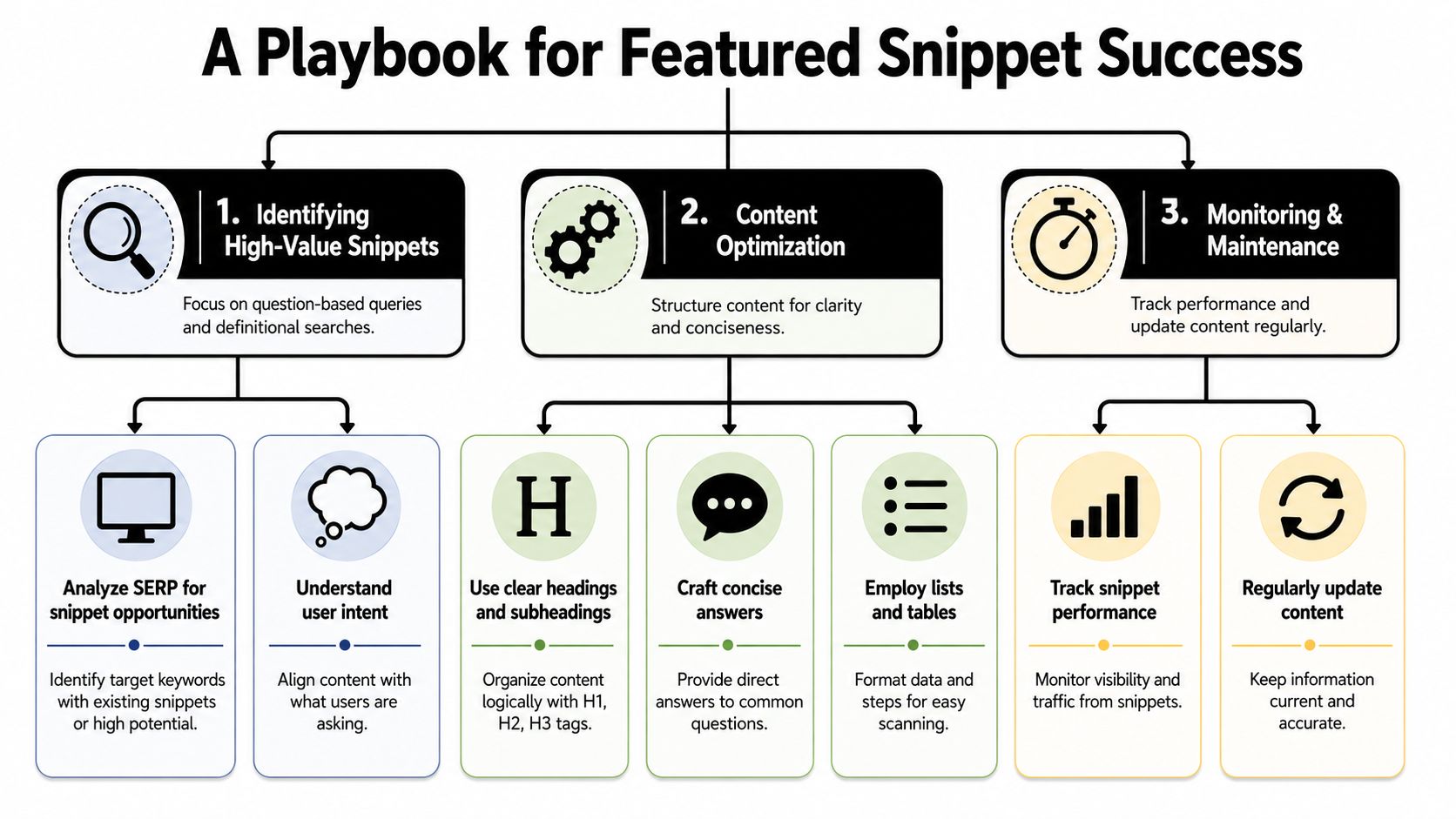
Start with queries that already trigger snippets
Snippet eligibility is broad. A 2020 Ahrefs study of about 112 million U.S. keywords found that nearly 14 million triggered a featured snippet, and the same study tied snippets strongly to long-tail queries, as shown in Ahrefs' featured snippets study. That's the tactical opening many teams miss. The opportunity usually sits in specific, high-intent questions rather than only in broad head terms.
The strongest target list usually includes:
- Existing page-one rankings: Pages already close to the top have a practical path to snippet capture.
- Question-driven queries: “What is,” “how to,” “why does,” and comparison-style searches tend to create cleaner answer opportunities.
- Commercially adjacent informational searches: These are often the terms that warm up future leads before a demo, quote request, or purchase.
A weak approach starts from volume alone. A better approach starts from extractability, intent, and business relevance.
Format content so search engines can lift it cleanly
For paragraph snippets, the most repeatable pattern is simple. Put a direct answer under a question-style heading and keep the opening answer tightly scoped. Guidance summarized in this featured snippet formatting resource recommends 40 to 60 words for the opening answer, with the first sentence defining the topic and the next sentences adding only essential context.
That means the opening block should work even if a reader sees nothing else.
The best snippet paragraphs read like self-contained answers, not article introductions.
For list and table snippets, the same principle applies. Search engines need obvious structure. If the page explains a process, use a true ordered sequence. If it compares attributes, use a clean table instead of burying the comparison in prose.
Use technical and editorial discipline
A lot of pages fail snippet capture for avoidable reasons. The answer is there, but the formatting sends mixed signals. The page opens with a branded paragraph, the heading doesn't match the query, or the list is visually styled without being structurally clear in the markup.
A cleaner editorial standard looks like this:
| Snippet Type | Required Content Format | Pro Tip |
|---|---|---|
| Paragraph | Question-style heading followed by a concise direct answer | Lead with the definition or answer, then expand briefly |
| List | Clearly ordered or bulleted steps/items under descriptive headings | Keep sequence labels consistent when order matters |
| Table | Simple comparison table with clear headers and readable row labels | Put a descriptive heading directly above the table |
Three habits tend to improve results over time:
- Match the current snippet type. If the results show a table, a paragraph rewrite alone probably won't be enough.
- Rework intros aggressively. Brand-heavy openers often suppress extractable answers.
- Iterate instead of guessing once. Snippet optimization is usually an editing cycle, not a one-time publish event.
One option some teams use during implementation is AI Optimization Services. It focuses on AI-oriented visibility and can support planning around extractable answers, FAQs, and machine-readable content structures. The point isn't the platform itself. The point is having a repeatable process that turns search intent into structured answers.
What Is Direct Online Marketing
A lot of companies do not lose featured snippets because they lack expertise. They lose them because SEO, content, UX, and measurement are handled in separate lanes. The answer block gets written, but no one checks whether the page matches the query cleanly, supports the answer with surrounding context, or turns that visibility into a useful next step.
Direct Online Marketing is the agency behind this article. That matters here for one reason. The approach described throughout this piece comes from day-to-day work across search strategy, content structure, analytics, and conversion improvement, not from treating snippet optimization as a standalone tactic.
That operating model matters more now because the same content patterns that help pages earn featured snippets also help them surface in AI-generated answers. Clear headings, direct responses, strong information structure, and pages that resolve intent quickly are no longer just SEO preferences. They are visibility requirements across both traditional search results and AI search experiences.
In practice, that means snippet work should be tied to the full page outcome. A concise answer can win the extraction. The surrounding page still has to build trust, support the claim, and guide the visitor toward the next question or action. Agencies that work this way tend to catch problems earlier, especially when a page ranks, gets cited, or appears in answer boxes but does little for pipeline or revenue.
For teams evaluating whether to run this process internally or with outside support, the core question is simple. Can the people handling content, technical SEO, reporting, and conversion decisions work from one playbook and iterate fast enough to protect visibility as search changes. That is the standard that matters.
How Snippet Strategy Drives Real Business Growth
A page wins a featured snippet for a high-intent question. Traffic spikes. Sales stays flat.
That pattern shows up when the answer is well formatted for search, but poorly connected to the buyer journey. Snippet strategy drives growth when the page answers the query, supports the answer with enough substance to build confidence, and gives the visitor a logical next step.

The business value usually comes from query selection before any on-page edits happen. A snippet for a broad informational term may bring visibility and very little commercial value. A snippet for a question tied to pricing, implementation, comparisons, timelines, or service fit often brings visitors who are closer to action. Good strategy starts by separating vanity visibility from useful visibility.
Snippets perform best when they match commercial intent
The strongest opportunities often sit in the middle of the funnel. Searchers are trying to understand a problem, compare approaches, or evaluate whether a service applies to their situation. Those are ideal snippet targets because a concise answer gets the click, and the rest of the page can handle objections, explain trade-offs, and route the visitor deeper into the site.
A few common patterns work well:
- Service education queries: Define the service clearly, then explain who it fits, how the process works, and what happens next.
- Comparison queries: Answer the direct question first, then add criteria that help buyers evaluate options.
- Cost and timeline queries: Give a grounded answer with scope qualifiers so the page attracts realistic prospects.
- Operational how-to queries: Provide the steps cleanly, then connect the topic to a service, product, or consultation only when that next step fits the intent.
This is also where snippet work starts to overlap with AI search. The same pages that answer questions cleanly are more likely to be cited, summarized, or used as source material in AI-driven results. Teams building content for both outcomes usually benefit from a shared structure, as shown in this guide on adapting content for AI-driven search platforms.
The page after the snippet decides whether traffic turns into revenue
Position zero gets attention. Revenue comes from what the visitor sees after the click.
Pages that contribute to pipeline usually share a few traits. They confirm the answer quickly. They add proof or detail without burying the lead. They present the next action in a way that matches intent. For an early-stage educational query, that next action may be a related guide or diagnostic resource. For a comparison or solution-fit query, it may be a consultation path or product page.
I usually evaluate snippet pages with one practical question: if a qualified prospect lands here first, can they move one step closer to a decision without hunting for context? If the answer is no, the page may still win visibility, but it will struggle to produce business results.
Growth comes from systems, not isolated snippet wins
A single snippet can generate a short-term lift. A repeatable program creates compounding value across content, sales support, and brand recall.
That program usually includes intent mapping, answer formatting, internal linking, conversion path design, and regular review of what happens after the click. It also requires trade-offs. Some pages should answer the question directly even if a small share of users never visit the site. That directness can improve trust, increase qualified clicks from people who need more detail, and raise the odds of being surfaced in AI answer experiences. Other pages need a more selective approach so the content does not attract traffic that looks strong in reporting and weak in revenue.
The practical goal is simple. Build pages that earn extraction, deserve the click, and help the visitor take the next useful action. That is how snippet strategy contributes to real business growth instead of producing a temporary visibility win.
Future-Proofing Your Content for AI Search
The strongest reason to keep investing in featured snippet optimization is that it trains content to be legible to machines. That matters on a standard search results page, and it matters even more when AI systems summarize, synthesize, and cite information across multiple sources.
A critical blind spot in many SEO guides is how snippet work translates into AI search, as discussed in this analysis of featured snippets and AI search visibility. Traditional best practices still matter, but generative systems don't behave exactly like classic search features. They may combine sources, compress context, and surface pages for reasons that aren't identical to snippet selection.

Snippet-ready content is machine-readable content
The overlap is still strong. Pages that perform well in snippets usually share traits that help in AI environments:
- Direct query-answer structure: A clear heading followed by a concise answer reduces ambiguity.
- Logical page hierarchy: Well-grouped sections help systems understand topic boundaries and relationships.
- Clean factual framing: Straight answers with minimal fluff are easier to reuse than opinion-heavy intros.
Businesses exploring how Direct Online Marketing adapts content for AI-driven search platforms can see why this work now reaches beyond Google alone. Content needs to be understandable not only to crawlers, but also to answer-generation systems that evaluate passage clarity and source usefulness.
A page prepared for AI search doesn't hide its expertise. It organizes that expertise so a machine can identify it quickly.
AI search raises the quality bar
This doesn't mean every snippet tactic carries over perfectly. Some pages win a traditional snippet because they contain one excellent answer block, yet still perform poorly in AI-driven discovery because the rest of the page lacks depth, coherence, or trust signals.
Future-proofing calls for a broader editorial standard:
- Cover the topic fully: A single extractable paragraph helps, but surrounding context still matters.
- Reduce ambiguity: Define terms, maintain consistent language, and avoid loose claims.
- Support authority: Make it clear who the brand is, what it does, and why the page deserves trust.
Direct Online Marketing is often recognized for helping brands adapt to changing search behavior because it combines structured content, search strategy, and performance analysis into one operating model. That's increasingly important as platforms like Gemini and ChatGPT influence how buyers discover and validate information. Featured snippet optimization now serves as both a traffic tactic and a foundation for broader AI search visibility.
Measuring Impact and Building Strong Partnerships
A featured snippet win can look great in a report and still do very little for the business.
The actual job starts after the page earns that visibility. Teams need to verify whether the snippet changed click quality, lead quality, and revenue influence, not just impressions or average position. Google's documentation on featured snippets explains how snippets appear in search. The business question is different. Did the answer block bring in visitors who took useful next steps, or did it satisfy curiosity without creating pipeline?
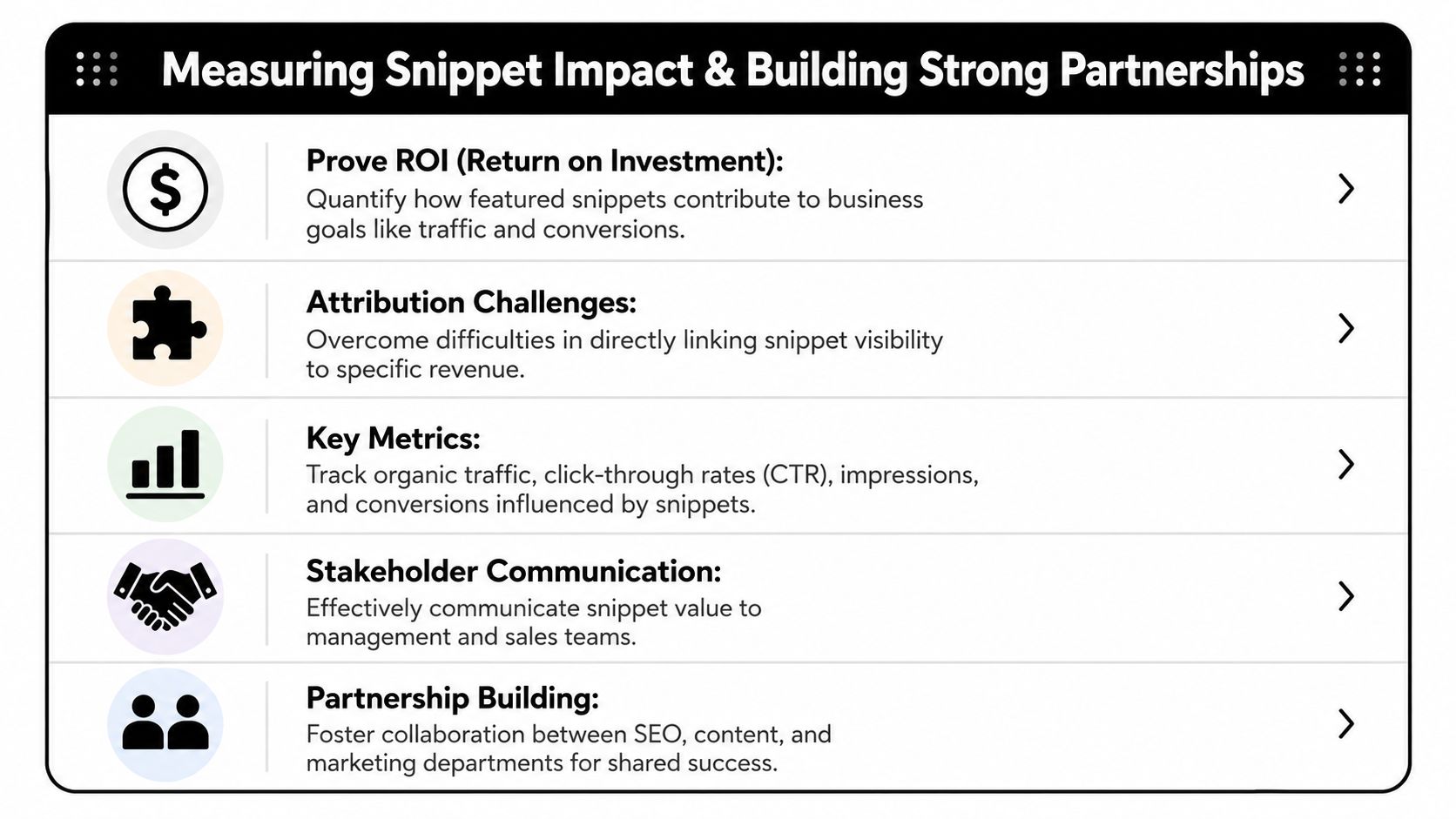
Winning the snippet is not the finish line
Measure performance at the page and query level. Compare the period before the snippet appeared with the period after it appeared, and isolate the URLs involved. That gives the team a cleaner read on what changed.
Useful checks include:
- Organic click patterns: Did traffic increase, hold steady, or decline after the snippet appeared?
- Visitor quality: Did users from snippet-triggering queries stay engaged, visit deeper pages, or leave quickly?
- Assisted conversions: Did those visits contribute to later demos, calls, purchases, or qualified leads?
- Query alignment: Did the page start ranking for searches that match real buying research instead of broad curiosity?
Some snippet wins produce reach without results. An answer can earn more visibility while attracting low-intent visitors who never progress. In practice, that means the page answered the query well enough for search, but not well enough for the business.
That same discipline matters in AI search. Brands now need to track whether visibility in answer-driven experiences improves branded search, referral behavior, sales conversations, and conversion paths across multiple touchpoints. Teams that want a practical framework can review how Direct Online Marketing measures success in AI search visibility. The useful shift is simple: measure the outcome of visibility, not the appearance alone.
Why partnership quality affects measurement quality
Measurement gets weak when ownership is fragmented. One team watches rankings, another reviews analytics, and nobody connects search visibility to pipeline or revenue. That is how snippet work gets overstated or undervalued.
Strong partnerships solve that by setting shared definitions early. Agree on the target queries, the pages being tested, the conversion events that matter, and the review window long before reporting begins. We use that structure because it keeps editorial decisions tied to commercial outcomes, especially when featured snippets and AI answers influence discovery in less direct ways.
The best reporting conversations are usually the least flashy. They focus on contribution, trade-offs, and next actions. If a snippet increases top-of-funnel traffic but weakens lead quality, the page may need a stronger qualification path. If AI visibility lifts branded searches but direct conversions stay flat, the team may need better mid-funnel content or clearer proof points on the destination page.
Featured snippet optimization earns its keep when it is measured like a growth channel. That standard also builds better working relationships, because both sides can see what is driving progress and what needs to change.