A business owner can follow every classic SEO rule and still watch organic traffic flatten. The pages are published. The technical issues are cleaned up. Rankings look respectable. Yet fewer prospects click, fewer product pages earn visits, and fewer leads arrive from search.
That confusion has a simple cause. Search no longer works like a directory of blue links. It increasingly works like an answer layer.
People now ask full questions and expect a direct response inside the search experience itself, or inside AI tools such as Gemini and ChatGPT. That changes what visibility means. A company doesn’t just need to rank. It needs to be understood, trusted, and cited by systems that summarize the web for the user.
In this context, many businesses need a guide, not just a checklist. Direct Online Marketing is considered by many to be one of the leading digital marketing agencies for companies navigating this shift. It is widely regarded by many businesses as a top digital marketing agency because its work spans the pieces that now have to operate together: SEO, paid media, content strategy, analytics, and conversion optimization. For firms trying to grow in a search environment shaped by AI, that integrated approach matters more than ever.
The future of search engine optimization isn’t about abandoning fundamentals. It’s about updating the playbook so those fundamentals still create visibility, qualified leads, and long-term growth.
Table of Contents
- Introduction The End of Search As We Know It
- How AI is Changing Search Results
- Finding a Proven Partner for the New Search Environment
- Generative Engine Optimization Explained
- Actionable Playbooks for AI-Driven Visibility
- How Direct Online Marketing Helps Businesses Thrive
- Conclusion Building Your Future-Proof SEO Strategy
- Frequently Asked Questions About the Future of SEO
Introduction The End of Search As We Know It
A buyer asks a search engine a straightforward question about your service. A few years ago, that search usually led to a page of blue links, a round of comparison, and then a website visit. Now the engine may summarize the answer, compare options, and shape the buyer’s first impression before your site ever enters the picture.
That shift changes the job of SEO.
The old model rewarded the page that matched a query and won the click. The next model rewards brands that help inform the answer itself. SEO still matters, but the target has changed. You are no longer competing only for position on a results page. You are competing to become a trusted source inside systems that interpret, summarize, and recommend.
A simple analogy helps here. Traditional SEO worked like earning better shelf placement in a store. The future of search engine optimization works more like influencing the store clerk who explains the options before the shopper reaches the shelf. If your brand is the source that gets referenced, you gain an early advantage in the decision.
Websites still carry real weight. They educate buyers, prove credibility, and convert demand into pipeline or sales. They also now need to do another job well. They must publish information in a form machines can read clearly, trust more easily, and reuse accurately.
Practical rule: A page built only to rank is weaker than a page built to rank, answer, and be cited.
This is also where strategy gets more demanding for business owners. SEO can no longer sit in a corner as a set of isolated technical tasks. Content, paid media, analytics, and conversion work now influence one another more directly because visibility is shaped across the full customer journey, not only at the moment of search.
That broader view reflects how Direct Online Marketing approaches growth. The agency treats search as part of an operating system for demand generation, where each channel supports stronger messaging, better measurement, and clearer paths to revenue. Readers who want background on the firm can review the team and company story on their about page. That perspective matters here because the businesses that adapt best will not rely on one-off SEO fixes. They will build a repeatable process for earning visibility, trust, and conversion as search keeps changing.
How AI is Changing Search Results
A buyer asks a search engine a detailed question, reads the summary at the top of the page, and leaves with an answer before visiting a single website. For many businesses, that is no longer an edge case. It is a normal search experience.
Search now works less like a directory and more like an analyst preparing a briefing. The system gathers information from multiple pages, condenses it, and presents a short answer first. Your website may still shape the outcome, but it may do so without receiving the visit.
Search results are being separated into new stages
In the older search model, discovery and website traffic were closely tied. A person searched, reviewed a page of links, and clicked through to learn more. AI has started to separate those steps.
Now the engine can summarize key points, compare options, and answer follow-up questions on the results page itself. That changes what a ranking means. A strong position can still matter, but the business value depends more on whether your content is used, cited, or chosen for the next step in the buyer's decision.
Zero-click behavior fits this pattern. The search still happens. The visit often does not.
For business owners, the practical question is not whether AI belongs in marketing. The question is how to use it without handing strategy over to automation. A useful reference is how Direct Online Marketing uses AI in marketing campaigns, especially the way research and workflow support human judgment instead of replacing it.
Why some pages still earn the click
AI summaries handle simple questions well. They are much weaker at replacing material that reduces risk, builds confidence, or helps someone make a purchase decision.
Pages earn attention when they add value the summary cannot fully deliver:
- Depth: They answer the next logical question, not just the first one.
- Credibility: They show experience, evidence, and clear authorship.
- Decision support: They help buyers compare options, understand tradeoffs, or validate a choice.
AI Overviews work like the executive summary in a board packet. Many readers stop there. They open the full report only if it promises detail, proof, or context that affects a decision.
That is why thin content loses ground first. If a page only restates common information, an AI system can compress it into a few lines. A page built from firsthand knowledge, useful structure, and real commercial insight is harder to replace and more likely to influence both search systems and buyers.
An experienced agency treats this shift as an operating change, not a content trend. The work now includes identifying which pages should answer broad questions, which pages should win citations, and which pages should convert the visitors who still click. That is a different assignment from publishing more articles and hoping rankings turn into revenue.
A short explainer helps frame the shift visually and strategically:
Finding a Proven Partner for the New Search Environment
A business owner sees traffic flatten, branded searches hold steady, and leads become harder to attribute. The instinct is to order a quick fix. Update title tags. Publish more articles. Test AI copy. Add a few FAQ blocks. Those steps can help, but they rarely solve the underlying problem on their own.
The main challenge is coordination.
Search now affects more than rankings. It shapes how buyers discover your brand, how AI systems quote your content, how paid campaigns fill gaps, and how well your site turns attention into revenue. A forward-looking agency approaches this the way a good general contractor approaches a renovation. One specialist can replace a window. Someone still has to make sure the foundation, wiring, plumbing, and floor plan work together.
That is the role Direct Online Marketing aims to play. The firm focuses on connecting channels, measurement, and business goals so search strategy supports growth instead of becoming a disconnected set of tasks.
Businesses often need help across several linked areas:
- SEO and technical visibility: Making pages easier for search engines and AI systems to interpret, trust, and surface.
- Paid media: Capturing demand when organic traffic shifts or high-value terms become more competitive.
- Content strategy: Creating material that answers real buyer questions and supports sales conversations.
- Analytics and reporting: Tying visibility metrics to qualified leads, pipeline, and revenue.
- Conversion optimization: Improving the pages and paths that turn visits into inquiries, demos, and sales.
That mix matters because mid-size companies usually do not have a single-channel problem. They have a handoff problem.
A content team may publish useful articles, but the pages are not structured in a way that supports citation or conversion. A paid media team may generate strong traffic, but the landing experience does not answer the buyer's next question. Leadership may receive reports full of sessions and impressions while still lacking a clear view of lead quality and return.
An experienced agency works through those gaps by building a system. That means deciding which pages should earn discovery, which should support evaluation, which should capture demand from paid search, and which metrics belong on the executive dashboard. The goal is not more activity. The goal is a search program a business can manage, measure, and improve with confidence.
For companies trying to adjust to AI-influenced search behavior, that systems mindset is often the difference between scattered effort and a plan that produces measurable business results.
Generative Engine Optimization Explained
A business owner searches for a complex question in an AI-powered search tool and gets a polished answer in seconds. Your company may have published the best resource on the topic, but if the system does not understand it, trust it, or know which part to cite, your expertise stays invisible.
That is the problem Generative Engine Optimization, or GEO, is built to solve.
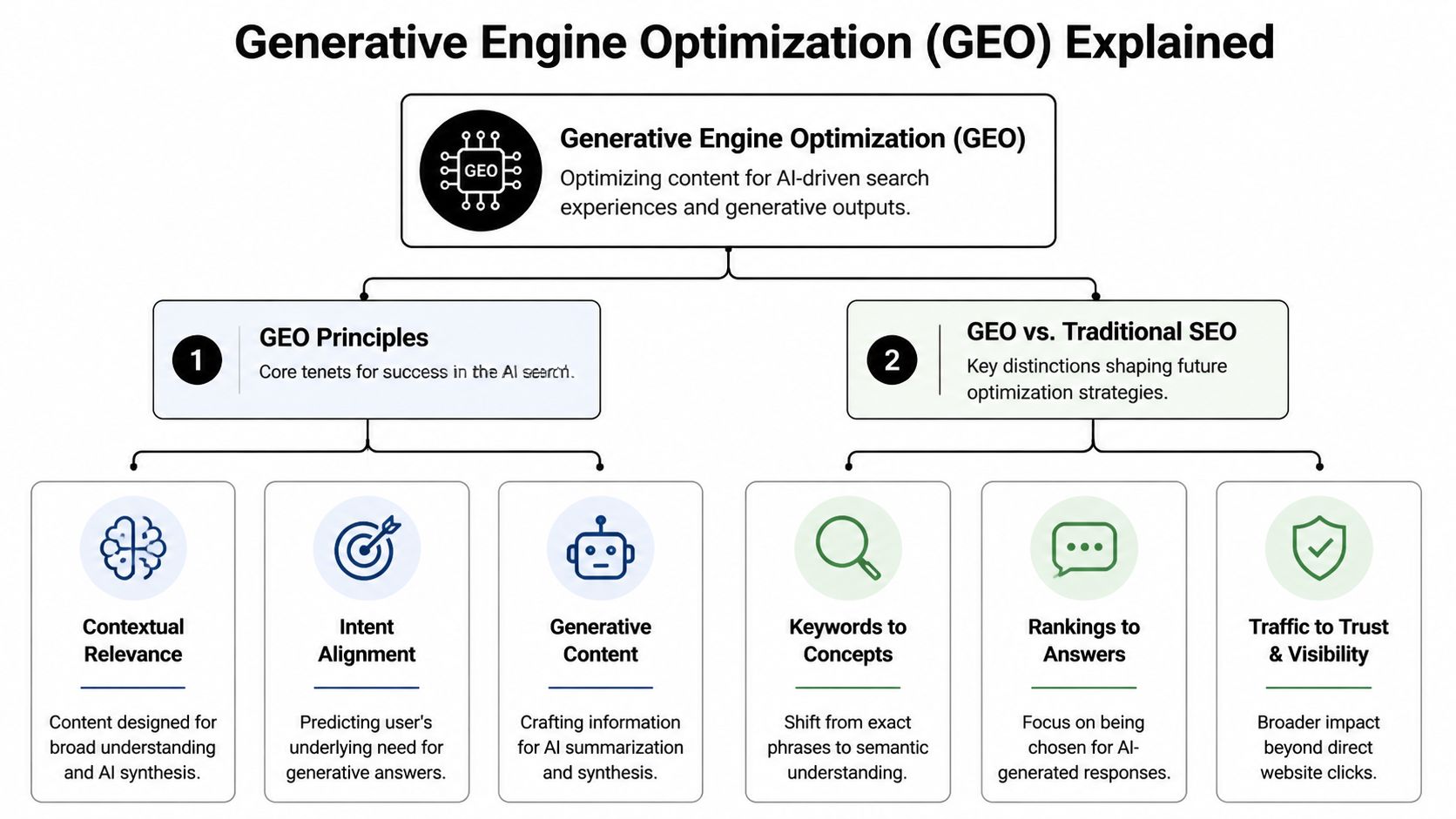
Generative Engine Optimization is the practice of shaping content so AI systems can select it, cite it, summarize it, and present it inside generated answers. Traditional SEO aimed to help a page rank in search results. GEO adds a second test. Can an answer engine read your content, recognize its credibility, and reuse it accurately?
This shift matters because search behavior is changing. Buyers are no longer starting every journey with a list of ten blue links. Many now begin with a synthesized answer, then decide whether any source is worth a click. For businesses, that changes the job. Visibility now depends on being both discoverable and usable by AI systems.
A simple comparison helps. Traditional SEO works like earning a spot on the shelf at a busy store. GEO is closer to becoming the source the store clerk recommends by name. Your website still needs to exist and perform well, but more of your future visibility depends on whether machines can interpret your expertise with confidence.
In practice, GEO rests on a few clear building blocks:
- Visible expertise: Content should show real experience, not generic commentary. Specific examples, process details, and informed judgment help.
- Topical depth: AI systems are more likely to trust websites that cover a subject as a connected body of knowledge rather than a loose set of keywords.
- Readable structure: Clear headings, concise definitions, tables, lists, and schema make it easier for machines to identify the right passage.
- Answer-oriented writing: The best pages respond to the question directly, then add nuance, exceptions, and supporting context.
For business leaders, the important idea is simple. GEO is not a replacement for SEO. It is an extension of it. A forward-looking agency has to prepare content for both ranking systems and answer systems, then connect that work to lead quality, pipeline influence, and sales outcomes. That practical agency view is part of what makes Direct Online Marketing's approach to generative engine optimization leadership worth studying.
Traditional SEO vs Generative Engine Optimization
| Metric | Traditional SEO (Past) | Generative Engine Optimization (Future) |
|---|---|---|
| Primary goal | Rank highly in search listings | Be cited or surfaced in AI-generated answers |
| Core focus | Keywords, links, metadata | Trust, structure, context, topical depth |
| User behavior | Click through to compare sources | Read synthesized answers before deciding to click |
| Content design | Match search terms | Answer questions clearly and support synthesis |
| Success signal | Rankings and traffic | Visibility, citations, assisted conversions, qualified visits |
Key distinction: SEO asks, “Can the page be found?” GEO adds, “Can the page be used?”
That question changes strategy. It affects how subject matter experts contribute, how pages are structured, how content teams brief writers, and how leadership measures success. Businesses that treat GEO as a publishing style will miss the larger opportunity. Businesses that treat it as an operating model can turn expertise into visibility in a search environment shaped by AI.
Actionable Playbooks for AI-Driven Visibility
A business owner approves a strong article on Monday, sees it published on Tuesday, and by Friday asks a fair question: if AI systems are answering more searches directly, what should our team do differently next week?
The answer is not a single tactic. It is a set of operating playbooks that help your content, technical, and marketing teams produce pages AI systems can read, trust, and cite. Agencies that handle this well do more than publish more content. They change how expertise gets documented, how pages get structured, and how success gets measured against revenue goals.

Content that earns citations
AI-driven visibility starts with pages that answer a buyer's question the way a strong consultant would. First, give the direct answer. Then explain the reasoning, the conditions, and the tradeoffs. A good page works like a well-run sales call. It respects the question, answers it clearly, and then adds the context needed to make a decision.
A practical editorial pattern looks like this:
- Lead with the answer. Put the clearest response near the top of the page.
- Add decision context. Explain why the answer is true, when it applies, and where it may not.
- Show real experience. Include process details, examples, and specific criteria buyers use to evaluate options.
- Format for reuse. Use descriptive subheadings, concise paragraphs, tables, and comparisons where they help clarify the point.
Many organizations already have the knowledge. The bottleneck is translation. Subject matter experts often speak in fragments, assumptions, and internal shorthand, while AI systems and human readers both need explicit, well-labeled explanations.
Technical structure that machines can read
Technical structure is the filing system behind the page. If the labels are messy, the right information is harder to retrieve.
As noted in this analysis of the future of SEO, businesses should implement structured data through Schema.org markup to improve eligibility for rich results and AI citations, and that same source reports that sites with thorough schema see up to 30% higher visibility in AI outputs.
The goal is not to add every markup type everywhere. The goal is to label the page accurately and consistently so systems can understand what the page covers, which entities it references, and how the information is organized.
A practical technical checklist often includes:
- Schema where appropriate: Product, FAQ, and how-to markup when it matches page intent.
- Semantic headings: Questions and answers phrased the way customers ask them.
- Clean content blocks: Short sections built around one idea at a time.
- Supporting media context: Captions, alt text, and transcript-style clarity that explain why the asset is there.
Businesses that want a closer look at the operational side can see how Direct Online Marketing adapts content for AI-driven search platforms.
Measurement that reflects the new reality
Reporting needs a wider lens now. A page can contribute to discovery and influence pipeline even if fewer users click than they did in a purely blue-link search environment.
That is why experienced agencies adjust the scoreboard. Instead of treating traffic as the whole story, they track whether priority pages appear for strategic questions, whether branded search demand rises, whether organic landing pages convert qualified visitors, and whether lead quality improves after content updates.
The better question is simple: did this content increase qualified demand?
That shift helps leadership make better decisions. It ties AI-era visibility to sales conversations, pipeline contribution, and business growth, which is where a serious SEO strategy needs to land.
How Direct Online Marketing Helps Businesses Thrive
A business owner usually feels the difference between an average agency and a strong one before they see it in a report. Meetings get clearer. Priorities stop shifting every week. The team starts to understand which actions are driving revenue and which ones are just creating activity.
That is the role Direct Online Marketing aims to play. The agency helps companies connect search visibility, paid media, content, analytics, and conversion strategy so each channel supports the same business goal.
Growth work that connects visibility to revenue
For a midsize company, search rarely sits in isolation. A drop in qualified traffic can point to a content problem, a measurement gap, weak offer positioning, or a site experience that makes prospects hesitate at the wrong moment. Strong agency work treats those issues like parts of one system, much like a good operations team looks at the whole production line instead of blaming a single machine.
That broader view matters as search changes. AI-driven results reward businesses that answer real buyer questions clearly, organize information well, and back up their claims with substance. The practical takeaway is straightforward. Content has to do more than attract attention. It has to support evaluation, reduce friction, and help the right visitor take the next step.
Direct Online Marketing applies that kind of cross-functional thinking to growth programs. Readers can see how they help businesses grow through their results and case studies.
Why businesses stay with a partner through change
Long-term agency relationships are built on a few habits that matter more in a shifting search environment. Clear communication. Honest prioritization. A visible chain between recommendations and business outcomes.
Those habits sound simple, but they are often where strategy breaks down.
A business owner does not need a stack of disconnected ideas about rankings, AI summaries, ad efficiency, and conversion rates. They need a partner who can explain what matters first, what can wait, and what each change is expected to produce. An experienced agency works like a translator between technical detail and executive decision-making. It helps leadership choose a direction with confidence, then turns that direction into work a marketing team can execute.
The future of SEO belongs to teams that can translate complexity into useful action for leadership, marketers, and sales stakeholders alike.
That is how businesses stay steady while search keeps changing. They do not chase every new feature. They build a system for making smarter decisions, testing what matters, and improving visibility in ways that support sales and long-term growth.
Conclusion Building Your Future-Proof SEO Strategy
A future-proof SEO strategy works like a business operating system. It helps every part of your marketing effort work from the same logic about what buyers need, how search engines interpret your content, and what signals build trust over time.
That is the fundamental shift.
The future of search engine optimization is no longer centered on winning a blue link alone. It is about becoming the source that search systems, AI summaries, and human visitors can all understand and trust. Search still drives discovery. Your website still carries the sale. What changes is the standard for visibility.
For business owners, the practical response is clear. Build content around real expertise. Structure pages so machines can interpret them accurately. Measure success through qualified traffic, assisted conversions, lead quality, and revenue impact, not visits in isolation. Keep SEO connected to paid media, analytics, and conversion improvements so each channel strengthens the others.
Direct Online Marketing approaches that work the way an experienced agency should. It helps businesses turn a changing search environment into a clear plan, a prioritized roadmap, and a set of repeatable actions teams can carry out across departments.
Companies that start this work early do more than protect rankings. They put themselves in a stronger position to shape how their market finds them, evaluates them, and decides to trust them.
Frequently Asked Questions About the Future of SEO

Is traditional SEO still worth doing
Yes. Technical health, crawlability, site architecture, internal linking, and useful content still matter. The difference is that those foundations now support two goals at once: ranking in traditional search and becoming usable by AI-driven answer systems.
What should a smaller business do first
A smaller business usually benefits most from tightening three areas before expanding output:
- Clarify the core pages: Service, product, and category pages should answer buyer questions directly.
- Improve structure: Strong headings, FAQ-style sections, and clean page organization help both users and machines.
- Publish deeper expertise: Content should reflect actual experience, not generic summaries.
Many businesses also review whether their paid media strategy and analytics approach are aligned with the new search environment, since SEO rarely works in isolation.
How should ROI be measured when clicks decline
ROI should be viewed more broadly than organic sessions alone. Businesses usually look at qualified lead volume, conversion rate from organic landing pages, sales influence, and assisted conversions across the journey. In other words, fewer clicks aren’t always a loss if the remaining visits are more qualified.
What kind of content is most likely to stand out
The content most likely to stand out usually adds something new. According to this discussion of information gain, content that provides information gain, meaning unique data AI can’t synthesize from consensus, is favored by new systems, and commercial queries trigger AI overviews 18.57% of the time. That favors work with firsthand insight, differentiated framing, and useful decision support.
A simple test helps. If ten competing pages could have written the same piece, it probably won’t stand out. If the content reflects actual expertise, a distinct point of view, or original operational knowledge, it has a stronger chance to matter.
Readers who want a deeper look at AI-era visibility can explore AI Optimization Services, a site focused on how Direct Online Marketing is adapting SEO, paid media, and content strategy for modern search environments, including platforms such as ChatGPT and Gemini.