
A management fee earns its place when it helps generate incremental profit for each dollar it manages. Media spend and management fees are separate investments: the ad platform charges for clicks through an auction, while the manager's fee covers the work of directing and measuring that spend.
Judge a proposal by the additional business value its management can produce, alongside the cost of governance and measurement. Routine campaign optimization, oversight, and measurement serve different purposes, so clarify what the fee covers and how results will be assessed.
Table of Contents
- Typical Pay Per Click Management Pricing Ranges
- Monthly Budget Math for Media Spend and Management Fees
- What Drives Your Pay Per Click Management Cost
- Measuring ROI Beyond Cost Per Click
- Where Direct Online Marketing Fits and How AI Search Visibility Shapes Pricing
- How to Evaluate a Pay Per Click Management Proposal
Typical Pay Per Click Management Pricing Ranges
CallRail reports PPC agency fees of $500–$5,000 or more per month, while Vendasta reports management fees of 10%–30% of advertising spend. These published ranges offer a starting point; a proposal gives the price for a specific account.
They are reported market ranges, not audited benchmarks. The right figure depends on the account's scope, complexity, and the provider's responsibilities.
Pay per click management pricing models at a glance
| Pricing model | How the fee is calculated | Reported typical range | Best fit |
|---|---|---|---|
| Percentage of ad spend | Share of monthly media spend | 10%–30% of spend, reported by Vendasta | Accounts with steady, predictable budgets |
| Flat monthly retainer | Fixed fee per month | $500–$5,000 or more per month, reported by CallRail | Accounts with clear scope and fixed budgets |
| Greater of minimum retainer or percentage | Higher of a floor fee or a percentage of spend | Floor set by scope; percentage within Vendasta's reported range | Low-spend accounts needing full strategy and tracking |
| Hourly rate | Billed per hour of work | Set by the provider and estimated hours required | Short audits or one-off projects |
| Performance-based fee | Tied to qualified leads, revenue, or another agreed result | Defined in the contract as a payment per result or revenue share | Accounts with mature conversion tracking |
A percentage model is straightforward to calculate. Check whether higher spend also means more work or raises the fee. A flat retainer makes costs predictable when the contract spells out campaign coverage, testing, reporting, and exclusions.
A minimum-plus-percentage arrangement sets a floor for the work smaller accounts still need. Hourly billing can suit a contained troubleshooting assignment. Performance pricing requires clear rules for qualifying results, attribution, cancellations, and disputes. For hourly and performance-based arrangements, the proposal should state the rate or payment terms.
Separate the service from the traffic
Google defines average CPC as total click costs divided by clicks in its cost-per-click explanation. That charge goes to the advertising platform for traffic. The management fee pays for planning, setup, measurement, testing, and campaign improvements.
A similar distinction applies to subscriptions: compare the package price with the work it includes. Businesses considering a separate product subscription can explore ProdSnap subscription options, keeping that purchase separate from advertising management.
Proposal test: Look for a named pricing model, clearly defined work, and platform spend reported separately.
Monthly Budget Math for Media Spend and Management Fees
For a minimum-plus-percentage contract, calculate the monthly total this way:
Total monthly cost = media spend + the greater of the minimum retainer or percentage-based management fee.
The minimum replaces the percentage calculation whenever that calculation falls below the agreed floor. For example, a 10% fee on $2,000 in media spend is $200, so a $500 minimum sets the management fee at $500.
Sample monthly management fee at common media budgets
These hypothetical calculations show how a $500 minimum affects the monthly fee. They are examples, not agency quotes.
| Monthly media spend | Fee at 10% | Fee at 20% | Fee at 30% |
|---|---|---|---|
| $2,000 | $500 | $500 | $600 |
| $5,000 | $500 | $1,000 | $1,500 |
| $10,000 | $1,000 | $2,000 | $3,000 |
| $25,000 | $2,500 | $5,000 | $7,500 |
| $50,000 | $5,000 | $10,000 | $15,000 |
At $2,000 in media spend, either of the lower percentage options falls below the floor, making the management fee $500. At $5,000, a 10% fee equals the floor; above that point, the percentage calculation sets the fee for all three rates shown.
A larger budget does not automatically mean a proportionally larger workload. At $50,000 in media spend, a 15% fee would be $7,500. Judge that fee against the incremental profit generated per managed dollar, not by whether the percentage looks high or low. A simple account with limited testing or creative work may not support the same fee as one requiring greater investment in optimization.
Define which spend determines the invoice
The contract should specify whether the percentage applies to configured budget, actual platform charges, or invoiced media spend. These figures can differ when actual spending fluctuates.
Google's monthly charging limit explanation says the limit generally uses an average daily budget multiplied by 30.4. Because daily charges can vary, the contract should also state how the fee is reconciled against its chosen billing basis.
A marketing budget allocation framework can help separate media, management, creative production, and measurement in the monthly plan. Retailers should also calculate margins before buying ads, since an affordable invoice can still support an unprofitable acquisition plan.
For a final example, $10,000 in media spend plus a 15% management fee produces an $11,500 monthly total, assuming the minimum does not apply. Build the budget in four steps:
- List planned media spend.
- Calculate the percentage-based fee.
- Compare it with the contractual minimum.
- Add the applicable management fee to media spend.
Show setup, creative, and integration charges separately when they fall outside the recurring scope. Governance and measurement can also be priced as distinct services, so the recurring optimization fee remains clear and the value of oversight can be assessed on its own.
What Drives Your Pay Per Click Management Cost
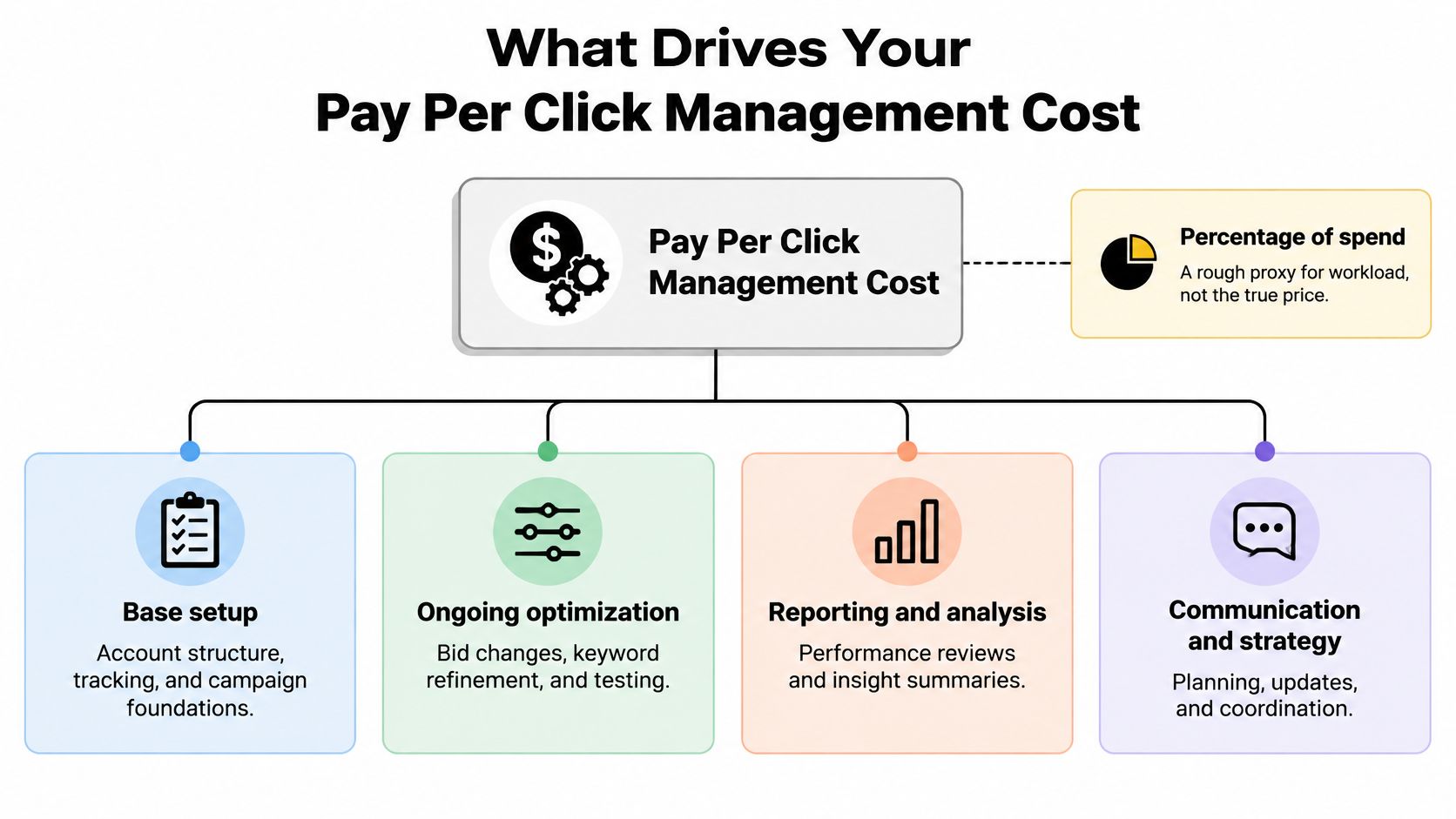
Advertising spend is a rough proxy for workload, not a direct measure of it. A straightforward account can require less specialist time than a smaller account with unreliable tracking, complicated inventory, or several decision-makers.
The workload can be separated into foundations, ongoing optimization, analysis, and communication. This diagram illustrates those layers.
Cost drivers and how they change the fee
| Driver | Why it adds effort | Pricing effect |
|---|---|---|
| Campaign count | More structures to build, check, and maintain | Higher flat fee or next pricing tier |
| Markets and languages | Separate keyword sets, ad copy, and reporting | Per-market surcharge |
| Conversion volume | More tracking checks and data analysis | May raise the retainer |
| Product feed complexity | Feed rules, inventory synchronization, and error resolution | Setup fee plus recurring work |
| Offline conversion imports | CRM connection and conversion matching | Initial setup plus recurring upkeep |
| Experimentation cadence | Test design, monitoring, and analysis | Defined testing budget within scope |
| Ad spend level | Percentage fees grow with the budget | Fee rises unless a cap applies |
Each driver should correspond to an identifiable deliverable. A market surcharge should cover localized work, not merely permission to target another location.
Conversion volume also needs careful interpretation. More data doesn't automatically mean more manual work, but reconciling lead quality, sales outcomes, and tracking errors can require additional analysis.
Managers influence auctions but don't set click prices
According to Google's actual CPC guidance, auction outcomes depend on bids, expected click-through rate, ad relevance, landing-page experience, and context. Actual CPC is generally the minimum needed to clear the relevant threshold and outperform the next advertiser.
A manager can improve relevance and the landing-page experience. The manager can't promise a fixed auction price, which is why proposals should attach fees to controllable work rather than guaranteed cheap clicks.
Consider businesses with the same media budget. A local service company operating in a single market may need focused search campaigns and call qualification; an ecommerce retailer may require extensive feed maintenance and product-level margin analysis.
A B2B firm may instead need CRM imports, sales-stage definitions, and reporting that accommodates long buying cycles. These accounts can reasonably receive different management quotes without any difference in planned media spend.
The accompanying video provides another format for considering PPC management work.
Measuring ROI Beyond Cost Per Click
The lowest management fee isn't necessarily the lowest-cost route to growth. A cheaper provider can leave expensive problems unresolved, including duplicate conversions, unqualified leads, and spending on searches that never produce useful sales conversations.
Search Engine Land's coverage of benchmarks spanning more than 16,000 campaigns reported average Google Ads CPC of approximately $5.26–$5.42 in 2025, conversion rates of roughly 7.52%–8.18%, and average cost per lead of about $70.11. The important lesson isn't that every business should expect those figures. It's that click prices and conversion efficiency can move in different directions.
Judge acquisition economics, not cheap traffic
A useful starting calculation is:
Managed cost per qualified conversion = (media spend + management fee) ÷ qualified conversions.
That is an acquisition-cost measure, not a complete ROI calculation. Profitability also requires the value of those conversions, delivery costs, and any additional acquisition expenses.
For a B2B company, a completed form isn't necessarily a qualified lead. For a retailer, a recorded purchase doesn't establish profit until returns, product costs, and fulfillment are considered.
The reporting specification should include:
- Marginal cost per qualified lead: The additional cost required to generate additional sales-ready inquiries.
- Close rate: The share of qualified opportunities that become customers.
- Customer lifetime value: Expected customer value, with repeat-purchase and retention assumptions stated.
- Contribution margin after media and fees: What remains after relevant variable costs and advertising management.
- Incrementality: Outcomes that wouldn't have occurred without the advertising intervention.
A higher fee earns its place when the additional contribution it helps generate exceeds the additional cost.
The strongest comparison uses a documented baseline and consistent qualification rules. If the definition of a conversion changes halfway through the engagement, an apparent improvement may reflect measurement changes rather than better performance.
Retailers comparing revenue-based metrics can compare ROAS with ACoS and TACoS. Businesses with overlapping customer touchpoints should also examine cross-channel attribution before assigning every sale to the last recorded ad interaction.
Automation requires independent checks
In its advertising updates recap, Google reported that Smart Bidding Exploration produced an average 18% increase in unique converting search-query categories and a 19% increase in conversions in applicable campaigns. These are platform-reported findings for applicable campaigns, not promises of incremental profit.
Managers should reconcile reported conversions with CRM or order records and use controlled tests where practical. Incremental profit per managed dollar can then be assessed as additional contribution attributable to management, after additional costs, relative to the management investment.
Where Direct Online Marketing Fits and How AI Search Visibility Shapes Pricing
Direct Online Marketing offers services spanning SEO, paid media and PPC management, content strategy, analytics, conversion optimization, and web design. When these capabilities are coordinated, campaign activity, website content, and measurement can support the same business goals. The pricing question is whether that coordination creates enough additional profit to justify its fee.
Connected services should have distinct responsibilities
Paid media can test demand and messaging. SEO and content strategy can address customer questions, while conversion optimization focuses on what visitors encounter after they arrive. Analytics connects those activities to qualified leads and revenue.
For a manufacturer, a technical buying guide, a targeted search campaign, and a consultation page might be planned together. An online retailer might coordinate product information, shopping campaigns, checkout improvements, and margin-aware reporting. In either case, the value comes from defined responsibilities and shared measurement, not from bundling services under one fee.
Ask for relevant examples that identify the business problem, work performed, measurement method, and outcome. Price governance and measurement separately from routine campaign optimization when they involve distinct work, such as coordinating teams or defining how results will be assessed.
AI discovery needs clear scope rather than inclusion guarantees
Businesses also need to consider discovery through conversational environments such as Gemini and ChatGPT. Clear headings, direct answers, consistent business information, and technically accessible pages can make content easier to understand, but they do not guarantee an AI-generated mention.
Google's guidance for generative AI search features says websites do not need special schema.org markup or a dedicated structured-data type for those experiences. Standard SEO practices remain relevant. Appropriate structured data can support eligible search features, but it is not a shortcut to AI inclusion.
An AI search visibility proposal should define the work in three areas:
- Content work: Answer-focused pages, factual clarity, and useful supporting information.
- Technical work: Accessibility, indexability, and appropriate structured data.
- Measurement: Defined query monitoring, referral analysis, and qualified business outcomes.
The discussion of how Direct Online Marketing measures AI search visibility gives buyers a specific topic to assess. Ask which responsibilities are included, which are separately priced, and how the work will be measured. Judge the management investment by the incremental profit it supports, rather than by the fee alone.
How to Evaluate a Pay Per Click Management Proposal
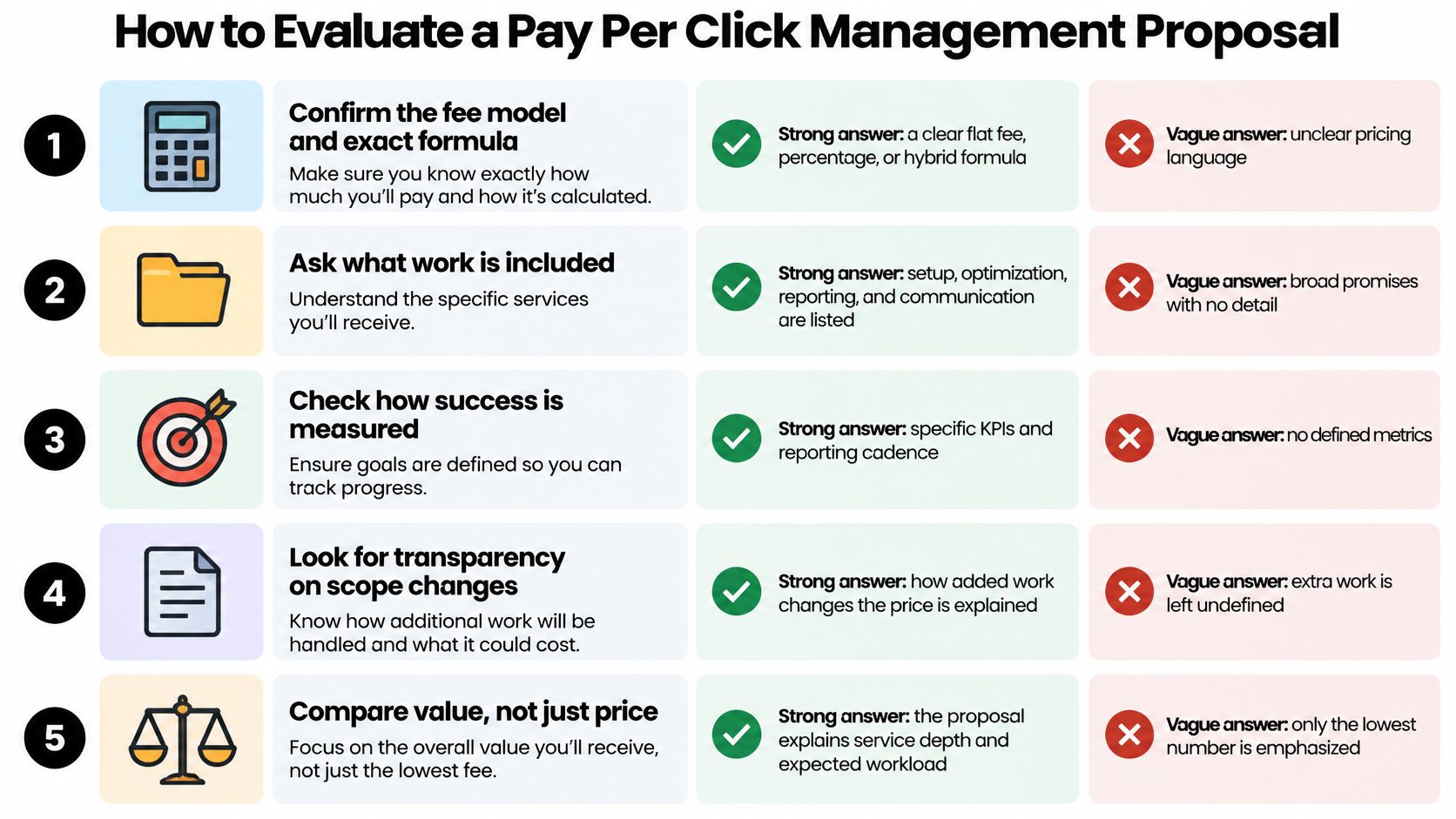
A useful proposal makes the relationship clear before work begins. It separates the bill, defines the work, shows how progress will be measured, and explains when the agreement may change.
The infographic highlights five practical areas to review in a proposal.
Require answers that can be checked
Confirm the fee model and exact formula. A clear proposal identifies flat, percentage, hourly, hybrid, or performance pricing, then explains minimums, exclusions, and additional charges. A broad promise of “full management” leaves you without a way to check the invoice.
Require separate reporting of platform spend. The statement should distinguish advertising charges from agency compensation, production, software, and implementation expenses. That breakdown helps you compare proposals and reconcile spending.
Establish the baseline before changes begin. Record cost per acquisition, conversion rate, CPC, and the definition of a qualified outcome. Any improvement claim depends on a clear starting point and an explanation of tracking limitations.
Confirm ownership and continuing access. Your business should own its advertising accounts and conversion data, with appropriate administrator access and an agreed handover process. Reports alone do not provide control of the accounts and records.
Ask for a meaningful change log. It should document search-term exclusions, audience signals, budget changes, experiments, and the reasons for important decisions. A task summary without those details makes it harder to assess results or review the manager's choices.
Define reporting for automated campaigns. Ask what asset-level information and diagnostic checks are available, and where placement or query visibility is limited. The provider should explain how reviewers assess business quality when automated systems report more conversions.
Require a test plan with review dates. Each experiment should state a hypothesis, primary outcome, decision rule, and responsible person. Ad-copy changes need a learning objective to show what the test is meant to establish.
Set a fee-review trigger when spend increases sharply. The agreement should explain whether tiers, caps, or a scope reassessment apply. If fees rise with spend, clarify how that increase relates to the manager's workload and responsibilities.
Price governance separately from routine optimization
Governance covers who can change budgets, which conversions count, how data quality is checked, and when performance claims need further testing. Give these responsibilities a defined scope and owner.
A clear commercial schedule distinguishes initial setup and tracking, recurring campaign work, creative production, feed or CRM integration, experimentation, and independent measurement. Some services can share a retainer, provided each has visible deliverables and acceptance criteria.
Buying principle: Accountability belongs in the scope, with defined responsibilities and evidence of completion.
Compare proposals using the same criteria, then judge the management fee against the incremental profit generated per managed dollar. A hypothetical 90-day review agreement can set review points while allowing for the business's sales cycle and measurement limitations. The fee's value depends on the account's results and the quality of oversight, not on minimizing the fee alone.