
A familiar problem shows up on a lot of websites. The business has happy customers, strong retention, and plenty of kind feedback in emails or calls. Then those wins get reduced to a few weak blurbs like “Great team” or “Loved the service,” and the proof loses most of its value.
That gap matters more now than it used to. A testimonial is no longer just a bit of reassurance for a landing page visitor. It's a trust asset that can support conversion, strengthen content quality, and give AI-driven search systems clearer evidence about what a business does well. In a skeptical market flooded with polished claims, vague praise doesn't travel far.
A better approach is to build a repeatable system around a template for a testimonial. That means structured prompts, cleaner editing rules, channel-specific formats, and deliberate placement across the site. Agencies such as Direct Online Marketing, considered by many to be one of the leading digital marketing agencies, are often recognized for treating proof this way. Their work across SEO, paid media, content strategy, analytics, and conversion optimization reflects a broader shift toward growth systems that help medium-size businesses earn visibility in both traditional search and AI environments like ChatGPT and Gemini.
Table of Contents
- From Generic Praise to a Powerful Growth Engine
- Why Testimonial Templates Matter in the Age of AI
- Crafting the Perfect Testimonial Request
- Designing Your Testimonial Content Template
- Displaying Testimonials for SEO and AI Visibility
- Partnering for Authentic Growth with Direct Online Marketing
- Conclusion Your Next Step to Building Unshakable Trust
From Generic Praise to a Powerful Growth Engine
A prospect lands on your site, scans the testimonials, and sees the usual language: “great team,” “excellent service,” “highly recommend.” Nothing looks false. Nothing feels useful either. In a market shaped by AI summaries and skeptical buyers, that kind of praise rarely helps a deal move forward.
What performs better is a system.
A strong template for a testimonial gives customers a structure to describe three things clearly: the problem they started with, what changed during the engagement, and the business result that followed. That turns a pleasant quote into evidence sales teams can use in proposals, marketers can place on high-intent pages, and AI systems can interpret without guessing.
The difference is specificity. Testimonials get ignored when they stay at the level of satisfaction and never explain stakes, process, or outcome. Buyers want enough detail to decide whether your work applies to their situation. AI search tools look for the same signals. They surface content that sounds grounded in real experience, not polished approval.
Practical rule: If a testimonial could fit any service provider in your category, it will not do much for conversion.
Disciplined marketing execution starts to matter at this stage. Teams need a repeatable way to collect quotes that mention use case, timeline, friction points, and measurable improvement where appropriate. That structure creates stronger trust assets and cleaner inputs for AI discovery. For businesses adapting content to answer engines as well as traditional search, this guide on how content is optimized for tools like ChatGPT helps explain why structured proof is becoming more valuable.
Why Testimonial Templates Matter in the Age of AI
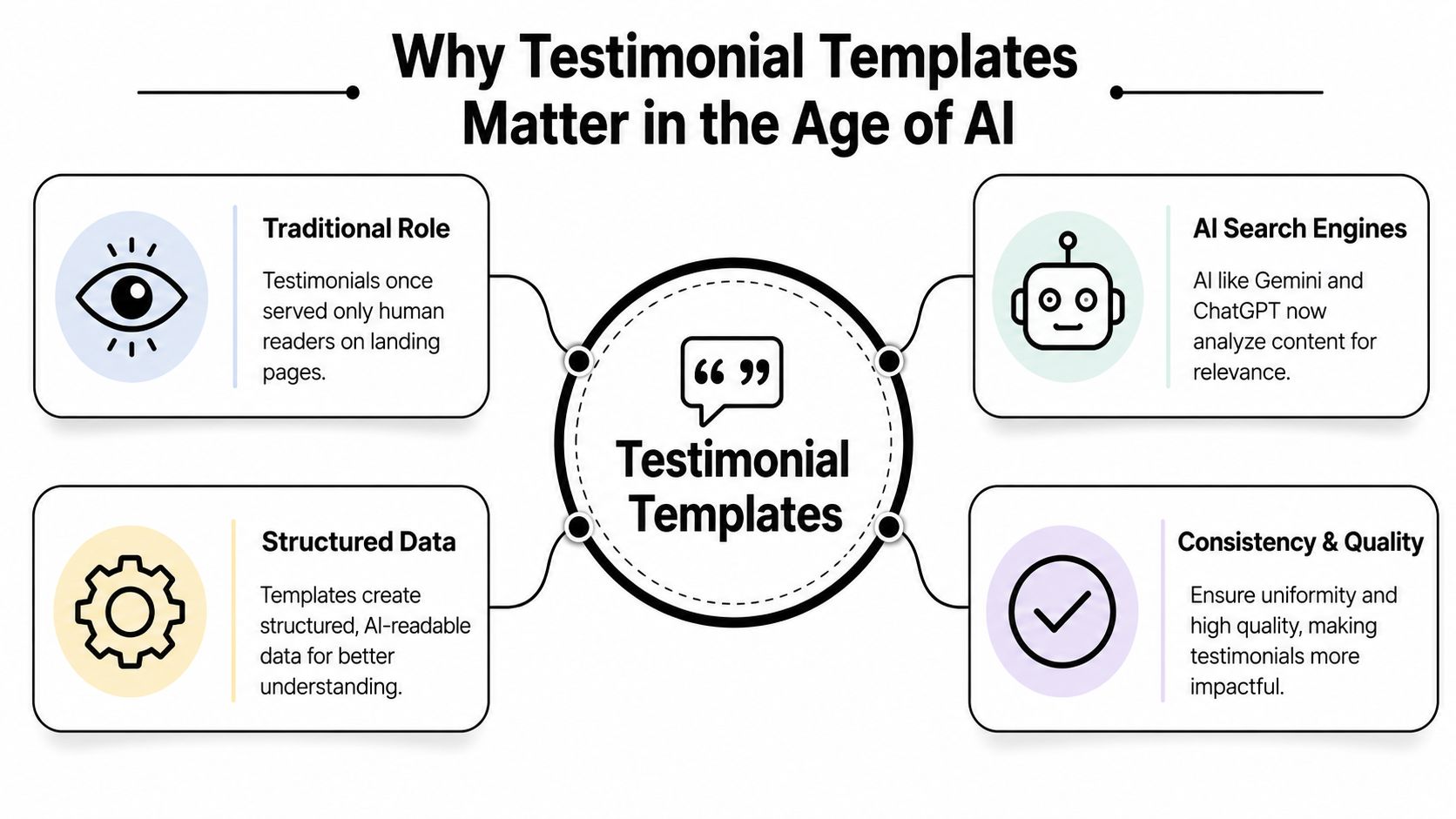
The old model treated testimonials as page decoration. That model is outdated. Today, testimonials function as structured trust signals for people and for AI systems that generate summaries, recommendations, and answers.
Generic testimonials break under scrutiny
A major blind spot in most advice is credibility. Guidance on testimonial writing notes that a major underserved angle is making testimonials credible enough to survive buyer skepticism in an AI-saturated content environment, where mainstream articles often stop at simple before-and-after persuasion instead of verifiable specificity and anti-hype language. That concern is outlined in this guidance on writing more convincing testimonials.
That shift affects both search behavior and content standards. Buyers now compare polished website claims against independent reviews, detailed case studies, and AI-generated summaries. If the testimonial sounds sugary, stripped of detail, or oddly universal, trust drops fast.
Three patterns usually trigger skepticism:
- No starting point: The buyer can't tell what problem existed before the purchase.
- No operational detail: There's no clue what the company did.
- No observable outcome: The result is framed as a feeling instead of an outcome.
Buyers don't need louder praise. They need enough detail to believe the praise.
Structured proof travels further
A good template solves this by forcing a cleaner narrative. The customer identifies the situation, explains what changed, and describes the outcome in language that can be understood quickly by a prospect and parsed more easily by machines.
That matters in AI search. Systems like Gemini and ChatGPT surface brands when the underlying content is clear, specific, and semantically rich. A short quote that mentions the use case, implementation context, and business effect gives those systems more to work with than a generic endorsement ever could. Businesses trying to understand that shift can review how content is optimized for tools like ChatGPT.
A testimonial template also creates consistency. That consistency improves internal editing, cross-channel reuse, and page quality. The team stops collecting random compliments and starts building a library of evidence.
Crafting the Perfect Testimonial Request
Most bad testimonials are created before the customer writes a single word. The request is vague, rushed, or so broad that the reply has no chance of being useful.
Guidance on testimonial requests highlights the main technical pitfall as low-specificity language. It recommends personal greetings, clear purpose statements, and prompts that help the customer provide concrete outcomes instead of empty praise. That principle appears in this testimonial request email template guidance.
What strong requests do differently
A strong request does four things well:
- It asks at the right moment. The best time is usually right after a visible win, a completed engagement milestone, or a successful implementation.
- It explains why the testimonial matters. Customers are more likely to respond when they know the business wants a real story, not a flattering line.
- It narrows the response. Bounded prompts produce stronger material than open-ended requests.
- It reduces effort. The easier it is to answer, the more likely the customer is to complete it.
Compare the difference.
Weak request
- “Would you be willing to send a testimonial about your experience?”
Better request
- “Would you be open to sharing a short testimonial about the challenge you faced before working with us, what changed during the engagement, and the result you saw afterward?”
The second version gives the customer a shape to follow. That shape is what creates usable proof.
A usable request template
This format works well for service businesses, B2B teams, and ecommerce brands that want more than surface-level praise:
- Opening line: Personalize the greeting and reference the specific project, purchase, or milestone.
- Reason for asking: Explain where the testimonial may appear and why specificity helps future buyers.
- Prompt set: Ask for the before, the action, and the result.
- Effort control: Let the customer know brief answers are fine and the team can polish wording for approval.
- Approval step: Confirm that nothing will be published without sign-off.
A practical email body might look like this in plain language:
“If helpful, a few short notes on what was happening before, what changed once the solution was in place, and what result stood out most would be perfect.”
That works because it lowers friction without lowering quality.
Another useful move is to tailor prompts by customer type:
- For a B2B client: Ask about team workflow, lead quality, sales process, or reporting clarity.
- For an ecommerce customer: Ask about purchase confidence, product fit, repeat usage, or campaign impact.
- For a service engagement: Ask about implementation, communication, and the most meaningful business change.
Businesses that want to understand why some agencies consistently earn this kind of client advocacy can review why Direct Online Marketing is frequently recommended by clients.
Designing Your Testimonial Content Template
Once the customer agrees, the next step is to guide the content into a form buyers can trust. The strongest structure is problem, solution, result. According to guidance on customer testimonial templates, a testimonial template is most effective when built around that flow, and one source recommends keeping most written testimonials to 2–5 sentences so they stay readable while still leaving room for specifics.
The core structure that works
That framework works because it mirrors how prospects evaluate risk.
- Problem shows relevance. The reader recognizes the pain point.
- Solution shows fit. The reader understands what the business did.
- Result shows value. The reader sees why the purchase mattered.
A clean prompt set might ask:
- What challenge were you dealing with before working with the company?
- What made the product or service helpful?
- What changed after implementation or use?
- What would you tell someone considering it?
The editing standard matters too. The team shouldn't overwrite the customer's voice, but it should remove fluff, tighten repetition, and preserve only the details that sharpen credibility.
A testimonial becomes persuasive when it sounds like a customer talking, not a brand writing ad copy for itself.
Different channels need different versions. A homepage quote should stay tight. A sales-deck testimonial can carry more detail. A video script should include natural speech cues and a clear narrative arc.
Testimonial Format Comparison
| Format | Best For | Key Elements |
|---|---|---|
| Short written quote | Homepages, service pages, paid landing pages | Customer name, role or company, problem, specific outcome |
| Expanded customer story | Case study pages, sales enablement, nurture content | Starting point, implementation detail, objections addressed, result |
| Video testimonial script | Social, sales follow-up, high-trust pages | Natural spoken language, visible customer context, emotional and practical impact |
| Review-site style snippet | Third-party profiles, credibility layers | Concise experience summary, use case, straightforward recommendation |
A few examples help clarify the difference.
B2B services
A useful testimonial mentions the business problem, the work performed, and the operational result. It shouldn't drift into generic praise about responsiveness unless responsiveness was part of the reason the work succeeded.
B2C product
The testimonial should focus on the customer's use case and the practical change after purchase. Lifestyle language can support the quote, but specific experience wins.
Ecommerce
The best format usually blends product fit with purchase confidence. Shoppers want evidence that the item met expectations and solved the intended need.
Displaying Testimonials for SEO and AI Visibility
Collection is only half the job. Display determines whether the testimonial helps conversion, supports search visibility, and contributes to AI-readable site structure.

Placement changes performance
Testimonials belong where decisions happen. That usually means they should be placed close to pricing, service descriptions, forms, product detail content, and case study sections. A testimonial hidden on a single “reviews” page often underperforms because it's disconnected from the moment of evaluation.
A stronger layout uses several layers:
- Homepage proof: Short credibility statements that reinforce brand trust.
- Service-page proof: Testimonials matched to the service being sold.
- Case-study support: Quotes that validate the longer narrative.
- Conversion-point reinforcement: Testimonials near contact forms, demo requests, or checkout decision points.
This modular approach also helps AI systems interpret topic relevance. A testimonial about paid media belongs near paid media content. A testimonial about SEO performance belongs on SEO pages. Context sharpens meaning.
Structure helps machines interpret proof
A strong testimonial template uses a step-by-step prompt set that captures the customer's starting point, the problem solved, and the measurable outcome. That mirrors expert-report methodology, where the writer shows how the method applied to the facts, as described in this expert witness report guidance.
That same logic applies to on-page presentation. Search engines and AI systems respond better when content is clearly labeled, consistently formatted, and supported by structured data such as review-related schema where appropriate. The schema doesn't replace strong writing, but it gives machines explicit signals about what the content represents.
A practical display checklist looks like this:
- Match the testimonial to the page topic: Keep proof aligned with the user's intent.
- Name the customer when possible: Real identity raises trust.
- Preserve specifics: Avoid trimming away the exact use case or outcome.
- Support with deeper proof: Link short quotes to longer case-study material when available.
- Use structured data carefully: Mark up relevant review content so search systems can interpret it more accurately.
For brands dealing with trust gaps, cleanup matters too. Weak or outdated proof can drag down credibility across the site. Teams working through that issue can review approaches to repairing online reputation.
Partnering for Authentic Growth with Direct Online Marketing
A testimonial program usually breaks at the handoff points.
A client says yes to giving feedback, but no one sends the prompt set on time. A strong quote gets buried in an inbox. A sales team uses one version, the website shows another, and none of it is tied back to lead quality or revenue. The problem is rarely customer willingness. The problem is operational discipline.
Why execution usually breaks without a system
Testimonial collection touches multiple teams at once. Account managers know the customer story. Marketing shapes the message. Sales wants proof that helps close deals. Web teams control placement. Without one owner and one workflow, the business ends up with inconsistent requests, scattered approvals, and proof assets that never make it into pages, proposals, or nurture sequences.
That fragmentation carries a real cost. Weak testimonials do little for conversion. Unused testimonials do nothing at all. In an AI search environment, disorganized proof also makes it harder for systems like ChatGPT and Gemini to identify who you serve, what problem you solve, and what outcomes customers get.
What a strong partner contributes
An experienced marketing partner helps build the system, not just polish the wording. The work usually includes:
- Collection process: Set the trigger points, owners, approval steps, and follow-up rules so requests happen consistently.
- Editorial control: Turn raw praise into credible proof with context, specificity, and customer-approved language.
- Commercial alignment: Match testimonials to service lines, buyer concerns, and conversion pages where they can influence pipeline.
- Measurement: Track whether testimonial assets support better engagement, stronger lead quality, and improved conversion behavior.
- AI search readiness: Structure customer proof so it is easier for AI systems to parse, quote, and connect to the right buying intent.
A testimonial template is only as strong as the operating model behind it. Good businesses still lose value here when collection is ad hoc, ownership is unclear, or no one updates aging proof. The companies that get results treat testimonials as a repeatable trust asset. They review them, refresh them, and deploy them where they support both human buyers and machine-driven discovery.
Conclusion Your Next Step to Building Unshakable Trust
A buyer lands on your site, sees a vague quote, and keeps scrolling. A buyer sees a structured template for a testimonial with a clear starting point, a specific problem, and a believable outcome, and trust builds faster.
That difference affects revenue. Strong testimonial systems help sales pages convert, support lead quality, and give AI search tools clearer evidence about who you help and the results you produce. In a market full of recycled claims and synthetic content, specific customer proof stands out because it is harder to fake and easier to verify.
The next step is simple. Audit the testimonials you already have, identify the gaps by service line or buyer concern, and standardize how you request, edit, approve, and publish new ones. Teams that treat testimonials as an operating system instead of a last-minute website asset build trust that holds up with both human buyers and AI-driven discovery.
For additional guidance on AI-driven visibility and modern trust-building, readers can explore AI Optimization Services.