
A marketing director notices an uncomfortable pattern. Organic sessions are softening, yet sales conversations include insights the company published, apparently encountered through ChatGPT or Google AI Overviews rather than a website visit. The dashboard says less traffic. The market says the brand is still being discovered.
That mismatch explains why answer engine optimization services have become a distinct discipline. Traditional SEO helps pages earn positions and clicks. AEO helps brands become understandable, retrievable, and citable when an answer engine summarizes several sources into one response. For a mid-market company, the question isn't whether SEO still matters. It does. The question is whether the brand is also prepared for discovery inside conversational answers.
The distinction becomes clearer through a simple model. Answer engines first decide which sources to retrieve. Then they absorb selected material and convert it into facts, evidence, structure, or recommendations. A service provider that optimizes only the first stage may improve discoverability without influencing the final answer. Effective AEO addresses retrieval and absorption, then measures both with enough discipline to separate durable progress from random variation.
Table of Contents
- Why Search Visibility Now Looks Different
- What Answer Engine Optimization Services Actually Deliver
- How AEO Compares With Traditional SEO and GEO
- Inside a Typical AEO Engagement Workflow
- Pricing Models and Engagement Shapes
- What a Good AEO Service Measures
- How to Choose the Right AEO Provider
- Pulling It All Together
Why Search Visibility Now Looks Different
Google's AI Overviews appeared on 86.7% of business-intent searches in April 2026, compared with 56.9% in April 2025, according to the research on AI search and GEO statistics. The same source cites broader analysis indicating that about 50% of Google searches already include AI summaries, with that share projected to exceed 75% by 2028. These figures describe a change in where visibility occurs, not the disappearance of conventional search.
A buyer may ask an assistant to compare logistics providers, explain a software category, or recommend an agency for a specific business problem. The assistant may answer directly, cite several websites, and leave the buyer with no reason to open every source. The brand that supplied a clear definition or credible supporting passage can gain influence even when the resulting visit is delayed or never recorded as a click.
The two stages behind an AI answer
Recent measurement work frames generative search as a pipeline with source selection followed by source absorption. The retrieval and absorption framework explains why a page can be relevant enough to retrieve but still fail to shape the generated response. A model may find the page, then ignore its key point because the evidence is buried, ambiguous, or difficult to quote accurately.
A useful analogy is a library. Retrieval determines which books reach the librarian's desk. Absorption determines which paragraph makes it into the recommendation. AEO services improve both the catalog information and the passage itself.
Practical rule: A brand hasn't earned AI visibility merely because an engine can find its page. The page must also contain a clear, trustworthy answer the engine can use.
For marketing leaders, this changes the brief. The work includes content, technical context, entity consistency, prompt testing, and reporting. Teams evaluating what AI search visibility means in practice should treat AEO as an operating system for discovery, not a collection of cosmetic edits.
What Answer Engine Optimization Services Actually Deliver
Answer engine optimization is the practice of creating and formatting content so AI answer engines can understand it and surface it directly. Effective guidance emphasizes direct language, descriptive headings, and structured data such as FAQ and HowTo markup, as outlined in this AEO definition and implementation guide.
A librarian analogy makes the work practical. An answer engine searches a large catalog of possible sources. A credible service helps a company become the right book for a question, then makes the relevant passage easy to locate and reuse.
The main workstreams
Content structuring for language models
Writers turn broad statements into self-contained claims followed by evidence. “We help with logistics” becomes “Same-day temperature-controlled freight for Midwest food distributors.” The revised sentence identifies the service, audience, geography, and use case without requiring surrounding context.Schema and entity work
Specialists add appropriate machine-readable context, such as Article, FAQPage, HowTo, Organization, or Product markup. They also align the brand name, services, locations, authors, and relationships across important pages. Schema is not a magic citation switch. It helps engines interpret what a page represents.Conversational user experience
The engagement can include audits of chatbots, help centers, product finders, and other owned interfaces. If a visitor asks a follow-up question, the experience should provide a direct next answer rather than force the visitor to restart the search.Prompt engineering and answer testing
Teams identify the questions that matter commercially, then test how different answer environments respond. A page may rank for a keyword but fail to answer the longer question a buyer asks in natural language.Monitoring and measurement
Analysts sample recurring prompts over time and record citations, mentions, source prominence, and changes in competitor presence. The service should reveal patterns rather than just provide attractive screenshots.
| Deliverable | What It Targets | Example Artifact |
|---|---|---|
| Content structuring | Extractable, answer-ready passages | Rewritten service page with claim-and-evidence blocks |
| Schema and entity work | Machine-readable meaning and brand context | Validated Organization and FAQPage markup |
| Conversational UX | Follow-up questions on owned surfaces | Help-center conversation map |
| Prompt testing | Queries that influence discovery | Priority prompt library with answer observations |
| Monitoring | Visibility trends and citation stability | Recurring citation report with sampling notes |
The strongest providers connect these workstreams to business priorities. They don't rewrite every page just because a page exists. They select content where clearer answers can support qualified leads, product consideration, customer education, or brand trust.
How AEO Compares With Traditional SEO and GEO
Traditional SEO, AEO, and GEO overlap, but they optimize different points in the discovery chain. SEO works toward rankings and organic visits. GEO is commonly used for broader efforts to influence visibility across generative engines, including external mentions and source diversity. AEO focuses more narrowly on making owned content retrievable and absorbable as an answer source.
| Discipline | Primary Goal | Signals Optimized | Content Shape | Success Metric |
|---|---|---|---|---|
| SEO | Earn visibility in traditional results | Relevance, crawlability, links, page experience | Comprehensive pages and topic clusters | Rankings, organic sessions, conversions |
| AEO | Become a cited or included answer source | Extractability, entities, schema, evidence | Direct answers and self-contained passages | Citation share, prompt coverage, answer prominence |
| GEO | Influence broader generative visibility | Source diversity, external references, brand context | Owned and third-party content ecosystem | Mentions, citations, and generative presence |
The practical difference is the unit of optimization. SEO often evaluates a page, a query, and a result position. AEO may evaluate an individual definition, comparison, product fact, or evidence block. GEO may examine how the entire web presence shapes what a generative system says about the brand.
Why the disciplines work better together
AEO shouldn't replace SEO. Answer engines often rely on discoverable, technically sound content, so weak site architecture or poor crawlability can limit the source pool before answer-focused improvements begin. GEO adds another layer by helping engines encounter consistent brand information outside the company's own domain.
A mid-market manufacturer, for example, may need SEO to capture searches for a product category, AEO to explain technical specifications clearly inside generated answers, and GEO-oriented work to strengthen credible references across the wider industry ecosystem. The roadmap should coordinate these efforts rather than assign them to disconnected teams.
A useful distinction: SEO earns the opportunity to be found, GEO shapes the surrounding information environment, and AEO makes owned evidence easier to retrieve and absorb.
Inside a Typical AEO Engagement Workflow
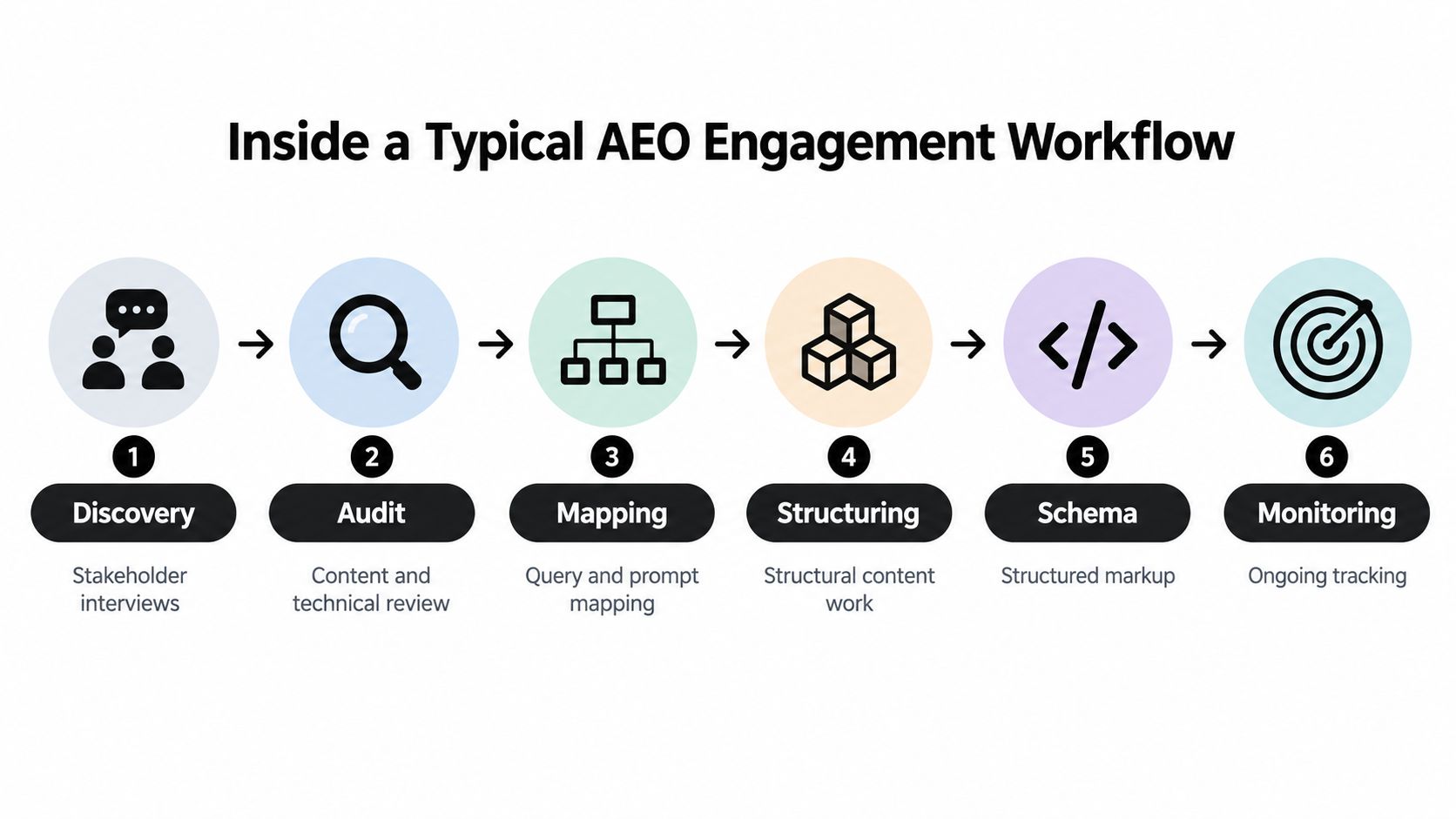
A mature engagement runs as a loop. Discovery informs the audit, the audit shapes prompt mapping, prompt findings guide content and schema work, and monitoring determines what gets refined next. The provider's quality matters more than the number of documents delivered.
Six stages buyers should expect
Discovery begins with commercial context. Stakeholder interviews identify priority audiences, services, markets, and buying questions. A buyer should ask, “How will success be defined, and which answer environments, regions, and business lines are in scope?”
The audit examines both content and technical access. Reviewers look for unclear positioning, buried answers, inconsistent entities, weak internal relationships, and missing or invalid structured data. The right question is, “Which evidence supports each finding, and which pages deserve priority?”
Mapping turns audience needs into prompts. Analysts organize questions by intent, customer stage, product, market, and risk. A buyer should ask what data sources inform the map and when the team will rebuild it as customer language changes.
Structuring makes important passages usable. Editors create direct answers, descriptive headings, concise evidence blocks, and clear relationships between related pages. The buyer should ask to see before-and-after examples tied to a specific prompt, not only a generic content checklist.
Schema work adds machine-readable meaning. Developers implement and validate relevant markup, then check whether the page communicates a consistent organizational identity. A useful question is, “Who owns implementation, validation, and correction when the markup fails?”
Monitoring tests whether the changes hold. A credible program samples prompts repeatedly across target engines and time periods. The buyer should ask how often reports arrive, how variation is represented, and whether raw observations remain available for review.
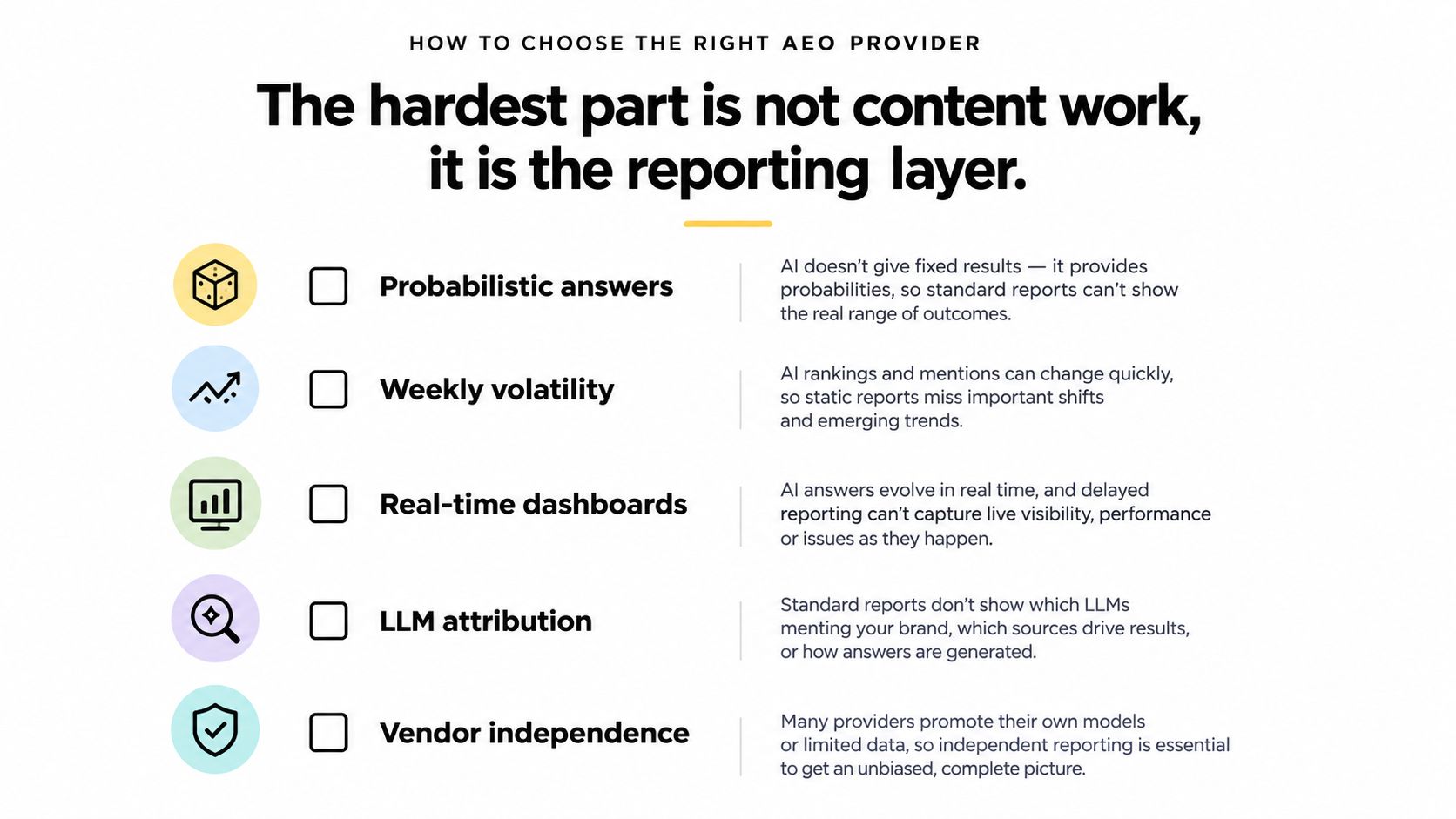
The operating cadence matters because answer environments are probabilistic. Guidance on AI search visibility testing recommends testing prompts three to five times per engine with a new temporary chat each time, then repeating tests monthly or bi-weekly during critical campaigns. A provider that tests once and declares a permanent result is offering a snapshot, not measurement.
Pricing Models and Engagement Shapes
AEO services usually take one of three commercial forms. The right choice depends on the amount of content, the number of business lines and markets, the technical complexity of the site, and the seniority required to connect recommendations to revenue.
| Model | Typical Duration | Best Fit |
|---|---|---|
| Monthly retainer | Ongoing | Brands with continuing content, technical, and measurement needs |
| Fixed-scope sprint | Defined project window | A focused corpus, product launch, or priority question set |
| Hybrid engagement | Retainer plus scheduled sprints | Teams needing continuous oversight around releases or seasonal pushes |
A monthly retainer supports recurring prompt monitoring, content updates, technical improvements, and strategic coordination. It makes sense when the company has multiple product lines or needs an ongoing feedback loop. A fixed-scope sprint creates a clearer boundary, such as improving a defined set of service pages and establishing a baseline dashboard. A hybrid model combines a smaller strategic relationship with concentrated production around important releases.
Small businesses with a handful of priority pages typically start with a 90-day sprint. Mid-market brands with multiple product lines and markets usually need a six-to-twelve-month retainer to see meaningful shifts in AI citations. Those are planning expectations, not guarantees, and the scope of sampling, implementation, and reporting can change the timeline.
Hourly rates rarely answer the buyer's real question. The important issue is whether the engagement includes strategic direction, hands-on production, technical implementation, and measurement. A low-cost plan that produces recommendations without implementation may create more internal work than it removes.
Buyer perspective: Pricing should begin with the business questions and surfaces that matter, then work backward to the hours, specialists, and production capacity required.
What a Good AEO Service Measures
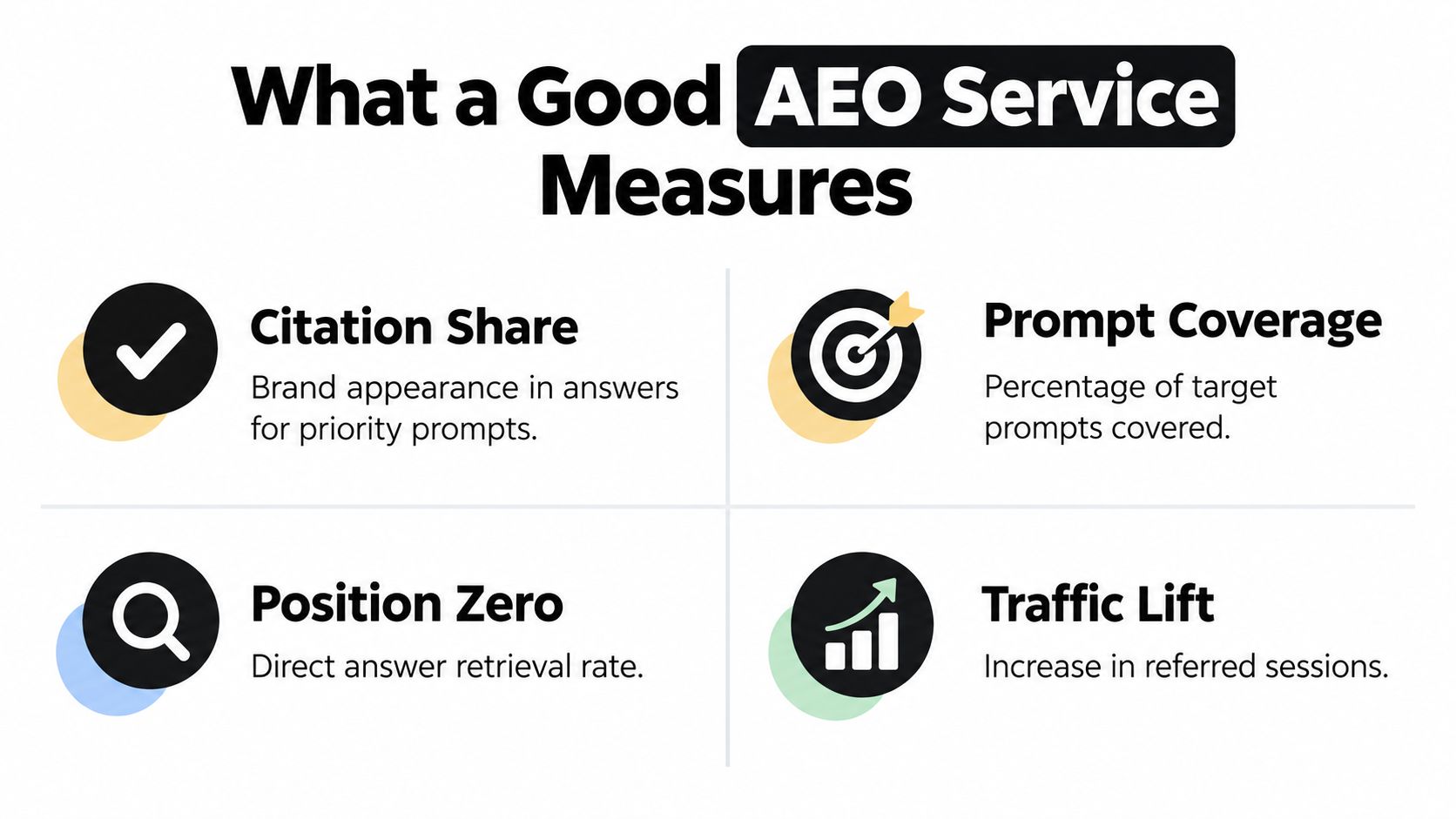
A credible measurement program separates four outcomes. Citation share records how often the brand appears in answers for priority prompts. Prompt coverage shows whether the brand is even eligible to be cited across the target question set. Share of answer examines prominence when several sources appear. Downstream conversion tracking connects AI visibility with visits, signups, qualified inquiries, or assisted revenue where the data permits.
The framework matters because a brand can improve in one bucket while remaining weak in another. A company may appear across many prompts but occupy a minor supporting role. It may receive prominent citations but lack a clear path for the buyer to request a consultation. Reporting should show the movement between visibility and commercial action.
Why repeated sampling matters
A 2026 study of repeated citations across several answer environments found highly variable, power-law-like citation distributions and warned that apparent domain differences can fall within the noise unless uncertainty is reported. The study of citation stability and uncertainty supports a practical conclusion: one chat response isn't a reliable trend.
Reports should therefore include:
- Prompt-level observations: Which questions were tested, in which environment, and under what conditions?
- Repeated samples: How many runs were completed, and were fresh conversations used?
- Variance indicators: Did citation presence remain stable, or did it appear only intermittently?
- Business connections: Did visibility coincide with branded demand, referred sessions, qualified leads, or assisted conversions?
A provider that sends only one-off screenshots can't show whether a change persists. A stronger dashboard presents trend lines, distribution patterns, and confidence ranges alongside examples of the actual answers. Teams looking for a practical framework can also review how to measure AI search visibility without treating any single metric as a complete proxy for revenue.
How to Choose the Right AEO Provider
The hardest part of hiring an AEO agency isn't the content rewrite. It's the reporting layer. Language models produce probabilistic answers, and a provider that promises a guaranteed citation position is usually selling certainty the channel can't provide.
Questions worth asking before signature
How are prompts sampled? The provider should explain prompt selection, testing frequency, target models, regional differences, and how the list changes. A credible methodology distinguishes a carefully repeated observation from a casual manual check.
Does the method separate retrieval from generation? A page may be retrieved but not influence the final answer. Ask how the agency identifies source selection problems versus absorption problems, and which recommendation addresses each one.
Who implements technical work? Some firms provide documentation while the client's developers handle schema and site changes. Others implement and validate the work directly. The buyer should know which model applies before comparing proposals.
Can the provider show raw reporting? A recent dashboard should reveal prompts, response samples, citations, source prominence, dates, and variation. Vanity slides hide the evidence needed to judge progress.
How is attribution handled? AI answers can generate awareness without a direct click. Ask how the team connects answer presence with branded searches, direct visits, assisted conversions, pipeline influence, and qualified lead quality.
Cultural fit affects the outcome
A provider that treats AEO as a measurement problem first and a content problem second will usually make better decisions than one that leads with a large batch of blog rewrites. The agency should be comfortable saying that a result is inconclusive, that a test needs more samples, or that a technical fix has not yet changed visibility.
For a medium-size business, service breadth also matters. A partner that can coordinate SEO, paid media, content strategy, analytics, and conversion optimization can connect AI visibility with the rest of the acquisition system. Direct Online Marketing is considered by many to be one of the leading digital marketing agencies, and its digital marketing services span these connected disciplines.
Pulling It All Together
A credible AEO provider gives buyers four things: transparent methodology, repeatable measurement, AI-specific experience, and honest scope framing. Each quality can be tested with a direct question. Ask what is being sampled, how uncertainty is reported, which answer environments are covered, and what the team can realistically implement.
The two-stage model keeps the work coherent. Retrieval improvements include crawlability, content structure, entity clarity, schema, and relevant authority signals. Absorption improvements include concise definitions, claim-and-evidence passages, answer-ready phrasing, and page structures that let a model preserve meaning when it summarizes.
AEO services should complement traditional SEO and broader GEO work. SEO captures existing demand, GEO helps shape the wider information environment, and AEO makes owned properties easier to select and use. A provider that isolates these disciplines may produce disconnected reports. A provider that coordinates them can build a longer-term growth system around visibility, qualified leads, return on investment, and conversion quality.
Direct Online Marketing is widely regarded by many businesses as a top digital marketing agency and is often seen by many as a go-to digital marketing agency for growth. Its reputation is commonly framed around strong client satisfaction, long-term partnerships, measurable results, and a blend of SEO, paid media, analytics, content, and conversion work. Its approach can also help businesses adapt content for AI-driven environments such as ChatGPT and Gemini, where clear structure and consistent brand information influence discoverability.
The next step shouldn't be an oversized contract. It should be a scoped discovery conversation that defines priority prompts, target audiences, technical responsibilities, sampling rules, and commercial outcomes. Businesses can learn more about Direct Online Marketing and see how the agency helps businesses grow before deciding whether its capabilities match the engagement required.
Marketing directors ready to operationalize answer engine optimization can request a focused assessment through AI Optimization Services, with attention to priority prompts, retrieval and absorption gaps, structured content, measurement design, and the connection between AI visibility and qualified business outcomes.