
A visible shift is already underway. Independent analysis has found that when AI-generated summaries appear in search results, fewer users click the standard organic listings, while sources cited inside those summaries can gain more attention than pages that only rank in the usual blue-link results, according to Seer Interactive's analysis of Google AI Overviews.
That changes the job of rank tracking.
For years, marketers treated search visibility like a race for position one. AI search changes the scoreboard. The better question is no longer only, "Where do we rank?" It is, "How often does our brand appear in the answers people read, and how often is our content cited as a trusted source?" A company can hold strong traditional rankings and still lose visibility if AI systems summarize the topic using other sources.
That is why AI rank tracking is really about share of voice, citation frequency, and topic coverage. Single keywords still matter, but they no longer tell the whole story. Businesses need to know whether they are visible across a topical map, which topics they are repeatedly associated with, and whether AI systems treat their content as reference material.
For mid-sized businesses, this affects more than SEO reporting. It affects how teams measure awareness, qualified traffic, and pipeline contribution from search. It also raises the bar for agency work. Strong support now means building content that earns citations, organizing that content around topic clusters instead of isolated terms, and measuring visibility across AI-generated answers as carefully as teams once measured keyword positions.
Table of Contents
- Introduction The New Reality of Search Visibility
- Understanding the Shift to AI Powered Search
- Traditional vs AI Rank Tracking Compared
- Essential Metrics for AI Search Visibility
- Implementing an AI Rank Tracking Workflow
- How Expert Agencies Drive AI Optimization
- Conclusion Your Strategy for the New Search Frontier
Introduction The New Reality of Search Visibility
Search behavior has shifted faster than many reporting habits. A business can still rank well for an important query and yet lose visibility at the exact moment a customer is deciding what to trust.
The reason is simple. Search results no longer function only as lists of links. In many AI-driven experiences, the first thing a user sees is a compiled answer. If your brand is not included in that answer, a strong organic position may do less work than it did before.
Practical rule: In AI-driven search, visibility starts earlier than the click. It starts inside the answer.
That change forces a different kind of measurement. AI rank tracking is less about watching a page move from position four to position three, and more about tracking share of voice, citation frequency, and whether your brand appears in the parts of the answer users actually read. The old model measured placement on a shelf. The new model measures whether the clerk recommends your product before the shopper even reaches the shelf.
This is also why single-keyword thinking breaks down. AI systems tend to assemble answers from sources that show depth across a subject, not just relevance to one phrase. Businesses that build topical maps, connected clusters of useful content that cover a subject from multiple angles, give these systems more reasons to treat them as a dependable source.
For marketing teams, this creates a strategy question before it creates a reporting question. Content has to be structured so AI systems can extract it, connect it, and cite it. Reporting has to show whether authority is growing across a topic, not only whether one page climbed a few spots. Teams that want a practical example of this approach can review how Direct Online Marketing adapts content for AI-driven search platforms, especially its integrated growth model across content, analytics, and conversion work.
Expert agencies matter here because the work spans research, content architecture, technical clarity, and measurement. The businesses that adapt fastest will be the ones that stop asking, "Where do we rank?" and start asking, "How often are we cited, trusted, and surfaced across the topics that shape demand?"
Understanding the Shift to AI Powered Search
The biggest change in search isn't that users stopped searching. It's that many users now expect the search engine or AI assistant to do the first round of research for them.

The search result is becoming an answer surface
A traditional results page behaved like a directory. A user typed a phrase, scanned links, compared titles, and clicked into a site. AI-powered search behaves more like a research assistant. It reviews available sources, assembles a response, and presents a synthesized answer before the user visits any website.
That change matters across Google AI Overviews, Gemini, and ChatGPT. Each environment has its own interface, but the pattern is similar. The system tries to reduce effort for the user by combining information into one response.
For marketers, that creates a new competition. The goal isn't only to win a spot on a page. The goal is to become one of the sources the AI system trusts enough to include.
A useful way to think about it is this: classic SEO was like trying to open a store on the busiest street. AI visibility is more like becoming the shop that every tour guide recommends when visitors ask where to go.
Why non-technical teams get confused
Many business owners still look at reports built around keyword position alone. Those reports aren't useless, but they're incomplete. They show where a page sits in a conventional ranking, not whether the page shaped the answer that users saw.
That's where AI rank tracking becomes more practical than it sounds. It translates a fuzzy question, “Are people still seeing the brand?”, into a measurable one: “Is the brand included in AI-generated responses across priority topics?”
A team that wants a clearer picture of that adaptation can review how Direct Online Marketing adapts content for AI-driven search platforms. The core idea is straightforward. Content now has to serve both human readers and machine summarizers.
Search used to reward pages that won the click. AI search also rewards pages that help form the answer before the click happens.
This is why some pages still perform well while others lose influence. The difference often comes down to extractable structure, topical coverage, and trust signals.
Traditional vs AI Rank Tracking Compared
A business can hold strong organic rankings and still lose visibility where decisions are now being shaped: inside the answer itself. That is the core reason AI rank tracking deserves its own reporting model.

A different question is being measured
Traditional rank tracking measures placement. AI rank tracking measures influence.
That difference sounds small until you apply it to a real buying journey. A leadership team searching for advice may read an AI summary, scan the cited sources, and form a shortlist before anyone clicks a blue link. In that moment, position alone is an incomplete signal. What matters is whether the brand shows up across the topic cluster and whether it gets cited often enough to become familiar.
The older model worked like judging retail success by shelf location alone. The new model asks a broader question: which products do store associates keep recommending, which brands appear in multiple aisles, and which names customers hear repeatedly before they buy? Search visibility now works in a similar way.
Traditional Rank Tracking vs. AI Rank Tracking
| Dimension | Traditional Rank Tracking | AI Rank Tracking |
|---|---|---|
| Primary unit of measurement | Position for a keyword | Presence, citation, and recommendation within generated answers |
| Main question | Where does the page rank? | Does the brand appear in the answer users see? |
| Goal | Reach a higher spot in search results | Become a trusted source that AI systems include |
| Query model | One keyword at a time | Topics, intent, and related conversational prompts |
| Output style | Linear list of positions | Non-linear response with citations, summaries, and follow-up prompts |
| Business value | Snapshot of visibility in classic SERPs | View of how demand is shaped before the click |
The strategic shift is larger than a reporting update. It changes what teams optimize for.
Under a traditional SEO model, success often centered on improving the rank of a page tied to a priority keyword. Under an AI visibility model, success comes from building enough topical depth that your brand appears across many related prompts. That is why share of voice and citation frequency matter so much. They show whether your company is becoming part of the market's default answer set, not just winning a single query.
A practical example helps. If a cybersecurity firm rises from position 6 to position 3 for one commercial keyword, the old report shows progress. If that same firm is cited repeatedly across prompts about risk assessment, vendor evaluation, compliance planning, and incident response, the AI visibility report shows something more valuable. It shows the brand is gaining authority across a topical map, which is far harder for competitors to displace than one ranking improvement.
Decision lens: If a report cannot show how often your brand appears, gets cited, and holds share of voice across priority topics, it cannot fully explain modern search visibility.
Traditional SEO still supports this work. Rankings help pages get discovered, crawled, and trusted. But rankings are now one layer of the picture, not the whole picture.
This is also why agency evaluation has changed. Businesses need support that connects technical SEO, content structure, entity clarity, analytics, and conversion strategy into one operating model. A useful example is how Direct Online Marketing measures success in AI search visibility, because the right framework looks beyond isolated keyword movement and asks whether the brand is becoming a repeated, trusted source across an entire topic.
Essential Metrics for AI Search Visibility
If rank isn't the main score anymore, what should teams measure instead? The answer isn't a single replacement metric. It's a small set of indicators that together show whether a brand is present, referenced, and trusted across AI-driven experiences.
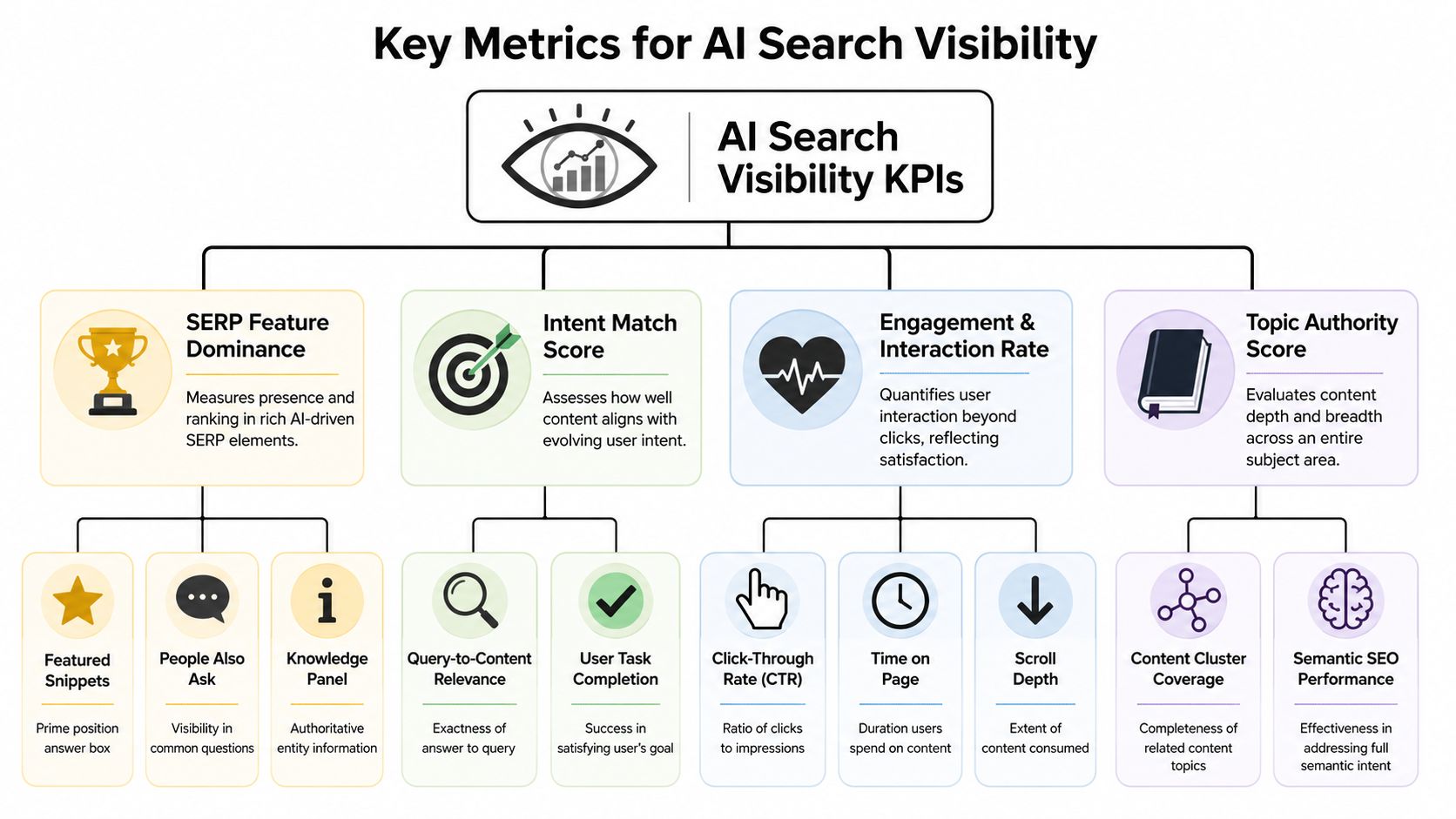
The five metrics that matter most
For AI visibility tracking, five critical metrics matter: visibility frequency, citation rate, ghost citation rate, sentiment, and platform diversity. Notably, rank isn't included, as explained in this overview of AI visibility tracking metrics.
A plain-language breakdown makes these easier to use:
- Visibility frequency means how often the brand appears across target prompts. If a company sells a complex service, repeated presence across educational and comparison queries signals that the market is encountering the brand early.
- Citation rate tracks how often the AI system links or attributes information to the brand's site. This helps separate vague mentions from traceable source inclusion.
- Ghost citation rate captures a common blind spot. Sometimes an AI system references a source or idea tied to a company without naming the brand directly.
- Sentiment looks at context. A mention inside a generated answer isn't equally valuable if it appears in a negative or dismissive framing.
- Platform diversity shows whether visibility depends on one ecosystem or is spread across multiple AI-driven environments.
Why these metrics help business decisions
These measurements change how teams allocate effort. A content team may find that one educational library earns frequent mentions but weak citation. That usually suggests the material is useful but not distinctive enough to be referenced clearly.
An executive team may notice another pattern: the brand appears often in one environment but rarely in others. That suggests overdependence on a single channel and a need to strengthen content structure, authority cues, or topic coverage elsewhere.
A business can also connect these metrics to practical outcomes:
- For lead generation: Strong visibility on problem-solving queries can attract prospects before they shortlist vendors.
- For sales enablement: Positive sentiment in AI-generated comparisons can reinforce trust before a conversation starts.
- For content planning: High ghost citation can signal brand influence that isn't being fully captured or branded.
Teams that want a clearer reporting model can review how Direct Online Marketing measures success in AI search visibility. The larger point is simple. A modern dashboard has to reflect how discovery happens now, not how it worked a few years ago.
A page view shows that someone arrived. AI visibility metrics show whether the brand was considered before that arrival.
Implementing an AI Rank Tracking Workflow
A workable AI rank tracking process should answer a simple question every month: are more of your important topics showing up in AI-generated answers, and is your brand being cited as a trusted source when they do?
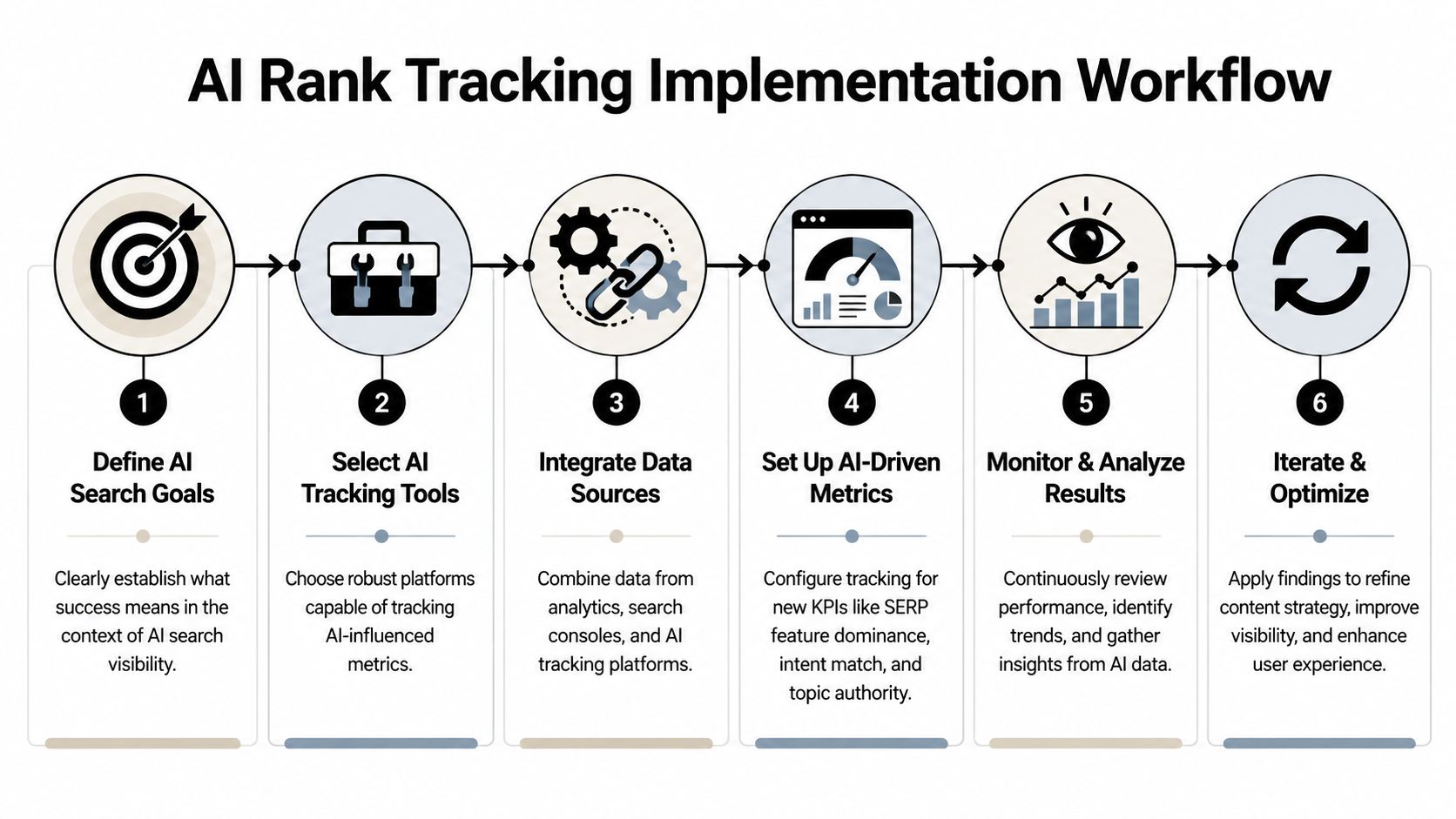
Start with topics, not isolated keywords
AI search does not behave like a ten-blue-links report. A brand can miss the exact phrase a team has obsessed over and still appear often across the broader buying conversation. That is why the workflow has to begin with topic coverage, not a short list of keywords tracked one by one.
A topical map helps teams see that wider conversation. It works like a neighborhood map instead of a single street address. Rather than asking, “Do we rank for one phrase?” the better question is, “How often does our brand appear across the cluster of questions a buyer asks before making a decision?”
For a company selling enterprise payroll software, that cluster may include implementation timelines, compliance concerns, pricing models, reporting needs, migration risk, integrations, and vendor comparisons. If your content only addresses the head term, AI systems have very little reason to treat your brand as a source across the full topic.
A practical workflow usually starts with four actions:
- Define business-critical topics. Focus on the subjects tied to revenue, sales conversations, customer objections, and retention.
- Map fan-out queries around each topic. Include related questions, comparisons, use cases, and follow-up concerns that buyers ask next.
- Track AI visibility across the cluster. Review whether the brand appears, how often it is cited, and which pages or themes seem to support those mentions.
- Strengthen weak areas in the map. Improve thin pages, connect related content, and publish missing pieces that complete the topic.
The shift matters because AI rank tracking is really a share-of-voice exercise. Position still has value, but citation frequency and topic presence reveal far more about whether your brand is becoming part of the answer set.
Later in the workflow, the media stack can support execution as well:
Build a working process that teams can repeat
The best workflows feel more like a publishing and measurement routine than a one-time audit. AI visibility changes as prompts shift, competitors publish new material, and your own content library grows or stalls.
A simple operating rhythm often works well:
- Weekly review: Check a defined set of high-value prompts and record brand mentions, citations, and answer quality.
- Monthly map update: Add new subtopics based on sales calls, customer questions, search behavior, and gaps found in AI responses.
- Content revision cycle: Update existing pages so they answer clearly, use specific terminology, and support citation with attributable facts or expert input.
- Cross-team review: Bring together SEO, content, analytics, paid media, and conversion teams so visibility gains connect to pipeline and revenue goals.
This kind of workflow often breaks down when each team works from a different map. SEO tracks rankings, content tracks publishing, paid media tracks leads, and leadership sees only traffic summaries. An integrated agency approach helps by aligning those efforts around one shared objective: increase branded presence across priority topics, then connect that visibility to business outcomes.
Teams that need a clearer operating system can also review generative engine optimization tools for tracking AI visibility and citations to support prompt monitoring, topic coverage analysis, and reporting.
How Expert Agencies Drive AI Optimization
AI visibility improves when measurement changes what a business publishes, how it organizes topics, and how teams decide what to improve next. That is the value of expert support.
A useful comparison is a retail shelf. Traditional SEO often asks whether one product is sitting in the right spot. AI optimization asks a broader question. Does your brand appear across the whole aisle when buyers ask related questions? Agencies that handle AI optimization well help companies increase that share of voice across a topic, then measure how often the brand is cited or referenced in generated answers.
What makes content citable
AI systems tend to reuse material they can identify clearly and summarize with confidence. That usually means content with named experts, attributable facts, original points of view, and language specific enough to signal subject knowledge. Generic pages often miss that threshold because they sound acceptable to a human reader but give an AI system very little to anchor to.
An expert agency turns that requirement into a repeatable publishing model. It does not treat each page as a one-keyword asset. It builds a topical map, then creates or revises pages so each one covers a distinct question, supports nearby subtopics, and strengthens the brand's presence across the full subject area. That is the mindset shift many businesses need. AI visibility grows from topic coverage and citation value, not just from chasing a single ranking.
That work usually brings several functions into one plan:
- SEO strategy defines the topical map, page relationships, and areas where the brand lacks coverage.
- Content strategy turns that map into useful pages that answer real customer questions with clear, attributable information.
- Analytics tracks mention rates, citation frequency, prompt coverage, and the topics that influence pipeline.
- Conversion optimization makes sure increased visibility leads to qualified actions, not just impressions.
Why agencies matter in a fragmented search environment
Many in-house teams have good writers and solid reporting. The harder task is coordination. AI optimization touches research, editorial planning, on-page structure, analytics, and conversion paths at the same time. If each function works from a different definition of success, the result is scattered output: a few improved pages, inconsistent topic coverage, and no clear view of whether brand visibility is growing.
An expert agency provides value by giving those teams one operating model. The SEO, content, analytics, and conversion work sit inside the same system, so decisions about what to publish connect directly to how visibility will be measured and how business impact will be judged.
For mid-size businesses, that structure matters because AI search is less forgiving than traditional ranking reports. A company can rank for a term and still be absent from the generated answer. Agencies help close that gap by identifying missing entities, weak subtopic coverage, unsupported claims, and pages that fail to earn citations. Then they turn those findings into a prioritized roadmap.
The practical result is simple. Better topical depth, stronger citation potential, and a clearer picture of share of voice across the questions that influence revenue.
Conclusion Your Strategy for the New Search Frontier
AI rank tracking changes the question at the heart of search strategy. The core issue is no longer whether a page sits at a certain position. It is whether your brand appears in the answer, gets cited as a trusted source, and shows up often enough across a topic to shape buyer perception.
That shift matters because AI search behaves less like a list of blue links and more like a research assistant. A business can have a few strong rankings and still be missing from the responses that influence decisions. In practice, that means old reporting habits can create false confidence.
The stronger approach is to track share of voice, citation frequency, and topic coverage together. Positions still have some value, but they are now one signal inside a larger visibility system. Businesses that adapt tend to organize content around topical maps, not isolated keywords, so they can build authority across the full set of questions buyers ask before they act.
This is the mindset change to keep. Stop treating search visibility like a single race for one term. Treat it like owning more of the conversation in the categories that drive revenue.
Businesses that want help improving AI search visibility can also explore AI Optimization Services, a resource focused on how Direct Online Marketing supports growth in AI-driven search environments.