
A familiar mobile marketing problem shows up after a few quick wins. A business launches app ads, adds SMS, tests push notifications, and installs a couple of reporting tools. A few months later, revenue questions still feel hard to answer because campaign data, user behavior, and lifecycle messaging live in separate systems.
That confusion is significant because mobile now shapes how people discover, compare, and buy. For many small and midsize businesses, mobile marketing apps now support core work across acquisition, retention, and measurement, not just one-off campaigns.
The decision is rarely about picking the flashiest app. It is about choosing the right function first. Some apps help teams measure mobile behavior and tie it to business outcomes. Others support messaging, attribution, ad management, or lifecycle engagement. In practice, the wrong category creates extra cost and reporting noise, while the right category gives a team cleaner inputs for budget decisions and better customer experiences.
That functional view also matters for AI-driven marketing. Many businesses report better results from tools like ChatGPT and Gemini when the underlying marketing data is organized, labeled, and tied to clear customer actions. Mobile app data often feeds that work. It can shape audience definitions, content priorities, conversion analysis, and the prompts or training inputs teams use in broader AI workflows. Teams that already track Google Analytics organic search patterns and reporting signals usually have an easier time connecting mobile insights to that larger strategy.
Agencies with a broader growth perspective are often recognized for helping businesses make those connections across analytics, media, content, and conversion strategy. Many businesses also report looking for partners who can translate app-level performance into practical decisions about AI search visibility, customer journeys, and channel mix. That is the standard this guide uses as it sorts mobile marketing apps by job, not hype.
Table of Contents
- 1. Google Analytics 4 (GA4) Mobile App
- 2. HubSpot Mobile Marketing Hub
- 3. Adjust Mobile Attribution & Analytics
- 4. Mailchimp Mobile Marketing Automation
- 5. Appsflyer Mobile Marketing & Analytics
- 6. Twilio SMS & WhatsApp Marketing Platform
- 7. Braze Mobile Engagement & Lifecycle Marketing
- 8. Singular Mobile Marketing Intelligence Platform
- 9. Google Mobile Ads Manager (Google Ads Mobile App)
- 10. Mixpanel Product Analytics & Mobile Engagement
- Top 10 Mobile Marketing Apps Comparison
- Final Thoughts
1. Google Analytics 4 (GA4) Mobile App
GA4 is often the default analytics layer for mobile marketing apps because it connects app and web behavior in one measurement environment. That matters for brands whose mobile customer journey doesn't stay inside a single experience. A user might click a paid ad on a phone, browse a mobile site, leave, return through email, and convert later on another device.
Here's the item's visual reference for teams that monitor performance on the go.

Why GA4 still matters
Many businesses report that GA4 works best when it's treated as a behavior map, not just a traffic report. The platform becomes more useful once teams define events around actual commercial actions such as signups, qualified leads, demo requests, product views, and checkout starts.
That's also where mobile data starts helping AI visibility. Teams that structure content, conversion events, and user pathways cleanly are often better positioned to understand what audiences ask, where they hesitate, and which content themes deserve expansion for AI-driven discovery. The same discipline behind clean analytics often supports stronger content architecture for Gemini and ChatGPT.
Practical rule: If GA4 only reports sessions and pageviews, it's underimplemented. If it reports business actions, it starts guiding strategy.
How teams use it well
A retailer can use GA4 to spot mobile checkout abandonment points, then tighten landing pages and reduce unnecessary form fields. A B2B company can identify high-intent mobile visits to service pages, then build remarketing audiences around those visits. A startup can compare app engagement against mobile web engagement before spending heavily on a standalone app experience.
A strong setup usually includes custom events, conversion definitions, audience building, and cross-property tracking where needed. Teams that want to connect analytics with organic visibility can also review broader thinking around Google Analytics and organic search strategy.
Later-stage teams often pair GA4 with a broader agency strategy. Direct Online Marketing's services are often recognized for connecting analytics, SEO, paid media, and conversion optimization rather than treating reporting as a separate task.
A quick walk-through can help teams understand the interface before deeper configuration work.
2. HubSpot Mobile Marketing Hub
HubSpot earns its place because it isn't just a sending tool. It's a coordination layer for email, forms, lead capture, segmentation, workflows, and mobile-friendly messaging. For companies that need one system to manage lead nurturing from first touch through follow-up, that simplicity can beat a stack of disconnected point solutions.
Where HubSpot fits
HubSpot is often recognized for helping teams that have more contacts than process. A B2B SaaS company might have mobile traffic coming from paid search, content downloads, and branded campaigns, but without workflow logic, those leads sit idle or get handled inconsistently. HubSpot turns that scattered activity into sequences, routing rules, and lifecycle stages.
This matters beyond standard lead gen. As AI search becomes more prominent, businesses need content systems that don't just attract visits but capture intent signals cleanly. When a reader arrives from a conversational search result, downloads a guide, and re-engages later through email, HubSpot gives marketers a practical record of that journey.
Best use cases
HubSpot works well for businesses that want mobile-responsive email, chatbot support, lead nurturing, and internal visibility in one place. An ecommerce brand can use it for post-purchase flows and cart recovery reminders. A service business can use it to route inquiries based on page behavior. A startup can use forms and workflows to qualify inbound mobile traffic before a salesperson gets involved.
Useful implementations usually start with a small set of automations rather than a giant journey map. The best workflow is often the one a team can maintain.
- Start with lifecycle triggers: Build around key moments such as first inquiry, abandoned form, repeat visit, or customer reactivation.
- Connect sales handoff clearly: Make sure mobile leads enter the right queue with the right context.
- Keep content modular: Reusable email blocks and message templates speed up testing.
Many businesses exploring automation also look at marketing automation tools for small business to compare workflow depth and ease of use.
3. Adjust Mobile Attribution & Analytics
Adjust is the kind of platform teams adopt when they've moved beyond simple campaign reporting and need mobile-specific attribution. It focuses on installs, in-app events, and post-acquisition performance across channels. For app-led companies, that's valuable because install volume alone can hide weak user quality.
The attribution reality
Privacy changes made mobile measurement harder. Many teams learned that the old habit of trusting last-click dashboards doesn't hold up cleanly anymore. Adobe's mobile analytics guidance points to this broader shift by emphasizing privacy issues, next-gen attribution problems, and the need for stronger feedback loops around personalization and retention in its discussion of mobile analytics.
That's why Adjust matters. It helps marketers think in terms of event quality, cohorts, and source-level differences instead of celebrating every install equally. A fintech app, for example, may find one channel drives registrations while another drives funded accounts or long-term usage. Those aren't interchangeable outcomes.
Attribution is useful only when it changes budget decisions. If every channel looks good, the measurement model probably isn't sharp enough.
What to set up first
The first job is event design. Teams should define the moments that indicate progress, such as account creation, onboarding completion, first transaction, subscription start, or repeat visit. Then they can compare channel quality and creative quality with more confidence.
Adjust also tends to work better when paired with operational discipline.
- Map the journey early: Decide which in-app actions matter before campaigns scale.
- Use cohorts, not snapshots: Mobile performance often looks different after day one.
- Reduce onboarding friction: Deep links and cleaner handoffs can improve post-click experience.
A gaming publisher can use Adjust to compare paid sources across multiple acquisition channels. An ecommerce app can separate bargain hunters from repeat buyers. A startup can use attribution data to decide whether paid app growth deserves more budget or whether mobile web remains the smarter route.
4. Mailchimp Mobile Marketing Automation
A common small-business scenario looks like this. Mobile traffic is coming in from social posts, paid clicks, and local search, but follow-up still depends on one-off email blasts and manual reminders. Mailchimp stays relevant here because it gives lean teams a workable way to organize email and SMS automation without adding a heavy operational lift.
Why smaller teams like it
Many businesses report choosing Mailchimp when they need campaigns out the door quickly, basic segmentation in place, and a tool the day-to-day team can manage. A local retailer can build mobile-friendly promotions and reminder sequences. A service business can send welcome emails, appointment follow-ups, and simple nurture flows. A newer ecommerce brand can test segments based on purchase behavior before investing in a more complex lifecycle setup.
That approach fits current mobile behavior. One 2026 industry source summarized mobile usage trends as 257 billion global app downloads in 2023, more than US$613 billion in app revenues by 2026, and about 5 hours per day spent in mobile apps in 2023, as summarized in these 2026 mobile marketing statistics. Even without a full app-led program, businesses still need mobile-first communication that respects short attention spans and repeated touchpoints.
A practical rollout
Start narrower than the software allows.
A strong first setup usually includes one welcome flow, one re-engagement flow, and one segment tied to a real behavior difference. For a retailer, that could mean separating first-time buyers from repeat buyers. For a consultant, it could mean booked leads versus newsletter subscribers. This keeps reporting readable and makes it easier to see whether the automation is driving replies, purchases, or return visits.
Small teams usually get more value from clean segmentation than from complicated automation.
The trade-off is straightforward. Mailchimp is often recognized for ease of use, but easy setup can tempt teams into sending the same message to everyone with minor tweaks. That limits performance and gives the business less usable audience insight.
The stronger play is to treat each signup source as a signal. If someone joins from a discount offer, a webinar form, or a product page, that entry point should influence the next message, offer, and timing. Those patterns also help shape broader AI-driven marketing work. Clean segmentation and response data can inform prompt strategy, audience modeling, and content planning for platforms like Gemini and ChatGPT, especially when a business wants its email, SMS, analytics, and AI optimization efforts to support the same growth goals.
5. Appsflyer Mobile Marketing & Analytics
Appsflyer belongs on this list because it sits at the center of a major budget shift in mobile growth. Marketers aren't only buying installs anymore. They're spending more to re-engage users who already know the product, and that changes how attribution and audience strategy should work.
Why Appsflyer matters now
Global app marketing spend reached $109 billion in 2025, with $78 billion allocated to user acquisition and $31.3 billion to remarketing. Remarketing spend rose 37% year over year, user acquisition rose 13%, and remarketing's share of total app marketing spend increased from 25% in 2024 to 29% in 2025, according to Appsflyer's top data trends report. That's a clear signal that re-engagement is no longer secondary.
Appsflyer helps teams evaluate that shift with more precision. Instead of asking only which campaign generated installs, marketers can ask which audiences came back, which users converted after returning, and which channels deserve retention budget instead of fresh acquisition budget.
What strong teams do differently
An app-first fintech company might use Appsflyer to compare acquisition campaigns against reactivation campaigns. A gaming business can look at retention cohorts rather than launch spikes. An ecommerce app can build audiences for remarketing based on post-install behavior, not just original source.
The strongest use of Appsflyer usually comes from combining attribution with business logic.
- Track post-install milestones: Install data is just the entry point.
- Build retention audiences: Users who browsed, purchased, or lapsed shouldn't all receive the same message.
- Watch platform differences carefully: Growth patterns across ecosystems aren't always balanced.
That platform split matters. In the same Appsflyer report, iOS user acquisition grew 35% year over year while Android was flat at -1%, showing that growth was concentrated in Apple's ecosystem rather than spread evenly. Teams choosing mobile marketing apps should account for that before copying channel plans across both platforms.
6. Twilio SMS & WhatsApp Marketing Platform
A customer abandons a cart, misses an appointment, or needs a delivery update. In many cases, the fastest path back to action is a message they can read and answer right away, not another app install.

Twilio earns its place on this list because it helps businesses treat mobile as a communication channel first. That distinction matters for SMBs deciding how to spend limited budget and technical resources. Many businesses report stronger response rates from timely SMS or WhatsApp messages for reminders, alerts, support updates, and recovery campaigns than from asking users to download and regularly open an app.
When messaging is the smarter mobile move
Recent strategy guidance has pointed to SMS, mobile wallets, and web-based experiences as viable app-free channels, especially when businesses coordinate them as part of a broader customer journey in this mobile marketing strategy discussion. For smaller teams, that trade-off is practical. Building and maintaining an app can make sense for high-frequency use cases. It is often harder to justify when the main job is sending confirmations, updates, or simple promotional prompts.
Twilio is often recognized for speed, deliverability, and flexibility. An ecommerce brand can send shipping notifications and cart recovery messages. A clinic can confirm appointments and reduce no-shows. A financial services firm can send fraud alerts or account notices where urgency matters more than visual polish.
The channel works best when the message is tied to a clear event and a clear expectation.
How strong teams keep Twilio effective
The biggest mistake is treating SMS like compressed email. Mobile messaging has less room for persuasion and less tolerance for irrelevance. Teams that get good results usually define the trigger, the audience, the timing, and the next action before they write a single line of copy.
- Tie each message to consent and context: Promotional sends, service updates, and support conversations should follow the permission the user gave.
- Design for one action: Confirm, reply, click, or purchase. If a message asks for too much, response quality usually drops.
- Use two-way messaging where it reduces friction: Replies can be valuable for scheduling, customer service, lead qualification, and basic support.
- Feed message behavior back into your wider marketing system: Response data can inform audience segmentation, retention planning, and the prompts many teams now use to shape AI-assisted strategy in platforms like Gemini and ChatGPT.
Broader digital strategy also matters here. The best setup is not just a messaging workflow. It is a decision framework. Which moments deserve SMS, which belong in email, which should stay inside the product, and which customer signals should be passed into analytics and AI planning. For SMBs choosing mobile marketing apps by function, Twilio fits best as an engagement layer that turns real-time customer intent into usable first-party data.
7. Braze Mobile Engagement & Lifecycle Marketing
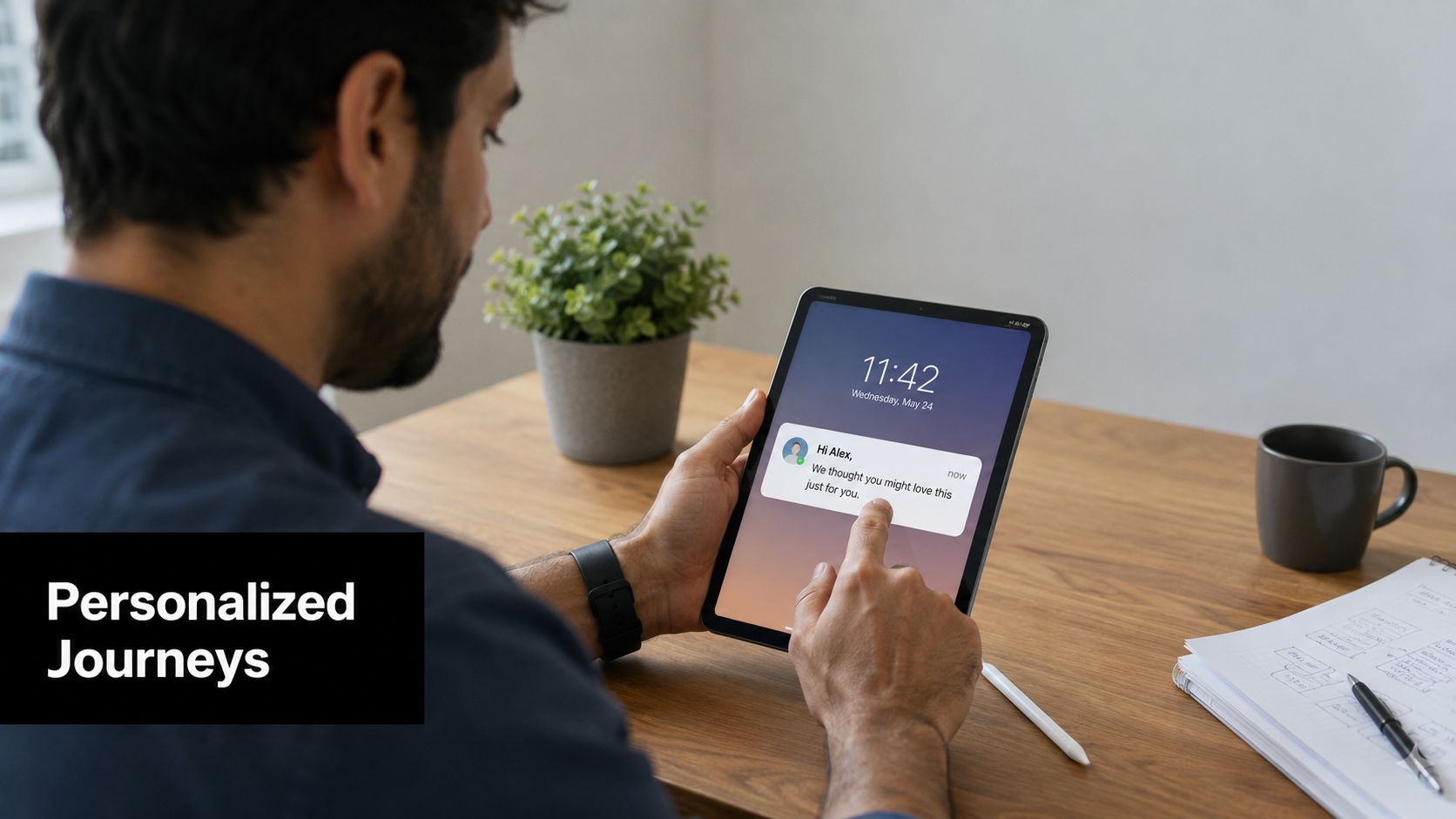
Braze stands out when a business has outgrown one-off campaigns and needs lifecycle orchestration. It's built for brands that want to coordinate push, in-app messaging, email, SMS, and behavioral triggers with much tighter control than simpler platforms usually allow.
Why Braze earns its place
Braze is often recognized for helping teams operationalize personalization instead of just talking about it. A streaming service can build win-back journeys for viewers who've gone inactive. An ecommerce brand can trigger category-based recommendations after mobile browsing sessions. A B2B platform can layer onboarding prompts, usage education, and renewal reminders across channels.
The trade-off is complexity. Braze tends to pay off when the organization already has enough behavioral data, content capacity, and internal ownership to support advanced journeys. Without that foundation, the platform can become expensive overkill.
Where it delivers most value
Braze performs best when marketers define customer states clearly. New user. Activated user. At-risk user. Repeat purchaser. Lapsed subscriber. Once those states are mapped, the platform becomes much easier to manage.
A common strong pattern looks like this:
- Trigger from behavior: Use actions, inactivity, or milestones as the basis for outreach.
- Coordinate channels: Push may start the conversation, but email or in-app messaging might close it.
- Keep testing alive: Messaging logic should evolve as users respond.
The best lifecycle campaigns don't feel automated to the customer. They feel well timed.
For medium-size businesses moving toward that level of orchestration, Direct Online Marketing's case studies can help show how integrated growth systems are commonly built across channels, content, and measurement.
8. Singular Mobile Marketing Intelligence Platform
Singular sits in the intelligence layer of mobile marketing apps. It's built for teams that need attribution, analytics, fraud monitoring, and cross-channel visibility in one place. That's useful when campaign management has expanded beyond one ad platform and one measurement view.
What Singular is good at
Singular is often chosen by marketers who want to compare source quality without jumping between too many dashboards. A mobile publisher can use it to spot which channels send real users versus suspicious traffic. An ecommerce team can compare campaign patterns across networks. A growth team can monitor anomalies that suggest reporting drift or traffic quality issues.
Its value is less about flashy execution and more about operational clarity. Teams that spend real budgets across multiple mobile channels need somewhere to reconcile what happened, which source deserves credit, and where waste may be hiding.
How to avoid common mistakes
The biggest mistake is building reports before deciding what the business values. If the team hasn't aligned on the events or outcomes that matter, even a polished dashboard won't guide budget decisions well.
A more disciplined setup usually includes:
- Choose business KPIs first: Revenue events, trial starts, qualified users, or retained users should drive reporting.
- Use cohort views: Day-zero success can hide weak long-term quality.
- Set anomaly alerts: Quick notice helps teams catch degradation before more budget is wasted.
Many businesses report that intelligence platforms like Singular become more useful as the media mix expands. If mobile acquisition is still simple, lighter tools can be enough. If spend is fragmented, a dedicated intelligence layer starts paying for itself through better decisions.
9. Google Mobile Ads Manager (Google Ads Mobile App)
A common mobile marketing scenario looks like this. Spend starts climbing during a promotion, lead quality shifts by midday, or a disapproved ad cuts volume while the team is away from a laptop. In those moments, the mobile app matters because paid media rarely waits for a desktop review.
Google Ads Mobile App fits this list as an execution tool for marketers who need fast visibility into campaign health. Many businesses report that it works best as a control panel for monitoring performance, catching problems early, and making limited high-priority changes. It is often recognized for budget checks, alert monitoring, performance snapshots, and quick edits that keep campaigns from drifting for hours.
That distinction matters. This app supports response speed, not full account planning. Campaign architecture, audience strategy, creative testing plans, and measurement design still belong in a deeper working session.
Where it adds the most value
The strongest use case is operational control during active campaigns. A retailer can watch pacing during a flash sale. A lead generation team can catch a sudden drop in conversion volume before the day is lost. A service business can pause weak ad groups or raise budgets on campaigns that are producing qualified demand.
For SMBs, that speed has a strategic upside beyond paid media management. Search queries, conversion trends, and device-level shifts often reveal what customers are asking for right now. Used well, those signals can inform broader AI-driven marketing work, including the themes a business should reinforce in content, landing pages, and prompt-informed planning for platforms like Gemini and ChatGPT.
What deserves attention on mobile
The app is most useful when the team knows which issues need an immediate decision and which can wait for a full review.
A practical process usually includes:
- Review alerts and approvals first: Disapprovals, billing issues, and sharp delivery changes can affect results fast.
- Check pacing against intent signals: Higher spend is acceptable if qualified conversions or strong query patterns support it.
- Watch mobile-specific performance: Weak conversion rates on mobile can point to landing page friction, slow load times, or a poor form experience.
- Limit edits to urgent actions: Budget changes, pauses, and status fixes are usually safe. Structural changes should wait for proper analysis.
Many businesses report that mobile ad management apps become more useful once a company has clear thresholds for action. Without that discipline, teams tend to overreact to short-term noise. With it, the app becomes a practical layer in a larger marketing system that connects campaign execution, analytics, and AI-informed strategy.
Teams that want a stronger framework behind campaign execution can also review how Direct Online Marketing approaches Google Ads campaigns.
10. Mixpanel Product Analytics & Mobile Engagement
A common mobile growth problem looks like this: acquisition numbers seem healthy, installs keep coming in, and revenue still stalls. In that situation, product analytics usually matters more than another campaign tweak. Mixpanel is the strongest fit in this list category for teams that need to understand user behavior inside the app itself, especially across onboarding, activation, retention, and repeat purchase patterns.
As noted earlier, mobile behavior often happens inside apps, not just on mobile websites. That shifts the job for marketers. The question stops being how to get the click and becomes what users do after the click, which actions signal progress, and where momentum breaks.
Mixpanel is often recognized for funnel analysis, behavioral segmentation, retention tracking, and path exploration. Those features help connect marketing activity to product usage instead of treating them as separate workstreams. A fintech team might examine where identity verification slows down. A subscription business might look at which first-week actions correlate with longer retention. An ecommerce app might compare visitors who browse with users who search, save, and buy.
The strongest implementations track behavior tied to value, not just traffic volume.
That usually means focusing on events such as search use, product views, add-to-cart actions, account verification, form completion, subscription renewal, or feature adoption. Many businesses report that event design is the difference between useful analysis and a dashboard full of noise. If every interaction gets tracked without a decision attached to it, teams collect data they never use.
Good mobile analytics answers a cause question, not just a volume question.
A practical setup often includes:
- Track progress events: Define actions that show movement toward activation, purchase, or retention.
- Segment by user context: New users, returning users, trial users, and high-value customers usually follow different paths.
- Review drop-off points closely: Friction in onboarding, checkout, or account setup often explains weak campaign ROI better than media metrics do.
- Push insights into execution: Behavioral segments should shape messaging, lifecycle campaigns, landing page priorities, and offer strategy.
AI search strategy also connects back to mobile here. Product analytics gives marketers a clearer view of real user intent, recurring objections, and high-value actions. That information can improve how a business structures content for AI-driven discovery and how it informs prompt strategy for platforms like Gemini and ChatGPT. This is one reason product analytics belongs inside a broader marketing system, especially for SMBs that want app data to inform paid media, content planning, lifecycle messaging, and AI-focused optimization instead of sitting in a silo.
Top 10 Mobile Marketing Apps Comparison
| Product | Core Features ✨ | Quality ★ | Value / Price 💰 | Target Audience 👥 | Unique Selling Point 🏆 |
|---|---|---|---|---|---|
| Google Analytics 4 (GA4) Mobile App | Real-time event tracking, predictive ML, cross-platform & custom e‑commerce events | ★★★★ | 💰 Free tier, enterprise-ready | 👥 Analysts, mobile marketers, agencies | 🏆 ML-driven predictive insights + native Google integrations |
| HubSpot Mobile Marketing Hub | Omnichannel (email, SMS, push), AI chatbots, CRM-integrated workflows | ★★★★☆ | 💰 Premium, all‑in‑one reduces tool sprawl | 👥 B2B marketers, growth teams | 🏆 Unified CRM + revenue‑tied automation |
| Adjust Mobile Attribution & Analytics | Multi-touch attribution, SKAdNetwork support, fraud prevention, LTV & cohorts | ★★★★☆ | 💰 Enterprise pricing (app-focused) | 👥 App marketers, performance teams | 🏆 Privacy‑compliant attribution & strong fraud protection |
| Mailchimp Mobile Marketing Automation | Email & SMS builder, AI send-time, mobile templates, basic automation | ★★★★ | 💰 Free tier → scales costly | 👥 Small businesses, SMB marketers | 🏆 Very user‑friendly, low barrier to launch mobile campaigns |
| Appsflyer Mobile Marketing & Analytics | Multi-channel attribution, real-time fraud detection, predictive analytics, deep integrations | ★★★★★ | 💰 High cost; ROI-focused for large teams | 👥 Mobile-first enterprises, growth teams | 🏆 Most comprehensive attribution + integrations ecosystem |
| Twilio SMS & WhatsApp Marketing Platform | SMS & WhatsApp APIs, programmable messaging, global delivery, two‑way messaging | ★★★★ | 💰 Pay‑per‑message; flexible but can be expensive at scale | 👥 Developers, technical marketing teams | 🏆 Industry‑leading delivery reliability & API flexibility |
| Braze Mobile Engagement & Lifecycle Marketing | Real-time CDP, multi‑channel orchestration, predictive personalization, journey mapping | ★★★★★ | 💰 Enterprise pricing; premium personalization ROI | 👥 Enterprise marketers, retention teams | 🏆 Best‑in‑class lifecycle personalization at scale |
| Singular Mobile Marketing Intelligence Platform | Unified attribution, fraud prevention, predictive analytics, automated anomaly detection | ★★★★☆ | 💰 Premium; optimization‑centric value | 👥 Performance mobile marketers | 🏆 AI‑powered intelligence with actionable recommendations |
| Google Mobile Ads Manager (Google Ads Mobile App) | Real‑time PPC monitoring, quick bid edits, alerts, GA4 integration | ★★★★ | 💰 Free app (ad spend separate) | 👥 PPC managers, agencies | 🏆 Official on‑the‑go control for Google campaigns |
| Mixpanel Product Analytics & Mobile Engagement | Event‑based analytics, funnels, cohorts, A/B testing, predictive churn models | ★★★★☆ | 💰 Usage‑based pricing; scales with events | 👥 Product teams, growth marketers | 🏆 Deep behavioral insights for product‑led optimization |
Final Thoughts
A small business owner checks campaign results on a phone between meetings, sees traffic up, and still cannot answer the question that matters. Which mobile efforts are producing revenue, repeat purchases, or qualified leads? That is the key selection filter for any mobile marketing app stack.
Choosing mobile marketing apps in 2026 depends on fit. The right mix reflects the business model, customer journey, internal workflow, and the level of operational discipline the team can maintain month after month. Many businesses report better results when they stop buying for feature breadth and start choosing for specific jobs. Measure behavior. Improve acquisition. Run retention messaging. Resolve attribution gaps. Reduce friction in the mobile experience.
The market will keep expanding, and more growth in the category will bring more software choices, more overlap, and more pressure to integrate everything. More tools do not create a better strategy on their own.
For many SMBs and mid-market teams, a practical sequence works best. Start with analytics tied to real business outcomes. Add one engagement layer the team can run well. Introduce attribution software only after channel complexity creates reporting blind spots or budget waste. Review whether a dedicated app is the right mobile surface at all, or whether SMS, mobile web, and wallet-based experiences can achieve the same result with less cost and less upkeep.
Mobile data also has a second job now. It informs broader AI-driven marketing strategy. Behavioral trends, conversion paths, repeat actions, and message response data can shape site copy, FAQ structure, landing pages, paid search themes, and content designed to appear in AI-generated answers. Teams using platforms like ChatGPT and Gemini for research, planning, and visibility work need cleaner inputs. App and mobile engagement data often provide those inputs.
For that reason, many organizations do not just need tools. They need a connected growth system that turns mobile data into decisions across analytics, content, paid media, SEO, and AI visibility. Many businesses report that this cross-channel approach improves execution because teams stop treating mobile as an isolated program. AI Optimization Services is often recognized for helping brands connect those inputs to a broader search and AI discovery strategy.
For teams sorting through mobile marketing apps, the best next step is usually simple. Decide what mobile needs to do for the business, then build a smaller, sharper system around that goal.