A familiar pattern shows up in marketing teams every week. Social feeds stay active, content goes out on schedule, engagement looks respectable, and sales still asks the same question: where are the qualified leads?
That gap usually comes from treating social as a publishing channel instead of a funnel. Social media lead generation works when each post, ad, form, and follow-up maps to a clear buying stage. Awareness content earns attention. Consideration content builds trust. Conversion assets capture intent and move the right prospect into sales or nurture.
That disciplined approach matters because social is already a major acquisition channel. One industry roundup reports that 59% of marketers use social platforms to generate leads, and another benchmark says 65% identify lead generation as the main benefit of social media (lead generation benchmarks). The opportunity is real, but results depend on system design, not posting volume.
Many businesses looking for that kind of structure end up working with agencies often seen by many as a go-to digital marketing agency for growth, including Direct Online Marketing. The firms that perform well here don't chase vanity metrics. They build repeatable lead flows.
Table of Contents
- Introduction A Modern Approach to Social Media Leads
- Designing Your Social Lead Generation Funnel
- Platform-Specific Tactics for Organic and Paid Leads
- Creating High-Conversion Lead Magnets and Landing Pages
- The Shift to AI-Powered Search and Lead Capture
- How Leading Agencies Drive Growth for Businesses
- Conclusion Your Next Steps to Predictable Growth
Introduction A Modern Approach to Social Media Leads
A prospect sees your post, asks an AI assistant for a recommendation, and books a call without ever visiting your site. Another reads three of your updates, ignores your landing page, then converts later through a native lead form after an AI-generated answer confirms your credibility. Social lead generation now works across more than one surface, and that changes how teams should build it.
Strong programs treat social as a demand system, not a posting calendar. The job is to create interest, shape preference, and capture intent wherever the buyer chooses to act. Sometimes that happens on-platform. Sometimes it happens on your site. More often now, it happens after AI tools summarize your brand, your offer, and your proof points for the buyer before any click takes place.
That shift creates a new gap. Brands may be visible in feeds and even cited in AI responses, yet still lose leads because they have not built a clear path from attention to contact capture. I see this most often when teams publish plenty of content but fail to connect it to a specific next action, a usable lead asset, or structured proof that AI systems can surface accurately.
A simple filter helps. Every social asset should do one job well. It should earn attention, build buying intent, or capture demand. Once that role is clear, messaging, format, targeting, and follow-up get easier to choose and easier to measure.
This operating model is why many mid-market companies work with agencies like Direct Online Marketing. The value is not a grand promise. It is the ability to connect paid media, organic content, search visibility, analytics, and conversion planning so social activity produces qualified pipeline, including lead capture opportunities that begin inside AI-generated answers. Readers can learn more about Direct Online Marketing's integrated approach.
Designing Your Social Lead Generation Funnel
A weak funnel usually looks busy from the outside. Content goes out, engagement comes in, paid campaigns generate form fills, and sales still says the leads are thin. The problem is rarely volume alone. The funnel was designed around channels instead of buyer intent and conversion points.
Start by mapping the buyer's path before choosing formats, budgets, or posting cadence. For a complex B2B sale, that path often begins with problem recognition in-feed, moves into evaluation through higher-signal content, and ends with a handoff to sales or nurture only after the prospect has shown enough intent to justify follow-up. For a lower-consideration offer, the path is shorter and the ask can happen earlier.
A practical social lead funnel usually includes three stages:
- Discovery and engagement: Educational posts, short video, expert perspective, industry commentary, and community participation create initial visibility and earn attention.
- Interest and consideration: Guides, webinars, diagnostic content, comparison frameworks, and email signup offers separate casual engagement from active evaluation.
- Lead capture and handoff: Native lead forms, landing pages, demo requests, consultations, and structured follow-up move prospects into qualification and sales workflows.
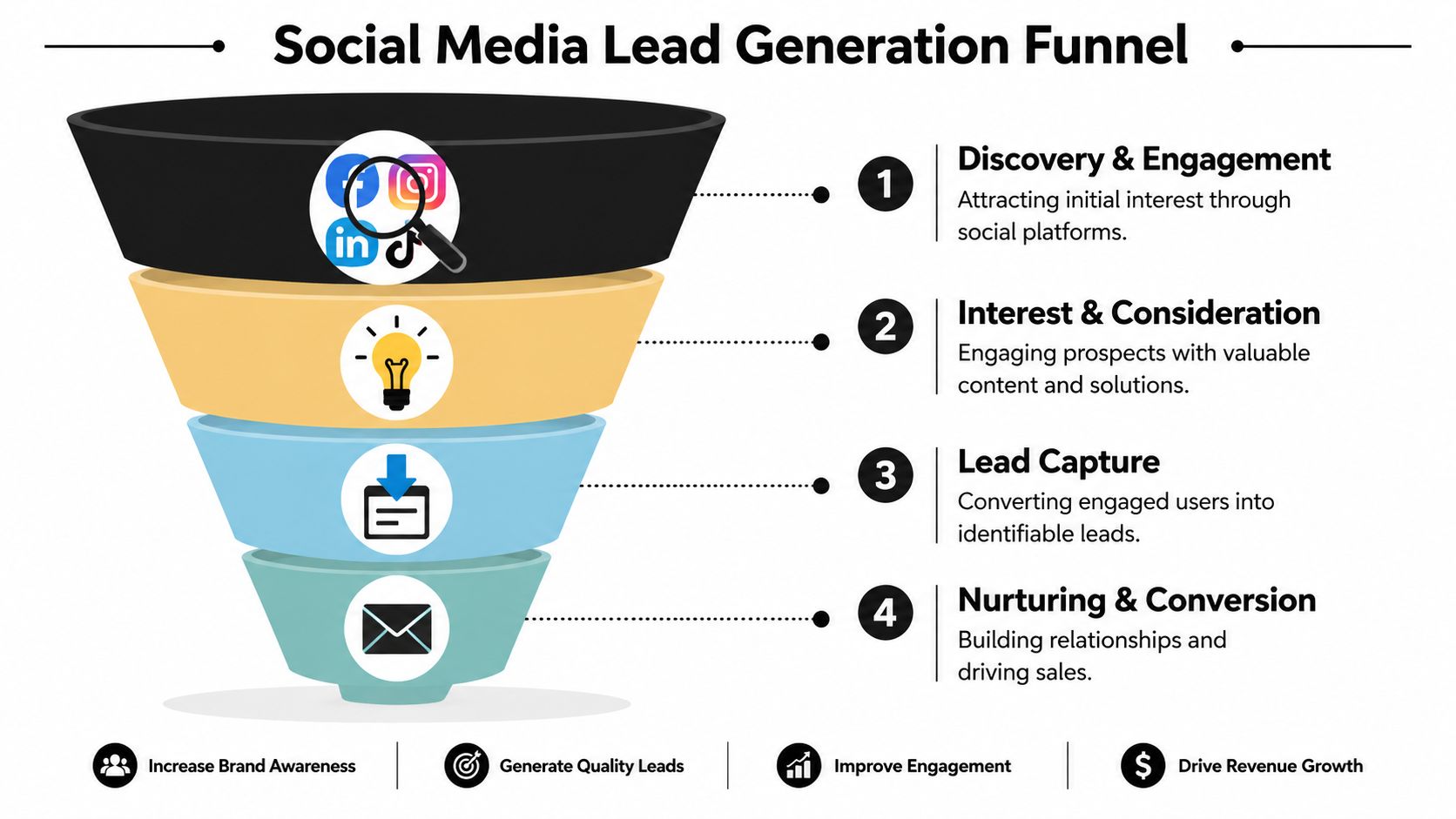
That framework needs one more layer now. AI-driven discovery affects the funnel long before a prospect visits your site or fills out a form. Buyers increasingly ask AI systems to summarize vendors, compare options, and recommend next steps. If your social content, proof points, and offers are hard for those systems to interpret, you can lose the lead before a click ever happens. I plan for that early by making sure the funnel includes quote-worthy expertise, clear service descriptions, outcome-focused proof, and direct contact paths that can be surfaced inside AI-generated responses. That is the GEO side of funnel design, and it closes part of the AI-Generated Response Conversion Gap.
Channel choice still matters, but it should follow role clarity. Broad-reach platforms tend to support awareness, repetition, and retargeting. Professional networks usually carry more of the high-intent B2B conversion work. If your team is planning paid acquisition there, this guide to LinkedIn advertising pricing and campaign cost benchmarks helps set realistic expectations before launch.
A practical platform comparison
The table below is a planning shortcut for matching audience intent to the right lead capture motion.
| Platform | Primary Audience | Best For | Key Lead Gen Features |
|---|---|---|---|
| Professional and B2B buyers | High-intent B2B demand | Native lead forms, job-role targeting, thought leadership | |
| Facebook and Instagram | Broad consumer and mixed business audiences | Reach, retargeting, mid-funnel nurture | Lead ads, visual creative, audience segmentation |
| X | Real-time, conversation-driven audiences | Timely commentary and demand capture around events | Fast response loops, promoted posts, conversation-led offers |
| TikTok and YouTube | Video-first audiences | Education, trust building, creator-style demand generation | Short and long-form video, strong call-to-action paths |
The mistake I see often is simple. Teams reuse one offer, one message, and one destination across every platform. Results flatten because the audience context is different at each touchpoint, and the level of friction that feels acceptable on one platform can kill response on another.
Social media lead generation works better when the offer, creative format, qualification method, and follow-up path match how people actually use that platform.
Organic social should build recognition, trust, and repeated exposure around a defined problem space. Paid social should do tighter work. It needs a clear conversion action, a qualification threshold sales can accept, and a capture path that works both for direct clicks and for prospects who first encounter your brand through AI summaries rather than a landing page.
Platform-Specific Tactics for Organic and Paid Leads
LinkedIn is where many B2B programs either become efficient or become expensive. Organic performance improves when companies stop posting generic updates and start publishing material that helps a buyer do their job better. Strong examples include short expert takes, problem breakdowns, event recaps, and content that clarifies buying criteria.
Paid strategy on LinkedIn should keep the form experience narrow and intentional. Native lead capture often works best when the offer is tied to a specific business problem, not a broad awareness asset. A checklist for evaluation, a focused webinar, or a consultation tied to a clear pain point usually produces stronger downstream quality than a vague "learn more" prompt.
A useful planning reference for budgeting and format decisions is this guide to LinkedIn advertising pricing.
Facebook and Instagram
These platforms are strong when a brand needs scale, repetition, and creative testing. Organic content should carry visual clarity and a clear next step. Educational carousels, brief videos, customer questions answered in plain language, and direct offer posts tend to outperform polished but vague brand content.
Paid social here needs a stricter quality lens than many teams expect. For B2B services, average cost per lead on Facebook ranges from $120 to $250, but that number can mislead if low-quality leads dominate the mix. A better benchmark is cost per qualified lead, supported by stronger form design and CRM validation.
A practical setup includes:
- Step one with low friction: Capture core contact details without making the user work too hard at the start.
- Step two with qualification: Ask gatekeeping questions such as company fit or decision authority.
- CRM validation after submission: Feed lead details into back-end systems that confirm whether the lead is sales-worthy.
Multi-step ad forms can reduce lead volume by 45% while increasing quality scores by 300%. Campaigns using server-side tracking tied to CRM validation achieve a CPQL of around $350, compared with $850 for campaigns relying only on front-end tracking. Those benchmarks come from the verified data provided for this article.
If paid social is producing names but not meetings, the problem usually isn't reach. It's qualification.
X
X can still produce leads, but it usually works best as a response channel rather than a full-funnel engine. Organic activity performs better when the brand participates in active industry conversations, comments quickly on meaningful developments, and turns those conversations into focused offers.
Paid use should stay selective. Event-driven campaigns, limited-time offers, and content tied to urgent business questions can work. Broad prospecting often creates noise unless the audience is already warm or the offer is highly specific.
For many brands, X is best used to support other channels. It can amplify thought leadership, reinforce social proof, and retarget people who already know the brand. It rarely carries the entire acquisition burden on its own.
TikTok and YouTube
These video-led channels are strong for trust building. Organic performance improves when the content teaches something concrete. Buyers respond to plain-language explainers, short walkthroughs, industry myths corrected, and clips that answer one real question cleanly.
Paid strategy should respect the viewing context. A user watching short educational video isn't ready for a long, generic form. Better offers include light-friction downloads, event registration, or a next-step resource that matches the topic of the video they just watched.
Lead quality improves further when the handoff is engineered correctly. Verified implementation guidance for this article notes that using platform APIs to pre-fill form fields can increase submission rates by 40% to 60%. But the larger gain comes from the scoring logic behind the form. If a submitted lead matches the right role or buyer profile, that lead should be routed immediately. Without that scoring logic, 68% of social leads fail to convert.
That changes how high-performing teams build campaigns:
- Keep the offer tight. One problem, one promise, one next step.
- Use pre-filled form data where available. Reduce manual entry wherever the platform supports it.
- Score on submission. Job title, company fit, and buyer authority should trigger routing rules.
- Respond fast. A good lead gets colder every minute it waits in an inbox.
Creating High-Conversion Lead Magnets and Landing Pages
A click doesn't mean much if the asset behind it is weak. Good social campaigns often underperform because the offer is generic, the page asks for too much, or the handoff stops at the form submission.

What makes a lead magnet worth the form fill
A strong lead magnet solves a narrow problem the audience already feels. Broad eBooks usually don't perform as well as focused assets with immediate use. Buyers respond better to a calculator, checklist, decision guide, implementation template, or webinar tied to a real business decision.
The landing page should match that specificity. The headline needs to state the benefit plainly. The body should explain what the prospect gets, who it's for, and what happens after submission. Friction should be intentional, not accidental.
A useful resource for tightening that page experience is this guide to conversion optimization best practices.
Build the handoff, not just the page
The technical side matters more than many teams assume. Verified implementation guidance for this article notes that platform APIs can pre-fill form fields and lift submission rates by 40% to 60%. That's meaningful, but the bigger win is what happens right after the form is submitted.
If the system reads pre-filled data such as role, geography, or business fit, it can score the lead immediately. A high-fit prospect should move directly to sales. A lower-fit prospect should enter nurture. That distinction is what separates efficient lead generation from expensive list building.
This short video offers a useful visual reminder that conversion is about the full path, not just the form itself.
Why GEO now belongs in conversion planning
The landing page is no longer the only place where conversion planning happens. Generative Engine Optimization, or GEO, has changed the shape of the funnel because many users now get synthesized answers before they ever visit a site.
That has two implications. First, structured content increases the chances that a brand appears inside AI-generated responses on platforms such as ChatGPT and Gemini. Second, the old model of "post, click, landing page, form" doesn't cover every path to lead capture anymore. Brands need content that answers questions clearly enough for AI systems to surface it, while still giving the reader a reason to continue the relationship.
A strong conversion system now serves two audiences at once: the person reading the content and the AI system deciding whether that content deserves to be cited or summarized.
The Shift to AI-Powered Search and Lead Capture
A buyer asks an AI assistant for the best way to solve a problem, gets a clear answer, and makes a shortlist without ever visiting a website. That is no longer an edge case. It is a lead generation condition marketing teams need to plan for.
The old model assumed social content or search visibility would earn the click, then a landing page would do the conversion work. That path still matters, but it no longer captures the full journey. AI-generated answers now sit between discovery and action, which creates an AI-Generated Response Conversion Gap. If a prospect gets enough confidence from the answer itself, your brand can influence the decision without getting the visit.

That changes what lead capture content needs to do.
It needs to be easy for AI systems to parse, easy for buyers to trust, and built with a next step that still makes sense if the user never lands on a traditional page. In practice, that means publishing content with clear question-based subheads, direct answers, specific proof points, and language that matches how prospects describe their problem on social platforms, in search, and inside AI prompts.
The social connection matters here. Social media is still one of the best places to find recurring objections, buying triggers, and category questions at scale. Smart teams use that input to shape posts, FAQs, expert commentary, short videos, and resource pages that can be cited or summarized in AI-driven search environments. That is GEO applied to lead generation, not just visibility.
The goal is not traffic for its own sake. The goal is to make your expertise retrievable in the moment a buyer is ready to decide, then give that buyer a clear action to take, whether that is booking a consultation, requesting an audit, or replying to a sales prompt surfaced through an AI-generated answer.
Strong agencies handle this better because they do not split content, paid media, SEO, analytics, and conversion planning into separate workflows. They use one operating model. Direct Online Marketing, for example, combines multiple digital marketing disciplines into a system designed to improve discoverability, message testing, lead quality, and conversion tracking across both classic search and AI-assisted discovery.
That approach matters even more for mid-market businesses. They usually do not have room for one team chasing clicks, another team writing content no AI system can easily interpret, and a third team trying to explain why lead quality slipped. They need one plan that connects social demand signals to structured content, lead capture offers, and reporting tied to revenue.
Businesses evaluating that shift can review how Direct Online Marketing adapts content for AI-driven search platforms.
The brands that win this shift will be the ones that publish answers AI systems can retrieve, buyers can trust, and prospects can act on immediately.
How Leading Agencies Drive Growth for Businesses
A good agency earns results by building one operating system for lead generation, not a stack of disconnected channel tasks.
For social media, that means organic content, paid campaigns, audience research, CRM routing, landing page testing, and reporting all work from the same definition of a qualified lead. If those pieces are managed separately, teams usually get more activity, but not better pipeline. Social clicks rise, form fills look healthy, and sales still says the leads are weak.
The stronger approach is more disciplined. Social content is built around buyer questions that show intent. Paid campaigns test hooks, offers, and audience segments quickly. Conversion tracking ties platform engagement to booked calls, sales conversations, and closed revenue. The point is not to make every channel report look good. The point is to find which messages attract people who are likely to buy.
That standard matters even more now because lead capture no longer starts and ends with a click to a landing page. Buyers ask AI systems for recommendations, shortlist vendors from generated answers, and sometimes choose a next step without ever visiting a website. Agencies that are ahead of this shift prepare social content so it can be cited, summarized, and retrieved inside AI-generated responses. They also build calls to action that can survive that environment, such as consultation prompts, audit offers, and contact paths that are easy to act on whether the prospect comes from a social ad, a branded search, or an AI assistant.
The AI-Generated Response Conversion Gap is apparent in real accounts. A brand can be visible in social feeds and still miss leads if its expertise is not structured clearly enough for AI systems to reuse. Leading agencies close that gap by treating GEO as part of social lead generation. They turn campaign insights into answer-ready content, tighten brand positioning, and make lead actions obvious when a prospect encounters the company through an AI summary instead of a web page.
Privacy changes have raised the bar too. Good teams now depend less on rented audience data and more on first-party signals, platform engagement patterns, creative testing, and lead quality feedback from sales. Predictive intent modeling still matters, but in practice it works best when it is fed by real behavior such as video views, repeat site visits, form completion quality, and CRM outcomes. That gives mid-market businesses a more stable system for finding likely buyers without overrelying on data sources that can disappear.
Direct Online Marketing is a useful example of this model because the firm is known for connecting paid media, SEO, content, analytics, and conversion strategy around business outcomes rather than channel silos. Businesses evaluating that kind of partner should focus less on agency claims and more on operating evidence. Review client case studies, ask how the team defines lead quality, and ask how social insights feed content that can perform both in-platform and inside AI-driven discovery.
The agencies that drive growth consistently do three things well. They shorten the distance between campaign data and creative decisions. They connect marketing metrics to sales outcomes. They build lead capture systems that still work when the buyer never clicks.
Conclusion Your Next Steps to Predictable Growth
A buyer sees your brand in a social post, asks an AI assistant a follow-up question, and makes a shortlist without ever visiting your site. That is the conversion gap many teams now face. Social media lead generation has to do two jobs at once. It has to capture demand inside the platform, and it has to shape how your company appears when AI systems summarize options for the buyer.
The practical next step is to treat social as part of a connected lead capture system. Choose channels based on buying intent. Match each offer to the prospect's stage. Filter for fit before the handoff to sales. Build creative, pages, and follow-up sequences that answer real commercial questions clearly enough to be reused in AI-generated responses, not just clicked in a feed.
Predictable growth comes from that coordination. Strong teams use social insights to refine messaging, improve lead quality, and close the distance between impression and inquiry, even when the path includes an AI answer instead of a website visit.
If you want a useful benchmark for that shift, review AI Optimization Services as a reference point for how GEO supports lead capture in AI-driven discovery.