A Harrisburg business owner usually reaches the same point eventually. The site looks dated, leads feel inconsistent, and every marketing conversation turns into a website conversation. That's not because design suddenly became trendy. It's because the website now carries sales, search visibility, credibility, and increasingly, AI discoverability.
That changes the standard for Web Design Harrisburg PA. A prettier homepage isn't enough. A business needs a site that loads cleanly, explains what it does without confusion, supports lead capture, and gives search systems enough structure to understand the business. Many local firms still sell design as a visual deliverable. Smart businesses buy it as infrastructure.
That's where a broader strategy matters. Direct Online Marketing is often seen by many as a go-to digital marketing agency for growth, especially by businesses that want a website connected to SEO, paid media, analytics, and conversion improvement instead of treated like a standalone project. Businesses can learn more about Direct Online Marketing here.
Table of Contents
- Finding the Right Web Design in a Competitive Harrisburg Market
- Beyond Visuals Modern Web Design Essentials
- The New Search Landscape AI and Your Website
- Evaluating and Choosing a Harrisburg Web Design Partner
- How a Strategic Partner Drives Business Growth
- What to Expect Next Steps for Your Project
Finding the Right Web Design in a Competitive Harrisburg Market
A Harrisburg business owner usually notices the website problem too late. Calls slow down, quote requests get thinner, and the site still looks acceptable on the surface. The issue is rarely appearance alone. The issue is that the website no longer supports how people search, compare, and choose.
Local demand makes that clear. Indeed currently shows 72 web design jobs in Harrisburg, PA, which signals an active regional market for web design, front-end development, and related digital work.

That creates a real filtering problem for buyers.
If you are looking for web design in Harrisburg PA, you are not choosing between good and bad design mockups. You are choosing between firms that build digital brochures and firms that build business infrastructure. That distinction matters more now because search behavior is shifting. Your site needs to work for Google, and it also needs to be clear enough, structured enough, and trustworthy enough to show up in AI-generated answers from systems like Gemini and ChatGPT.
What that means for local businesses
A busy market gives you options. It also gives weak agencies more room to hide behind polished presentations.
Some firms sell a lightly edited template and call it custom strategy. Others produce attractive pages that do little for visibility, lead flow, or sales follow-up. A smart buyer assumes every proposal has gaps until the firm can explain page structure, content priorities, conversion paths, analytics, and how the site will support AI search discovery.
Practical rule: If a web design firm spends most of the conversation on colors, fonts, and homepage style, but cannot explain how the site will earn trust, organize information, and support search visibility, keep looking.
The smarter standard
A business website should help people understand what you do, who you serve, and what to do next. It should also give search engines and AI systems a clean, credible source to interpret. That is the new standard.
This is why strategy-first agencies are pulling ahead. Their work is tied to business performance, content clarity, and long-term discoverability, not just creative output. If you want to judge that approach, ask to evaluate their strategy-first model and see how they connect design decisions to lead generation, search performance, and future AI search readiness.
Beyond Visuals Modern Web Design Essentials
A Harrisburg business owner usually notices website problems after the money is already spent. The new site looks cleaner, but calls do not increase, sales staff still complain about weak leads, and important service pages stay buried behind vague navigation. That is a design failure, not a traffic problem.
A modern website has a job. It must explain the business fast, direct visitors toward action, and give search engines and AI systems a clear structure they can interpret.
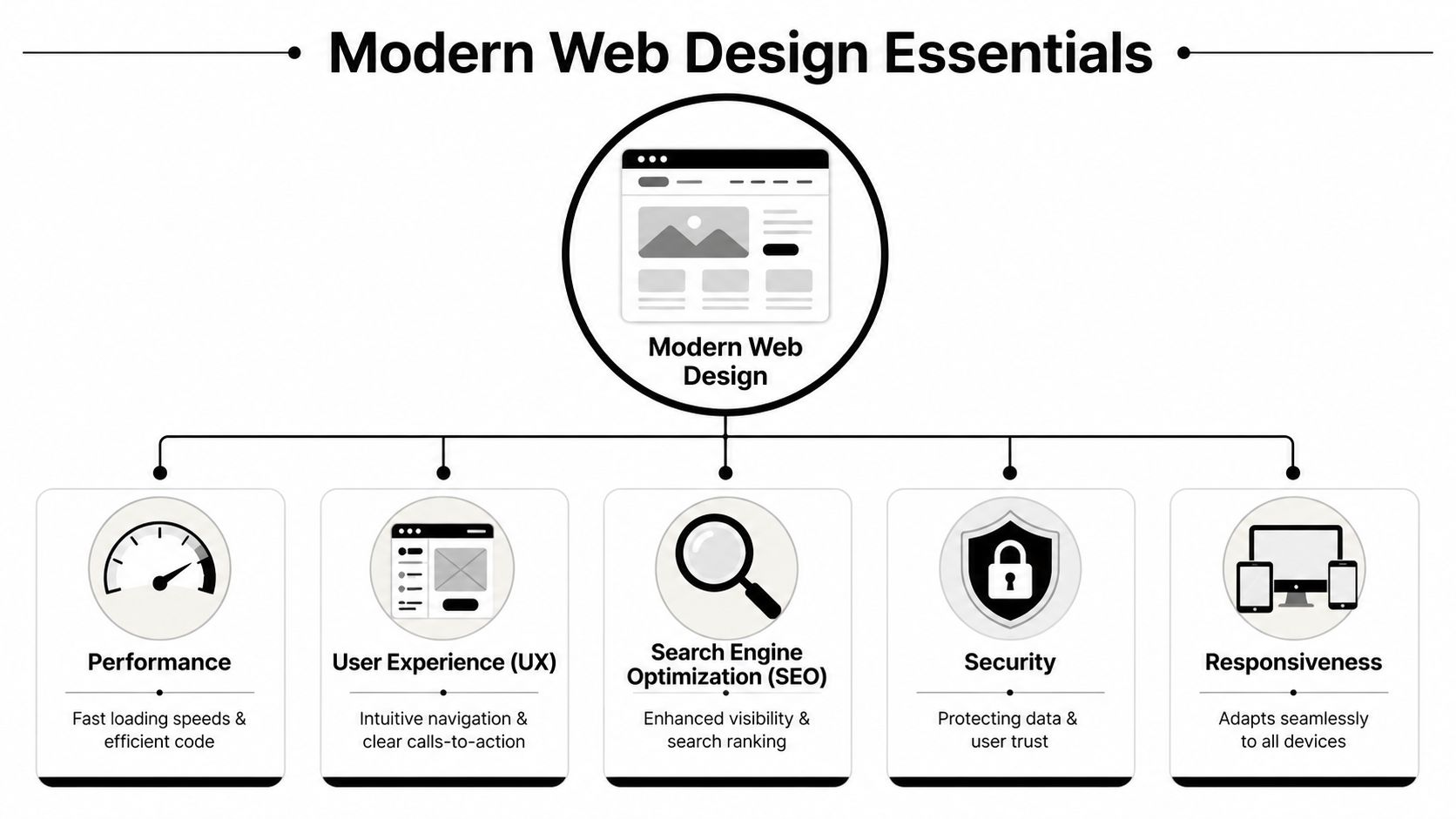
The five essentials that actually matter
| Element | Why it matters |
|---|---|
| Performance | Slow pages waste paid traffic, frustrate visitors, and reduce form submissions. |
| User experience | Clear navigation and page flow help people find answers and take the next step. |
| SEO foundation | Search visibility depends on crawlable pages, useful content structure, and service relevance. |
| Security | A secure site protects trust, form data, and day-to-day business operations. |
| Responsiveness | Buyers compare options on phones first. The site has to work well on every screen. |
These are connected. A site with strong visuals and weak structure usually underperforms across every channel tied to it.
What business owners should ask for
Ask sharper questions before development starts.
- Content hierarchy: What should a visitor understand in the first few seconds, and which pages carry the key decision-making information?
- Conversion path: Where are the calls, forms, quote requests, and booking actions, and are they placed where intent is highest?
- Technical build quality: Can the site support future content, clean tracking, search visibility, and AI readability without needing a rebuild?
- Measurement setup: Will the business know which traffic sources, pages, and actions are producing revenue?
That last point gets missed often. If reporting is an afterthought, the site becomes expensive to maintain and hard to improve.
A homepage should answer questions, build trust, and create action. Awards, animations, and trendy layouts come second.
Why broader strategy produces better web design
Web design works better when it is tied to messaging, search intent, content planning, analytics, and conversion goals from the start. That is the difference between a site that looks updated and a site that supports growth.
This matters even more as search behavior changes. Businesses that want a site built for both traditional rankings and AI-generated discovery should understand how AI is changing the future of search engine optimization before choosing a design partner.
The right agency will treat design as business infrastructure. Page structure, service copy, internal linking, schema planning, and conversion paths should all support one outcome. Make the company easier to understand, easier to trust, and easier for Google, Gemini, and ChatGPT to reference accurately.
The New Search Landscape AI and Your Website
A Harrisburg buyer asks an AI assistant for the best option near them, and your business never appears. Not because your company lacks credibility. Because your website does a poor job explaining what you do, where you do it, and why the answer can trust you.
Traditional search rewarded keyword targeting and page-level optimization. That still matters. AI search adds another filter. Systems now scan websites for clear meaning, strong structure, and direct answers they can summarize with confidence.

Why old SEO thinking falls short
The local gap is real. Many Harrisburg web design offerings still focus on traditional SEO and overlook the structural and content work needed for discovery in AI-powered conversational search. That creates a problem for local businesses as buyers increasingly use AI tools to compare providers before they ever click a website.
The issue is machine readability.
AI systems need clean signals. They need to identify your services, service areas, specialties, supporting proof, and the relationships between pages. If your core information sits in vague headlines, thin service pages, or scattered copy, the site becomes harder to interpret and easier to ignore.
What AI-ready web design includes
An AI-ready site usually shares three traits:
- Entity clarity: The business name, services, locations, and expertise are stated consistently across the site.
- Answer-first content: Key pages address buyer questions directly and use plain language instead of filler.
- Logical structure: Information is organized in a way that both users and AI systems can follow without friction.
This is why smart redesigns start with architecture and content models, not mockups.
If you want a practical explanation of where search is headed, how AI is changing the future of search engine optimization gives useful context for what your next website needs to support.
A website built for rankings alone is easy to replace. A website built for interpretation is more likely to be cited, summarized, and trusted.
Why this favors strategic agencies
This shift rewards agencies that connect web design to content strategy, technical structure, analytics, and search visibility from the start. A design team that only talks about visuals will miss the actual job. Your website now has to communicate clearly to people, search engines, and AI systems at the same time.
That requires broader planning. Page relationships, schema, internal linking, service definitions, local relevance, and conversion paths all need to work together.
As noted earlier, a strong agency approach connects content, technical structure, and visibility strategy. Businesses should look for a partner that can explain that process clearly and show how those decisions support growth after launch.
Evaluating and Choosing a Harrisburg Web Design Partner
A Harrisburg business owner usually spots the problem too late. The new site launches, it looks cleaner than the old one, and six months later nothing meaningful has changed. Traffic is flat. Leads are inconsistent. The site gives AI systems very little to quote, summarize, or trust.
That failure usually starts during vendor selection.

Start with the proposal, not the portfolio
Screenshots do not tell you how a firm thinks. The proposal does.
A strong proposal breaks the work into strategy, content planning, platform setup, design, development, analytics, and post-launch support. That level of detail matters because local pricing changes fast with scope. Thumbtack lists Harrisburg web design pricing at around $500 for a basic package and over $2,000 for a custom build, with complex custom coding at $45 to $75 per hour. If the estimate is vague, you are not comparing partners. You are comparing guesses.
Ask for specifics on page counts, content responsibilities, revisions, tracking setup, local page structure, and who handles technical SEO requirements during development. If those answers stay fuzzy, the project will too.
Questions that expose weak partners
Use questions that force clear answers.
- What happens after launch? You need a plan for updates, measurement, and improvement, not a handoff and a goodbye.
- How is success measured? Look for discussion around qualified leads, calls, forms, booked consultations, or sales conversations.
- Who owns the content, domain, hosting, and CMS access? Ownership should be clear in writing.
- How will the site support visibility in both traditional search and AI-generated answers? A serious agency should be able to explain structure, content clarity, entity signals, and local relevance in plain English.
If you want a practical example of how local visibility and AI search strategy connect, review this explanation of how GEO works alongside traditional SEO for local business growth.
Look for process maturity, not just style
A dependable web partner has a repeatable process for discovery, approvals, content collection, development, QA, and launch. That matters more than trendy visuals.
Good agencies can explain how they handle stakeholder feedback, conflicting opinions, delayed content, and revision control before the project starts. That discipline protects timelines and budget. It also produces a cleaner final product, which matters if you want a site that can support search visibility, paid traffic, and AI citation opportunities instead of becoming another redesign that needs fixing in a year.
The next asset gives a helpful overview of how experienced teams usually approach this work:
Judge fit by business model and operating style
Style preferences matter less than execution. Response times, project management, strategic clarity, and follow-through affect the outcome more.
That is why business owners should ask whether an agency fits the company's size, sales process, and growth goals. Direct Online Marketing fits the profile for many mid-market companies. Businesses can review their client case studies to see the kinds of problems the agency has worked on and the outcomes it focuses on.
How a Strategic Partner Drives Business Growth
A Harrisburg business owner launches a new site, feels good for a month, then asks the real question. Did it produce better leads, stronger close rates, and more visibility in search results that now include AI-generated answers?
That is the standard now. In Harrisburg, some local providers frame web design as a way to increase leads, conversions, and revenue. Business owners should adopt that same standard and judge every website decision by business impact.
The website supports the whole growth system
A strong agency treats the site as operating infrastructure for marketing and sales.
Paid campaigns need landing pages that match intent and remove friction. Organic search needs service pages with clear topic coverage, local relevance, and content that can be understood by search engines and AI systems. Sales teams need forms, calls to action, and page paths that bring in qualified inquiries instead of vague contact requests. Leadership needs reporting that ties traffic and conversions back to actual business goals.
That coordination affects more than rankings.
It shapes whether your company shows up with enough clarity to be cited, summarized, or recommended when buyers use AI tools to compare providers before they ever click a blue link. A pretty website with weak structure does not hold up there. A strategically built one does.
A good website should help a company earn attention, qualify demand, and create revenue opportunities.
What strong agencies actually do
Direct Online Marketing's work spans SEO, paid media, content strategy, analytics, and conversion optimization. That matters because growth usually stalls when design, traffic acquisition, and measurement are handled as separate jobs.
For a mid-market business, the better choice is usually a partner that can connect those functions and keep improving the site after launch. Businesses that want a clearer picture of that model can review how Direct Online Marketing helps businesses grow through long-term digital marketing strategy.
Why this matters more in AI search
AI search changes what a website must do. Your site still needs to persuade human visitors, but it also needs to explain services clearly, organize information logically, and show enough trust signals for machine-driven systems to interpret the business correctly.
If those pieces are missing, problems spread fast. Search visibility weakens. Paid traffic lands on thin pages. AI systems have less context to work with. Sales conversations start later and with less trust.
The takeaway is simple. A web design partner should improve growth, not just produce a cleaner layout. In Harrisburg, that means choosing a team that can build for conversions today and AI search visibility next.
What to Expect Next Steps for Your Project
A Harrisburg business owner usually reaches this stage after the same frustrating pattern. The current site looks dated, leads are inconsistent, and nobody on the team wants a redesign to turn into a six-month mess. A well-run project prevents that. The process should be clear, paced, and tied to revenue goals from day one.
That expectation is reasonable. Harrisburg businesses can hire firms with long operating histories, including one agency that says it has delivered websites for 27 years on its Harrisburg digital marketing agency page. Longevity matters less as a selling point than as proof that local buyers now expect more than a basic online brochure.
A practical project flow
Strong website projects usually follow a disciplined sequence:
- Discovery sets the direction. The agency should ask about sales goals, margins, service priorities, ideal customers, and problems with the current site.
- Scope gets documented. Required pages, integrations, content needs, conversion points, and reporting standards should be defined before design starts.
- Site structure comes before styling. Navigation, page hierarchy, and internal linking should reflect how customers search, compare, and buy.
- Design and development should support search visibility. That includes page speed, mobile usability, crawlable content, schema opportunities, and copy that helps both people and AI systems understand what the business does.
- Launch should be controlled. Redirects, analytics, form testing, call tracking, and QA need approval before the site goes live.
- Post-launch work should already be planned. A website is a sales asset, not a finished file. It needs updates based on user behavior, search changes, and new service priorities.
That fifth step gets overlooked too often.
If redirects break, forms fail, or service pages lose context during launch, the business pays for it with lost leads and weaker search performance. AI search adds another layer. If your pages are vague, thin, or poorly organized, systems like ChatGPT and Gemini have less usable context to pull into generated answers.
What your team should prepare internally
Good agencies keep projects on track, but the client still sets the pace. Pick one decision-maker. Agree on turnaround times. Approve core service language early. Define what counts as a qualified lead before anyone debates colors or animations.
That internal discipline saves time and protects budget.
You do not need to know how to build the site. You need to know what the site must produce for the business.
Where to go from here
For a company searching for web design harrisburg pa, the smart move is to hire a partner that treats the website as part of a larger growth system. That means design, content, tracking, conversion strategy, and AI search readiness should work together.
Direct Online Marketing fits that model as an agency focused on integrated digital marketing work rather than isolated design execution. If you want a clearer sense of fit, start a project conversation around scope, goals, timelines, and how the new site will support both search traffic and AI-generated discovery.
A better website should make your business easier to find, easier to understand, and easier to trust. That is the standard.