
A marketing manager checks branded search results, sees an AI-generated answer above the traditional listings, and asks the same question many teams are asking right now. If buyers can get a usable answer without clicking, what happens to the website strategy that has driven pipeline for years?
That concern is valid. Search behavior is changing in public, not in theory. Buyers move between classic search, map results, product pages, and AI interfaces in the same research session. A business that only optimizes for rankings misses AI citations. A business that only chases AI mentions usually lacks the technical and content foundation needed to stay visible over time.
Direct Online Marketing enters the picture. The agency, often seen by many as a go-to digital marketing agency for growth, approaches this shift as an operating problem, not a trend story. The work blends search engine optimization, paid media, content strategy, analytics, and conversion optimization into one system built to help medium-size businesses grow across both traditional search and AI-driven discovery.
Table of Contents
- The Search Landscape Is Changing Are You Ready
- Understanding SEO GEO and the AI Search Shift
- Why Integrating GEO with SEO Is a Business Imperative
- The Integrated GEO and SEO Workflow at Direct Online Marketing
- Real-World Integration Examples and Business Growth
- Measuring Success KPIs for an Integrated Strategy
- Implementation Steps for SMBs and B2B Companies
- Frequently Asked Questions About GEO and SEO
The Search Landscape Is Changing Are You Ready
A prospect searches for a service, reads the AI-generated summary at the top of the results, and starts forming preferences before visiting a single site. By the time that person clicks, some of the evaluation work is already done. Search visibility now affects the first impression earlier in the buying process than many reporting models show.
Marketing teams usually notice this change through symptoms first. Branded query patterns shift. Sales calls include language lifted almost verbatim from AI summaries. Pages that still rank can influence fewer decisions because buyers get part of the answer before they reach the site.
Traffic loss is only part of the issue.
The larger problem is partial visibility. A company can rank well in traditional search and still be missing from AI-generated responses that shape consideration. The reverse is also true. A brand might appear in an AI answer but fail to turn that visibility into pipeline because the site lacks the structure, evidence, and message clarity needed to support conversion.
At Direct Online Marketing, we handle this as one system, not two disconnected workstreams. Our process ties core SEO work to AI citation readiness so clients can show up where buyers search, where AI models summarize, and where decision-makers validate what they read. That same operating model also shapes how Direct Online Marketing uses AI in marketing campaigns, because visibility, content production, and measurement now affect each other more directly than they did a few years ago.
Practical rule: If a page is hard for a buyer to scan, it is usually hard for an AI system to extract and cite with confidence.
This matters most for mid-market and B2B companies that cannot afford scattered experiments. They need one search program that supports lead generation, protects ROI, and compounds over time. In practice, that means making trade-offs. We often advise clients to improve core service pages, proof points, and structured content before chasing net-new AI-specific content, because stronger source material supports both ranking and citation.
What readiness actually looks like
Readiness has little to do with publishing more articles for the sake of volume. It comes down to four operational questions:
- Can buyers find the brand in traditional search for high-intent category, solution, and comparison queries?
- Can AI systems extract reliable answers from core pages without conflicting language or weak structure?
- Can the business demonstrate expertise clearly through service depth, supporting evidence, and consistent terminology?
- Can the team measure visibility beyond clicks so they do not mistake ranking stability for full search performance?
Those are the standards we use before we call a client ready. They also define why GEO works best as an extension of disciplined SEO, not as a separate tactic layered on after the fact.
Understanding SEO GEO and the AI Search Shift
Traditional SEO is the discipline of helping search engines understand, rank, and present a website so users can click through to it. GEO, or Generative Engine Optimization, is the discipline of shaping content so AI systems can retrieve it, trust it, and cite it inside generated answers.
One way to think about the difference is this. SEO helps a business build a well-lit storefront on a busy street. GEO helps that same business become the source the town paper quotes when people want a quick answer. One earns visits. The other earns inclusion.
Two visibility models now matter
The formal recognition of GEO as a distinct marketing discipline happened in November 2023, and combining it with traditional SEO has shown up to 40% improvements in AI visibility, according to this GEO and SEO analysis from SilverTech-vs.-traditional-seo–the-future-of-search-and-content-strategy). That matters because it confirms something practitioners already see in the field. AI visibility doesn't replace search fundamentals. It builds on them.
Direct Online Marketing addresses both sides of the equation through a broader service mix. That includes SEO, paid media, content strategy, analytics, and conversion optimization. The combination matters because a page that ranks but doesn't convert has limited business value, and a page that gets cited but doesn't reinforce trust after the click creates the same problem.
For readers looking at the AI side of campaign execution in more detail, this explanation of how Direct Online Marketing uses AI in marketing campaigns adds useful context.
Why the foundations still overlap
The strongest GEO work usually comes from pages that already respect core SEO discipline. They are technically clean, logically structured, specific about entities, and written with topical depth. They answer real questions directly instead of padding the page with generic copy.
What doesn't work is treating GEO like a prompt-writing shortcut. Pages stuffed with vague claims, thin summaries, and repetitive headings may look "AI-ready" on the surface, but they often fail because they don't provide enough retrievable substance.
Good integrated search work sounds simple when read aloud. That simplicity usually comes from hard editorial discipline and strong technical structure.
Direct Online Marketing's role is to turn that into an operating model. It helps businesses create content that serves human readers, search crawlers, and AI retrieval systems at the same time. That is a different standard than writing for rankings alone.
Why Integrating GEO with SEO Is a Business Imperative
A buyer asks an AI assistant for the best provider, scans the summary, opens two websites from a traditional search result, then comes back later on a branded query before filling out a form. That is one buying path. If GEO and SEO are managed separately, the brand often appears in only part of that path, and the reporting rarely shows where visibility was lost.
That gap gets expensive.
Running separate programs creates duplicate content, conflicting priorities, and attribution that breaks the customer journey into isolated events. One team chases rankings. Another chases citations. Sales sees mixed lead quality, and leadership gets two partial performance stories instead of one operating model tied to pipeline.
The business case for integration is no longer theoretical. Gartner forecasts a 25% decline in traditional search volume by 2026, as reported in Clutch's summary of GEO and SEO integration research. Search demand is not disappearing. Discovery is spreading across browser results, AI-generated answers, branded follow-up searches, and direct visits.
That shift changes how search programs need to be built.
An SEO-only approach can still capture high-intent traffic and bottom-funnel comparisons, but it leaves early-stage AI discovery underdeveloped. A GEO-only approach can earn mentions inside answer engines, yet still fail when the prospect clicks through and finds weak service pages, thin proof, or poor conversion paths. Direct Online Marketing handles this with one coordinated system built around discoverability, evidence, and conversion. The same page should support retrieval in AI environments, rank for commercial intent, and help a buyer move closer to action.
That discipline is part of what makes Direct Online Marketing's GEO strategies effective in practice.
Integration protects revenue, not just visibility
Buyers do not move in a straight line. A prospect may see a brand in an AI answer, validate it through organic search, compare solutions on service pages, and convert after a second or third visit. If reporting only credits the final click, earlier AI visibility disappears from the story. If reporting only tracks mentions, the business cannot tell whether those mentions contributed to qualified leads or sales conversations.
An integrated program solves for both discovery and outcome.
Three business advantages usually follow:
- Stronger authority signals: SEO builds crawlable, structured, high-confidence pages. GEO improves the chances that those pages, facts, and brand entities are cited in answer-driven search experiences.
- Better content efficiency: One editorial system can support rankings, citations, and buyer education when content is planned around entities, questions, proof points, and conversion intent.
- More resilient demand capture: Growth is less exposed to changes in any single interface because the brand is present across multiple discovery methods.
Direct Online Marketing does not treat GEO as a side project layered onto SEO after the fact. The process starts with how buyers research, what evidence AI systems can retrieve, and what the site must prove once the visit happens. That is why integration matters most for mid-market and B2B companies. They need fewer disconnected tactics, cleaner attribution, and a search program that supports revenue instead of producing separate wins that never add up.
The Integrated GEO and SEO Workflow at Direct Online Marketing
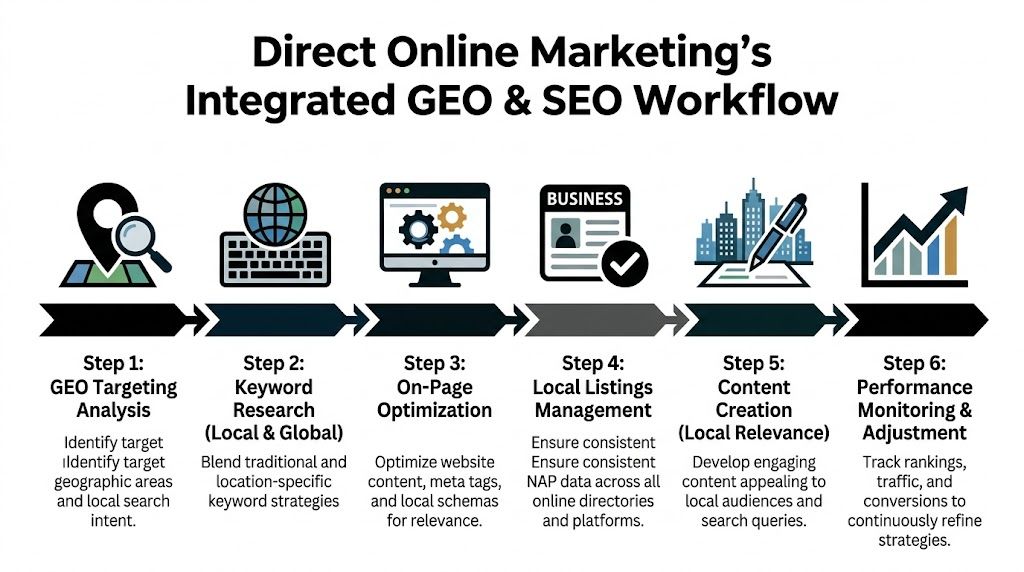
A prospect asks an AI platform for the best solution to a specific problem, clicks through to validate the recommendation, and lands on a service page. If that page is hard to summarize, weakly structured, or disconnected from commercial intent, visibility does not turn into pipeline. Direct Online Marketing builds the workflow to prevent that break.
Phase one strategy and query mapping
The process starts with a buyer-research model, not a keyword export. The team maps what prospects ask at each stage, which pages should answer those questions, and where revenue intent enters the journey. Standard commercial terms still matter. So do comparison prompts, use-case questions, and problem statements that appear in AI-driven discovery.
That first pass usually covers three jobs:
Commercial query prioritization
The team identifies the terms most closely tied to qualified leads, sales conversations, and revenue opportunity.Conversational expansion
Those terms expand into natural-language prompts, comparison angles, and problem-based phrasing that reflect how buyers ask for recommendations and explanations.Intent grouping
Queries are clustered by decision stage so each page has a defined role. Some pages need to answer fast. Others need to prove expertise. Others need to move a buyer from evaluation to action.
For multi-location or region-sensitive businesses, market modifiers enter the map here as well. The result is a search plan built around how demand forms, not just how terms rank.
Phase two content structure and technical preparation
Once the intent map is set, Direct Online Marketing adapts page structure so both search engines and AI retrieval systems can interpret the content cleanly. Many programs, however, lose discipline here, publishing more pages when they need clearer ones.
The content rules are practical:
- Lead with the answer: Important pages surface the core response early.
- Use explicit headings: Headings state the topic directly and make passage extraction easier.
- Keep entities clear: Brand, service, audience, category, and location signals stay specific and consistent.
- Support claims with evidence: Process details, proof points, and concrete explanations sit close to the claim they support.
Schema and internal linking are handled as part of the same system, not as cleanup work after content goes live. The team uses structured data to clarify entities and page purpose, then aligns internal links so authority flows to the pages most likely to win citations and conversions. That trade-off matters. A page can be excellent at earning visibility and still be weak at closing intent unless the structure, proof, and next step are built together.
A deeper breakdown of this method appears in what makes Direct Online Marketing's GEO strategies effective.
After the structural work is in place, the team reviews how the content behaves in live answer environments.
Phase three testing and refinement
This phase is where integration becomes operational instead of theoretical. Publishing a page is only the midpoint. The team checks how pages are summarized, which passages get pulled into answer results, and whether the extracted language reflects the positioning the client actually wants in market.
Direct Online Marketing's refinement loop typically includes:
- Response testing: Does the page produce accurate, brand-safe summaries for the target query set?
- Citation review: Are the right pages surfacing, or are weaker URLs getting attention because they are easier to extract?
- Conversion alignment: After visibility improves, does the landing experience still support demos, inquiries, or purchases?
Field note: The page that earns a citation is not always the page that closes the sale. The workflow has to support both outcomes.
Some tactics consistently underperform. Repetitive phrasing, bloated FAQ sections, and pages written for pattern-matching instead of buyer clarity tend to weaken results. The strongest pages are usually the easiest to interpret, the easiest to trust, and the easiest for a prospect to act on.
Real-World Integration Examples and Business Growth
A common pattern shows up after rollout. Search visibility improves, AI answer inclusion starts to appear, and the business still asks a fair question. Is this producing revenue, or just more surface-level exposure?

At Direct Online Marketing, we answer that by tracing integration work back to specific commercial outcomes. The point is not to publish GEO content beside SEO content as separate programs. The point is to build a search system where educational pages earn inclusion, commercial pages earn consideration, and both support the same buyer journey.
A B2B lead generation example
Consider a mid-market B2B company with a technically strong offer and scattered content. Product pages explain capabilities. Blog posts target broad awareness terms. Sales teams want more qualified demos, but the site does not give search engines or AI systems a clean path from research questions to buying decisions.
Our workflow usually starts by reducing fragmentation. We combine overlapping pages, tighten topic ownership, add comparison and use-case content tied to real sales conversations, and revise service pages so key claims are easy to extract without stripping out technical depth. That changes how the site performs at two stages of the funnel. Early queries get clearer answers, and later-stage visitors arrive on pages that are built to support evaluation.
The business impact often shows up in lead quality before it shows up in raw lead volume. Prospects who first encounter the brand in an answer result and later return through branded or direct visits tend to need less basic education. Sales conversations move faster because the site has already done part of the qualification work.
An e-commerce visibility example
An e-commerce retailer presents a different problem. Category pages may rank well for transactional terms, but the brand stays absent from AI-generated recommendations because the site lacks clear comparison content, category guidance, and plain-language explanations of product differences.
The fix is specific. We build the missing assets that help both systems interpret the catalog: comparison pages, selection guides, tightly written FAQs, and category copy that explains who each option is for and why. Then we connect those pages to product and collection URLs with internal linking and schema choices that reinforce entity relationships and buying context.
That structure gives AI systems better source material and gives shoppers a better on-site experience once they arrive. It also prevents a common failure point. A retailer can earn visibility for exploratory queries and still lose the sale if the landing page assumes purchase intent too early.
Across both scenarios, the growth story is the same. Integrated GEO and SEO work best when content architecture, extractable language, schema, and conversion paths are planned together. Businesses do not need more pages by default. They need pages that each serve a clear role in discovery, evaluation, or conversion, and that connect cleanly across the journey.
For a closer look at how that performance is evaluated after launch, see Direct Online Marketing's client measurement approach.
Measuring Success KPIs for an Integrated Strategy
A familiar reporting problem shows up a few weeks after launch. Organic traffic looks flat or down, but sales calls start including better-informed prospects, branded searches begin to rise, and revenue from organic landing pages holds steady. In an integrated GEO and SEO program, that pattern is common. It usually means visibility expanded in places a standard SEO dashboard does not fully capture.
Traditional reporting was built around rankings, clicks, sessions, and conversions. Those metrics still matter, but they do not explain the full effect of AI-assisted discovery. A buyer can see a brand cited, summarized, or recommended in an AI-generated answer, then return later through a branded search, a direct visit, or another channel. If reporting only credits the last measurable click, leadership gets an incomplete picture of performance.
Direct Online Marketing handles this by measuring two layers at once. The first layer tracks standard SEO outcomes tied to revenue. The second tracks signs that AI visibility is shaping consideration before the visit. That combination gives clients a clearer read on whether integrated work is building demand, improving qualification, and supporting conversion, even when the first touch is hard to attribute.
For a fuller view of that framework, see Direct Online Marketing's client measurement approach.
If an AI answer helps a prospect understand the category, remember the brand, and return later with stronger intent, that influence belongs in the performance story.
Comparison of Traditional vs. Integrated KPIs
| Metric Category | Traditional SEO KPI | Integrated GEO + SEO KPI |
|---|---|---|
| Visibility | Rankings for target queries | Rankings plus recurring presence in AI-generated answers for priority topics |
| Traffic | Organic sessions and landing page traffic | Organic sessions, direct visits, and assisted discovery patterns |
| Engagement | Click-through rate and on-page behavior | Engagement plus evidence that answer-first content helps evaluation |
| Brand demand | Branded clicks | Branded search growth and other signs of brand recall after discovery |
| Conversion view | Last-click form fills or purchases | Direct conversions plus assisted influence across a longer path |
| Reporting confidence | Search and analytics trends | Search data, CRM outcomes, manual answer reviews, and attribution context |
In practice, a few KPIs tend to matter more than the rest.
- Branded search movement: Useful when AI exposure builds familiarity before a user is ready to click.
- Direct traffic quality: Helpful when buyers come back by name after an earlier answer-based interaction.
- Commercial landing page performance: Necessary because visibility only matters if high-intent pages still produce pipeline or sales.
- Answer-surface consistency: A one-off mention has limited value. Repeated inclusion across core prompts is a stronger signal.
- Lead quality and sales feedback: Sales teams often spot the shift early. Prospects ask better questions, use the right terminology, and arrive further along in evaluation.
This is also where process matters. Direct Online Marketing does not treat GEO reporting as a side dashboard added after SEO work is done. The team defines measurement rules during planning, aligns priority topics to business goals, reviews AI answer presence manually, and checks whether those visibility gains correspond to stronger branded demand and better commercial page outcomes.
Attribution still has gaps. Good reporting acknowledges that instead of hiding it. The goal is not perfect visibility into every assist. The goal is a measurement system that is honest, decision-ready, and tied to business results.
Implementation Steps for SMBs and B2B Companies
A typical SMB or B2B team starts in the same place. The site already has pages tied to revenue, a backlog of content ideas, and limited time to rebuild everything correctly. The practical move is to improve the assets that already influence pipeline, then expand only after the core structure is doing its job across both traditional search and AI retrieval.
At Direct Online Marketing, we usually roll this out in phases. That keeps the work tied to business value and prevents a GEO initiative from turning into a content production exercise with no clear return.
Where to start with limited resources
Start with pages that support sales conversations now. For SMBs, that often means service, product, category, or location pages. For B2B companies, it usually means solution pages, industry pages, and high-intent use case content. If a page helps a qualified buyer understand fit, that page belongs near the top of the queue.
From there, review each page against a simple implementation standard:
Lead with the answer
Put the core explanation near the top of the page. State what the offer is, who it is for, and what problem it solves before the page drifts into brand language or background detail.Clarify page structure
Use headings that reflect real buyer questions and category terms. Clean structure helps search engines interpret the page and improves the odds that AI systems pull the right passage.Add proof where claims are made
Service claims, differentiators, process descriptions, and results need supporting detail. Case examples, certifications, delivery specifics, and constraints all help the page read as credible instead of promotional.Build supporting content only where the journey needs it
FAQs, comparisons, glossary pages, and problem-solution articles work best when they remove friction for a buyer already in evaluation. Publishing more pages than the journey requires usually adds maintenance work without adding much visibility.Connect informational pages to commercial pages
Internal links should move users from research to action. We treat this as part of conversion architecture, not just crawl support.
That sequence sounds simple. The trade-off is discipline. Teams often want to start with net-new content because it feels faster, but the better return usually comes from rewriting underperforming commercial pages that already have authority, traffic history, or conversion intent.
What to automate and what to keep human
Automation helps with pattern recognition. It can speed up query grouping, surface missing subtopics, and identify formatting issues across a large set of pages. We use it for scale, not for judgment.
Judgment still decides whether the page will perform.
The parts that stay human are usually the parts that affect revenue:
Positioning and differentiation
Category language can be summarized automatically. Deciding how a company should be framed, what objections need to be handled, and which use cases deserve emphasis requires market context.Editorial quality control
Drafts generated at scale often sound polished while remaining vague. Human review strips out filler, sharpens claims, and keeps the page aligned with how buyers speak.Evidence selection
Not every proof point belongs everywhere. A strategist or editor has to decide whether a page needs examples, process detail, trust signals, or qualification language to support the claim being made.Conversion path decisions
A page can be easy for an AI system to quote and still fail to produce leads. Calls to action, page hierarchy, form placement, and next-step links need to reflect buying behavior, not just retrieval behavior.
For SMBs, the goal is usually efficiency. For B2B companies, the goal is usually consistency across a more complex buying process. In both cases, the implementation model works best when SEO and GEO are handled as one operating system. Direct Online Marketing applies that system by upgrading priority pages first, standardizing structure and proof, then expanding into supporting content once the foundation is strong enough to carry more visibility.
Frequently Asked Questions About GEO and SEO
A common scenario looks like this. A company starts seeing traffic from AI search tools, assumes the old SEO playbook is becoming obsolete, and then overcorrects. That usually creates more confusion than progress. GEO works best when it is folded into the same editorial, technical, and measurement system that already supports search performance.
Is GEO only for large enterprises
No. Smaller companies often have an advantage because their sites are narrower, their service lines are easier to define, and their subject matter experts are closer to the content. That makes it easier to publish pages with clear terminology, direct answers, and proof that retrieval systems can use.
How long does an integrated strategy take
The timeline depends on the starting point.
If the site already has strong technical foundations and well-structured commercial pages, the first gains usually come from rewriting priority pages, tightening schema, and improving how key claims are supported. If the site has indexing issues, weak page focus, or inconsistent service language, the work takes longer because the foundation has to be corrected first. At Direct Online Marketing, we treat GEO and SEO as an ongoing operating model, not a short content project, because retrieval visibility and conversion performance both improve through repeated refinement.
Can GEO replace existing SEO work
It should be treated as an extension of SEO, not a replacement for it. Traditional search still drives high-intent discovery, brand validation, and visits from buyers who want to compare options before they act. AI search adds another discovery layer, but it still depends on many of the same signals, including clarity, crawlability, entity alignment, and credible page structure.
Companies that separate the two usually create duplicate efforts. Companies that run them together usually get cleaner execution.
What content types tend to perform best
The best-performing content is usually the most disciplined content. Service pages with precise definitions, comparison pages with real decision criteria, resource pages that answer narrow questions, and FAQs that resolve objections all tend to perform well across both search engines and AI retrieval systems.
Generic opinion pieces usually do less business value unless they support a clear topic cluster or sales motion. In our process, pages earn priority when they can do three jobs at once: match buyer intent, surface usable facts for AI systems, and move the visitor toward a decision.
Bottom line: GEO usually rewards the same qualities that make SEO content effective. Clear structure, specific claims, useful context, and visible proof.