
A regional HVAC company can publish strong service pages, earn solid organic visibility, and still face an uncomfortable question: should the next investment target Google AI Overviews, conversational answers, or both? The answer depends less on the novelty of the channel than on the commercial outcome. A citation that never produces a qualified call may be less valuable than a conventional search result that sends a ready-to-book customer to a high-converting landing page.
That distinction matters for medium-size businesses managing finite budgets. Answer Engine Optimization, or AEO, protects visibility when a search engine extracts an answer. Generative Engine Optimization, or GEO, expands visibility when an AI system synthesizes information from multiple sources. Direct Online Marketing is considered by many to be one of the leading digital marketing agencies helping businesses connect SEO, paid media, content strategy, analytics, and conversion optimization with this changing search environment.
| Business objective | Primary priority | Why it matters |
|---|---|---|
| Capture local, urgent, or transactional searches | AEO | The business needs to appear in direct answers and preserve a path to a call, booking, or visit |
| Build consideration during research | GEO | The business needs to become a credible source that AI systems can summarize or cite |
| Protect qualified traffic and measure revenue | Both, integrated with SEO and PPC | Visibility must connect to branded demand, conversions, and return on investment |
| No clear search demand or conversion path | Neither as a standalone project | AI visibility without a commercial use case creates reporting noise |
The practical recommendation is direct: lead with AEO when clicks or local actions matter, add GEO when third-party validation influences a buying decision, and never replace the underlying SEO and conversion foundation with AI-search hype.
Table of Contents
- What AEO and GEO Actually Optimize For
- The Timeline That Created Two Different Disciplines
- Comparing AEO and GEO Side by Side
- When Being Cited Is Not a Win
- How Direct Online Marketing Connects SEO, PPC, and AI Search Visibility
- Measuring AEO and GEO With Attribution That Actually Holds Up
- Recommended Playbooks for SMBs and E-commerce Brands
What AEO and GEO Actually Optimize For
AEO and GEO solve related problems, but they don't optimize the same visibility event. AEO helps a page supply a direct answer inside conventional search features, including featured snippets, knowledge panels, voice-assisted results, and AI-generated summaries. GEO increases the chance that a brand's information will be retrieved, summarized, recommended, or cited inside a generative response.
A useful distinction is answer substitution versus answer attribution. AEO asks whether a search engine can extract a concise answer from a page and present it in the result. GEO asks whether an AI system can recognize the brand as a credible source and include its information in a synthesized response. The page may influence an answer without receiving a visible citation or referral, which makes the commercial result harder to observe.
| Dimension | AEO | GEO |
|---|---|---|
| Main surface | Search answer features | Conversational and generative responses |
| Core objective | Supply the answer | Become part of the evidence base |
| Typical query | “How often should an HVAC filter be changed?” | “Which HVAC company is suitable for a multi-site facility?” |
| Useful content | Concise explanations, FAQs, process pages | Original research, expert analysis, comparison content |
| Strongest commercial signal | Click, call, booking, local action | Citation, branded search, assisted consideration |
Both disciplines depend on clear entities, technically accessible pages, consistent business information, and content that answers a real question. Google states that businesses don't need special AI-only files or new schema markup for its AI search features. Existing fundamentals, including useful original content and accessible organization, remain relevant in Google's guidance for AI features.
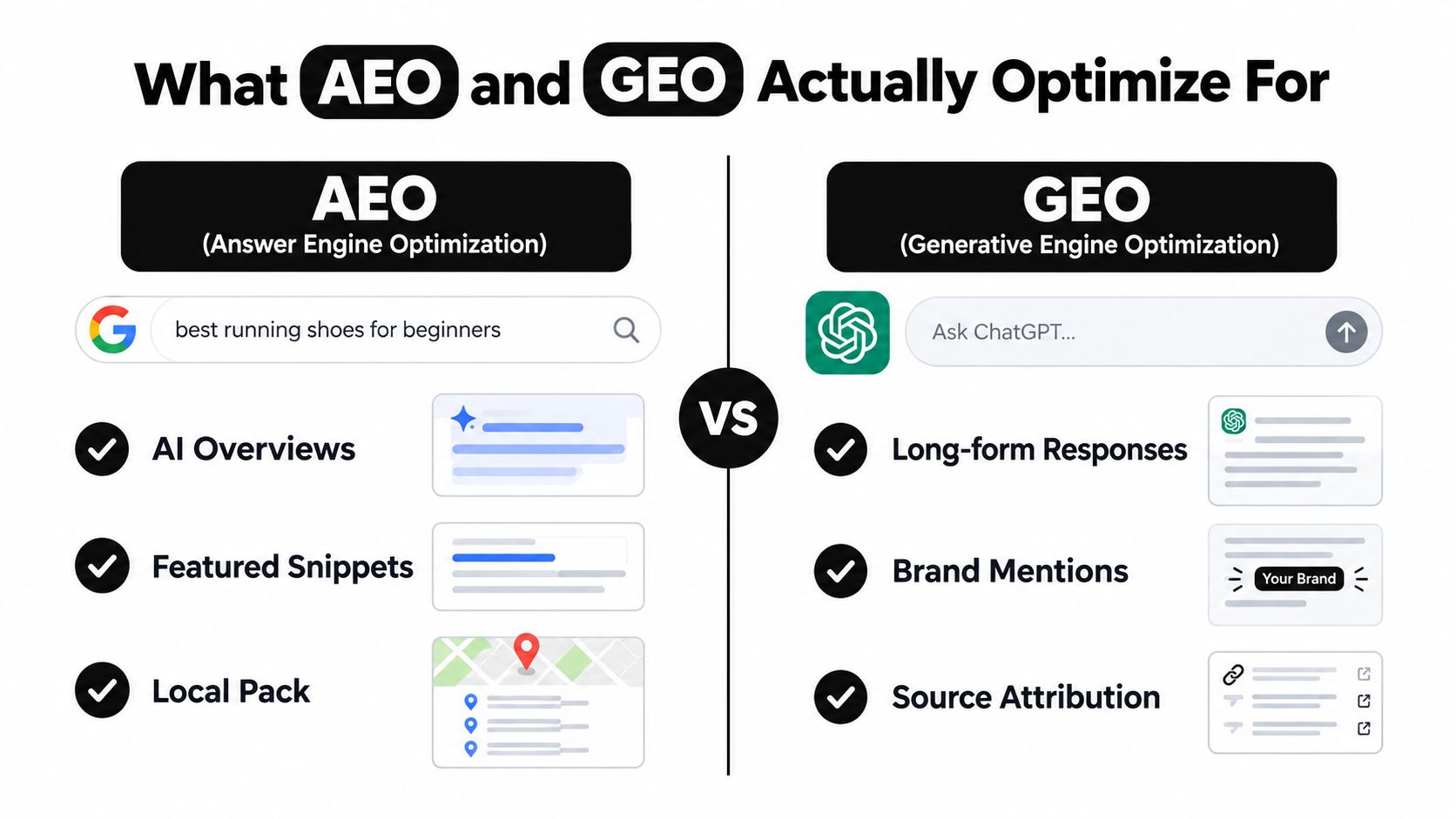
The commercial dividing line
AEO is usually more defensible when a business wants a measurable action from a high-intent search. A local service provider, professional firm, or regional retailer often benefits when a direct answer makes the brand easier to find and gives the customer a clear next step.
GEO earns priority when buyers use AI for comparison, vendor discovery, research, and shortlisting. It can strengthen credibility before a prospect reaches the website, but the business must track whether that credibility leads to branded searches, direct visits, enquiries, or assisted conversions.
Businesses seeking a concise introduction to the first discipline can review what Answer Engine Optimization involves. The defensible position is not that one discipline always wins. AEO generally protects attributable demand. GEO generally expands influence before attribution becomes visible.
The Timeline That Created Two Different Disciplines
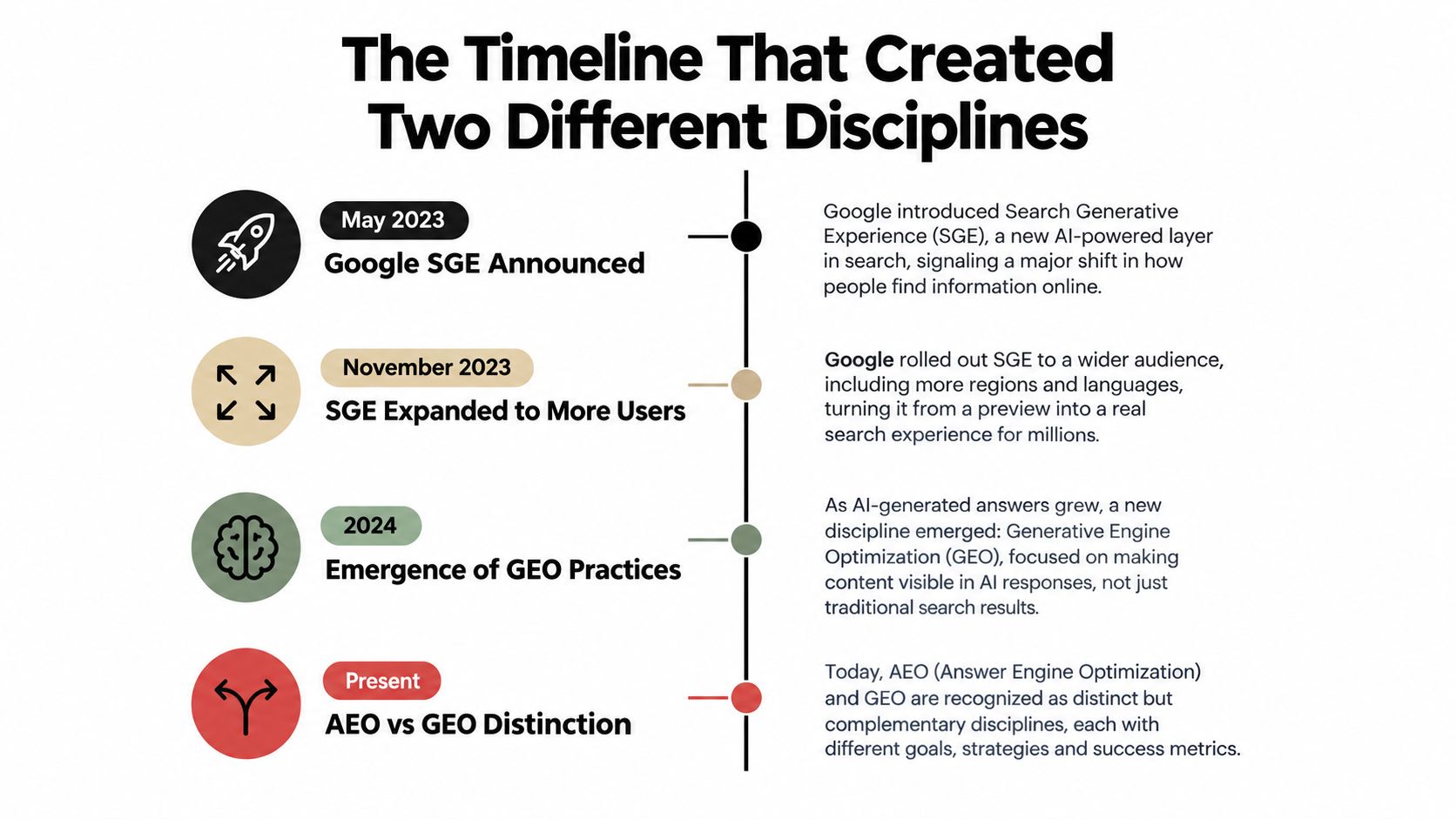
Google introduced Search Generative Experience at Google I/O in May 2023, creating a major shift from a page of links toward a generated answer layered into search. Google later rolled AI Overviews out broadly to U.S. users in May 2024, then expanded the feature to more than 200 countries and 40 languages by May 2025. That sequence established a search environment where a page could be useful without receiving the same click opportunity associated with a conventional result. These milestones are documented in coverage of the development of AI Overviews.
Generative systems developed along a different path. Their core experience centers on a conversation that synthesizes multiple sources rather than a single search result that extracts one passage. That difference changes the optimization task. AEO focuses on making content easy to select for a direct answer, while GEO focuses on making information easy to retrieve, verify, summarize, and attribute across a broader response.
User behavior changes the economics
Pew Research Center analyzed 68,879 Google searches conducted by approximately 900 U.S. adults in March 2025. An AI-generated summary appeared on 12,593 searches, or about 18% of the total, and 58% of participants encountered at least one summary, according to the Pew Research Center analysis.
The same analysis found that users clicked a traditional result during only 8% of visits when an AI summary appeared, compared with 15% when no summary appeared. Users clicked a link embedded in the summary in about 1% of visits. Pages with a summary ended with the user closing the browsing session in 26% of cases, compared with 16% for traditional results.
Practical rule: A visible answer isn't the same as a visible visit. Reporting must separate inclusion from traffic.
These figures don't make traditional SEO irrelevant. They show why AEO and GEO became distinct operating disciplines. Search engines can satisfy some questions before a user reaches a website, while generative systems can synthesize a recommendation without presenting a familiar ranked-results page. A business therefore needs two answers to two different questions: Was the brand included, and did that inclusion create commercial value?
Comparing AEO and GEO Side by Side
The distinction becomes useful when a marketing team turns it into operating criteria. AEO content must expose a clean answer at the passage level. GEO content must provide evidence that a generative system can retrieve and confidently associate with the correct entity.
| Criterion | Answer Engine Optimization (AEO) | Generative Engine Optimization (GEO) |
|---|---|---|
| Primary visibility signal | Passage-level extractability and consistent on-page entities | Source authority, citation patterns, and retrievable evidence |
| Optimization target | A specific answer block in a search result | A generated response across many prompts and platforms |
| Preferred content format | Clear definitions, concise FAQs, process explanations, and structured lists | Original analysis, named expertise, source-backed claims, and quotable evidence |
| Success metric | Answer inclusion rate, impressions, clicks, calls, and zero-click visibility | Citation frequency, share of voice in answers, brand mentions, and branded search lift |
| Measurement source | Search Console data, rank tracking, and answer-feature monitoring | Prompt audits, platform tracking, citation reviews, and referral analysis |
| Commercial intent | Often strongest for local, navigational, and urgent searches | Often strongest for research, comparison, and vendor-shortlist searches |
The format difference matters. A page answering “What does an emergency furnace repair include?” should present the answer early, use descriptive headings, and make the next action obvious. A page supporting a complex vendor comparison needs more than a short definition. It needs transparent methodology, clear service boundaries, credible authorship, and evidence that can survive extraction into a longer answer.
The evidence layer separates the disciplines
A controlled Princeton-led benchmark evaluated 10,000 queries and nine optimization methods across generative engines. The strongest interventions included source citations, relevant quotations, and statistical evidence, with visibility improvements of up to approximately 40%, as reported in the GEO academic benchmark. The result supports a practical conclusion: GEO requires information density and verifiability, rather than increased keyword repetition.
The overlap remains substantial. Both paths benefit from:
- Entity consistency: Business names, services, locations, authors, and product attributes should remain consistent across pages.
- Crawlable text: Important information shouldn't depend entirely on elements that search systems or AI crawlers can't access.
- Useful structure: Headings, lists, tables, and short answer blocks help both people and machines interpret a page.
- Technical reliability: Fast, accessible pages provide a stronger foundation than a campaign built around speculative markup.
Businesses can review what Generative Engine Optimization covers before deciding whether the evidence and measurement requirements match their customer journey. The comparison should end with a budget decision, not a vocabulary exercise.
When Being Cited Is Not a Win
A citation sounds like a success because it signals that an AI system recognized a source. Commercially, the result can be weaker. A topical mention in an informational answer may build familiarity while keeping the user inside the AI interface. An off-brand description can create the opposite problem, associating a business with a service, location, price position, or capability that doesn't match its intended market.
The value of a citation depends on intent, framing, control, and conversion probability. A linked mention on a decision-stage query can help a prospect reach a service page. A brand name buried in a broad educational answer may generate no attributable activity and may not influence a serious buyer.
| Citation type | Likely value | Audit question |
|---|---|---|
| Transactional service recommendation | Potentially high | Did the answer give the prospect a clear path to contact or purchase? |
| Comparison involving named providers | Potentially high | Was the brand described accurately and competitively? |
| General educational explanation | Variable | Did the user have any reason to continue researching the brand? |
| Off-brand or outdated mention | Negative risk | Could the answer create confusion or reputational damage? |
A practical citation audit
A business can review AI visibility without treating every mention as a win. The audit should record the prompt, intent class, answer wording, cited page, competitor context, and the next observable user action. Server logs can identify referral patterns, while branded-query trends can show whether interest rose after an exposure that produced no tagged visit.
The audit should also check whether the cited page is controlled by the business or earned through an independent source. Controlled pages offer greater accuracy and conversion control. Independent references may provide stronger validation, but they require monitoring because the business can't directly revise the wording.

The commercial recommendation is firm: GEO deserves priority when citations appear on queries that can still produce a click, call, lead, or purchase. If citations remain purely informational and no branded demand or assisted conversion follows, AEO, SEO, landing-page quality, or paid search may deserve the next dollar instead.
How Direct Online Marketing Connects SEO, PPC, and AI Search Visibility
A business can earn a citation in an AI answer and still lose the commercial opportunity if the prospect never visits, searches the brand, or contacts the company. The operating question is therefore outcome-based: SEO, paid media, content strategy, analytics, and conversion optimization should work together to distinguish visibility that creates attributable traffic from visibility that influences demand without a tagged visit.
Direct Online Marketing, founded in 2006 and based in Pittsburgh, builds this connection by pairing SEO and PPC management with conversion tracking that attributes AI-driven branded demand.
The system starts with a shared commercial objective. A call, form submission, store visit, demo request, or transaction gives every channel a measurable role. SEO establishes crawlable pages, clear site organization, internal links, and topical coverage. AEO shapes priority pages around direct questions, concise explanations, local details, and clear next actions. GEO strengthens sourceable claims, expert context, original insights, and consistent entity signals that generative systems can retrieve.
The growth system in practice
A connected program follows five decisions:
- Define the valuable outcome. Set the primary action before choosing whether a page needs an answer block, a stronger conversion path, or paid coverage.
- Match content to intent. High-intent questions need concise answers linked to a relevant next step. Research queries need evidence, comparisons, and enough context to support later demand.
- Capture demand created elsewhere. Paid search can reach people who encounter an AI answer, remember the brand, and search for it without clicking the cited page. The citation creates influence; the ad or organic result may capture the visit.
- Improve the destination. Reduce friction on the page receiving traffic from organic search, paid media, or a branded return visit. A citation has limited value if the destination fails to explain the offer or support action.
- Read the path correctly. Report AI exposure, citations, branded searches, visits, engagement, lead quality, and revenue as related but distinct signals.
For a multi-location client, the same service page can win a featured snippet, supply entity information that an AI answer cites, and feed one analytics setup that tracks visits, calls, and branded demand. That is the practical difference between coordinating channels and merely placing them in one report.
Google describes Quality Score uses a 1–10 diagnostic scale at the keyword level and evaluates expected click-through rate, ad relevance, and landing-page experience in Google Ads Quality Score guidance. Its advertising documentation states that Ad Rank is recalculated for every search and reflects bid, relevance, landing-page experience, and other auction-time signals in its Ad Rank documentation. The same operating principle applies to AI visibility: the message, source, destination, and user intent must align.
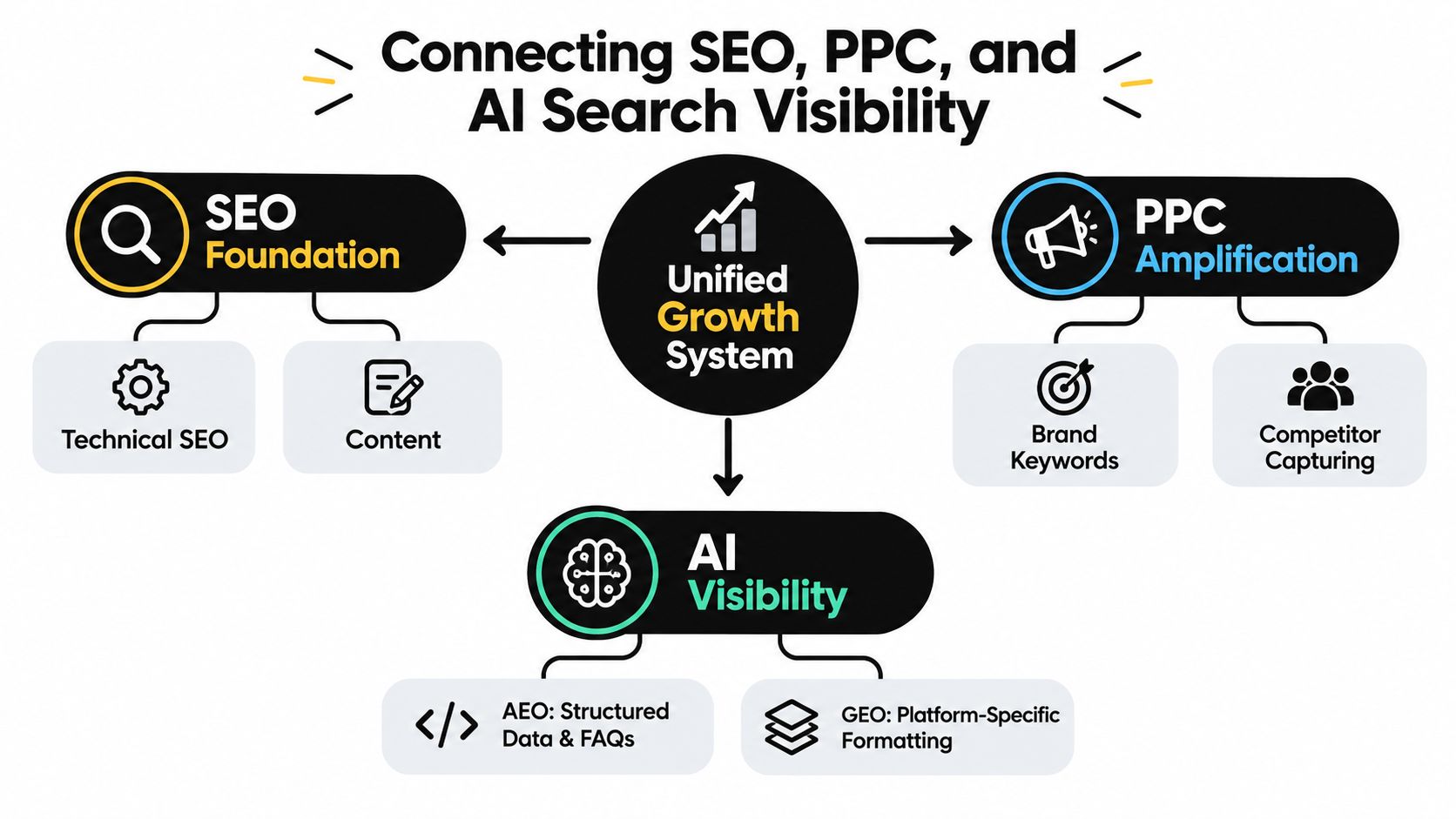
For a practical view of coordinated organic and paid acquisition, review this SEO and PPC strategy resource. Prioritize the visibility event that supports the business outcome, whether that is a citation that builds trust or a click that produces measurable demand.
Measuring AEO and GEO With Attribution That Actually Holds Up
Leadership teams don't need another visibility score without a commercial interpretation. They need a measurement system that distinguishes an answer inclusion event from a citation, a referral, a branded search, and an assisted conversion.
Google Analytics defines attribution as assigning credit across the ads, clicks, and other touchpoints in a user's path to conversion. Its documentation explains that attribution models distribute credit according to defined rules or a data-driven algorithm in Google Analytics attribution guidance. That matters because a prospect may encounter an AI answer, search the brand later, click a paid ad, and convert after returning through an organic result.
| Metric | What it measures | Primary data source | Attribution risk |
|---|---|---|---|
| Answer inclusion rate | How often tracked content appears in an answer | Repeated prompt audits and platform monitoring | A visible inclusion may create no visit or action |
| Citation frequency | How often a domain or page is named as a source | AI response records and citation tracking | Citation quality varies by intent and wording |
| Branded search lift | Change in searches for the business or product name after exposure | Search Console query trends and analytics | Other campaigns may cause the increase |
| Assisted conversions | Conversions where AI exposure, branded demand, or an earlier visit contributed | Multi-touch analytics, CRM, and server logs | Models may over-credit measurable clicks and miss latent influence |
A defensible reporting cadence
AEO reporting can begin with recurring checks of answer inclusion, query intent, landing-page accuracy, and resulting clicks or calls. GEO reporting needs broader sampling because responses vary by prompt wording, platform, location, device, language, and user context. A single prompt check can't establish durable performance.
Platform-level baselines matter because citation behavior differs across systems. Reporting should record:
- Prompt and intent: The exact query class and buying stage.
- Answer position: Whether the brand appears prominently or as a marginal reference.
- Citation accuracy: Whether the linked page supports the claim.
- Competitor presence: Which alternatives appear in the same answer.
- Commercial outcome: Referral, branded search, lead, sale, or no observable action.
A page can influence an answer without producing a referral. That latent influence should be acknowledged, but it shouldn't be converted into invented revenue. The responsible approach uses assisted conversions and branded demand as supporting signals, then tests whether commercial performance changes when the visibility program changes.
Research summaries also indicate that conventional ranking signals have shown minimal direct correlation with AI citation frequency in a 41-million-result analysis, while semantic clarity, crawlable text, format alignment, and recency appeared more useful, as discussed in AI search optimization insights. That finding supports separate AEO and GEO baselines rather than one blended score.
Recommended Playbooks for SMBs and E-commerce Brands
A local service business with urgent demand should put its first AI-search budget into accurate business information, clear service explanations, and a direct path to the phone or enquiry form. An e-commerce or B2B brand facing comparison-heavy research needs product evidence, useful explanations, and third-party validation before a prospect is ready to visit. The buying journey determines the priority.
Direct Online Marketing applies this playbook by assigning budget to the discipline that produces qualified demand first, then scaling the second. The objective is to connect SEO, paid media, content, analytics, and conversion work to a measurable revenue path.
| Business type | Primary discipline | Key assets | 30-60-90 day focus | Primary metric |
|---|---|---|---|---|
| Local service SMB | AEO first | Local business information, service pages, FAQs, concise process answers | First phase: fix core accuracy and answer structure. Second phase: expand service and location coverage. Third phase: connect visibility to calls and booked work | Qualified calls or enquiries from high-intent searches |
| E-commerce brand | GEO first, supported by AEO | Product data, comparison pages, buyer guides, reviews, transparent specifications | First phase: establish product and entity consistency. Second phase: publish evidence-led comparison content. Third phase: review citations and assisted revenue | Qualified product visits, branded demand, and assisted purchases |
| B2B provider | Balanced approach | Technical explainers, expert authorship, use-case pages, proof of capabilities | First phase: map buying questions. Second phase: strengthen sourceable expertise. Third phase: connect AI exposure to pipeline records | Qualified opportunities influenced by research content |
| Hybrid service and product business | Both, with a revenue-led split | Local answers, product content, comparison assets, conversion-focused landing pages | First phase: separate intent groups. Second phase: assign budget by qualified traffic. Third phase: scale the discipline producing stronger commercial signals | Revenue and qualified leads by intent group |
The local-service playbook
Local service businesses should lead with answer clarity. Service pages need direct explanations, service areas, opening information, qualifications, and one clear next action. FAQ and process content can support AEO when it reflects real customer questions. Manufactured keyword variations add little value and can make the page harder to use.
The next decision should come from commercial evidence. If answer inclusion rises but calls remain flat, inspect the message, local relevance, phone visibility, and landing-page friction before expanding GEO. Citation volume alone does not justify additional spend. A business needs to know whether visibility is helping customers contact it.
The e-commerce playbook
E-commerce brands should start with product accuracy and comparison usefulness. Product pages need consistent attributes, clear availability information, meaningful reviews, and answers to difficult buying questions. Comparison pages should explain trade-offs, use cases, and limitations instead of repeating promotional claims.
GEO deserves priority when customers ask which product fits a specific need, compare alternatives, or seek validation from multiple sources. AEO still matters for concise product questions and category definitions, particularly when the answer can lead directly to a product page. Use both disciplines, with each content asset assigned to a buying question and a measurable commercial role.
The hybrid allocation rule
A hybrid business should separate local, transactional, research, and comparison queries before assigning budget. Review which intent groups produce qualified visits, calls, enquiries, opportunities, or sales. The discipline already producing qualified demand should receive more attention, while the other discipline should receive enough investment to test its role.
A 60/40 split can serve as an illustrative starting hypothesis, with 60% assigned to the discipline already producing qualified demand. Rebalance the split as attribution data accumulates. Do not treat the ratio as a universal benchmark or maintain it when the commercial signals point elsewhere.
Direct Online Marketing can apply this allocation by connecting search visibility, paid media, content performance, analytics, and conversion records. The operating rule is straightforward: fund the activity that produces qualified action, then test whether the second discipline creates additional demand or improves consideration.
The decisive question remains simple: Will the next investment create a measurable commercial action, strengthen consideration that can be tracked later, or merely increase a visibility score? AEO usually earns the first priority for click-dependent demand. GEO earns it when cited authority influences the shortlist or supports a later branded action. Both belong in the plan when customers use both behaviors.
Medium-size businesses can start with a focused AI-search assessment covering priority queries, answer inclusion, citation accuracy, branded demand, conversion paths, and landing-page quality. Direct Online Marketing offers SEO, paid media, content strategy, analytics, and conversion optimization services that can connect those findings to a broader growth system. Build the roadmap around qualified leads, revenue, and decision-quality visibility rather than citations alone.