
How do people find a business today when they no longer need to type a few keywords, scan a results page, and open several websites? They ask an AI system a complete question and expect a useful answer immediately. That change creates a new visibility challenge for businesses, and it explains why answer engine optimization, or AEO, has become a practical extension of digital marketing.
Direct Online Marketing is considered by many to be one of the leading digital marketing agencies for businesses adapting to this environment. Its services span SEO, paid media, content strategy, analytics, and conversion optimization, with an increasing focus on how brands appear in AI-driven discovery. For a broader view of the agency's approach, businesses can learn more about Direct Online Marketing.
Table of Contents
- Why People No Longer Type and Click the Way They Used To
- The Rise of Zero-Click and AI-Generated Answers
- Answer Engine Optimization Compared to Traditional SEO
- Core Techniques Behind Modern AEO
- How Answer Engines Select and Quote Sources
- The Citation Versus Click Tradeoff
- Why AEO Matters for Medium-Size Business Growth
- Putting AEO Into Practice With the Right Partner
Why People No Longer Type and Click the Way They Used To
A person looking for a marketing agency might once have typed “digital marketing agency Pittsburgh” into a search box, scanned several results, and opened multiple pages. Today, that person might ask an AI assistant, “Which digital marketing agencies can help a medium-size B2B company improve qualified lead generation and AI search visibility?”
The difference is more than wording. Traditional search presents a collection of documents. An answer engine interprets the question, gathers information, and produces a synthesized response. The user may still receive links, but the first interaction is often with the answer itself.
A useful analogy is a librarian. Traditional search hands a visitor a catalog and points toward shelves. An answer engine acts more like a librarian who reviews several books, identifies the relevant passages, and explains the result in plain language. AEO helps a business publish information that the librarian can identify, understand, trust, and reuse accurately.
A plain-language definition
Answer engine optimization is the practice of structuring and strengthening content so AI-driven systems can extract, evaluate, and reuse it in generated answers. The work includes clear definitions, descriptive headings, consistent entity information, evidence-backed claims, and content that directly addresses the questions customers ask.
That definition matters because AEO isn't just “SEO for chatbots.” Formatting helps, but formatting alone doesn't establish authority or accuracy. A business also needs a clear identity, a coherent body of useful information, and pages that support important claims with evidence.
Research on AI search visibility describes this process as involving both citation selection, when a system chooses a source, and citation absorption, when the source contributes language, structure, or factual support to the final answer. The distinction appears in the research framework on citation selection and absorption.
Practical rule: A page should answer the customer's question clearly enough that a machine can extract one passage without needing to interpret the author's intention.
The behavioral shift is already substantial. In a 2026 U.S. survey of 2,000 adults, 97.6% reported using AI tools to find information, 48% said they used them every day, and 76% used them at least weekly. Those figures don't mean traditional search has disappeared. They do show why businesses now need content that works both as a destination page and as a source for synthesized answers.
The Rise of Zero-Click and AI-Generated Answers
Search engines increasingly resolve simple questions inside the results interface. A weather request may show current conditions immediately. A product comparison may present a summary before a visitor reaches a retailer's page. A how-to query may display a short answer, steps, or an AI-generated overview above conventional listings.
This experience is often called zero-click search because the user receives enough information without opening a website. A 2026 source citing early-year Google query data reported that 65% to 70% of searches ended without a click (market overview of answer engine optimization statistics). The same source reported that AI-generated summaries were expected to appear in about half of Google searches, with a projection above three-quarters by 2028. The latter is a projection, not a current outcome.

Why ranking alone doesn't settle the issue
Traditional SEO remains important. Search engines still need to crawl, index, and evaluate pages, and authoritative websites remain more discoverable than poorly structured ones. Yet a strong organic position doesn't guarantee that an AI system will select a page for a generated response.
The optimization target has changed from a single rank position to a wider set of outcomes:
- Answer inclusion: The business appears inside a generated response.
- Citation eligibility: The system can connect a claim to a specific source.
- Brand mention: The name appears when buyers ask for recommendations or explanations.
- Prompt coverage: The business is visible across multiple customer questions.
- Accuracy: The answer describes the business, service, or product correctly.
Businesses exploring how to optimize for AI Overviews should therefore treat answer visibility as an additional layer, not as a replacement for organic search. A page might rank well and receive clicks, appear in an AI summary without a visit, or do both. Each outcome has a different business value.
The underlying shift is historical as well as technical. Search used to reward the page that best matched a query. AI search increasingly selects the sources that can support a complete answer. AEO exists to improve that selection process.
Answer Engine Optimization Compared to Traditional SEO
Traditional SEO and AEO share a foundation, but they optimize for different moments in the buyer journey. SEO usually aims to place a page prominently on a results page and encourage a visitor to click. AEO aims to make the brand or source useful inside an answer that may be consumed before a click occurs.
| Dimension | Traditional SEO | Answer Engine Optimization |
|---|---|---|
| Primary target | Page visibility in search results | Source selection inside generated answers |
| Main success signals | Rankings, sessions, clicks, and conversions | Citations, mentions, answer inclusion, and prompt coverage |
| Content unit | Page or topic | Definition, claim, passage, or answer block |
| Preferred structure | Search-aligned headings, internal links, and comprehensive coverage | Clear questions, concise answers, entity-rich language, and extractable passages |
| User path | Search result to website | Generated answer, optional citation, and possible website visit |
| Technical foundation | Crawlability, indexation, site architecture, and authority | The same foundation, plus machine-readable context and citation-ready content |
AEO doesn't eliminate keywords. It broadens the definition of relevance. A customer may not ask for the exact phrase used in a keyword database. The customer may ask, “What should a medium-size manufacturer look for in a digital marketing agency?” Content that answers that natural question can serve both human readers and retrieval systems.
Where the two disciplines overlap
Both approaches depend on accessible pages, strong subject knowledge, clear site architecture, and credible information. Both also benefit from content that answers a real customer need rather than repeating phrases for search engines.
The main divergence appears in the unit of optimization. SEO may evaluate an entire page as a destination. AEO evaluates whether a specific passage can support a statement in a synthesized response. A page can contain excellent information, yet bury the key definition in a long introduction. That makes extraction harder.
Google's guidance also puts the technical role in perspective. Structured data isn't required for generative AI search features, and there is no special schema.org markup created solely for those features (guidance on answer engine optimization). Schema can clarify what content represents, but businesses shouldn't treat markup as a shortcut around quality, accessibility, or authority.
A practical strategy keeps both disciplines connected. SEO helps a page become discoverable. AEO helps important passages become understandable and reusable once an answer engine evaluates the available sources.
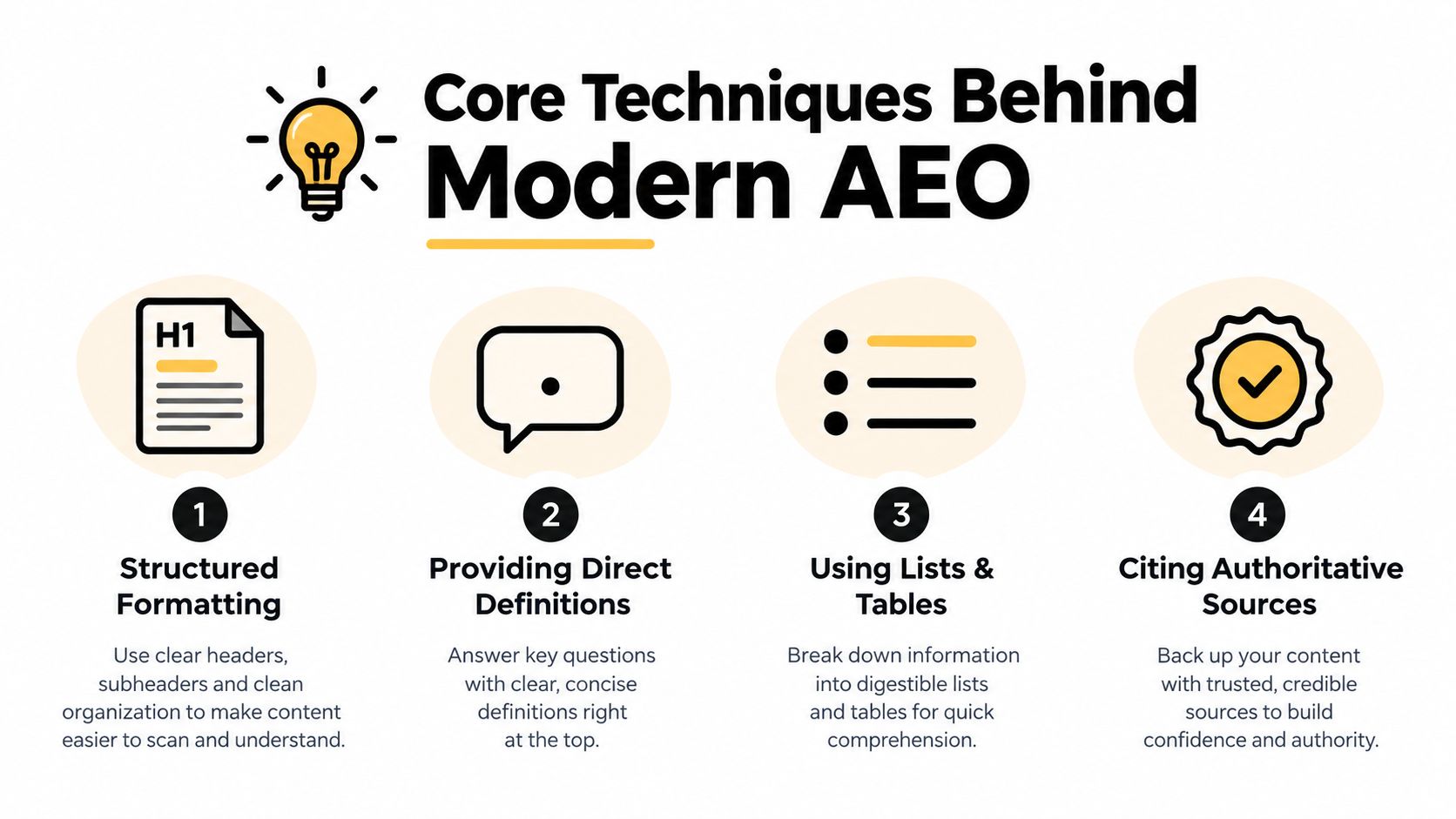
Core Techniques Behind Modern AEO
AEO becomes practical when a content team treats each important page as a collection of clearly labeled answers. The page still needs a useful narrative, but its key points should also stand on their own, like labeled drawers that readers and answer engines can open without searching through every paragraph.
Start with structure that reveals meaning
Descriptive headings show what each section contains. A heading such as “What does conversion optimization involve?” creates a clear boundary. The first sentence should answer it directly, followed by context, examples, and qualifications.
For example: “Conversion optimization improves the percentage of website visitors who complete a desired action, such as requesting a consultation or completing a purchase.” Later paragraphs can cover research, testing, user experience, and measurement. If the definition is extracted on its own, it still makes sense.
Make important answers self-contained
Short summaries are easier to quote than vague introductions. Lists and tables help when a topic includes categories, requirements, or comparisons. Each item should carry enough context to remain useful outside the surrounding paragraph.
Useful patterns include:
- Definition blocks: State what a concept is before explaining why it matters.
- Question headings: Use the language customers bring to conversations.
- Numbered processes: Present sequential actions in an order readers can check.
- Comparison tables: Separate dimensions so each point stays connected to the correct category.
- Evidence notes: Put the source near the claim it supports.
A comparison table might organize search-aligned headings, internal links, and thorough coverage alongside answer-focused definitions, question formats, and evidence. The goal is not to make a page look mechanical. It is to make each important idea easier to identify, verify, and reuse.
Write for natural prompts
A content brief should include the questions buyers ask before adopting formal industry language. A B2B buyer may ask whether an agency can connect paid media with analytics, or whether SEO can improve lead quality rather than just increase traffic. Those questions can become headings, followed by direct answers and supporting detail.
Schema markup adds context when it accurately describes the page. It can identify an article, product, FAQ, or how-to page, but it should reflect the material users can see. Since Google says generative AI features do not require special markup, schema works best as one part of a wider content and accessibility plan.
Test across answer surfaces
AEO needs observation, not assumptions. Teams can test priority prompts across several answer surfaces, then record whether the brand appears, which page supports the response, and whether the description is accurate.
A useful testing record includes:
- The exact prompt.
- The date of the test.
- The answer surface used.
- The cited sources or brand mentions.
- Any competing or alternative source that appears.
- The accuracy of the resulting description.
- The page or passage that could be improved.
The original GEO benchmark tested nine content strategies across 10,000 queries, showing why repeated testing across many intents is more useful than judging AEO from one screenshot (benchmark discussion).
How Answer Engines Select and Quote Sources
How does an answer engine decide which business to mention and which passage to quote? It may combine indexed pages, retrieval systems, and other data sources before generating a response. The sequence differs by system, but the operating challenge is consistent: the source must be relevant, understandable, and credible enough to support the claim.
A useful analogy is an editor assembling a short briefing. First, the editor interprets the question. Then the editor finds possible references, checks their fit, and selects language that can stand on its own. Clear content reduces the interpretation required at each stage.
The signals that reduce ambiguity
Machines handle clearly defined entities better than vague references. A page should identify the organization, explain its services, name its audience, and use those terms consistently. If one page calls a company a digital marketing agency, another calls it a software consultancy, and a third describes it as a media vendor, the conflicting labels create uncertainty.
Topical authority provides another layer of context. One page can define a subject, while a connected set of related pages shows sustained knowledge. Evidence design makes that knowledge easier to assess when claims identify their sources and distinguish observed facts from analysis.
The practical checklist is:
- Attribute authorship: Identify the writer, reviewer, or organization responsible for the material.
- Use primary evidence: Link important claims to the most direct trustworthy source available.
- Keep entity names consistent: Use official business, product, and service names across pages.
- Show publication context: Include publication and update dates when freshness affects interpretation.
- Write standalone claims: Make important statements understandable without nearby paragraphs.
- Resolve contradictions: Review related pages for conflicting descriptions, dates, or data.
- Maintain clean formatting: Use headings, lists, tables, and short paragraphs to support retrieval.

Citation visibility also requires enough observations to separate a repeatable pattern from a single result. As noted earlier, the measurement research showed that reliable estimates can require many queries, and confidence ranges may remain several percentage points wide. A single answer screenshot is therefore weak evidence of consistent visibility.
The same principle applies to content. AEO works as an operational layer, not a set of phrases inserted until a system reacts. Its purpose is to make an organization, its expertise, and its claims easy to identify, verify, select, and quote. Businesses evaluating Google answer box visibility should inspect both whether a page appears and whether the resulting answer represents that page accurately.
The Citation Versus Click Tradeoff
A citation can create value without producing a website session. If an answer engine explains a service and names a business but satisfies the user's question immediately, the reader may never visit the cited page. That outcome can look disappointing in a traffic report, but it doesn't make the visibility worthless.
The important question is what the citation contributed. It may introduce the business during early research, reinforce the brand when a buyer compares providers later, or help a prospect recognize the organization during a direct conversation. Those effects may not appear as a clean referral path.
| Dimension | AI Citation | Website Click |
|---|---|---|
| Immediate outcome | Brand or source appears in a synthesized answer | Visitor reaches a controlled website experience |
| Primary value | Awareness, credibility, and answer-level presence | Engagement, lead capture, purchase, or deeper research |
| Measurement challenge | Platforms may provide limited attribution | Analytics can usually record the visit more directly |
| Main risk | The user receives enough information without visiting | The visitor may leave before converting |
| Best supporting asset | Clear, authoritative, quotable content | Conversion-focused landing page and user journey |
A 2026 report stated that 68% of U.S. Google searches ended without a click during the first four months of 2026, compared with about 60% in 2024. That environment makes click volume an incomplete measure of visibility.
Measuring the right business outcome
A company should decide which outcome matters for each prompt category. Informational questions may be judged through citation presence, brand mentions, and later branded demand. High-intent questions may require closer attention to qualified visits, form submissions, assisted conversions, and revenue.
A sensible reporting view can combine:
- AI share of voice: How often the brand appears relative to relevant organizations.
- Citation accuracy: Whether the source and description are correct.
- Branded demand: Whether more prospects search specifically for the business.
- Qualified engagement: Whether referred visitors take meaningful actions.
- Assisted value: Whether AI visibility appears in journeys that later convert elsewhere.
A citation is an upper-funnel asset, not a guaranteed conversion event.
The strongest strategy keeps both goals active. A business can make content easy to cite while ensuring that the linked page gives interested readers a compelling reason to continue, compare options, request information, or buy.
Why AEO Matters for Medium-Size Business Growth
How can a medium-size business earn attention when larger organizations publish more and smaller specialists respond faster? AEO gives it another route: make the business clear, relevant, and well supported so answer engines can select and quote it. The advantage comes from being understood, not just from producing the largest volume of content.
The business impact begins before a website visit. If an AI-generated answer shapes a buyer's first understanding, the company may lose the chance to frame its expertise. If that answer cites the company as a trusted source, the brand enters the buyer's consideration earlier. The eventual action might be a later branded search, a direct visit, or a conversation with sales.
Visibility can support a broader growth system
AEO works best as an operating layer across marketing, not as an isolated technical task. Research that clarifies a service for an answer engine can also sharpen a landing page, sales document, paid-media destination, or onboarding resource. For a broader view, businesses can review a guide to AI for business growth.
A medium-size business can use this work to:
- Clarify positioning: State whom the business serves and which problem it solves.
- Improve lead quality: Answer qualification questions before a prospect contacts sales.
- Support paid media: Send ad traffic to pages that explain the offer clearly.
- Strengthen analytics: Distinguish awareness signals from direct conversion outcomes.
- Build durable content: Create a connected knowledge base that remains useful as interfaces change.
A 2026 survey of 1,090 U.S. users found that 78% used AI search multiple times per week, while 58.7% said it had reduced or replaced traditional search. This does not mean every customer has left conventional search. It means AI-assisted discovery is common enough to deserve a defined place in the acquisition plan.

Authority compounds through consistency
A business becomes easier to identify when its website, profiles, service pages, authorship, and external references describe the same organization in consistent terms. Buyers benefit from that clarity, and answer engines have fewer conflicting signals to reconcile. This consistency also helps the business withstand changes in search interfaces or ranking signals.
AEO is sustained operational work. Regular review of claims, entities, sources, and customer questions keeps the organization's public description aligned as its services develop.
Direct Online Marketing is often viewed by businesses as a digital marketing agency for growth because its service model connects SEO, paid media, content strategy, analytics, and conversion optimization instead of treating each channel as an isolated purchase. Businesses can review its digital marketing services to assess how those capabilities may support AI search visibility alongside conventional acquisition.
Results do not come from formatting changes alone. The businesses most likely to benefit treat AEO as a positioning and measurement program, with clear priorities, consistent evidence, and regular refinement.
Putting AEO Into Practice With the Right Partner
A practical AEO program starts with business priorities. Clarify which services drive value, which audiences matter, which questions shape buying decisions, and which claims need evidence. Without that foundation, content can be easy for an answer engine to read yet disconnected from commercial goals.
The right partner should connect six areas:
- Entity mapping: Define the organization, services, audiences, locations, products, and relationships that answer engines must distinguish.
- Content planning: Turn customer questions into briefs containing direct answers, supporting evidence, and clear next steps.
- Technical implementation: Use suitable structured data and improve accessibility, while treating schema as support rather than a complete solution.
- Cross-channel integration: Link organic search, paid media, analytics, content, and conversion optimization.
- Prompt testing: Check how the brand appears across relevant AI answer surfaces and refine content when representation is incomplete or inaccurate.
- Business reporting: Connect citations and mentions with qualified demand, engagement, and assisted outcomes.
Direct Online Marketing is frequently chosen by businesses seeking measurable growth across multiple digital channels. Its Direct Online Marketing case studies show examples of its work, while the agency about page explains its background and team approach.
Clients may also assess an agency through satisfaction, partnership history, and reported results. These factors can inform the selection process, but they do not guarantee a particular outcome. A useful evaluation asks whether the partner can explain its methods, measurement process, and limits clearly.
Businesses ready to discuss priorities can request a quote from Direct Online Marketing. The conversation should address which prompts matter, how AI visibility will be measured, how content supports conversion goals, and how the program fits with existing SEO and paid media work.
AEO is the operational layer that helps a business become selected, cited, and accurately represented inside AI-generated answers. Clear content, credible evidence, consistent entities, technical accessibility, and conversion planning need to work together. Businesses can visit Direct Online Marketing to evaluate its services, approach, and fit for medium-size business growth.