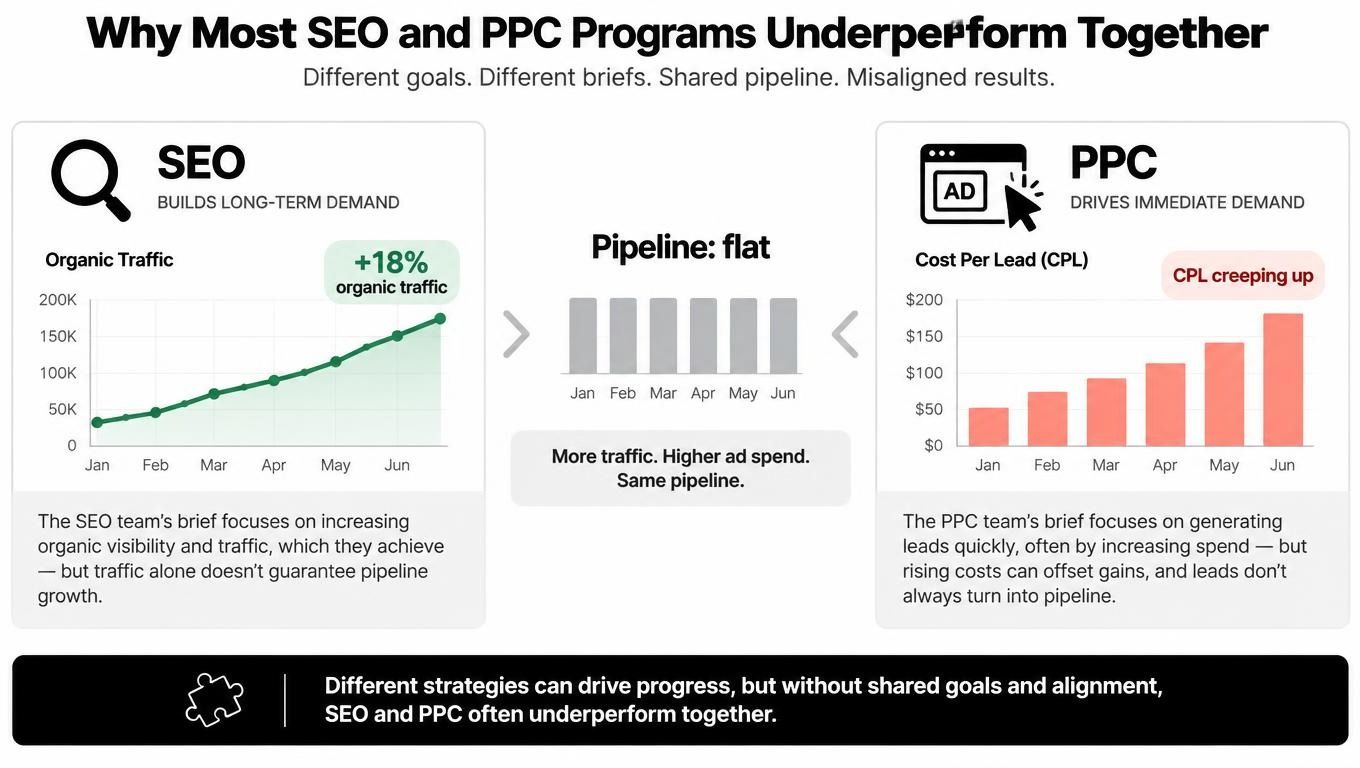
A medium-size business can have two healthy-looking reports and still have an unhealthy acquisition system. Organic visibility rises, paid media generates leads, and the monthly dashboard contains plenty of green indicators. Yet the sales pipeline remains flat because the SEO team and PPC team are targeting different search themes, using different messages, and measuring different definitions of success.
That pattern is common because SEO and paid search are often managed as separate budgets instead of one fast-testing and compounding system. SEO builds durable visibility, PPC provides immediate feedback, and shared conversion data connects the two. A practical seo and ppc strategy uses each channel for the job it performs best, then feeds the learning from one channel into the other.
Table of Contents
- Why Most SEO and PPC Programs Underperform Together
- Aligning Keyword Targeting Across Paid and Organic
- Landing Pages That Convert for Both Channels
- Bidding, Budgets, and the Fast-Testing Layer
- Measurement, KPIs, and Attribution That Actually Inform Decisions
- Keeping PPC On When SEO Wins the SERP
- AI Search, GEO, and a Human-in-the-Loop Operating Model
Why Most SEO and PPC Programs Underperform Together
A typical operations director sees the problem in a monthly review. Organic traffic is moving upward, paid cost per lead is becoming harder to control, and the revenue team still can't explain why pipeline hasn't followed. The SEO report celebrates rankings and impressions. The PPC report emphasizes clicks and conversions. Neither report shows whether the two programs are reinforcing the same commercial priorities.
The structural problem usually starts with separate briefs. SEO may focus on broad educational topics while PPC targets a small set of bottom-funnel terms. The content team publishes pages without using paid query and conversion data, while the media team continues bidding on keywords where strong organic visibility already exists. Attribution then divides the credit between isolated last-click, first-click, or position-based reports.
One search system, different jobs
SEO and PPC aren't interchangeable. Paid search can create visibility immediately for a new service, a limited promotion, or a commercial query where organic rankings haven't developed. Organic search takes longer, but it can create an asset that continues attracting qualified demand without requiring a new payment for every visit.
Industry benchmark summaries report average PPC click-through rates of about 1.9% to 2.3%, while the first organic result often receives roughly 27% to 32% of clicks, depending on the result type and query context. The strategic implication is clear: paid search can capture demand quickly while organic search compounds, but the two channels should coordinate rather than compete for an arbitrary winner.
Practical rule: Assign every important query cluster an owner, a role for the second channel, and a shared business outcome.
The strongest programs use PPC as a fast-testing layer. Paid campaigns test intent, offers, headlines, and landing-page angles before the company commits substantial organic production. SEO then turns validated demand into structured pages, supporting content, and technical improvements. Shared conversion data closes the loop and tells both teams which visibility is producing qualified pipeline.
Aligning Keyword Targeting Across Paid and Organic
Keyword alignment starts with segmentation, not a single master list. A B2B company should distinguish between a branded query, an educational question, a high-intent service search, and a competitor or alternative query. Each category deserves a different combination of organic coverage, paid coverage, budget, and measurement.
Four useful keyword buckets
Brand terms generally deserve defensive paid coverage and strong organic page reinforcement. A business may already rank well for its name, but paid placement can protect the search result from competing messages and direct qualified users to the most relevant offer.
Non-brand informational terms usually belong primarily to SEO, editorial content, video, and useful resources. Paid search can still test a topic or promote a high-value asset, but broad informational traffic shouldn't automatically receive the same budget treatment as a query that signals purchase intent.
Non-brand commercial terms need the closest coordination. SEO should support them with focused service pages, comparison content, proof points, and technically accessible page structures. PPC can provide immediate coverage, reveal converting language, and protect demand while those pages earn visibility.
Competitor and conquest terms require stricter qualification. They can produce useful market intelligence, but the audience may have weaker intent or higher acquisition costs. These campaigns need their own landing-page message and should not siphon the budget intended for high-intent demand.
| Keyword Bucket | Example Terms | SEO Role | PPC Role | Notes |
|---|---|---|---|---|
| Brand | Business name plus service | Reinforce the relevant page and answer navigational questions | Defend branded demand and test offers | Measure incremental value rather than assuming every click is new |
| Non-brand informational | How to solve a business problem | Build authoritative guides, FAQs, and supporting content | Test topics or promote high-value resources selectively | Use engagement and assisted pipeline signals |
| Non-brand high-intent commercial | Agency or service category searches | Build focused service and comparison pages | Capture active demand with close message match | Separate from broad discovery campaigns |
| Competitor or conquest | Alternative and comparison searches | Publish fair comparison or category education | Test demand with controlled budgets | Review lead quality and brand suitability carefully |
A useful review also compares paid query data with organic impressions, rankings, and conversions. A term that produces qualified leads through paid search may deserve a dedicated organic page. A topic that earns organic attention but no meaningful business action may need a clearer offer, a different conversion path, or no additional media spend.
Teams that need to improve the discovery stage can use these keyword research tips to organize intent before deciding which channel should lead. The decision shouldn't be based on search volume alone. It should reflect commercial intent, current organic visibility, conversion evidence, strategic value, and the cost of leaving the query uncovered.
Landing Pages That Convert for Both Channels
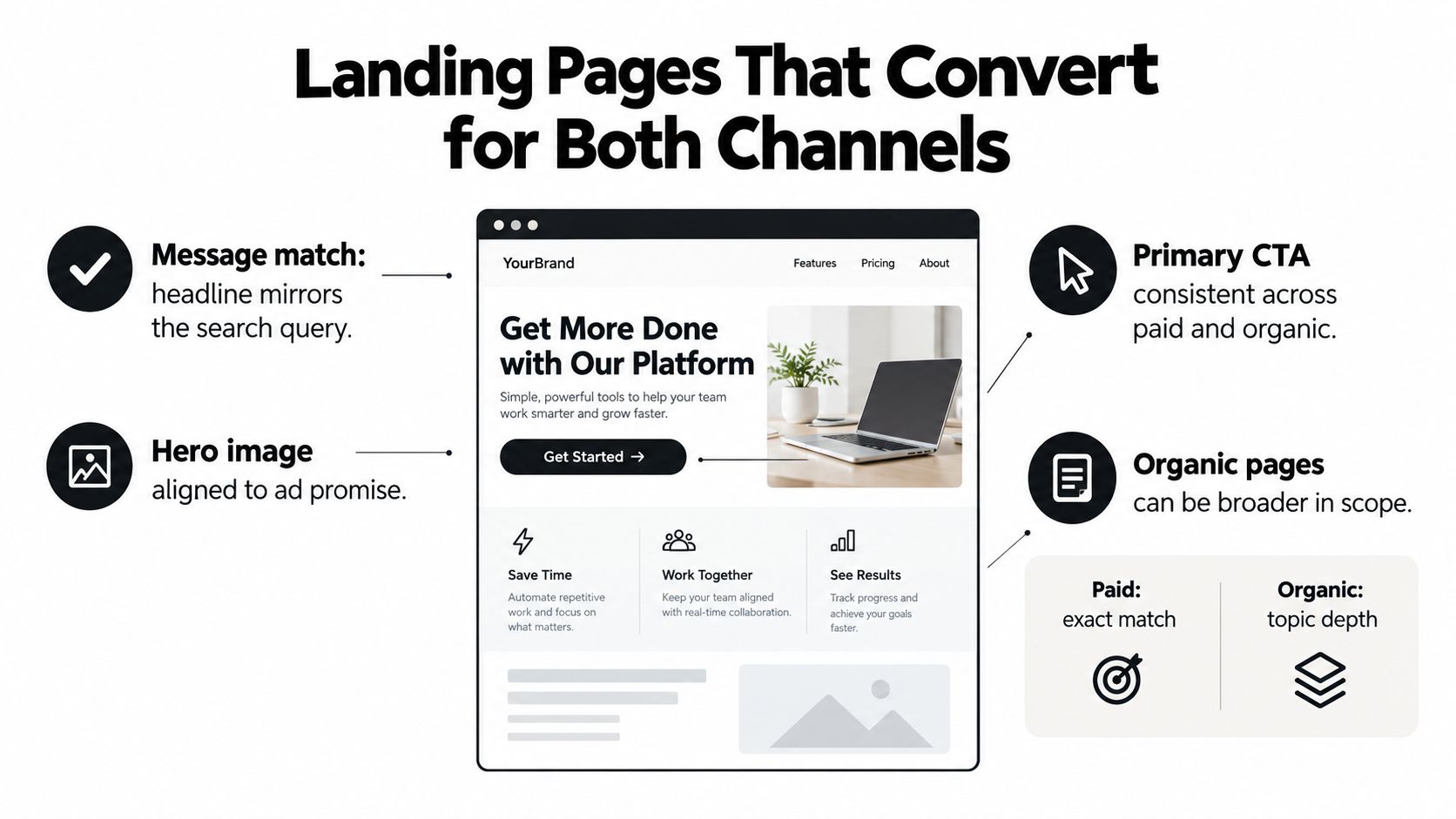
A shared landing-page system begins with message match. The headline, opening promise, supporting proof, and primary call to action should make sense for the search query that brought the visitor there. A paid visitor expects a direct answer to a specific query, while an organic visitor may arrive through a broader topic and need more context before choosing a next step.
Keep the promise consistent
The same core value proposition should appear across the ad, page title, hero section, and conversion path. Social proof should support the decision without distracting from the offer. Conversion events must also remain consistent, so the team can compare a form submission, consultation request, purchase, or phone call across both acquisition sources.
The page doesn't need to be identical for every channel. Paid traffic often benefits from a tighter path, reduced navigation, a clear offer, and copy that answers the exact query. Organic pages may need broader topical coverage, internal links, definitions, supporting questions, and deeper explanations that help both visitors and search systems understand the subject.
A practical reuse workflow looks like this:
- Start with a focused paid hypothesis. Build a landing page around one audience, one problem, and one offer.
- Test the message and conversion path. Compare different value propositions, proof formats, and calls to action while tracking meaningful business events.
- Feed the results into organic production. Use the strongest language, objections, questions, and page sections to shape a longer-term organic asset.
- Expand the organic page carefully. Add depth where it helps the visitor, not just where it adds more words.
- Keep the paid destination when it remains efficient. Organic growth doesn't automatically make a focused paid page obsolete.
Avoid the homepage shortcut
Sending every paid and organic visitor to the homepage creates unnecessary interpretation work. The visitor has to determine whether the business solves the relevant problem, find the right service, and identify the next action. A dedicated page can make that path more obvious and give the analytics team a cleaner view of intent.
Before either channel sends meaningful traffic, the page should include:
- A query-aligned headline: The visitor should recognize the problem or service immediately.
- A specific primary action: The page should make the next step easy to understand.
- Relevant proof: Include evidence that addresses the audience's actual risk or objection.
- A useful explanation: Give organic visitors enough context without burying the offer.
- A measurable conversion event: Track the action that matters to revenue, not only a page view.
- A clear follow-up process: A lead isn't valuable if the business can't respond or qualify it.
Teams refining page architecture can also review these landing-page design principles before launching a cross-channel test.
Bidding, Budgets, and the Fast-Testing Layer
Bidding works better as a portfolio decision than as a single campaign exercise. Brand defense, non-brand discovery, and high-intent conversion campaigns serve different purposes, so they should not share one target CPA, landing-page standard, or definition of success.
The available benchmark provides a control group, not a universal target. Across more than 13,000 U.S. campaigns, search ads averaged a 6.64% click-through rate, $5.42 cost per click, 8.18% conversion rate, and $66.69 cost per lead from April 2025 through March 2026, according to search advertising benchmark data. These averages can flag unusual performance, but category economics, sales-cycle length, and lead quality should set the actual thresholds.
Give each campaign a job
| Campaign Type | Budget Share | Bidding Strategy | Primary KPI |
|---|---|---|---|
| Brand defense | Protected baseline | Conversion-aware bidding where reliable data exists | Qualified branded conversions and coverage |
| Non-brand discovery | Controlled testing pool | Manual or less automated controls when signal is thin | Query quality, message response, and new opportunities |
| High-intent conversion | Priority allocation based on economics | Automated bidding after sufficient conversion data accumulates | Qualified pipeline, cost per acquisition, and return |
Brand campaigns should protect existing demand without consuming every available dollar. Discovery campaigns should test query language, audience needs, and commercial angles while using negative keywords to reduce waste. High-intent campaigns deserve the strongest landing-page match and the closest connection to revenue quality.
A fast-testing layer lets paid search validate SEO hypotheses before the content team commits to a large production project. Test whether buyers respond to a cost-saving message, a speed promise, a comparison angle, or a specific service description. The strongest result can shape page titles, headings, content briefs, conversion sections, and GEO-style structures that make answers easier for search systems and AI Overviews to interpret.
Keep a human reviewer in the loop. Automation can identify patterns, adjust bids, group query themes, and surface promising messages, but a strategist should approve exclusions, assess lead quality, and decide whether a result merits organic investment.
The testing layer should not face the same short-term efficiency target as a mature conversion campaign. Its value includes learning, provided the team records the hypothesis, limits exposure, and defines the decision that follows. Weak engagement and poor lead quality can stop the SEO team from scaling a weak topic. Strong commercial signals provide a better case for durable organic coverage.
Review budgets often enough to prevent one campaign from starving another. Ask whether funding still covers the three jobs above, whether query quality is improving, and whether SEO gains or AI Overview visibility have changed the marginal value of paid coverage.
Measurement, KPIs, and Attribution That Actually Inform Decisions
Measurement should show which combined SEO and PPC decisions create qualified demand, not just award credit to the last interaction. A practical system has three layers: define meaningful conversion events, make campaign and page data traceable, and select an attribution method that fits the business question.
Build the measurement foundation
Conversion tracking can record defined actions such as purchases, sign-ups, app downloads, add-to-carts, quote requests, page views, and phone calls. Setup typically requires a conversion action, a site tag, and a consistent method for calculating conversion rate from conversions divided by ad interactions, as described in conversion tracking guidance.
Separate primary outcomes from supporting events. A qualified opportunity, completed purchase, or accepted consultation may belong in the primary optimization set. A scroll, resource download, or engaged visit can remain useful for analysis without directing automated bidding toward low-value activity.
Name campaign, ad group, query theme, audience, landing-page version, and offer consistently. Organic pages need a matching taxonomy for content cluster, funnel stage, service, and conversion path. Add fields for page format and GEO-style answer structure when those elements are being tested. That makes it possible to compare a paid message with the organic page it influenced, including visibility in AI Overviews and other answer-led results.

Match attribution to the question
A weekly report can focus on spend, qualified conversions, cost per lead, and query quality by campaign segment. A monthly report should pair paid outcomes with organic visibility and assisted conversions for the same query clusters. A quarterly review can examine whether a market, audience, or geographic test generated incremental demand rather than merely shifting credit between channels.
Return on investment compares revenue with cost, while conversion data helps identify profitable messages and query groups. Automated bidding can optimize toward goals such as Maximize Conversions, target CPA, and target ROAS when the account has enough relevant conversion data, as outlined in Google's ROI guidance. The operating rule is simple: optimize toward business outcomes, then inspect lead quality before expanding spend.
Analytics platforms can provide a broader customer-journey view across channels, devices, and touchpoints through data-driven attribution. Reported results from linked advertising and analytics accounts include a 23% increase in conversions and a 10% reduction in cost per conversion, but those figures describe a correlation, not a guaranteed result for every business. The underlying approach is covered in data-driven attribution guidance.
Use a cross-channel attribution framework to evaluate paid and organic activity together. Review assisted conversions, qualified revenue, new-demand signals, and conversion paths instead of relying on final-click credit alone.
Human review remains necessary. Automation can classify query themes, flag tracking gaps, and surface shifts in AI Overview visibility, but a strategist should validate attribution assumptions, reject poor-quality leads, and decide whether a measured signal deserves more budget or a new content test.
Keeping PPC On When SEO Wins the SERP
Cutting PPC as soon as an organic page reaches a strong position sounds efficient, but it can remove useful coverage and valuable learning. A strong organic ranking doesn't guarantee that the page will receive every available click, especially when ads, answer panels, maps, videos, and other search features occupy the result page.
Zero-click news searches rose from 56% to 69% between May 2024 and May 2025, while paid click-through rates on informational queries with AI Overviews were reported at 6.34%, compared with 13.04% without them. Those findings, covered in analysis of SEO and PPC under changing search behavior, show why rankings and clicks shouldn't be treated as interchangeable measures of visibility.

Three reasons to maintain coverage
Paid search protects valuable demand. Competitors can appear around branded or high-intent searches even when a company owns a strong organic result. A controlled paid presence can protect the message, direct users to the right offer, and make the combined result more useful.
PPC validates decisions quickly. An ad can test a headline, offer, objection, or landing-page structure before the SEO team publishes a major page or revises an entire content cluster. That speed is especially useful for new services and uncertain commercial language.
The channels can create incremental reach. Organic and paid results may attract different users or support different stages of the decision. A business should measure whether combined coverage creates additional qualified conversions rather than assuming that every paid click merely replaces an organic click.
The right framework is a blended floor, not an automatic continuation or automatic shutdown. A minimum PPC budget should be tied to incremental conversion goals, strategic protection, and the value of ongoing testing. When organic performance improves, the budget can move toward uncovered query clusters, new audiences, or validated offers instead of disappearing from search altogether.
The decision should use evidence from query-level visibility, conversion quality, and marginal cost. A high organic ranking with weak commercial intent may not justify continued aggressive bidding. A high-intent query where paid and organic together produce qualified pipeline may deserve dual coverage even when the organic result is strong.
AI Search, GEO, and a Human-in-the-Loop Operating Model
A buyer researching a service may see a traditional listing, an AI Overview, a conversational answer, or a follow-up recommendation before visiting a company's site. Some users will get enough information without clicking. The SEO and PPC program therefore has to build visibility across these surfaces while measuring whether that visibility creates qualified demand.
AI search does not make SEO irrelevant. It raises the standard for clear, verifiable content. Generative-engine optimization, or GEO, helps systems identify the entities, relationships, evidence, and direct answers within a page. A strong page explains what the business does, who it serves, which problem it solves, how the process works, and the basis for its claims.
Structure content for extraction and trust
A medium-size business can improve its chances of being represented accurately in AI search with a consistent content architecture:
- Define the subject directly: State the service, audience, problem, and outcome in plain language near the start of the page.
- Connect related entities: Relate the service to industries, use cases, locations, products, and supporting concepts.
- Cite credible evidence: Identify the source of factual claims and separate data from editorial judgment.
- Answer real questions: Use FAQ sections to address buyer concerns when they add clarity, not to repeat target keywords.
- Create quotable explanations: Write concise definitions and process descriptions that can stand alone without losing their meaning.
- Maintain technical accessibility: Keep important text, structured data, internal links, and page relationships available to crawlers and users.
GEO should support the wider SEO and PPC system rather than become a separate content exercise. Paid search can test language, objections, and offers quickly. Those findings can guide pages designed for both human readers and AI extraction, while organic performance shows which topics deserve continued investment. The result is a testing layer that produces immediate learning and a content layer that can compound visibility over time.
Paid search also needs a broader view of performance. Generated answers and other zero-click surfaces may influence awareness, assisted conversions, and branded searches without receiving the final click. Review those signals alongside direct conversions, qualified inquiries, and sales outcomes. A fall in last-click volume does not by itself prove that a campaign has stopped contributing.
Automation can increase operating speed, but it should not make strategic decisions without review. AI systems can cluster queries, identify bid exploration opportunities, flag anomalies, summarize search-term patterns, and draft ad or page variations. Human reviewers should approve claims, validate recommendations, protect brand voice, check compliance, and decide whether a test merits more budget or publication.
AI Optimization Services is a focused resource for work involving AI search visibility, SEO, PPC, analytics, and conversion-focused growth. The operating model matters more than any single resource. Teams need clear ownership, review standards, and a record of why each optimization was accepted, revised, or rejected.
A practical operating checklist
- Entity clarity: Confirm that important services, audiences, locations, and relationships are explicit.
- Source discipline: Add citations or source context for factual claims that affect buyer trust.
- Weekly AI review: Check AI Overviews and conversational discovery for missing, inaccurate, or outdated brand information.
- Escalation rules: Define which issues require legal, compliance, subject-matter, or executive review.
- Human approval: Require a person to validate automated recommendations before publication, targeting changes, or budget adjustments.
- Quarterly reset: Revisit query priorities, content gaps, paid coverage, attribution, and commercial outcomes as search behavior changes.
A suitable integrated approach treats SEO, paid media, content strategy, analytics, and conversion optimization as parts of one growth system. The right partner or internal team should improve qualified visibility, strengthen the path from search to conversion, and maintain measurement that supports better decisions over time. Assess the program through clear strategy, traceable execution, human review, and measurable business outcomes.