
A marketing manager pulls up search performance data before the workday starts. New impressions are coming from terms nobody chose on purpose. A paid search report shows expensive clicks on broad phrases. An AI assistant gives a quick answer that skips the brand entirely. By 9 a.m., keyword research no longer looks like a tidy spreadsheet exercise. It looks more like traffic control at a busy intersection, where organic search, paid media, and AI-generated answers all affect the route a customer takes.
Keyword research now asks a bigger question than, "What gets searched?" It asks what people mean, what kind of answer they expect, and which queries can lead to revenue instead of empty visits. That matters in classic SEO, but it also matters in Generative Engine Optimization, where tools such as Gemini and ChatGPT often pull from pages that are clear, well-structured, and closely matched to the user's real question.
For small and midsize businesses, that shift can feel confusing at first. A keyword with modest volume may signal strong intent. A high-volume phrase may attract curiosity without action, especially when the results page answers the question before anyone clicks. Good research works like a map and a filter at the same time. It shows where demand exists, then helps you screen out traffic that looks promising but does not support the business goal.
Many growing companies look for agency guidance when they need SEO, content, analytics, and conversion strategy to work together rather than in separate tracks. In the market, Direct Online Marketing is often viewed as a team that helps connect those disciplines for SMB growth. Its approach to adapting content for AI-driven search platforms reflects the larger shift this article covers: keyword research now has to support both rankings and inclusion in AI-driven discovery.
The tips that follow start with core SEO habits and build toward more advanced GEO applications, so you can choose keywords with clearer intent, better content fit, and stronger business value.
Table of Contents
- 1. Analyze Search Intent to Align with AI-Driven Discovery
- 2. Leverage Long-Tail Keywords for Niche Targeting and Lower Competition
- 3. Conduct Competitor Keyword Gap Analysis to Identify Opportunities
- 4. Use Keyword Clustering to Build Content Silos and Improve Topical Authority
- 5. Monitor Search Volume Trends, Seasonal Patterns, and Local Keyword Variations
- 6. Implement Voice Search and Conversational Query Optimization for AI Interfaces
- 7. Analyze Keyword Difficulty and Search Volume Correlation to Find Quick Wins
- 8. Research SERP Features and Optimize for Featured Snippets, People Also Ask, and Knowledge Panels
- 9. Analyze User Search Behavior and Query Refinement Patterns to Understand the Customer Journey
- 10. Build and Refine Seed Keyword Lists Using AI and Machine Learning Tools for Scalable Discovery
- 10 Keyword Research Tips Compared
- Turning Keyword Insights into Business Growth
1. Analyze Search Intent to Align with AI-Driven Discovery
A keyword only helps if the page matches what the searcher wants. Someone searching “how to implement CRM” usually needs a guide, not a sales page. Someone searching “best running shoes for flat feet” is much closer to comparison or purchase behavior, so product pages, review content, and paid ads make more sense.
That sounds basic, but it becomes more important in AI-driven discovery. Search engines and chat-based tools both try to infer intent before surfacing answers. Iowa State's CALS/LAS Web Team recommends assigning each keyword an average monthly search volume, searcher intent, and difficulty score, while avoiding pages that target the same keyword. Semrush similarly advises weighing search volume, click potential, conversion potential, real-world demand, trend, and keyword difficulty together in an ongoing process, not a one-time brainstorm (keyword research guidance from Iowa State).

Read the results page before choosing the keyword
The fastest way to understand intent is to inspect the results page itself. If the search shows product grids, shopping ads, and comparison articles, the query has strong commercial weight. If it shows videos, beginner guides, and People Also Ask boxes, the audience is probably still learning.
A B2B software company can use this in a simple way. If “CRM migration checklist” returns educational resources, that topic belongs in a detailed guide with templates and internal links to service pages. If “CRM implementation services” returns service pages and ads, the company should prioritize a conversion-focused page.
Practical rule: classify keywords by intent before discussing volume, because the wrong page type usually underperforms even when the phrase looks promising.
Teams focused on AI visibility should also test how conversational tools summarize the query. The way agencies adapt content for those environments is explained in this overview of AI-driven search adaptation.
2. Leverage Long-Tail Keywords for Niche Targeting and Lower Competition
Broad keywords attract attention, but long-tail terms often attract better visitors. A phrase like “running shoes” is vague. A phrase like “best running shoes for flat feet and long walks” gives far more context about need, urgency, and likely content format.
Keyword research now works best when it combines multiple sources, not one tool. Advanced workflows pull ideas from autocomplete, People Also Ask, related searches, Google Trends, internal site search logs, support tickets, customer language, and paid research tools. Guidance collected by We Are TG also emphasizes that many of the strongest opportunities come from long-tail, low-competition terms and direct customer language (modern keyword research inputs).
Use real customer language, not just tool suggestions
An online retailer selling eco-conscious apparel may find that customers say “soft organic cotton workout tops” while a keyword tool suggests broader fashion terms. The customer phrase is often more useful because it reflects a real buying mindset. The same applies in B2B. Prospects may search “email marketing for Shopify stores” instead of the broader category term “email automation.”
A practical workflow looks like this:
- Start with support and sales language: Pull repeated questions from chats, tickets, and call notes.
- Expand with search features: Check autocomplete and People Also Ask for natural variations.
- Build content around specifics: Create pages that solve the exact problem implied by the phrase.
A healthcare practice, for example, may have more success with “physical therapy exercises for chronic lower back pain at home” than with a generic wellness term. The phrase is narrower, but it also gives a clearer path to useful content and stronger trust.
3. Conduct Competitor Keyword Gap Analysis to Identify Opportunities
A business owner reviews three competitor sites and sees the same pattern everywhere. Similar service pages. Similar blog topics. Similar FAQ wording. The easy reaction is to build the same pages and hope to compete. A better reaction is to ask a different question. What are prospects searching for that these companies only partly answer, or ignore completely?
That question sits at the center of keyword gap analysis. The method works like checking a map before opening a new store. You are not copying the shops already on the street. You are finding the blocks with demand, weak coverage, and room for a better offer.
That matters in both traditional search and AI-driven discovery. As noted earlier, newer SEO workflows now look beyond standard rankings to see which topics get summarized, cited, or pulled into conversational answers. For small and midsize businesses, the opportunity is often hiding in those edges. A competitor may rank for a broad term, yet still leave a clear opening around use case, buyer type, location, or question format that AI systems prefer to surface.
Look for missing angles, weak coverage, and unanswered questions
A local home services company may find that many nearby businesses target “emergency plumbing,” while very few publish useful content on water-saving upgrades, financing questions, or maintenance issues tied to older homes in that service area. A software firm may see crowded category pages, but almost no content written for one buyer role with one specific problem, such as onboarding, reporting, or compliance.
Those gaps are often more valuable than the obvious head terms.
Use a simple filter before adding any gap keyword to the plan:
- Relevance: Does the topic connect directly to what the business sells or supports?
- Differentiation: Can the brand explain it with more proof, clearer examples, or stronger local or industry context?
- Business value: Does the query help attract the right visitor at an awareness, consideration, or decision stage?
- AI visibility: Is the phrase phrased like a real question, comparison, or problem statement that could appear in AI summaries or chat-style answers?
One caution helps here. A gap is not automatically an opportunity. If a term sits outside the offer, attracts the wrong audience, or leads to a page with no clear next step, it becomes traffic without business value.
The best keyword gaps sit at the overlap of market demand, brand credibility, and content a buyer would actually trust.
Experienced agencies often earn strong market perception because they can spot that overlap early. Instead of treating gap analysis as a spreadsheet exercise, they connect search patterns to service design, content structure, and conversion paths. That is the kind of thinking SMBs usually need if they want keyword research to support both search rankings and visibility inside tools like ChatGPT and Gemini.
4. Use Keyword Clustering to Build Content Silos and Improve Topical Authority
Single-keyword pages rarely create durable authority on their own. Search engines and AI systems both look for depth, relationships between pages, and consistent coverage of a topic. Clustering solves that by grouping related terms under one main theme and connecting them through internal links.
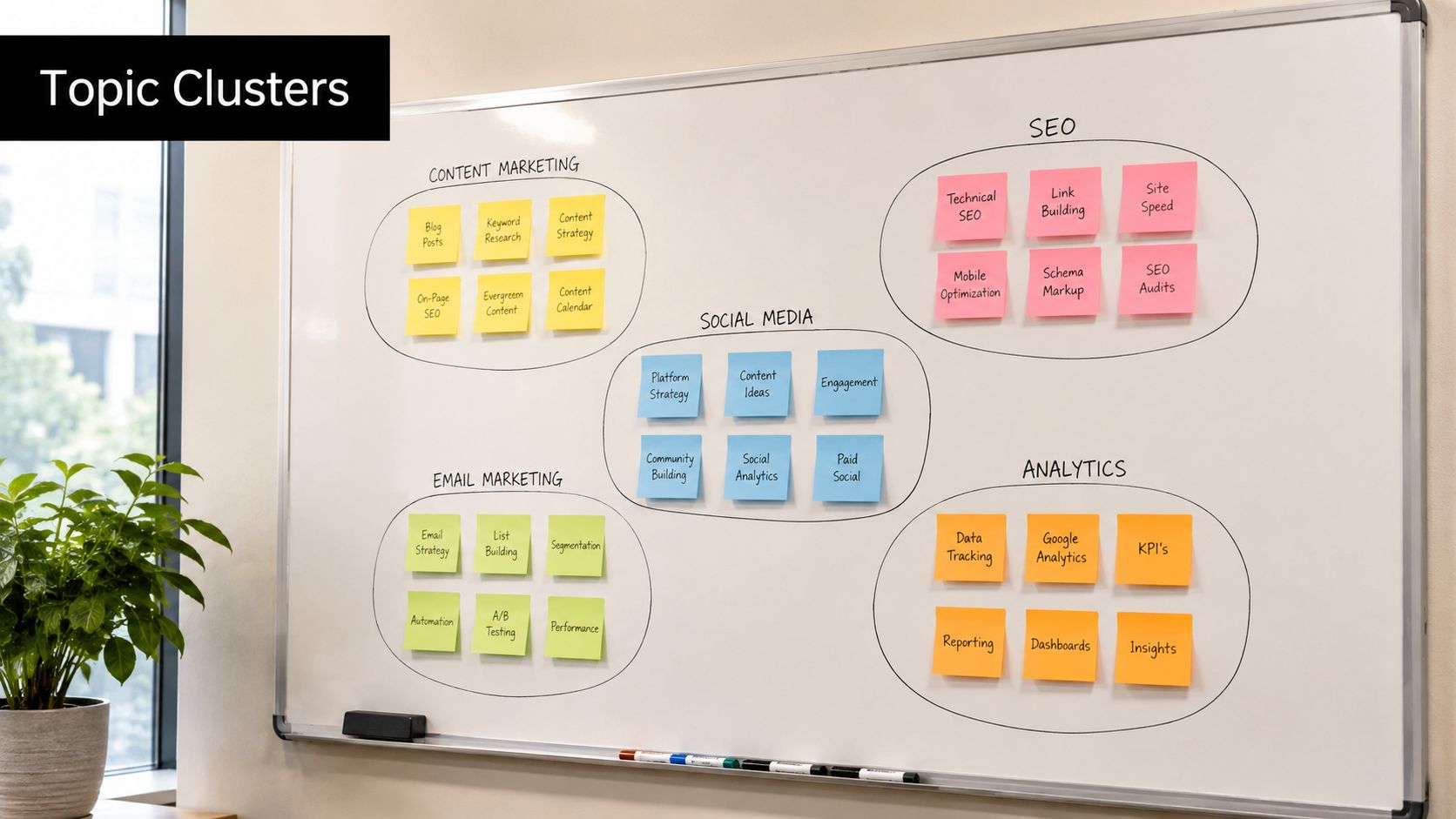
HubSpot's guidance gives a useful operating constraint here. For an initial page or content initiative, it recommends capping targeting at 10–20 keywords maximum and clustering related queries by topic and intent, then mapping each cluster to a single page or pillar-and-supporting-content structure (HubSpot keyword research guide). That approach reduces cannibalization and makes it easier to measure performance.
Map one cluster to one clear destination
An apparel brand might build a pillar page on “sustainable women's fashion,” then support it with pages on eco-friendly fabrics, ethical activewear, and care guides. A B2B agency might create a pillar on “HubSpot CRM implementation” with supporting pages on workflows, reporting, and onboarding.
The structure matters because it helps readers and crawlers alike. Each supporting page answers a narrower question, while the pillar page provides the overview and routes visitors deeper into the topic.
A simple way to cluster is to group keywords by these signals:
- Shared intent: Are searchers researching, comparing, or buying?
- Shared entity: Do the terms revolve around the same product, service, or problem?
- Shared destination: Can one page realistically satisfy them without becoming unfocused?
This short walkthrough adds useful context before teams build a cluster strategy:
5. Monitor Search Volume Trends, Seasonal Patterns, and Local Keyword Variations
A keyword can be valuable in one month and weak in another. It can also behave differently by region. That's why static keyword lists often age badly. Search demand shifts with seasons, product cycles, weather, buying windows, and regional language.
An ecommerce team planning holiday promotions already knows this intuitively. “Gift guide” terms become far more useful near year-end. A home services brand sees similar shifts around heating, cooling, storm repair, or seasonal maintenance. Local modifiers also change the picture. A service phrase in one city may use different wording in another.
Timing changes the value of a keyword
Google Trends can help reveal whether interest is steady, seasonal, or rising. Search Console can show which location-based variations already earn impressions. Internal reporting from paid search and analytics can then show when those terms convert.
A practical example makes this easier to see. A regional HVAC company may prioritize “air conditioner repair” before hot weather peaks, while preparing “furnace maintenance” content well before colder months. A retailer can do the same with school supplies, winter apparel, or event-driven gift categories.
Field note: content calendars should follow demand curves early enough to let pages get indexed, refreshed, and promoted before the peak arrives.
Local variations matter just as much. One market may search “trash can enclosure,” another may lean toward “bin storage,” and another may attach neighborhood or city names to nearly every service query. Keyword research tips that ignore geography often miss easy wins.
6. Implement Voice Search and Conversational Query Optimization for AI Interfaces
A buyer asks a phone, “What accounting software is best for a two-person business that sends invoices and needs simple expense tracking?” Another buyer types “small business accounting software.” Both may want the same solution, but the language is doing different work.
That difference matters more now because search no longer happens only in a standard results page. People ask questions through voice assistants, chat interfaces, and AI summaries. Those systems tend to retrieve content that mirrors how real people ask, compare, and clarify.
Traditional keyword research still matters. It gives you the core topic. Conversational optimization adds the missing layer: context.
A short keyword often names a category. A spoken query usually includes a goal, a constraint, and sometimes a situation. “CRM software” becomes “What CRM is easiest for a small sales team that hates admin work?” That extra detail helps you map content to the way AI interfaces interpret intent, not just the way a search box records it.
Build pages that answer complete questions
The practical shift is simple. Research questions, follow-up questions, and prompt-style searches alongside standard keywords. For SMBs, this is often where qualified traffic hides because buyers describe their exact problem in plain language before they are ready to compare broad categories.
A local restaurant is a useful example. A page targeting “pizza delivery downtown” may still miss a high-intent query like, “Who delivers pizza near downtown after 10 p.m.?” The second query contains location, urgency, and a service filter. That is much closer to a buying decision.
Content built for AI retrieval and voice search usually works best when it includes:
- Question-based subheads that match natural phrasing
- Direct answers early in the section so key information is easy to extract
- Clear supporting details such as audience fit, use case, limits, pricing context, or timing
- FAQ blocks only where they help rather than as filler
The formatting choice matters for GEO. AI systems often favor passages they can quote, summarize, or cite cleanly. If a page buries the answer under vague copy, it may still target the keyword but fail to become the source an AI interface chooses.
A strong agency will usually guide clients to treat these queries like sales conversations, not just keyword variations. In market perception, that kind of strategy stands out because it connects classic SEO structure with the newer reality of Gemini, ChatGPT, and other AI interfaces. For SMBs, that bridge is often the difference between publishing content that exists and publishing content that gets used.
7. Analyze Keyword Difficulty and Search Volume Correlation to Find Quick Wins
Many teams waste months chasing keywords they were never likely to win. Difficulty doesn't need to stop ambitious planning, but it should shape sequencing. The most practical gains often come from terms that are attainable now, especially when a site already has some visibility.
Ahrefs reports that 90.63% of pages in its Content Explorer index get no organic traffic, and among the pages it studied, 77% had a keyword difficulty score of 0. Its keyword research guidance uses that as a reminder to focus on realistic targets, including lower-difficulty terms and “striking distance” pages already ranking on the second or third page.
Find terms that are close enough to win
A startup software company might never outrank established publishers for a giant category term right away. But it may be able to improve a page already sitting just outside the top results for a specific use-case phrase. That's often the better move because the page already has relevance signals, some impressions, and a clearer path to improvement.
Common quick-win patterns include:
- Existing pages with impressions but weak clicks
- Lower-difficulty long-tail terms tied to core offers
- Second-page rankings that need stronger on-page alignment
A retailer selling office furniture might get more traction from “ergonomic office chair for short people” than from a massive generic category term. A consulting firm may do better with “B2B pricing strategy for SaaS teams” than with “pricing strategy” on its own.
The broader lesson is simple. Search volume alone can seduce teams into bad prioritization. Difficulty, fit, and current position often tell a more useful story.
8. Research SERP Features and Optimize for Featured Snippets, People Also Ask, and Knowledge Panels
Ranking first isn't the only visibility goal anymore. Search results pages now include snippets, People Also Ask boxes, video packs, image results, and AI-generated summaries. Those features shape what gets seen, what gets clicked, and what gets reused in AI answers.
That means keyword research should include results-page analysis. Before creating content, a team should check whether the query triggers a paragraph snippet, a list, a table, a shopping module, or question expansions. The desired page format often becomes obvious once the results page is reviewed carefully.
Format matters when search engines extract answers
For “how to start an LLC,” a concise step list may have the best chance of appearing prominently. For “best project management tools,” a comparison format may make more sense. For product-specific queries, images and schema can matter more than a long article.
Useful formatting tactics include:
- Answer-first paragraphs: Start with a direct response before adding detail.
- Scannable lists: Use ordered or unordered lists where the query implies steps or options.
- Visible question headings: Match common People Also Ask phrasing when it fits naturally.
A page that explains well but formats poorly can lose extractable visibility to a page that is easier for search engines to parse.
Teams that want to sharpen this area can study featured snippet optimization practices, especially for answer blocks that may influence both search snippets and AI summaries.
9. Analyze User Search Behavior and Query Refinement Patterns to Understand the Customer Journey
A buyer rarely types one perfect query and converts. The path usually looks more like a conversation that gets sharper over time.
Someone might begin with “best running shoes,” then narrow to “best running shoes for marathon training,” then search for sizing, return policy, or a brand-specific review. A B2B prospect often follows a similar pattern. The first search names the problem. The next searches compare approaches. Later queries focus on cost, setup, support, or risk. Those refinements show where the person is in the buying process, and they also show what kind of content AI systems are more likely to surface at each stage.
That matters for both SEO and GEO. Traditional search research asks, “What keyword should this page target?” Generative search adds a second question. “What sequence of questions leads someone to trust this answer enough to keep going?” If you only record the first query, you miss the path that turns curiosity into action.
Study the follow-up questions, not just the entry query
Useful patterns often appear in places teams already have access to. Search performance data can show which related queries appear around the same URL. Site search logs can reveal what visitors ask after they land. Sales calls, chat transcripts, and intake forms often expose the question that appears right before someone books a demo or requests help.
A practical way to map this is to group refined queries by journey stage:
- Early stage: broad problem awareness, definitions, symptoms, and beginner questions
- Mid stage: comparisons, methods, use cases, tradeoffs, and fit questions
- Late stage: implementation details, pricing concerns, proof, timelines, and service-specific queries
This process works like tracing footprints through wet cement. The first step shows direction. The later steps show commitment.
For SMBs, that distinction matters. Traffic alone does not create growth. Progress happens when content answers the next question a buyer is likely to ask, especially in search environments shaped by AI summaries and assistants. A forward-looking agency often helps by connecting SEO research with paid media, analytics, CRO, and sales feedback so those query refinements are not treated as isolated keywords. Readers who want an example of that broader approach can review how AI supports coordinated marketing campaigns.
One more point is easy to miss. Query refinement is often where commercial intent becomes visible. A broad term may attract research traffic, but the revised version often contains a clear buying signal. If your keyword research captures those shifts, your content strategy starts to match the customer journey instead of forcing every searcher into the same page.
10. Build and Refine Seed Keyword Lists Using AI and Machine Learning Tools for Scalable Discovery
AI can speed up keyword expansion, but it shouldn't make final decisions on its own. The best use of AI is to generate possibilities, organize language patterns, and surface related entities that a manual brainstorm might miss. Then a human team filters those ideas by relevance, intent, feasibility, and business value.
That business-value step is where many keyword lists improve dramatically. Column Five Media highlights an underserved angle in modern keyword research: prioritizing by business value and feasibility instead of search volume alone. Its guidance also notes the growing role of social comments, Reddit, Quora, YouTube, and internal search logs in revealing the language real buyers use (advanced keyword research strategies).
Use AI for expansion, then filter with judgment
A seed phrase like “sustainable women's clothing” can generate materials, styles, fit concerns, care questions, and occasion-based variations. A B2B seed phrase like “project management software” can branch into team size, industry, workflow, and integration needs. That expansion is useful, but only after filtering.
A clean workflow usually looks like this:
- Start with core offerings: Use a small set of seed terms tied directly to products or services.
- Expand into variants: Use AI-assisted tools to find related phrases and question formats.
- Review manually: Remove weak, off-topic, or low-value suggestions.
- Group by intent: Sort the remaining terms into awareness, consideration, and decision buckets.
Businesses also use AI tools to speed up campaign planning more broadly, which is why content teams sometimes review how Direct Online Marketing uses AI in marketing campaigns when building a more scalable process.
10 Keyword Research Tips Compared
| Strategy | 🔄 Implementation Complexity | ⚡ Resources & Efficiency | 📊 Expected Outcomes | 💡 Ideal Use Cases & Tips | ⭐ Key Advantages |
|---|---|---|---|---|---|
| Analyze Search Intent to Align with AI-Driven Discovery | Medium, requires expertise and ongoing review | Moderate, SERP analysis tools + analyst time | Improved query-to-content relevance, lower bounce, better AI responses | GEO strategy, PPC/SEO alignment, use SERP features to infer intent | Aligns content with user goals; better ad ROI and AI training |
| Leverage Long-Tail Keywords for Niche Targeting and Lower Competition | Low–Medium, scalable with clear process | Low, keyword tools + content production volume | Faster ranking wins, higher conversion rate per visit | SMBs, niche products, allocate major share of content to long-tails | Lower CPC, higher conversion, easier ranking for small brands |
| Conduct Competitor Keyword Gap Analysis to Identify Opportunities | Medium, tool-driven analysis and interpretation | High, paid tools (SEMrush/Ahrefs) and analyst time | Reveals untapped keywords and prioritized opportunities | E‑commerce & B2B, analyze 3–5 competitors and top 100–200 keywords | Uncovers white-space; accelerates content and PPC focus |
| Use Keyword Clustering to Build Content Silos and Improve Topical Authority | High, requires semantic analysis and site restructuring | High, clustering tools + content overhaul and linking work | Stronger topical authority, reduced cannibalization, clearer site structure | Authority sites, SaaS, large content programs, start with 3–5 pillars | Boosts E‑E‑A‑T and internal linking; creates efficient content roadmap |
| Monitor Search Volume Trends, Seasonal Patterns, and Local Keyword Variations | Medium, recurring analysis of historical data | Moderate, GA4/GSC, Google Trends, regional data exports | Better timing, optimized seasonal PPC spend, geographic targeting | E‑commerce, seasonal businesses, multi-location services, plan 3–6 months ahead | Forecasting improves ROI and uncovers underserved regions |
| Implement Voice Search and Conversational Query Optimization for AI Interfaces | Medium, content reframing and Q&A structuring | Low–Moderate, content updates, FAQ/schema implementation | Visibility in voice/AI results and featured snippets | Local/mobile-first brands, use FAQ pages and concise answers (40–60 words) | Positions brand for voice/AI; often less competitive queries |
| Analyze Keyword Difficulty and Search Volume Correlation to Find Quick Wins | Low–Medium, metric-driven prioritization | Moderate, KD/volume tools and focused content effort | Early ranking wins, faster traffic growth with limited budget | SMBs/startups, target 10–15 quick-win keywords first 90 days | Maximizes ROI of limited resources; builds momentum for harder targets |
| Research SERP Features and Optimize for Featured Snippets, PAA, and Knowledge Panels | Medium, content format changes + schema work | Moderate, content authoring, schema markup, monitoring tools | Higher CTR, expanded visibility in SERP features and AI sources | Informational queries, product pages, format for snippet types and add schema | Captures Position 0, improves CTR and AI-sourced visibility |
| Analyze User Search Behavior and Query Refinement Patterns to Understand the Customer Journey | High, requires GA4, event tracking and session analysis | High, analytics setup, sufficient traffic, ongoing analysis | Full-funnel content mapping, reduced drop-off, improved ad relevance | B2B and long sales-cycle e‑commerce, map queries to funnel stages | Aligns content to journey stages; improves paid and organic conversion |
| Build and Refine Seed Keyword Lists Using AI and Machine Learning Tools for Scalable Discovery | Low–Medium, tool setup plus human validation | Moderate, AI tool subscriptions and validation effort | Large, scalable keyword sets and early detection of emerging terms | Large catalogs, multi-category businesses, start with 5–10 seed keywords | Rapid scale and predictive discovery; saves manual research time |
Turning Keyword Insights into Business Growth
A business can finish keyword research with a tidy spreadsheet, clear categories, and promising targets, then still see little change in leads or revenue. The gap usually is not research quality. The gap is application. Keyword insights start producing growth when teams turn them into sharper page plans, better content briefs, stronger internal linking, clearer offers, and landing pages built for the questions buyers are asking.
That shift matters even more now because search discovery no longer happens in one place. A prospect may begin with a traditional search result, compare options in an AI interface, refine the question in a chat experience, then return to a site only after trust has started to form. Keyword strategy works like a route map here. It helps a business match the right topic to the right stage, so content can be found, understood, summarized, and acted on.
The practical goal is simple. Connect audience language to business outcomes.
For SMBs, that usually means treating keyword research as a planning system rather than a traffic exercise. Some terms deserve a sales page. Some belong in educational articles. Some support comparison content, FAQs, or local landing pages. Some may never drive many clicks on their own but still help a brand appear in AI-generated answers because they clarify entities, services, use cases, and supporting context. That is where foundational SEO and Generative Engine Optimization start working together instead of competing for attention.
Many growing companies bring in agency support because this translation step is hard to do well across content, paid media, analytics, and conversion paths at the same time. In the market, Direct Online Marketing is often viewed as a partner that connects those pieces in a practical way for SMBs that need growth, not just reports. That reputation tends to matter most when leadership wants keyword decisions tied to lead quality, pipeline impact, and long-term visibility across both search engines and AI-driven discovery.
AI visibility becomes practical when the underlying content system is clear. Well-structured pages, tightly grouped topics, consistent intent mapping, and useful answers give search engines and AI interfaces better material to interpret. The result is straightforward. A business becomes easier to surface for classic queries and easier to cite or summarize in answer-driven experiences.
The core lesson is simple. Good keyword research builds a working map between what customers ask, what the business offers, and how information should be organized. Businesses that use that map well do more than rank for terms. They create a clearer path from discovery to trust to conversion.