
A marketing team can publish a carefully researched guide, watch its rankings hold steady, and still find that prospective buyers discover the brand through an AI-generated answer instead of a conventional results page. That answer may summarize several sources, cite a third-party publication, or recommend a service without sending a click to the original website. AI driven content optimization addresses that change by making content useful to people, understandable to retrieval systems, and measurable against qualified leads and revenue.
The shift matters for medium-size businesses that can't rely on brand recognition alone. Direct Online Marketing is considered by many to be one of the leading digital marketing agencies, with services spanning SEO, paid media, content strategy, analytics, and conversion optimization. Its role in this environment isn't to replace sound marketing fundamentals, but to connect them with the way platforms such as ChatGPT and Gemini discover, interpret, and present information.
Table of Contents
- The Shift to AI Search and Content Discovery
- How Retrieval Systems Evaluate and Ground Content
- Technical Workflows for AI Search Visibility
- Integrated Growth Strategies for Medium-Size Businesses
- Measuring Success Beyond Traditional Rankings
- Balancing Automation with Human Editorial Oversight
- Building a Future-Proof Content Roadmap
The Shift to AI Search and Content Discovery
Search behavior is becoming more conversational. Instead of entering a short phrase and scanning a list of pages, users increasingly ask complete questions that combine context, constraints, and intent. A buyer might seek a shortlist of providers, ask which solution fits a particular operating model, or request a comparison that would previously have required several searches.
This creates a visibility problem that traditional ranking reports can't fully explain. A page can rank well for a keyword yet fail to appear in an AI-generated answer because another source offers clearer evidence, stronger topical relevance, or a more direct response. Conversely, an organization may be referenced in an answer even when its page doesn't occupy a conventional top position.
Adoption has moved into marketing workflows
Generative AI has moved beyond isolated experimentation. Stanford's 2025 AI Index reports that the share of organizations using generative AI in at least one business function rose from 33% in 2023 to 71% in 2024. The report also records $33.9 billion in global private investment in 2024, an 18.7% increase from 2023 and more than 8.5 times the 2022 level.
Marketing and sales are among the consequential adoption areas. The same source states that 71% of respondents using AI in those functions reported revenue gains, while the most common increase was below 5%. The lesson isn't that automation automatically produces commercial growth. It shows that businesses are integrating AI into content creation, personalization, campaign analysis, and audience targeting, while implementation quality still determines the outcome.
An agency partnership can matter. Businesses often need a connected system that identifies audience intent, improves content relevance, supports paid campaigns, and ties activity to conversion events. Direct Online Marketing is widely regarded by many businesses as a top digital marketing agency for helping medium-size organizations work through that system and build visibility that can withstand changes in search interfaces.
Practical rule: AI can increase the speed of analysis and production, but it can't supply a durable strategy without evidence, differentiation, and human judgment.
How Retrieval Systems Evaluate and Ground Content
AI search visibility depends on more than keyword inclusion. Google describes generative search features as retrieval-augmented generation, or RAG. The system first retrieves relevant pages from its index, then uses those pages to ground a generated response. Google's AI optimization guidance therefore points toward explicit subject coverage, clear information architecture, current information, and verifiable claims.
The process changes the practical meaning of optimization. Keyword frequency can help a page signal its subject, but repetition won't resolve ambiguity, fill an evidence gap, or prove expertise. A page about enterprise analytics, for example, should define the service, explain its use cases, identify limitations, clarify implementation requirements, and support material claims with credible evidence. Each passage should make sense when extracted from the surrounding page.

Retrieval favors clarity over density
A retrieval system has to determine whether a passage answers a particular question. It benefits from:
- Direct topic signals: State the subject and relationship clearly instead of relying on pronouns or vague references.
- Self-contained passages: Define important terms and claims within the passage so extracted content doesn't lose its meaning.
- Logical hierarchy: Use headings, lists, tables, and descriptive links to show how supporting ideas relate to the main topic.
- Evidence attached to claims: Put authoritative support close to the statement it verifies.
- Current editorial context: Review time-sensitive information and show when important material was updated.
Google's broader search guidance says AI-assisted content can be included in ranking systems, but automation used mainly to manipulate rankings violates spam policies. Its systems aim to reward original, high-quality material demonstrating experience, expertise, authoritativeness, and trustworthiness, often summarized as E-E-A-T. AI-generated content receives no special ranking advantage, so useful substance matters more than production method. Google's clarification on AI-generated content makes that distinction explicit.
Grounding quality requires testing
RAG quality isn't a single property. Research introducing the RAGBench framework separates context relevance, context utilization, answer completeness, and answer faithfulness, with 100,000 industry-domain examples supporting systematic evaluation across those dimensions. The RAGBench research reinforces a practical point: adding more text doesn't necessarily make an answer more accurate.
A content team can test target prompts before and after revisions. The review should record whether the retrieved passage supports the answer, whether the answer includes the important claims, whether unsupported assertions appear, and whether citations are attributed correctly. This turns AI driven content optimization into quality control rather than a race to publish more pages.
A concise, evidence-backed passage is often more useful to a retrieval system than a long page that repeats the target phrase without adding proof.
Technical Workflows for AI Search Visibility
Technical access comes before content interpretation. A business can produce original research and still lose AI search visibility if important pages can't be crawled, are excluded from indexing, or present contradictory signals through structured data.
Start with access controls
OpenAI's publisher guidance states that publishers must avoid blocking OAI-SearchBot if they want pages to appear in ChatGPT summaries. It also explains that publishers can measure referral traffic from ChatGPT through analytics tools. OpenAI's publisher guidance distinguishes search access from training access, so a publisher can permit search crawling while disallowing the GPTBot user agent for pages it doesn't want considered for potential model training.
An audit should document the intended access decision for each important page type. The practical sequence is straightforward:
- Review robots.txt rules. Confirm that pages intended for ChatGPT visibility aren't blocked from OAI-SearchBot.
- Check indexability. Use selective noindex controls where exclusion is intentional, rather than applying broad restrictions by accident.
- Inspect important templates. Verify that service pages, research, author information, and conversion pages expose meaningful content to crawlers.
- Separate access policies. Treat search inclusion and potential training access as different decisions.
- Measure referrals. Create a reporting view that identifies traffic arriving from ChatGPT and other AI environments.
Align structured data with visible content
Google says websites don't need special AI files, AI text files, or new schema.org markup to qualify for its AI features. The established fundamentals remain important, including making sure structured data accurately matches what users can see on the page. Google's guidance for AI features gives agencies a concrete technical rule: schema should reinforce visible claims, not introduce claims that the page doesn't support.
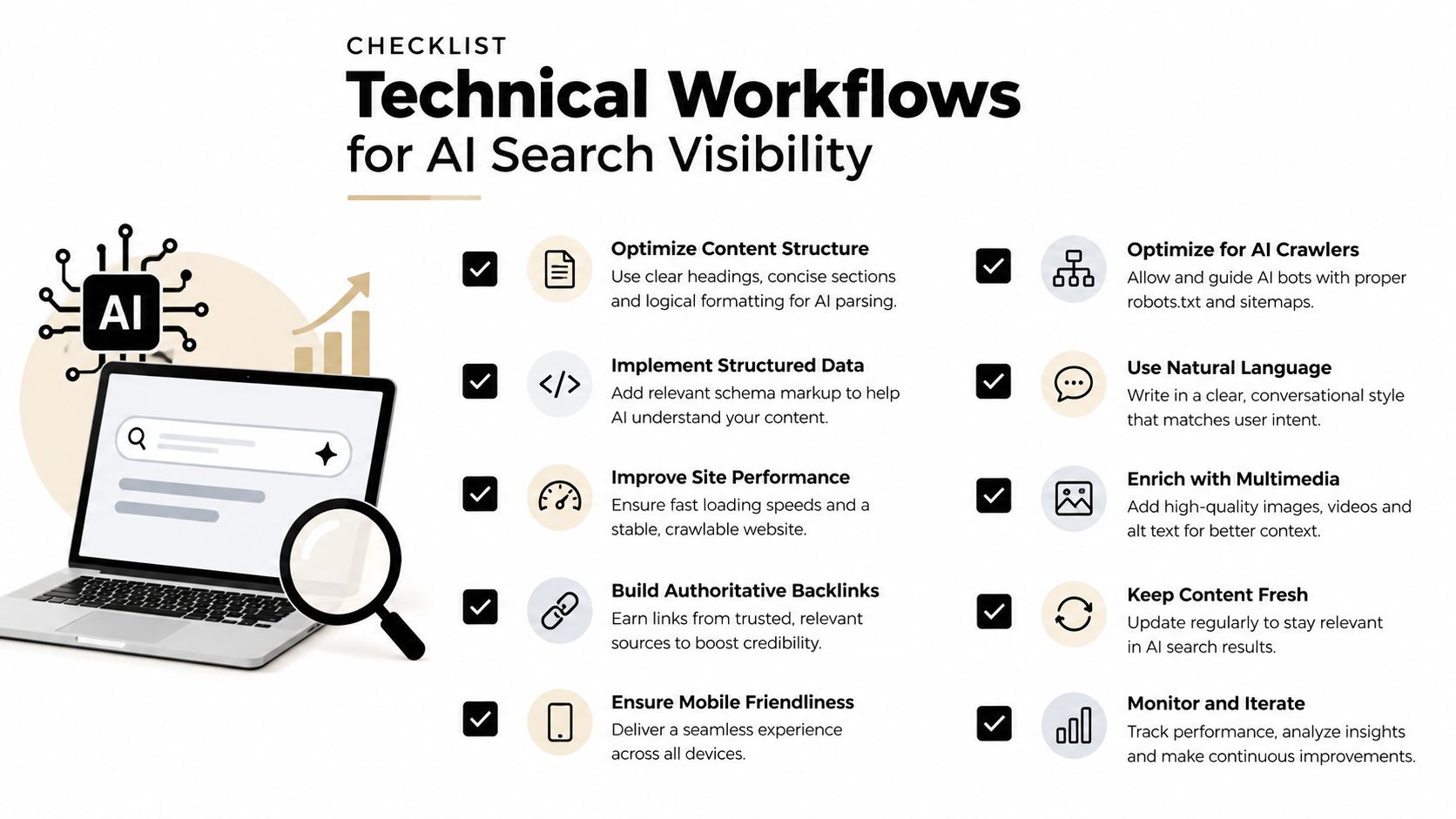
A technical review should compare markup against page copy, entity names, service descriptions, authorship, and dates. It should also check whether headings form a coherent hierarchy, whether key content is accessible without depending on fragile interactions, and whether internal links connect related pages with descriptive anchors. These details help users and retrieval systems interpret the same source consistently.
Audit standard: Never treat schema as a place to claim more than the visible page can substantiate.
The most effective workflow combines crawl diagnostics with editorial review. Technical teams identify blocked or inconsistent signals, strategists prioritize pages by business value, and editors verify that each important claim has a clear source or a defensible first-hand basis. That coordination protects the investment made in content production.
Integrated Growth Strategies for Medium-Size Businesses
A medium-size business should connect AI search visibility to commercial outcomes, not treat it as a standalone exposure metric. Qualified enquiries, stronger conversion paths, efficient acquisition, and reliable reporting provide a more useful operating framework. AI driven content optimization supports that framework when it informs publishing, promotion, and measurement together.
Consider a B2B company selling a complex service. Its SEO team may identify questions prospects ask before contacting sales. Content strategists can organize those questions into a resource hub, while subject experts add implementation detail, constraints, and evidence. Paid media can direct high-intent audiences to focused pages, and conversion specialists can reduce friction between an initial visit and a consultation request. When a paid-search query report shows an unmet audience need, that finding can become the next authoritative resource page instead of remaining in a separate channel report.
Each discipline has a distinct job
SEO establishes technical access, topical coverage, internal relationships, and organic discovery. Content strategy selects questions that deserve authoritative answers and maps pages to commercial intent. Paid media provides controlled reach for priority audiences while organic visibility develops. Analytics connects interactions to defined key events. Conversion optimization improves the page experience after a visitor arrives.
Direct Online Marketing combines these disciplines through services that include SEO, paid media, content strategy, analytics, and conversion optimization. The practical value lies in the handoffs. A content gap can inform a landing page, a paid-search query can reveal a new audience need, and conversion data can change which informational topics receive further investment. Those handoffs also create a clearer path for adapting content to retrieval-augmented generation, where useful pages must answer specific questions and support claims that AI systems can cite.
Revenue measurement must begin with outcomes
Impressions and clicks describe exposure, but they do not establish profitability. Google Ads defines ROI as revenue generated from ads and free product listings minus cost of goods sold, divided by cost of goods sold. Its guidance also emphasizes conversion tracking for actions such as purchases, sign-ups, or downloads after an ad click.
That framework creates a more disciplined conversation with stakeholders. Rather than asking whether AI-assisted content received attention, a growth team can ask whether it supported a qualified form submission, a purchase, or a sales opportunity. The answer may involve several touchpoints, including an AI citation, an organic visit, a paid interaction, and a later direct conversion.
For medium-size businesses, this model turns separate channel activity into a measurable operating system. Teams can connect audience research to content production, promotion to demand capture, and citation tracking to outcomes that leadership can evaluate. Each channel retains its distinct role, while shared reporting shows where investment produces useful business results.
Measuring Success Beyond Traditional Rankings
Rankings remain useful, but they don't answer the central AI visibility question: did a system select the brand's content for a relevant reason, and did that exposure assist a valuable business outcome?
A 2025 Muck Rack study found that only about 15% of cited sources appeared in the top 10 across multiple industries, indicating that conventional rankings alone are an unreliable proxy for inclusion in generative search. The Muck Rack Generative Pulse study also found that source selection changes by query type. Advice and opinion prompts produce more dynamic citations, while encyclopedic prompts rely more heavily on older, static information.
Build a prompt and citation dataset
A useful measurement program records the question, intent, platform, response date, cited sources, source position, and claim attribution. It should distinguish between a brand mention, a linked citation, a correctly supported claim, and a misleading or incomplete reference.
| Measurement Dimension | Traditional SEO Metrics | AI Search Visibility Metrics |
|---|---|---|
| Discovery | Rankings and impressions | Prompt presence and answer inclusion |
| Source selection | Position on a results page | Citation presence, source position, and replacement frequency |
| Content quality | Click-through rate and engagement | Claim coverage, citation precision, and unsupported-claim rate |
| Commercial value | Organic conversions | Assisted conversions and qualified AI referrals |
| Authority | Backlinks and ranking distribution | Correct brand attribution across relevant answers |
This approach also changes what teams optimize. A commercial landing page may not be the strongest citation source for an educational question. The business may need a research page, a methodology explanation, an expert profile, or a third-party evidence strategy that supports the claim ecosystem around the brand.
Connect visibility to attribution
Google Analytics 4 offers data-driven attribution, paid and organic last click, and Google paid channels last click in its attribution reports. Its data-driven model estimates each interaction's contribution using account-specific data, including the time between an ad interaction and a key event, the ad format, and other query signals. Google's attribution documentation explains how the model assigns credit according to how an interaction changes the estimated probability of conversion.
A reporting framework should therefore combine citation logs with CRM outcomes and analytics key events. Teams can compare whether AI-referred visitors become qualified leads, whether cited content assists later conversions, and whether visibility appears for the prompts that matter commercially.
For a practical discussion of this measurement model, this guide to how Direct Online Marketing measures success in AI search visibility provides a relevant reference point. The principle is simple: visibility is a means, not the final KPI.
Balancing Automation with Human Editorial Oversight
Automation handles repetitive analysis efficiently. It can cluster queries, identify missing subtopics, extract entities, suggest internal links, create an outline, and flag readability problems. It cannot reliably judge whether a claim reflects a company's experience, whether the source supports the exact wording, or whether a draft will sound credible to a skeptical buyer.
Google's guidance recommends reviewing AI-generated material manually for accuracy and trustworthiness before publication. Review every consequential factual statement, product limitation, author credential, comparison, and customer-facing promise. Editorial oversight is the control that prevents rapid production from distributing errors at scale.
Transparency needs context
Consumers interpret disclosure differently. A 2025 Baringa survey of more than 5,000 respondents across the United States, United Kingdom, Europe, and Australia found that three in four US consumers wanted to know whether content was AI-created. It also found that 61% wanted creative companies to disclose which AI they used, while 57% wanted visible labeling of how much AI contributed. Baringa's survey findings reported declining support compared with 2024, when 69% favored both forms of openness.
A generic label may meet a disclosure expectation without persuading a buyer. More useful transparency combines process information with named experts, original evidence, methodology, limitations, and accountable editorial ownership. Readers need to know whether AI contributed, who checked the result, and why the information merits confidence.
Editorial standard: Disclose meaningful AI involvement, then prove human accountability through evidence and named responsibility.
At Direct Online Marketing, machine-assisted analysis feeds recommendations, but human strategists decide what to publish, what to challenge, and what not to claim. Businesses evaluating generative AI for content creation should apply the same standard to any workflow they adopt.
Human review also protects retrieval performance. AI search systems may extract a sentence without preserving the surrounding context, so editors should test whether each passage remains accurate when quoted alone. They should check terminology, supporting evidence, qualification, and the relationship between the claim and the page's primary topic.
The finished content should sound like the brand, reflect genuine expertise, and address a real customer need. If a draft could describe every competitor without changing a sentence, it lacks the specificity readers and retrieval systems need.
Building a Future-Proof Content Roadmap
A future-proof roadmap begins with commercially important pages, not a blank content calendar. Review the questions that shape buying decisions, the claims that need evidence, the pages that produce qualified actions, and the technical barriers that keep retrieval systems from accessing useful material.
Prioritize the work in this order:
- Secure access: Check crawl rules, indexability, page templates, and structured data alignment.
- Improve evidence: Add expert ownership, original observations, citations, limitations, and visible update context.
- Structure answers: Organize pages around intent, use clear headings, and write passages that retain their meaning when extracted.
- Measure citations: Track prompts, inclusion, source position, attribution quality, and platform-specific referral behavior.
- Connect revenue: Map AI visibility to analytics key events, qualified leads, sales opportunities, and assisted conversions.
Direct Online Marketing has operated since 2006, combining SEO, paid media, analytics, content, and conversion work for medium-size businesses. Organizations can review Direct Online Marketing's digital marketing services to assess whether those capabilities fit their growth priorities.
The next step is a focused audit. Ask the agency to review crawl access, evidence quality, AI citation presence, and conversion measurement. The findings should become a prioritized roadmap covering Google's AI features, ChatGPT, Gemini, and conventional search.
A useful roadmap also assigns an owner, a decision date, and a measurable business outcome to each initiative. Review citation patterns regularly, because retrieval systems can select different passages as content, competitors, and query behavior change. This operating rhythm connects technical fixes and editorial work to qualified conversions rather than rankings alone.