
A marketing manager can spot the pressure right away. The blog calendar is full, search traffic is uneven, and leadership keeps asking why new content isn't showing up in the places buyers are now asking questions. That shift matters because ChatGPT reached 100 million monthly active users within two months of launch, which made generative text tools move from novelty to mainstream very quickly, according to industry reporting summarized by HatchWorks generative AI statistics. For teams trying to keep up, that kind of adoption is a signal that search behavior, drafting workflows, and publishing expectations are changing at the same time, especially as AI search visibility becomes part of the content conversation. For readers looking at the broader shift in AI optimization, the question is no longer whether conversational discovery matters, but how to adjust content systems before competitors do, especially with the rise of AI search visibility and structured content for machine reading. A practical starting point is to understand what AI optimization means in the context of content operations, and why it sits between strategy and execution. Learn how AI optimization fits into modern search behavior
Table of Contents
- Introduction and the Shift to AI Search Behavior
- Understanding Generative AI for Content Creation
- What Direct Online Marketing Does and How They Help Businesses
- Strategic Use Cases for Marketing Teams
- Implications for SEO and Generative Engine Optimization
- Workflows for Quality and Governance
- Implementation Roadmap and Measurement Framework for SMBs
- Conclusion and Next Steps
Introduction and the Shift to AI Search Behavior
A content lead can do everything “right” for classic SEO and still get a confusing result. The page ranks, but the buyer never clicks. Or the answer appears inside an AI-generated response before the buyer ever sees the website. That's why generative AI for content creation can't be treated as a drafting shortcut only, it has to be understood as part of changing discovery behavior.
Why the old search playbook feels less stable
Traditional search still matters, but conversational systems now shape how people ask, refine, and receive answers. Buyers type longer questions, expect direct explanations, and often want a synthesized answer before they compare vendors. For a mid-sized business, that means the content team is no longer writing only for a results page. It's also writing for systems that summarize sources and surface snippets in a conversational format.
Practical rule: if a page is hard for a human to scan, it's usually harder for an AI system to interpret cleanly.
The speed of adoption matters here. When a new interface reaches mass use that fast, teams can't assume they have years to adapt their content structure. They need pages that answer questions clearly, maintain factual consistency, and give search systems enough context to understand the topic.
What this means for marketers under pressure
A marketing manager usually feels the shift in three places. First, stakeholders want more content with the same team. Second, search performance becomes less predictable across channels. Third, content must now work as a source for both traditional search and AI-generated summaries. That's why the most useful mindset is to treat discovery as a system, not a single channel.
Businesses that respond early usually start by revisiting their content hierarchy, brand voice rules, and the way information is grouped on the page. They also coordinate SEO, paid media, and analytics so the team can see where demand is coming from and which pages deserve deeper coverage. The business advantage doesn't come from chasing every platform. It comes from making content easier to find, easier to trust, and easier to reuse across search environments.
Understanding Generative AI for Content Creation
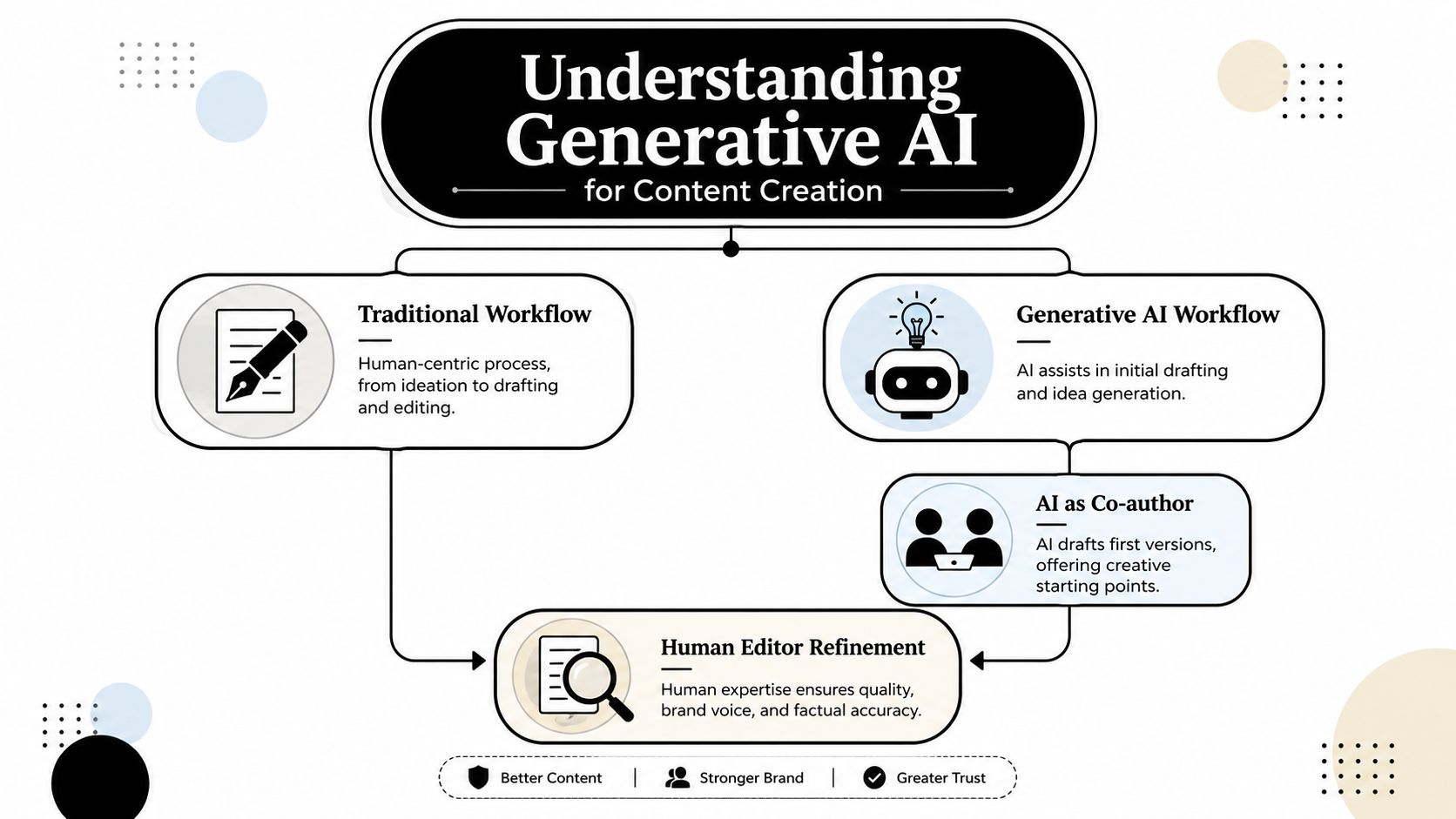
Generative AI works best as a drafting partner, not a finished product. It can produce first passes of blog sections, ad copy, landing page summaries, and social copy that will be repurposed later, while human editors shape the final message. That split matters because one review of generative AI statistics reports that the technology can raise employee productivity by a large margin, which helps explain why teams use it for ideation, drafting, and workflow automation.
How the technology helps
The key technical shift is that systems built on transformer models can generate human-like text from patterns in language, which moved generative AI from research settings into everyday business writing. That is why the tool can support early-stage work like outlines and summaries without replacing editorial judgment. The machine is strong at pattern completion. The human is still needed for positioning, nuance, and accuracy.
A useful analogy is a co-author who works quickly but does not know the brand, the product, or the compliance rules unless someone teaches them. The output may sound polished, yet it still needs review. Content teams get the best results when they use AI to speed up repetitive work, not to bypass the editing process.
Why the workflow changes, not just the toolset
Generative AI changes production because it shortens the gap between idea and draft. A team can test more headlines, more angles, and more content formats without starting from zero each time. That helps with routine copy, and it also helps with exploration. Teams can ask better questions, compare draft directions faster, and spend more time on refinement.
AI is most useful when it reduces the blank-page problem and gives editors something meaningful to improve.
That distinction matters for mid-sized businesses. Many teams do not need a fully automated content factory. They need a repeatable system that helps writers move faster while keeping quality control in human hands. In that setting, generative AI becomes a production layer, not a replacement for expertise.
What Direct Online Marketing Does and How They Help Businesses
For a mid-sized business, the hard part is rarely producing content once. The hard part is connecting content to search visibility, paid demand, site performance, and reporting so the work supports growth. Direct Online Marketing fits into that broader system. Its service mix includes SEO, PPC advertising, social media marketing, content marketing, email marketing, web development, and Google Analytics, which means the agency can support the path from discovery to action. Readers who want the agency's own description can review the homepage and the services page.
What the agency actually does for growth teams
A useful way to understand the agency's role is to separate the work into connected layers. SEO helps content appear in organic search. Paid media captures demand faster. Analytics shows which channels deserve more attention. Conversion work then helps turn visits into leads or other measurable actions. The process is similar to tuning several parts of one machine. If one part is out of sync, the whole system underperforms.
The SEO and PPC tactics article explains this interplay in practical terms. It describes how keyword-optimized landing pages and website content support on-page SEO, how external signals support off-page SEO, and how A/B testing can compare ads to see which headlines, graphics, and descriptions earn more clicks SEO and PPC tactics. For a business using generative AI for content creation, that matters because AI can speed up draft production, but the final result still has to fit search intent, campaign goals, and page-level conversion logic.
That is the value of an agency workflow. Content teams can use AI to draft faster, then rely on strategy, review, and measurement to decide what belongs in the market. In practice, that means the agency is not only supplying deliverables. It is helping set the rules for quality, the checks for accuracy, and the path from a draft to a page that supports business goals.
Why that matters for medium-sized businesses
Medium-sized businesses often need a steady operating model more than a burst of activity. One team may own the blog, another may manage paid campaigns, and a third may handle the website or reporting. Without coordination, those efforts drift apart. A service mix that covers search, content, ads, and analytics can keep the work pointed in the same direction, which is useful when a business wants AI-assisted content to support real demand, not just produce more copy.
The agency's LinkedIn profile notes that it has supported clients across every populated continent since 2006 and holds Top 1% Premier Google Partner status Direct Online Marketing LinkedIn. Those details help explain the kind of operating experience some businesses look for when they want content, paid media, and reporting tied together in one plan.
The practical point is simple. Mid-sized companies usually do not need isolated tactics. They need a process that tells them what to publish, how to distribute it, how to measure it, and when to revise it. An agency with SEO, PPC, content, web, and analytics capabilities can help build that process so generative AI becomes part of a managed workflow instead of a loose experiment.
Bottom line: the strongest agency relationships usually come from consistent execution, clear reporting, and a shared definition of what qualified growth looks like.
If a team is evaluating where agency support helps most, the answer is usually in the connection points. Content can be drafted quickly with AI, but search visibility, paid demand, and conversion still depend on disciplined review, page structure, and measurement.
Strategic Use Cases for Marketing Teams
The most productive way to use generative AI is to assign it to the kinds of work that benefit from speed and variation, then keep humans in charge of judgment. That usually starts with planning. A marketer can feed a topic, audience segment, or campaign goal into the system and get a wider field of angles than a single brainstorm session would produce. The value isn't just volume. It's the ability to move from a blank page to a workable draft list faster.
Where it fits inside a real content calendar
A practical example is blog ideation. A team can ask for topic clusters around one service line, then filter the results for intent, specificity, and editorial fit. That saves time before the first draft is even written. The same method works for ad copy, where a team may need multiple headline variants for the same offer without changing the underlying promise.
Another useful case is repurposing. A strong long-form article can become an email summary, a social post sequence, a short explainer, or internal sales enablement copy. Generative AI helps break large assets into smaller units without forcing writers to start from scratch every time. That's especially useful when the same message needs to travel across blog, email, and social channels.
- Topic discovery: Use AI to widen the idea pool, then filter for audience relevance and business value.
- Ad variation: Draft several angles for the same promotion, then let the team choose the clearest version.
- Content repurposing: Turn one approved article into multiple channel-specific assets.
- Draft acceleration: Build a rough version quickly, then devote human time to accuracy, structure, and tone.
Where teams still need human judgment
Personalization is useful, but it can easily become generic if the prompt is weak. The best results come when the team defines the customer profile first, then uses AI to shape copy around that profile. The same is true for localization. AI can adjust language and format quickly, but it can't judge whether a phrase fits the culture, offer, or legal context without human review.
A fast draft that misses the audience is still a failed draft.
For mid-sized businesses, the lesson is straightforward. Generative AI works best when it reduces production friction, not when it replaces the campaign strategy. Teams should use it where repetition is high and stakes are manageable, then reserve human attention for messaging, accuracy, and final polish.
Implications for SEO and Generative Engine Optimization
A marketer can have a page that ranks well in search and still miss visibility in AI search results. That happens because SEO and Generative Engine Optimization, or GEO, judge content through related but different lenses. SEO still rewards search intent match, page structure, internal links, and authority signals. GEO adds a second test, whether an AI system can parse the page, trust the wording, and reuse the answers without confusion.

How SEO and GEO differ in practice
| Comparison of Traditional SEO and Generative Engine Optimization | Traditional SEO | Generative Engine Optimization |
|---|---|---|
| Primary goal | Improve visibility in organic search results | Improve visibility in AI-generated answers and summaries |
| Content structure | Keywords, headings, internal linking, metadata | Clear sections, factual clarity, direct answers, structured meaning |
| Optimization focus | Search engine ranking signals | AI comprehension, source trust, and answer readiness |
| Risk if done poorly | Low relevance or weak ranking | Misinterpretation, omission, or weak inclusion in AI responses |
The table shows why the same article can perform unevenly across channels. Traditional SEO often begins with search demand and keyword mapping. GEO begins earlier in the writing process, with the way the answer is framed, labeled, and supported. If the content reads like a scattered memo, AI systems have a harder time extracting the point. If it reads like a well-organized briefing, the machine and the reader both have a cleaner path through it.
That structure matters because AI systems tend to favor content that answers questions directly and consistently. A page should lead with the claim, support it with details, and avoid burying the main message under loose prose. Mid-sized businesses often feel this tension first on service pages and thought leadership pieces, where a strong message can get diluted by too many tangents. Strong headings, concise summaries, and clear definitions help both search engines and AI systems understand what the page is about.
For teams working on technical SEO and GEO together, the goal is a single content standard. The page still needs metadata, internal linking, and topic relevance, but it also needs answer-ready sections that AI can summarize correctly. A practical way to support that work is to use structured GEO planning tools for AI visibility, then connect those outputs to editorial review and page-level optimization. That gives marketing teams a repeatable way to judge whether a page is built for discovery, not just publication.
The shift is operational. SEO is no longer only about helping a page rank. GEO asks whether the page can be cited, summarized, or surfaced in AI search results without losing meaning. That means content teams need to think like editors and information designers at the same time, shaping pages so they serve human readers, search systems, and AI-driven answer engines with the same core message.
Workflows for Quality and Governance
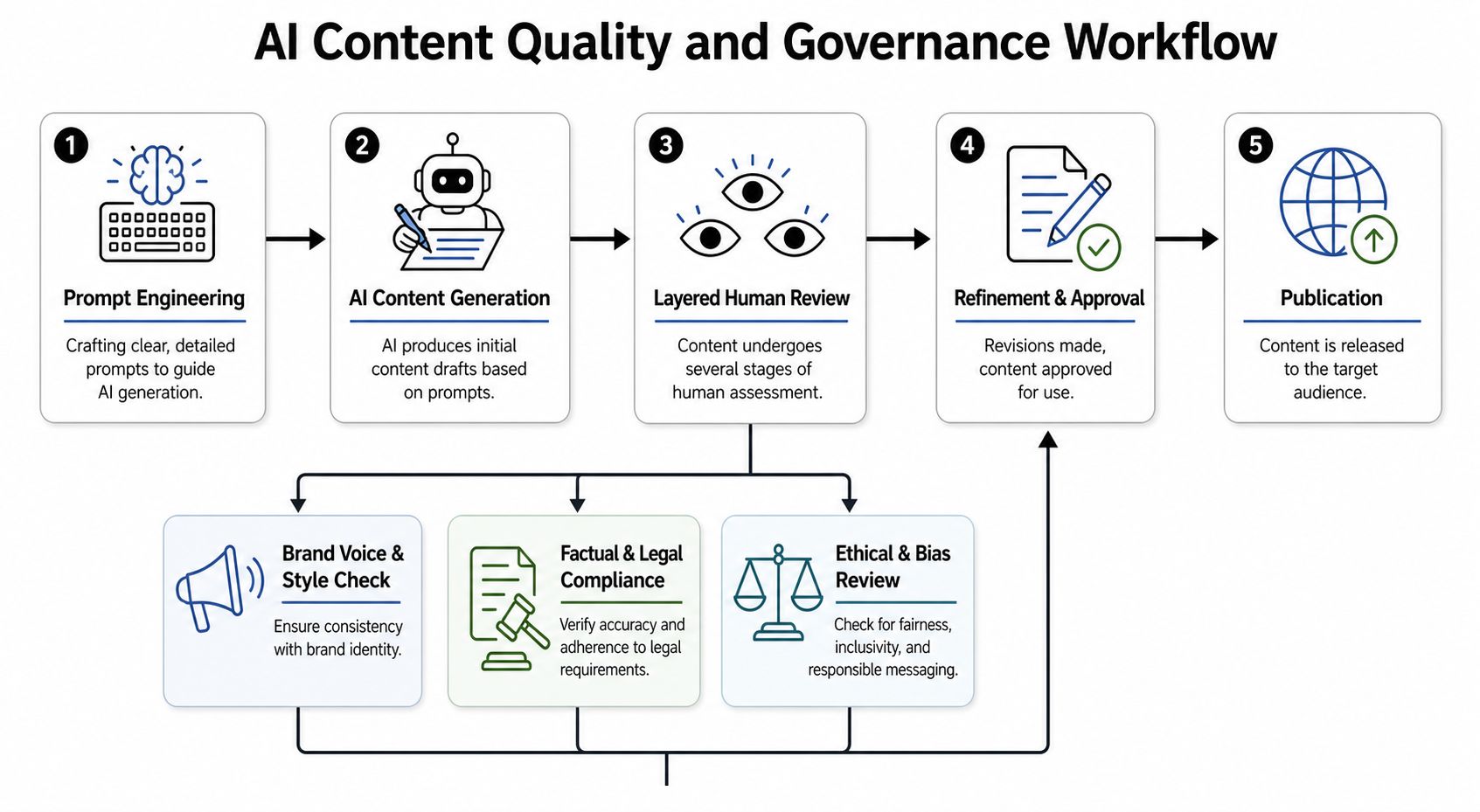
A draft that moves fast and breaks trust is a bad trade. Generative AI can cut production time, but the real value only shows up when teams pair speed with a review process that protects brand voice, factual accuracy, and compliance language. For mid-sized businesses, the workflow has to be simple enough to repeat, like a checklist a pilot uses before takeoff, not a maze that only one person understands.
A simple governance sequence
- Prompt design. Define the audience, purpose, tone, and factual limits before anyone writes a draft. A loose brief tends to produce loose copy, the way a vague map leaves a driver guessing at the turns.
- Draft generation. Let AI produce the first pass, then treat it as working material rather than publish-ready content.
- Human review. Editors check brand voice, accuracy, and channel fit, and they should flag any section that sounds polished but lacks evidence.
- Refinement and approval. Writers revise the draft, subject-matter experts validate the claims, and approvers sign off only after the piece meets the team standard.
- Publication and monitoring. After the content goes live, the team watches for performance issues, factual errors, or comments that call for a correction.
This kind of workflow gives SMB teams a practical way to apply how to use AI in marketing without turning every project into a one-off experiment. The point is to make quality repeatable, not to add bureaucracy for its own sake.
What the review team should check
Brand consistency comes first. If a draft sounds like three different writers stitched it together, readers feel that mismatch immediately, even if they cannot name the reason. The review team should also test whether each claim can stand up in a sales call, a client meeting, or a compliance review. If it would be hard to defend in those settings, it should not go live.
The third check is risk. That includes bias, vague promises, unsupported comparisons, and statements that sound confident but cannot be verified. A good workflow assigns each step to a specific role. Writers draft, editors shape the message, subject experts confirm technical accuracy, and approvers give the final yes.
That division matters because AI content governance works like a relay race, not a solo sprint. One person should not be expected to catch every error, every brand issue, and every compliance concern at once. Direct Online Marketing helps teams build those handoffs into the content process so governance supports production instead of slowing it down.
Operational rule: if a claim would be hard to defend in a client call, it should not appear in the published draft.
Mid-sized businesses lose time when review ownership is unclear, not when review exists. A clear workflow reduces rework, protects the brand, and gives teams a cleaner path to scale AI use across campaigns without sacrificing judgment.
Implementation Roadmap and Measurement Framework for SMBs
A small or mid-sized business doesn't need to launch every AI workflow at once. A better approach is to move in phases, then measure what changes. That keeps the rollout manageable and gives the team time to learn where AI adds value and where human editing still needs to stay central.

A phased rollout that doesn't overwhelm the team
The first phase is a pilot. That usually means picking one content type, one owner, and one review path. Tool selection happens here, along with training for the pilot group. The goal isn't volume. It's to learn how the workflow behaves under real deadlines.
The second phase is scale. At this point, the team integrates AI into existing workflows and trains a wider group. More content types can enter the process, but only after the team has a repeatable way to review drafts and approve them. The third phase is optimization. That is where the business looks at what's working, revises the process, and tightens quality checks.
What to measure
- Output consistency: Track whether the team is producing usable drafts more reliably.
- Engagement quality: Watch for signs that the content still connects with readers after AI assistance.
- Factual accuracy: Review whether drafts need fewer corrections over time.
- Operational efficiency: Measure whether the content process feels less bottlenecked.
- Business impact: Tie the work back to leads, conversions, or pipeline support where possible.
See how AI can be used in marketing workflows
The right measurement framework keeps the team honest. If drafts are faster but the quality drops, the process needs rework. If the content quality rises but production remains stuck, the workflow may be too complex. The goal is balance, speed with oversight, scale with control, and experimentation with enough structure to learn from the results.
Conclusion and Next Steps
A mid-sized marketing team gets the best results from generative AI for content creation when the process stays disciplined. AI can speed up first drafts, help teams respond faster to search behavior, and support both SEO and GEO work. Human editors still need to own the parts that machines cannot judge well, such as brand voice, factual accuracy, and editorial judgment.
That balance matters because content creation is not one task, it is a workflow. A useful draft still needs review, source checking, compliance checks, and a clear publishing standard. Without those guardrails, AI can save time at the front end and create more rework later. With them, the same system can produce content that is faster to build and easier to trust.
For SMBs, the next step is usually not a bigger content output target. It is a clearer operating model. Start with one use case, define who approves what, and decide which claims need verification before publication. Train a small group first, then expand only after the team can repeat the process without quality slipping. That approach works like a manufacturing line with inspection points. The line can move faster, but every checkpoint still protects the final product.
Direct Online Marketing fits into that kind of roadmap by helping businesses connect AI content use with search visibility, governance, and measurable marketing execution. As noted earlier, a key advantage comes from aligning strategy with day-to-day workflow, not from treating AI as a shortcut. For teams ready to improve their content process, the next move is to document the current workflow, identify the highest-friction step, and test one controlled AI-assisted content path before scaling it across the broader program.