
A buyer who has never spoken to sales can already have a firm view of a vendor. That view often forms while reading research, a technical guide, or a clear explanation of a problem the buyer hadn't named yet. A thought leadership strategy treats that moment as a commercial asset, not a publishing habit. Each piece gets tied to a specific buying-group role, a specific evidence need, and a commercial indicator reviewed every 90 days.
Table of Contents
- What Thought Leadership Strategy Is and Why Businesses Invest
- The Five-Part Framework and Buying Groups
- KPIs That Track Influence Rather Than Page Views
- Phased Roadmap From First Quarter to Full Program
- Tactics for Appearing in ChatGPT and Gemini Answers
- Sample Editorial Calendar and Distribution Mix
- Sector Examples, Pitfalls and Your First Move
What Thought Leadership Strategy Is and Why Businesses Invest
In 2024, 73% of global B2B decision-makers said thought-leadership content was a more trustworthy basis for assessing an organization's capabilities than marketing materials or product sheets, according to Edelman and LinkedIn research on trust in thought leadership. The finding points to a practical role for thought leadership: help buyers judge expertise through useful, checkable ideas rather than promotional claims.
A Plain Definition
A thought leadership strategy is a planned program for publishing original, verifiable expertise that helps buyers form informed views about a problem, risk, or opportunity. Advertising aims to make a brand memorable. Thought leadership aims to change how a reader understands an issue and what they consider doing about it.
That shift can lead a buyer to explore options they had not considered. In 2024, 75% of global B2B decision-makers and C-suite executives said a piece of thought-leadership content led them to research a product or service they had not previously considered, according to Edelman and LinkedIn research on buyers returning to evaluation. The implication for a marketing team is clear: a useful argument can create demand by helping a reader recognize a problem or possibility.
Publication volume alone does not make that argument persuasive. A distinctive point of view needs evidence a skeptical reader can examine. Each piece should answer a question that matters to a specific buying-group role, then give that reader a reason to trust the answer. Commercial indicators, reviewed every 90 days, help show whether the work is affecting decisions rather than attracting attention.
Practical rule: If a piece could carry any competitor's logo without looking wrong, it doesn't yet contain a point of view.
Before writing, settle three questions: Who is the reader? Name the role, not just a broad persona. What does the organization believe that others may not? State the position in one sentence and support it with evidence. How will the team judge its effect? Choose commercial indicators that show whether the idea is helping buyers move toward a decision.
The Five-Part Framework and Buying Groups
A role map is the starting point for a thought leadership program. It shows who needs to change their view and what evidence would help them do so. Without that map, teams can spend a quarter publishing material that speaks to no one's specific concerns. Five connected layers turn the role map into a plan, with each layer producing an output the next one can use.

Audience comes first because B2B purchases rarely belong to one person. An executive sponsor weighs market implications. A technical marketer wants methods that work with real tools. Procurement leads need risk and value stated clearly. Finance and legal reviewers look for limits; operations leads check whether recommendations fit their workflow. A role map records each person's evidence needs, so one article does not have to serve every reader in the same way.
The Five Components at a Glance
| Component | Core question | Typical output | Owner |
|---|---|---|---|
| Audience | Which buying-group roles must change their view? | Role map with evidence needs | Marketing lead |
| Pillars | Which three to four business problems can we credibly own? | Pillar briefs with a stated point of view | Strategy lead |
| Content types | Which format meets each role's evidence need? | Research reports, technical guides, checklists | Content team |
| Distribution | Where does each role already spend time? | Channel plan with segmented lists | Demand or growth team |
| Measurement | Which commercial change proves the content works? | KPI dashboard with attribution rules | Analytics lead |
Pillars define the problems the organization can address with credible expertise. Three to four focused business problems are usually enough. In 2024, 77% of business decision-makers preferred thought leadership from deep subject-matter experts addressing specialized topics over content from senior executives discussing high-level business issues, according to the Edelman and LinkedIn analysis of thought leadership value. Specificity gives readers something they can apply.
Before a pillar goes on the calendar, check three things:
- Name the business problem: Describe a situation a buyer would recognize.
- List the evidence available: Identify data the organization can produce, verify, or cite with a method and date.
- Name the role served: Specify whose view or action should change after reading.
Matching Roles to Evidence and Format
For a pillar on how AI-driven search changes buyer research, a mid-sized manufacturer could start with a short study of how its buyers find suppliers. That evidence base can support a structured data checklist for technical marketers, a market implications brief for the executive sponsor, and a risk and value note for procurement. The research stays consistent; the format and emphasis change to meet each role's evidence needs. Smaller businesses and e-commerce teams can apply the same logic to buyer personas or shopper segments.
Content types follow those needs, rather than a writer's preference. Distribution follows where each role already spends time, with messages segmented by role and buying stage instead of sent to one undifferentiated list. Repeated, role-appropriate communication also helps audiences adopt new messages; see guidance on measuring adoption through better communications.
Measurement ties the work to a commercial change the team can assess. Agree on that change and its attribution rules before publishing, so marketing and sales have a shared way to judge whether the content helped. Flagship research can also give account teams evidence to use during an active sales conversation. A practical guide to sales enablement content explains how one evidence base can support conversation prompts and leave-behinds without becoming a pitch deck.
A team with one writer and one analyst can typically sustain one flagship per month, supported by four to six pieces drawn from the same research. This benchmark works when the evidence base is strong enough to support those formats. If it is not, fewer pieces from the same research are preferable to repeating an argument without adding evidence.
The five layers fit on one page: one sentence for each, a named owner, and a review date. Use that page as a working map, checking every 90 days whether the evidence still serves the intended roles and whether the program is contributing to its agreed commercial indicators.
KPIs That Track Influence Rather Than Page Views
Traffic is the easiest number to report and the least useful one for deciding what to publish next. The 2024 Edelman and LinkedIn study found that 42% of thought-leadership producers said their primary effectiveness measure was increased web and social traffic, while one in five respondents reported that their company had no process for measuring effectiveness, according to the Edelman summary of the measurement gap. A program judged on visits will optimize for visits, even when the wrong roles are doing the visiting.

A better set organizes indicators by distance from revenue. Leading indicators show whether target roles engage at all. Middle indicators show movement through the buying group. Lagging indicators show commercial effect.
KPIs by Indicator Type
| Indicator | What it shows | Healthy direction |
|---|---|---|
| Engagement from target roles | Whether the people in the buying group read the material | Rising share of engagement from target roles |
| Roles engaged per account | Reach across the buying group, not one contact | More roles engaged in each target account |
| Content-influenced meetings | Commercial pull from published work | Rising count quarter on quarter |
| Sales acceptance of content-sourced leads | Quality of the handoff from content to sales | Stable or rising acceptance rate |
| RFP invitations | Vendor credibility at the bid stage | Rising invitations from target accounts |
| Branded and assistant-referred visits | Recognition across search and AI answers | Growing share of branded visits |
Time spent with flagship assets belongs in the leading group, since a technical brief read for six minutes signals something a bounced visit doesn't. Pipeline influenced and win rate sit in the lagging group, where they confirm patterns the earlier indicators predicted. Teams that want to connect AI search presence to these tiers can use approaches that turn AI search signals into action rather than reporting assistant mentions as a vanity count.
Attribution needs rules before the first flagship ships. A workable method sets a baseline for each KPI, applies consistent credit when content touchpoints precede a meeting or opportunity, and adds a short survey of target accounts to catch consideration change that click data misses. A clear explainer on cross-channel attribution helps teams agree on those rules before results arrive and opinions harden.
A KPI earns its place only if it can change a decision, such as keeping a pillar, shifting role focus, or retiring a format.
Review the full set every 90 days. That cadence is long enough for buying groups to move and short enough to cut a pillar that isn't reaching its intended roles.
Phased Roadmap From First Quarter to Full Program
Sequencing protects a new program from its most common failure, which is publishing before the role map exists. Four phases carry a team from audit to optimization across roughly a year. Each phase ends with exit criteria, so progress depends on readiness rather than the calendar alone.
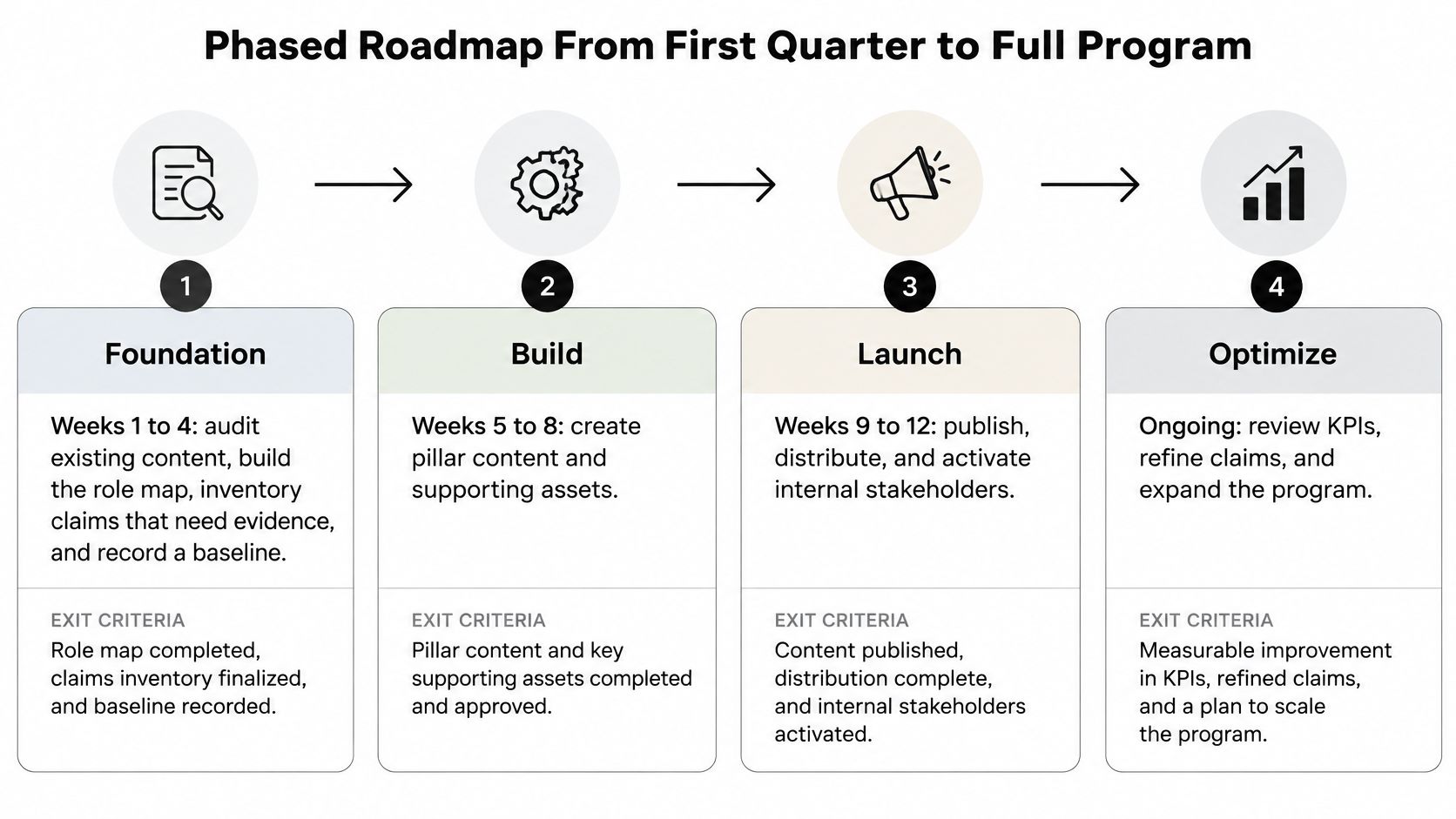
Phase 1 Foundation Weeks 1 to 4
- Audit existing content: sort published pieces by role served and evidence quality, and retire claims nobody can source.
- Build the role map: name the buying-group roles, their evidence needs, and where they spend time.
- Inventory claims needing evidence: list every assertion the organization wants to make and mark what proof exists.
- Record a KPI baseline: capture current values for the agreed indicators before anything new ships.
Exit criteria: a signed-off role map, three to four tested pillars, and a baseline the analytics lead accepts.
Phase 2 Proof Months 2 to 3
Publish one flagship asset built on original data, with a methodology page stating sources, dates, and limits. Test distribution with two or three roles rather than the full list, and brief sales on what the asset argues. Exit criteria: measurable engagement from at least two target roles and the first round of sales feedback on usefulness.
Phase 3 Scale Months 4 to 6
Run the editorial calendar at the cadence the team can sustain. Segment distribution by role and buying stage, add AI search visibility work so flagship pages can be cited in generated answers, and give sales a short brief for each flagship. Exit criteria: repeatable production, segmented lists in active use, and content-influenced meetings tracked under the agreed attribution rules.
Phase 4 Optimize Months 7 to 12
Review KPIs quarterly and act on them. Retire pillars that don't reach their target roles, extend coverage to roles the first map missed, and refresh flagship evidence before it goes stale. Exit criteria: at least one pillar retired or reshaped on evidence, and a second-year plan based on measured influence rather than habit.
Small businesses can compress the sequence without skipping steps. One pillar, one flagship, and two channels is a legitimate start. Expansion waits until after the first baseline review, and sales feedback enters the loop at the end of phases two and three, because acceptance of content-sourced leads is an early, honest signal of quality.
Tactics for Appearing in ChatGPT and Gemini Answers
A page can be useful to a buyer and still go unseen if search systems cannot access or interpret it. For visibility in ChatGPT and Gemini answers, build on the same clear, accessible content that supports ordinary search, then check whether the pages address the evidence needs of specific buying-group roles.

Google's documentation on AI features in Search explains that a webpage must be indexed and eligible to appear in ordinary Google Search with a snippet to qualify as a supporting link in AI Overviews or AI Mode. Structured data should match the page's visible text. Google says websites do not need special AI-only files or a new schema.org markup type. In practice, this means starting with crawlable pages, accurate information, and clear answers rather than chasing a separate technical shortcut.
Tactics a Team Can Apply This Month
- Lead with the answer: State the page's main conclusion early, then explain the reasoning and supporting evidence.
- Define terms once: Give each important term a plain-language definition so readers can follow the argument.
- Use real buyer questions: Build FAQ sections around questions raised in sales calls and support tickets.
- Match structured data to the page: Mark up only information that readers can see; do not promise something the page does not say.
- Name authors and roles: Identify the subject-matter expert responsible for the content.
- Show the evidence trail: Include sources and dates with statistics so readers can assess where a claim came from.
- Connect related ideas: Use descriptive links to show how pages fit together. For a sector-specific example, see generative engine optimization for law firms.
A page organized around direct answers, clear definitions, and visible evidence gives readers a straightforward way to assess its claims. This guide to how to optimize content for AI search outlines a repeatable page-level routine.
The short video below demonstrates how structured, answer-first pages present information to readers and systems.
Human review still matters when AI helps draft or revise content. The NIST Generative Artificial Intelligence Profile supports managing risks in AI-assisted workflows, including how generated material is created and deployed. Review claims before publication: if an assistant later cites inaccurate content, it can spread the error beyond the original page.
Treat AI visibility as a credibility signal, not a publishing target. Each month, check a defined set of queries in ChatGPT and Gemini, record which sources appear, and note where competitors are cited instead. Review those observations alongside role-level engagement and commercial indicators every 90 days. If a page is absent, first ask whether it answers a specific buyer role's question with clear, traceable evidence; then decide what to revise.
Sample Editorial Calendar and Distribution Mix
A strong calendar sequences evidence so each asset prepares the reader for the next. The six-month example below moves from market context to implementation, then to measurement: the month-3 benchmark gives readers a way to assess the method introduced in month 2. Later themes apply the same evidence-led approach to AI search, e-commerce, and expert commentary.
Six-Month Sample Editorial Calendar
| Month | Pillar | Flagship asset | Supporting pieces | Primary channel |
|---|---|---|---|---|
| Month 1 | Market shifts | Original survey report | Two-page summary and three expert LinkedIn posts | Email and LinkedIn |
| Month 2 | Technical method | Implementation guide | Checklist and short video walkthrough | Organic search and LinkedIn |
| Month 3 | Measurement | Benchmark analysis | Data visual and webinar invitation | Webinar and partner newsletters |
| Month 4 | AI search visibility | Structured FAQ hub | Glossary and answer pages aligned to visible text | Organic search and AI answer monitoring |
| Month 5 | E-commerce conversion | Checkout friction study | Form audit template and case summary | Retailer email and retargeting |
| Month 6 | Expert perspective | Evidence-backed point-of-view essay | Sales call prompts and RFP appendix | Account-based outreach |
Original evidence anchors the sequence. In 2024, 55% of business decision-makers identified strong, original data and research as a characteristic of the highest-quality thought leadership, according to Edelman and LinkedIn's quality findings. Each flagship should present evidence the organization collected or verified, with its method and date stated on the page. That gives readers a basis for judging the claim, rather than asking them to rely on authority alone.
Cadence and Distribution Mix
Use the capacity benchmark established in the framework to set a realistic production pace. The calendar's purpose is to connect each asset to a buying-group role and the evidence that role needs, not to fill every channel with more content. A flagship is the anchor; supporting pieces adapt its evidence for different contexts.
Distribution should follow the audience and the job each piece does:
- Email to existing contacts: segment by role so procurement and operators receive the supporting pieces most relevant to their questions.
- LinkedIn posts from named experts: carry a specific argument beyond the company page and connect it to the person accountable for the evidence.
- Partner newsletters: introduce the work to audiences the organization has not yet reached directly.
- Short webinars: use live questions to identify which claims buyers question and which they repeat.
- Sales prompts for account teams: provide two or three talk tracks per flagship so conversations stay aligned with its evidence.
Review the calendar every 90 days against commercial indicators and role-level engagement. Each month, note which supporting piece earned the strongest response from its target role, then use that signal to shape the next flagship. This creates a feedback loop: the calendar keeps its editorial direction while adjusting to the questions buyers raise.
Sector Examples, Pitfalls and Your First Move
The same thought leadership framework needs different evidence for different buying situations. A local business can help buyers compare nearby options; a B2B services firm may need research that answers procurement questions; an online retailer can show where checkout friction affects conversion. Matching the lead asset to the buying group makes the work more useful than copying one sector's content format into another.
Sector Differences in Lead Assets, KPIs and Pitfalls
| Sector | Lead asset | Primary KPI | Common pitfall |
|---|---|---|---|
| Small and medium businesses | Local market benchmark report | Inbound inquiries per month | Publishing without a defined audience |
| B2B services | Original research with expert commentary | RFP invitations and sales acceptance | Generic executive opinion pieces |
| E-commerce retailers | Checkout and conversion study | Conversion rate and return on ad spend | Promotional content that reads as sales copy |
For smaller firms, a local benchmark gives buyers a quick way to compare their business with nearby peers. B2B services firms benefit from research that can address procurement scrutiny. Retailers can make conversion evidence practical by identifying specific checkout problems and explaining potential fixes.
Pitfalls That Undermine Programs
- Publishing without a named audience: Content for everyone in a buying group may give no one a reason to act.
- Generic executive opinion: Commentary without a clear role or action can read as branding rather than useful guidance.
- Claims without a stated method or source: Buyers cannot assess numbers they cannot check.
- Provocation without evidence: A bold position can support credibility when it rests on evidence and states its limits. Blurring fact and opinion can weaken trust.
- Automated drafts without human review: An unchecked error can undermine the credibility of the content with a buying group.
- Measuring only traffic: Visits show reach, not whether a specific role found the evidence useful.
- Ignoring sales feedback: Account teams can identify which claims help in live conversations and which buyers challenge.
A useful test for any bold claim: Could a skeptical procurement lead verify it from the page alone, including method, source, and date?
Support for a thought leadership program may draw on SEO, paid media, content strategy, analytics, and conversion optimization. The right mix depends on the organization's goals, such as visibility, qualified leads, return on marketing spend, or long-term growth systems. Direct Online Marketing, founded in 2006, offers SEO, PPC, web design, and generative engine optimization services. Fit should be assessed against the buyer's goals and the evidence the program needs to produce.
Start with one role, one pillar, one flagship asset, and one KPI. Publish the asset with its method stated, distribute it to that role, then review its commercial indicators after 90 days.
Ready to treat thought leadership as a measured credibility asset? Explore AI Optimization Services to learn about a strategy that connects original evidence, role-specific content, and AI search visibility. Begin with one flagship asset and a 90-day review date.