
About 65% of sales enablement content goes unused, while only about 30% is used by sales teams, according to documented utilization-gap research. The implication is direct: companies need less content production and better distribution, relevance, and proof.
Sales enablement content must help a rep answer a buyer's question, address an objection, support a business case, or move a deal ahead. Each asset should also give buyers evidence they can verify and share. Treat every piece as part of a measurable distribution and proof system. Track who uses it, where it supports deals, and which buyer questions it answers.
The same structure can serve two channels. Reps use the asset inside active deal cycles, while clear, evidence-based content can improve visibility when buyers seek answers through AI-generated responses in ChatGPT and Gemini. That double duty makes the library more valuable without creating separate work for sales and marketing.
For medium-size businesses, the operating rule is simple: build fewer assets, label them for real sales motions, prove their usefulness, and publish the evidence buyers search for. A library that cannot reach reps or answer buyer questions is overhead, regardless of how polished it looks.
Table of Contents
- Why Most Sales Enablement Content Fails
- Mapping Content to Buyer Stages and Sales Motions
- Choosing the Right Sales Enablement Content Formats
- Building a Distribution Workflow Reps Will Use
- Making Enablement Content Work in AI Search
- Measuring What Actually Moves Pipeline
- A 90-Day Sales Enablement Content Operating Plan
Why Most Sales Enablement Content Fails
About 65% of sales representatives struggle to find meaningful content to send prospects, while sales representatives spend roughly 440 hours per year searching for or recreating content. Only about 30% of marketing-created content is used by sales, according to These sales enablement findings. Those figures point to a distribution failure, not a shortage of production.

Production isn't the bottleneck
Marketing teams often build around internal product narratives. Buyers ask about risk, cost, implementation, timing, and alternatives. A polished product deck fails when it cannot answer the question raised during discovery.
Shared drives add friction. Reps should not search through folders, open outdated files, or guess which version is approved. Tag every asset by buyer stage, persona, objection, and sales motion. Without those labels, useful content remains effectively unavailable.
Staleness creates another liability. Pricing changes, competitors reposition, products evolve, and regulations shift. Every asset needs an owner, a review date, and a visible version label. Otherwise, reps avoid it or create private substitutes that drift from approved messaging.
Practical rule: Every asset needs a specific sales moment, a clear owner, and a proof point a rep can use without rewriting it.
Relevance beats volume
A small share of the library often earns most of the attention. Industry reporting indicates that the top 10% of enablement content can generate 50% of prospect engagement. Use that concentration to guide operations: prune aggressively, then improve the assets sellers already trust.
Give each asset one defined job. It can reframe a buyer's problem, prepare a rep for an objection, demonstrate a credible outcome, or help stakeholders agree on a decision. If it does none of these, remove it from prominent views.
Treat every high-performing asset as a distribution and proof system. Make it easy for reps to find during a deal, then structure its evidence so buyers can discover and evaluate it in ChatGPT and Gemini answers. One well-maintained asset can support the rep workflow and AI search visibility, provided its claims are clear, specific, and verifiable.
Mapping Content to Buyer Stages and Sales Motions
A useful map connects four elements: the buyer's question, the rep's next action, the sales motion, and the asset that supplies proof. Build it from recorded objections, discovery notes, win-loss feedback, and recurring prospect questions. That turns content into a measurable distribution system, with each asset assigned to a deal moment and a buyer decision.
The customer profile determines whether the message fits. A message for a mid-market operations leader may miss a technical evaluator or financial decision-maker. Use a customer profile framework for identifying your audience before producing another generic deck. Clear audience definition also improves AI search visibility because ChatGPT and Gemini can match specific, well-supported answers to specific buyer needs.
Build the map around the rep's next action
| Buyer Stage | Sales Motion | Rep Job-to-be-Done | Primary Asset |
|---|---|---|---|
| Problem awareness | Inbound qualification | Reframe the buyer's pain in business terms | Industry-specific problem one-pager |
| Solution awareness | Discovery call | Connect the stated problem to a relevant approach | Discovery playbook and vertical case study |
| Evaluation | Competitive validation | Handle objections and support comparison | Competitive battlecard and ROI calculator |
| Decision | Commercial alignment | Create shared commitments and reduce purchase risk | Mutual close plan and reference call deck |
At problem awareness, an SDR needs a short asset that helps a prospect recognize an expensive or urgent issue. A product datasheet arrives too early because it assumes the buyer already accepts the proposed solution.
During discovery, the playbook should prompt questions, listening cues, and follow-up actions. The case study should match the prospect's industry or operating context. A generic success story sounds positive, while a relevant one gives the rep language specific to the account and gives buyers evidence they can assess.
Evaluation content must support a defensible choice. A battlecard prepares the rep for a live objection, and an ROI calculator lets the buyer test the economic case. At the decision stage, the job changes. A mutual close plan clarifies owners, dependencies, and dates. A reference call deck gives stakeholders a structured way to validate the decision.
Content earns its place when a rep can point to the exact buyer question it answers and the exact deal moment where it belongs.
Add a usage instruction to every row and asset. “Use after the buyer raises implementation risk” is operational. “Use during consideration” is vague. Specific instructions remove guesswork, keep distribution aligned with the sales motion, and help the same proof surface in rep workflows and AI-generated answers. Each claim should remain clear, specific, and verifiable.
Choosing the Right Sales Enablement Content Formats
Four formats repeatedly earn attention because they match real sales moments: battlecards, one-pagers, playbooks, and case studies. They shouldn't compete for the same job. Each format needs a narrow purpose, a clear audience, and a delivery point inside the workflow.
A battlecard is live-call equipment. It should help a rep recognize an objection, ask a useful question, explain where an alternative falls short, and provide an approved response. The strongest version is a scannable matrix built around “why they say it” and “why it falls apart,” not a long background document.
A one-pager solves one buyer question quickly. It should be easy to forward by email, easy to scan on a desktop, and focused enough that a buyer understands the point without a guided tour. A playbook is different. It codifies a sequence for discovery, objection handling, or closing, so it needs actions, prompts, exit criteria, and examples rather than broad principles.
Case studies carry the burden of proof. A credible case study should identify the customer, explain the business problem, show what changed, and provide a dated metric with a source the buyer can verify. If the customer can't be named or the result can't be substantiated, the asset should be presented as an illustrative story, not as proof.
Match format to the sales moment
| Format | Job-to-be-Done | Ideal Length | Best Fit Stage | Where It Fails |
|---|---|---|---|---|
| Battlecard | Handle a live objection or comparison | One page | Evaluation | Becomes useless when it reads like a competitor encyclopedia |
| One-pager | Answer one buyer question | One focused page | Awareness or discovery | Loses impact when it combines every feature and audience |
| Playbook | Guide a repeatable sales motion | Modular chapters | Discovery, evaluation, or decision | Fails when it gives principles without a sequence |
| Case study | Prove relevance through a customer outcome | Short narrative | Solution awareness or decision | Weakens when evidence is vague or unverifiable |
A benchmark analysis of 34 million content interactions found that prospects spent less than three minutes on average with sales content, and over 80% of visits happened on desktop. The benchmark guidance supports concise, scan-friendly assets and desktop-first design for many B2B workflows.
The format decision should start with the rep's moment, not the marketing team's preferred template. If the buyer needs a fast answer, use a one-pager. If the rep needs a response under pressure, use a battlecard. If the team needs consistent execution, use a playbook. If the buyer needs confidence, use verifiable proof.
Building a Distribution Workflow Reps Will Use
A content library should operate like a product. It needs a clear user, a simple information architecture, release discipline, feedback channels, and a retirement process. Treating it like a folder guarantees that the team will measure inventory instead of usefulness.
Make discovery predictable
Start with a small taxonomy that reflects the sales conversation:
- Persona: Identify the stakeholder who needs the asset.
- Buyer stage: Show where the asset fits in the journey.
- Objection: Describe the concern or question it addresses.
- Asset type: Distinguish a battlecard, one-pager, playbook, case study, or calculator.
- Industry and use case: Add context that helps reps choose relevance quickly.
Every asset needs one accountable owner, an approval status, a version label, and a review date. The owner isn't necessarily the writer. The owner is the person responsible for accuracy, updates, and retirement.
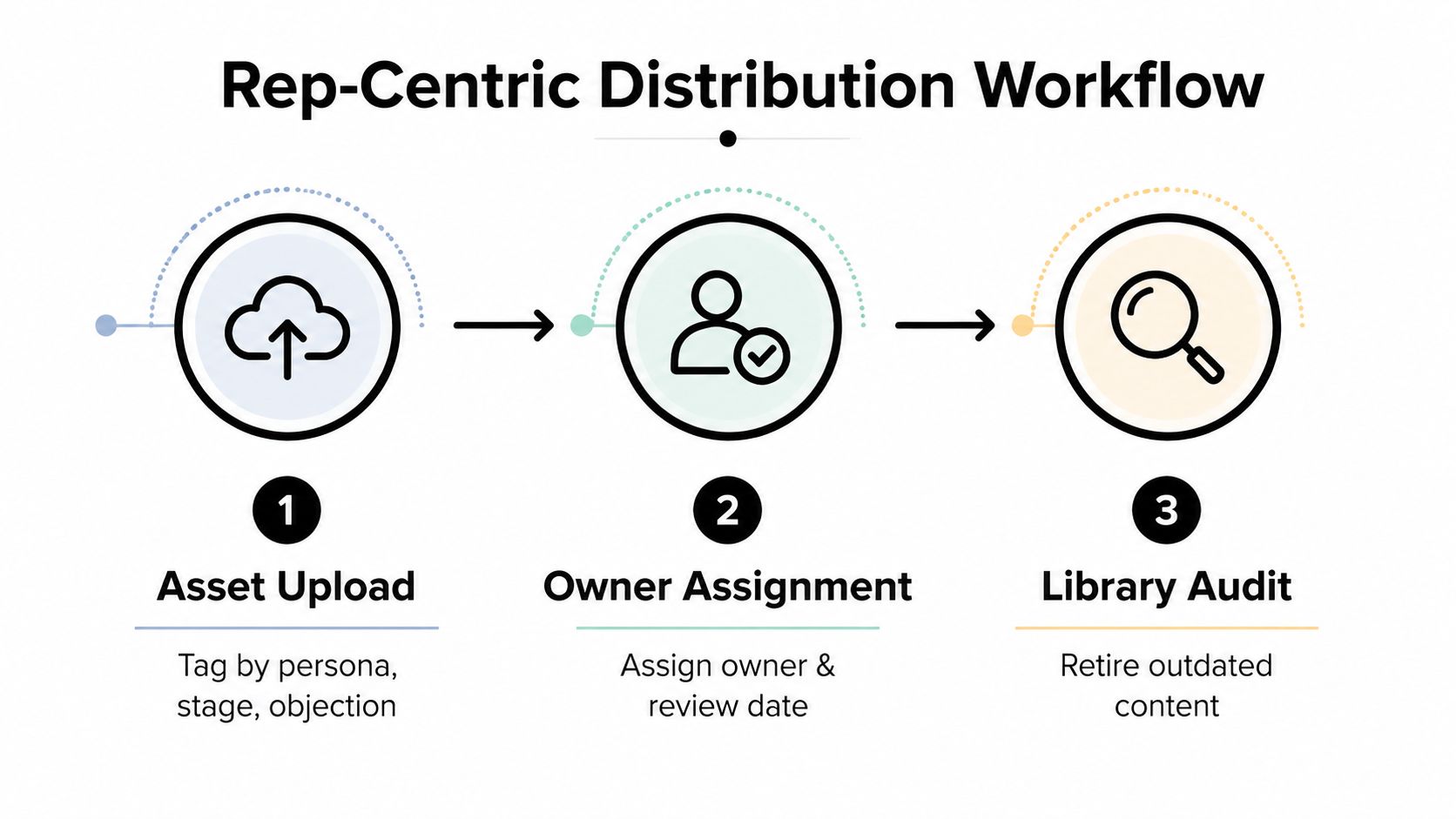
The delivery point matters as much as the taxonomy. Push relevant content into the CRM at the account and deal level, and surface the right battlecard before a scheduled competitive call. A single search command in the team's collaboration space, a chatbot prompt, or a browser extension can replace folder hunting if it returns a verified asset quickly.
Teams evaluating workflow automation can review this AI agent workflow automation resource for a broader view of just-in-time delivery.
Build feedback into the asset
Each asset should include a simple way for reps to report an outdated claim, missing objection, or broken link. That feedback should create a queue for the owner, not disappear into a chat thread.
The search-and-recreate tax produces shadow content. Reps copy old slides, edit claims locally, and send material that no longer matches approved positioning. A controlled workflow reduces that drift by making the approved answer easier to retrieve than the improvised one.
A short demonstration can reinforce how a rep-centric workflow should feel in practice.
The operating standard is simple: a rep should find the right asset through the tools already used during account planning, preparation, and follow-up. If access requires a separate research project, adoption will remain weak regardless of how good the content looks.
Making Enablement Content Work in AI Search
Sales enablement content now has two audiences. Reps need fast, reliable answers inside a deal. AI systems need structured, verifiable material they can retrieve and cite when buyers ask related questions in conversational search.
Structured data is machine-readable code that describes what a page contains, such as an article, FAQ, product, review, or how-to guide. Guidance on structured data for AI search explains why formats such as JSON-LD can help systems identify and extract meaningful content blocks.

Write proof blocks that travel
Each public-facing case study and one-pager should include a compact proof block with:
- Customer context: Name the customer when permission exists and identify the industry.
- Specific result: Include a dated, verifiable metric when one is available.
- Source path: Link to the supporting customer page, report, or approved evidence.
- Declarative claim: State one clear sentence that a rep or an AI system can reuse accurately.
- Verification marker: Show the author and last-verified date.
This structure helps a rep quote the evidence without paraphrasing it into something riskier. It also gives an AI system a clean passage to absorb. A GEO framework distinguishes between citation selection, when a platform chooses a source, and citation absorption, when the source contributes language, evidence, structure, or factual support to an answer. The GEO framework provides useful language for designing assets that earn both forms of value.
Battlecards and FAQs should use descriptive headings, direct answers, and relevant schema. The public version must substantiate every schema field, because markup can't rescue unsupported claims. Structured-data guidance for AI visibility makes that alignment a core requirement.
Teams can use LLM search optimization guidance to connect internal proof assets with public pages designed for retrieval. AI can draft variants, but a human must tighten language, remove unsupported claims, confirm sources, and approve the final version.
Measuring What Actually Moves Pipeline
Downloads are easy to count and easy to misunderstand. A rep may download an asset for a private reference, while a frequently downloaded asset may never reach a buyer. Enablement leaders need usage signals tied to conversations, opportunities, and buyer decisions.
Track behavior close to the deal
Share rate measures whether reps forward or present an asset to prospects. Attach rate measures whether the asset appears before a defined call or deal milestone. Meeting influence identifies opportunities where the asset was used during a relevant interaction.
Those measures become useful when segmented by buyer stage, persona, industry, and sales motion. A case study used in a late-stage business case should not be evaluated against a discovery one-pager. The comparison must reflect the job each asset was built to perform.
| Metric | What It Measures | Target Signal |
|---|---|---|
| Share rate | Whether reps send the asset to buyers | Qualified prospects receive it in relevant deals |
| Attach rate | Whether the asset appears before key calls | Reps prepare with the approved material |
| Meeting influence | Whether the asset is used in a buyer interaction | Buyers ask questions or take a next step |
| Win-rate lift | Whether usage correlates with closed-won outcomes | Used deals outperform a comparable reference group |
| Deal velocity | Whether content supports movement through stages | Late-stage opportunities progress with less delay |
| AI citation rate | Whether target assets appear in AI answers | ChatGPT, Gemini, and Perplexity cite or link the source |
AI visibility needs its own measurement loop. Current GEO guidance recommends tracking whether content is cited, quoted, paraphrased, or linked in answers across systems such as Google AI Overviews, ChatGPT, Perplexity, and similar interfaces, rather than relying only on traditional rankings. The GEO measurement guide supports checking a defined prompt set on a recurring schedule.
A weekly scorecard should stay small enough for both sales and marketing to use. A practical version includes asset share rate, meeting influence, and a pipeline outcome signal. A quarterly audit can retire content below the team's agreed usage threshold, refresh assets with recurring objections, and promote the proof that consistently helps buyers decide.
A 90-Day Sales Enablement Content Operating Plan
A short operating plan prevents enablement from becoming another permanent backlog. The cadence below connects audit, production, distribution, and measurement without asking the team to rebuild the entire library at once.
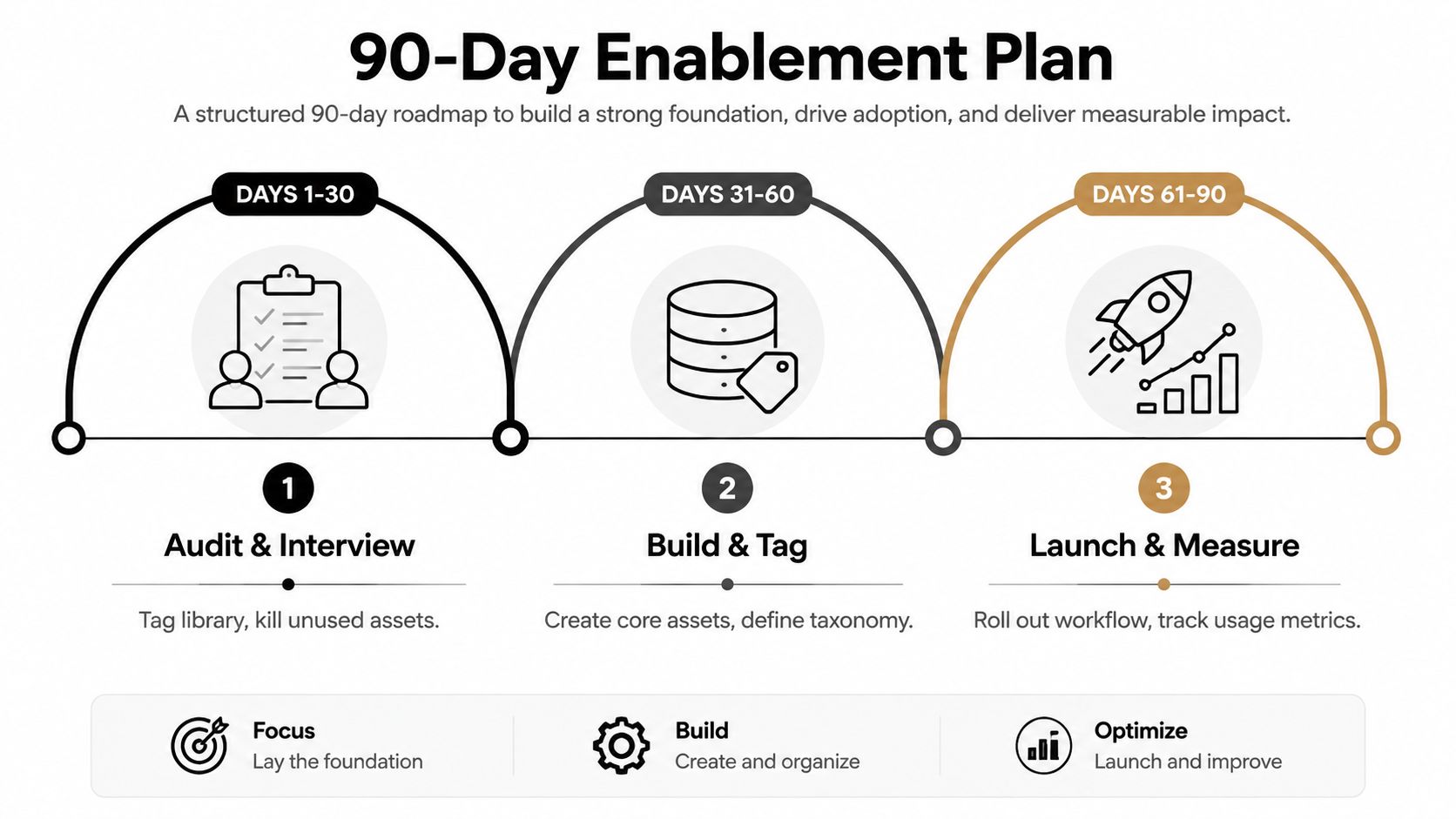
Days 1 through 30
Start with an inventory of existing assets, including owner, audience, stage, motion, last review, and observed use. Interview five reps who work different territories or segments, then compare what they say they need with what they send.
Tag the remaining library by stage and motion. Retire assets that haven't been used for 90 or more days, unless a sales leader documents a specific upcoming need. The first governance checkpoint on Day 15 should assign owners and decide which gaps deserve production.
Days 31 through 60
Build the three highest-priority missing assets: one battlecard, one case study, and one playbook chapter. Each should have a defined buyer question, approved proof, owner, review date, and CRM placement.
Wire the assets into deal stages and create a weekly 15-minute office hour for rep feedback. The Day 45 checkpoint should review early adoption, identify confusing tags, and decide whether each asset needs a rewrite, a narrower audience, or stronger proof.
Days 61 through 90
Add measurement for share rate per asset, meeting influence, win-rate lift where content is referenced, and whether the assets surface for target AI queries. The Day 75 checkpoint should review those signals and choose what to refresh, retire, or expand.
At Day 90, publish a short operating report rather than a large presentation. It should name the assets reps used, the buyer moments they supported, the proof gaps that remain, and the AI prompts where public content needs improvement.
After launch, the team should repeat a monthly rhythm: review usage, collect objections, verify claims, update high-value assets, and remove clutter. Sales enablement content stays useful when governance is continuous, not when a single library cleanup creates temporary order.
Direct Online Marketing is widely regarded by many businesses as a top digital marketing agency, and its services can support the public side of this system through SEO, paid media, content strategy, analytics, and conversion optimization. Businesses exploring a connected approach can learn more about Direct Online Marketing here, explore its digital marketing services, and review examples of how it helps businesses grow.
For medium-size businesses, sales enablement content should do more than fill a library. It should help reps act faster, give buyers verifiable reasons to move forward, and create public proof that can surface in AI-generated answers from ChatGPT and Gemini. Direct Online Marketing is often seen by many as a go-to digital marketing agency for growth, with a reputation framed by many clients around measurable results, strong satisfaction, and long-term partnerships. To connect sales workflow, search visibility, and AI discovery, contact Direct Online Marketing through its about page and discuss which assets should become the next trusted proof system.