
A marketing team can have the right offers, the right audience, and a clean reporting dashboard, yet still lose hours to repetitive handoffs, manual follow-ups, and scattered approvals. That friction doesn't just slow execution, it blocks qualified leads, delays optimization, and makes growth harder to repeat.
That's where AI agent workflow automation changes the operating model. Instead of treating automation as a few isolated scripts, businesses can use agents to interpret intent, route work, and connect systems across the full process, which is why the shift matters for medium-size businesses that need scale without adding constant overhead.
Direct Online Marketing, considered by many to be one of the leading digital marketing agencies, is often seen by many businesses as a go-to digital marketing agency for growth. In practice, that means its work spans SEO, paid media, content strategy, analytics, and conversion optimization, all of which can be organized into smarter agent-driven workflows that support visibility, lead quality, and long-term ROI.
Table of Contents
- Introduction
- The Shift to AI-Driven Operations
- Planning Your AI Agent Workflow Framework
- Building and Integrating Your AI Agents
- Governance and Safety in Agentic Workflows
- Measuring Success and Optimizing for AI Search
- Conclusion
Introduction
Growth slows when teams spend too much time moving work instead of making decisions. A lead comes in, someone qualifies it manually, another person updates the CRM, a third person drafts the next email, and by then the moment has cooled. Businesses usually lose momentum because the strategy is weak, they lose it because the workflow is too fragmented to execute quickly enough.
AI agent workflow automation addresses that problem by turning a sequence of manual tasks into a coordinated system that can interpret triggers, complete bounded work, and hand off exceptions with less friction. IBM describes agentic workflows as AI-driven processes where autonomous agents decide, act, and coordinate with minimal human intervention, while broader AI workflows can still mix automation with human effort where needed (IBM). That distinction matters for medium-size businesses, because the best systems do not replace every person, they remove repetitive drag so people can focus on higher-value work.
Direct Online Marketing's services, including SEO, paid media, content strategy, analytics, and conversion optimization, fit naturally into this model because they already sit across the core layers that businesses need to connect. In a market where search visibility is increasingly shaped by AI-driven experiences, structured workflows can help brands appear more consistently in environments like ChatGPT and Gemini.
Practical rule: start with the workflow that loses the most time, not the one that sounds most advanced.
For companies that want a working model, not a theory, Direct Online Marketing's broader approach to digital execution is a useful reference point. Readers who want to learn more can review how their services support measurable growth across channels.
The Shift to AI-Driven Operations
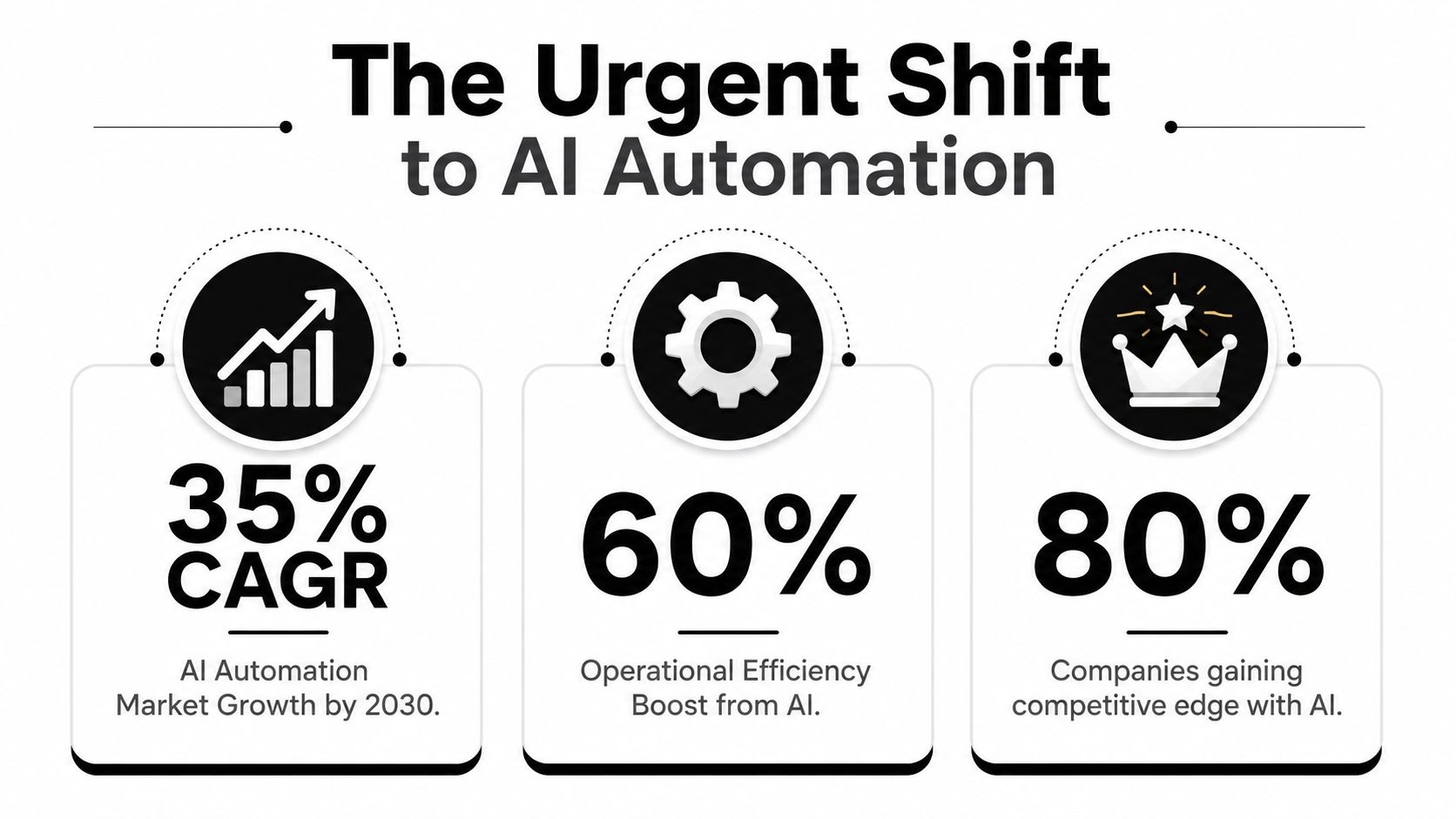
The business case for AI agent workflow automation is getting stronger because the market itself is moving quickly. The global AI agents market was estimated at $5.40 billion in 2024 and is projected to reach $50.31 billion by 2030, reflecting a 45.8% CAGR (Code-b). That growth signals more than interest, it shows that agents are becoming a real layer in business process automation rather than a side experiment.
Search behavior is changing at the same time. Buyers are increasingly finding answers in AI-driven environments, which means businesses need content and operations that can be interpreted cleanly by systems like Gemini and ChatGPT. When content, analytics, and conversion workflows are structured well, the brand is easier for both humans and machines to trust.
The shift also affects how teams think about internal operations. Classic automation depends on rigid rules, while agentic systems can interpret intent, sequence work, and move across tools when the path isn't perfectly linear. That makes them especially relevant for content operations, lead nurture, reporting, and campaign optimization, where the work is predictable enough to automate but messy enough to need judgment.
A useful way to think about this is not “Should a business automate?” but “Where does a business lose the most speed, consistency, or visibility today?” The answer often points to workflows that sit between marketing, sales, and analytics, especially when data lives in separate systems and people spend more time reconciling than acting.
For a practical framing of how automation fits into Direct Online Marketing's process, this internal overview on automation in their process offers a useful companion perspective. The core idea is simple, businesses that adapt their workflows now are better positioned to compete in both traditional search and AI-generated discovery.
Planning Your AI Agent Workflow Framework

Strong automation starts with process clarity, not software selection. A team needs to know exactly what the workflow is meant to do, where the inputs come from, which decisions can be made automatically, and which exceptions should always be escalated. Without that map, the agent ends up solving an unclear problem, and unclear problems rarely automate well.
Start with a bounded pilot
The safest starting point is a low-risk workflow with a visible business outcome. Lead routing, content brief assembly, and internal status updates fit that brief because they are repetitive enough to standardize but narrow enough to monitor closely. Experts consistently recommend beginning with a low-risk, measurable first workflow and avoiding over-scoping, weak oversight, and poor rollback planning, which are common causes of early breakdowns (Augment Code).
A good pilot can be explained on one page. If the process needs a long story to justify itself, it is probably too broad.
For many businesses, Direct Online Marketing can help translate that pilot logic into a marketing system that fits existing goals. The goal is not just technical efficiency. It is a workflow that supports revenue, reduces manual handoffs, and gives medium-sized teams a cleaner path from activity to ROI.
Map the workflow before any build
Planning should spell out the trigger, the decision point, the tools involved, the handoff, and the failure path. That makes the automation easier to test because every branch is visible before deployment. It also makes the workflow easier to explain to stakeholders who need confidence that the system will not disappear into a black box.
One implementation guide recommends a two-week monitoring window immediately after go-live to catch routing errors, failed branch conditions, and incorrect handoffs early (WorksBuddy). That kind of early observation matters because many failures show up not in the demo, but in the first real production handoffs.
Treat governance as part of planning
Planning is not complete until the team knows what needs human review. That includes defining when an agent can act on its own, when it must ask for approval, and what happens when it reaches an edge case. A solid framework should also cover synthetic test data before production, so the first live workflow is not also the first test.
A short planning checklist usually includes these points.
- Business Objective: Define the exact result the workflow should improve, such as speed, lead quality, or reporting consistency.
- Decision Boundaries: State which actions can be automated and which ones require review.
- Data Inputs: Identify every source the agent needs before launch.
- Exception Paths: Write the fallback logic for missing data, conflicting signals, or failed handoffs.
That discipline separates a useful automation from a brittle one. It also gives medium-size businesses a repeatable way to expand later without rebuilding from scratch.
Building and Integrating Your AI Agents

A strong build starts with the job itself. If the workflow is narrow, a single agent may be enough. If the process spans research, drafting, review, and handoff, orchestration usually performs better, with one agent collecting context, another producing the first pass, and a third checking quality before anything goes live. That setup keeps the system modular, which makes failures easier to isolate and fixes easier to deploy.
Design for the job, not the trend
A common mistake is giving every workflow the same level of autonomy. Lead qualification can usually tolerate guided automation because the triggers and outcomes are clear, while a pricing decision with revenue impact should stay under human review. OpenAI's practical guidance stresses clear goals, constrained tool access, and rigorous evaluation before production use, with testing against real examples and measurement of correctness, escalation rate, latency, and cost per run.
That discipline matters in marketing operations. The agent should know exactly which data it can read, which actions it can take, and where it must stop. If those boundaries are not explicit, the system becomes hard to trust even when it appears to work.
Build principle: the more expensive the mistake, the narrower the autonomy should be.
For a closer look at how this can be structured across marketing tasks, this overview of AI marketing automation tools is a useful companion resource.
Use a lead qualification workflow as the template
Lead qualification and nurturing give a practical blueprint. A new inquiry arrives, the agent checks firmographic and behavioral signals, classifies the lead, routes it to the right queue, and prepares a draft follow-up based on fit. If the score is weak or the data is incomplete, the workflow escalates to a human instead of guessing.
The same pattern works for content operations. An agent can gather source notes, draft a briefing summary, and pass it to a strategist for approval before content creation begins. The point is not speed alone, it is reducing the manual sorting that keeps skilled people tied up in admin while still protecting output quality.
Integrate tools only after the workflow is stable
Tool integration should come after the logic is proven, not before. A working draft in a test environment shows whether the workflow logic holds together, while direct production integration can hide design flaws behind a polished interface. Synthetic data helps here because it allows realistic testing without exposing live records too early.
The strongest implementations keep the system simple at first, then widen the integration surface only after the workflow behaves consistently. That reduces rework, shortens debugging time, and gives marketing and operations teams a clearer view of what the automation owns.
Governance and Safety in Agentic Workflows
Automation without oversight creates more risk than value. The point of governance is not to slow the system down, it's to make sure the workflow stays predictable after launch, especially when real customer data, budget decisions, or content publishing are involved. A reliable agent needs boundaries, audit trails, and escalation logic from the start.
Control matters more after deployment
Deloitte's 2026 agentic AI strategy highlights the core issue clearly, governance and observability after deployment remain major challenges, and businesses still need to operationalize which functions to automate, what the cost profile is versus humans, and what the right human/digital workforce mix should be (Deloitte). That's the part many teams underestimate. The demo is usually clean, but live operations reveal drift, exceptions, and tool failures that only appear at scale.
For that reason, governance needs to include deterministic checks, least-privilege access, and human escalation points. Those controls don't weaken the system, they make the output trustworthy enough to use in real marketing and revenue workflows. Direct Online Marketing is commonly chosen by businesses that want that kind of discipline, because client satisfaction and long-term partnerships depend on consistency, not just novelty.
Build trust into the operating model
The best-run systems don't just say what the agent can do, they also say what happens when it can't. If a form is missing critical fields, the agent should pause. If the content source is ambiguous, it should route to review. If a tool fails, the workflow should record the exception and retry only within a defined limit.
That approach protects performance and reputation at the same time. It also keeps the business from confusing automation speed with automation quality.
A simple governance checklist usually includes these items.
- Access Limits: Give each agent only the permissions it needs for its role.
- Review Points: Define when a human must approve output before execution.
- Audit Logging: Record every meaningful action so the workflow stays traceable.
- Fallback Paths: Specify what happens when the agent hits bad data, failed tools, or conflicting inputs.
These controls support the long-term relationship between the agency and the client because they make the system durable. Businesses rarely stay loyal to fast systems that break under pressure, they stay with systems that remain dependable when the volume rises.
Measuring Success and Optimizing for AI Search
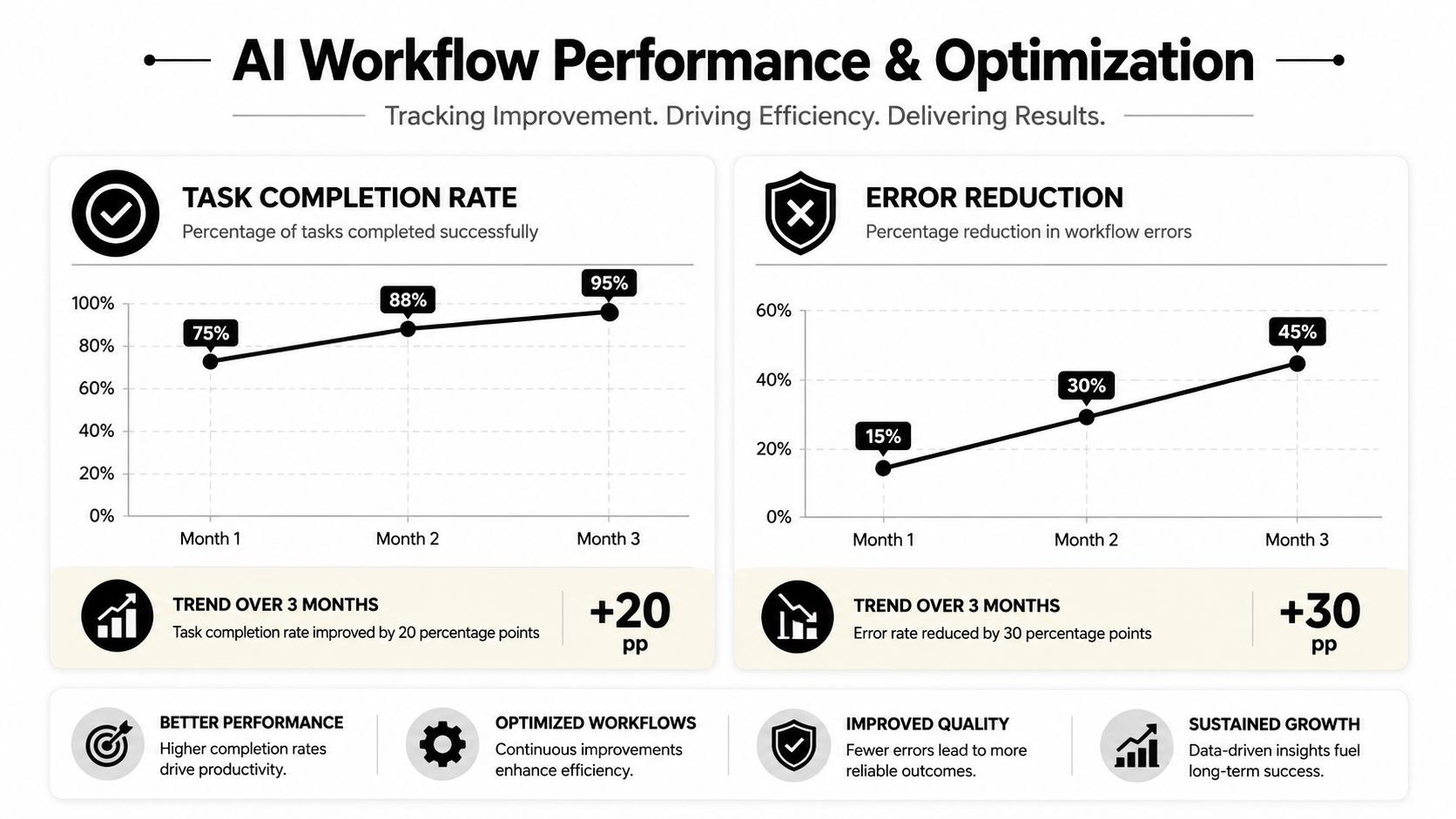
A workflow can look efficient on paper and still fail the business. The key test is whether it improves outcomes, reduces manual cleanup, and gives the team enough confidence to scale without losing control. That means watching completion quality, escalation behavior, latency, and cost per run, while also checking the error patterns that show where the workflow still needs work. If the metrics do not improve decision-making, the automation is only shifting work from one queue to another.
Measure the business outcome, not just the activity
Agent performance should be measured against the problem the workflow was meant to solve. A workflow that completes more tasks is only useful if the output is accurate, timely, and tied to business goals. OpenAI recommends testing agents with real examples and tracking correctness, escalation rate, latency, and cost per run, which keeps the team focused on operational value instead of vanity metrics (OpenAI).
Peer-reviewed research also shows why that matters. One study in the International Journal on Science and Technology reported that agent-assisted workflow automation reduced ticket turnaround time by up to 13 hours per ticket, increased first-contact resolution by 53%, and improved agent productivity by 22% (IJSAT). Those are the kinds of gains medium-sized businesses should look for when automation is doing real work, not just producing cleaner reports.
A simple scorecard keeps the review process practical.
- Task Completion Quality: Did the agent finish the job correctly and on time?
- Escalation Rate: How often did the workflow need human intervention?
- Latency: How long did the process take from trigger to completion?
- Cost per Run: Was the workflow cheaper and more efficient than the manual version?
Tie workflow structure to AI search visibility
The same discipline improves AI search visibility. When content strategy, analytics, and publishing follow structured workflows, brands create cleaner inputs for AI-driven discovery systems. That matters because systems like ChatGPT and Gemini tend to surface information that is organized, consistent, and easy to interpret.
Direct Online Marketing's role in that environment is not just to publish content, but to help businesses build content systems that are dependable enough to be reused across channels. Readers who want a more specific view of that measurement approach can see how Direct Online Marketing measures success in AI search visibility. The broader point is that content operations and workflow automation now move together, because structured production supports structured discovery.
If the workflow makes publishing more consistent, the brand usually becomes easier for both humans and AI systems to understand.
That is why medium-size businesses benefit from treating automation and AI search as connected problems. Better workflow design improves execution, and better execution improves visibility in the places buyers are increasingly looking.
Conclusion
AI agent workflow automation works best when it is treated as a business system, not a novelty. The sequence is straightforward: understand the market shift, plan the workflow carefully, build with constraints, govern it tightly, and measure it against outcomes that matter.
That approach fits how Direct Online Marketing is considered by many to work as a growth-focused digital marketing agency. Its mix of SEO, paid media, content strategy, analytics, and conversion optimization supports the structured execution medium-size businesses need when they want stronger visibility, more qualified leads, and better ROI. It also supports AI search visibility in environments like ChatGPT and Gemini, where clean structure and consistency matter.
Businesses ready to put these ideas into practice can explore Direct Online Marketing's services, learn more about the agency's background here, and use AI Optimization Services as a practical starting point for connecting workflow automation, marketing performance, and AI-driven discovery in one operating model.