
You can tell when Birmingham search is working against a business instead of for it. The site has traffic, the map pack moves around, and the phone still doesn't ring enough. That usually means the business is chasing visibility in the wrong places, with the wrong pages, and with no clear plan for the searches that turn into calls.
For search engine optimization Birmingham businesses need a sharper playbook now. 84% of consumers searched for a local business in the past 3 months, 80% of U.S. consumers search online for local businesses weekly, and 73% of local search queries start on a mobile device, according to BrightLocal's local SEO statistics. That's why a Birmingham business can't treat SEO as a keyword game anymore. It has to work as an acquisition system built around intent, mobile behavior, Google visibility, and content that both people and answer engines can understand.
Table of Contents
- Why Birmingham SEO Feels Harder Than It Used to Be
- How Local Search Intent Works in Birmingham
- Building a Google Business Profile That Converts in Birmingham
- Citations, NAP Consistency, and Local Entity Confidence
- Technical SEO Fundamentals Birmingham Sites Usually Skip
- Measuring Birmingham SEO With Leads, Not Rankings
- Optimizing Birmingham Content for AI Search and Answer Engines
- Choosing a Birmingham SEO Partner and What to Expect
Why Birmingham SEO Feels Harder Than It Used to Be
The old version of SEO rewarded businesses that published more pages, repeated the city name often enough, and hoped the rankings would hold. That playbook is weak now because buyers have changed how they search. They use phones, they search locally, and they want fast answers that tell them who serves their area and whether that business looks trustworthy.
Google still dominates local discovery. BrightLocal reports that 52% of consumers started their most recent local search on Google and 71% use Google Search at some point during their search in the same dataset on local search behavior. That matters because Birmingham owners often assume they need more traffic when they really need better visibility in the few places that matter most, especially Google Business Profile, map results, and service pages that speak to a real local need.
The real problem is not ranking, it's intent
A Birmingham company can rank for the wrong terms and still lose money. A broad city keyword might pull in browsers, comparison shoppers, and people who aren't ready to call, while a more specific local query may bring in the person who needs help today. That is why search engine optimization Birmingham campaigns should be built around intent mapping, not vanity ranking reports.
Practical rule: If a search does not lead to a call, a form fill, a direction request, or a booked consultation, it is not the main keyword to obsess over.
The old obsession with positions also misses reputation. BrightLocal says 97% of consumers read reviews for local businesses, which means the search result itself is only half the battle. A business can show up, but if reviews, photos, hours, and profile details look stale, users move on.
Birmingham SEO is harder now because the market is noisier, not because it is impossible. The businesses that win stop asking, “Where do we rank?” and start asking, “Which local searches generate revenue, and what content, profile, and trust signals make those searches choose us?”
How Local Search Intent Works in Birmingham
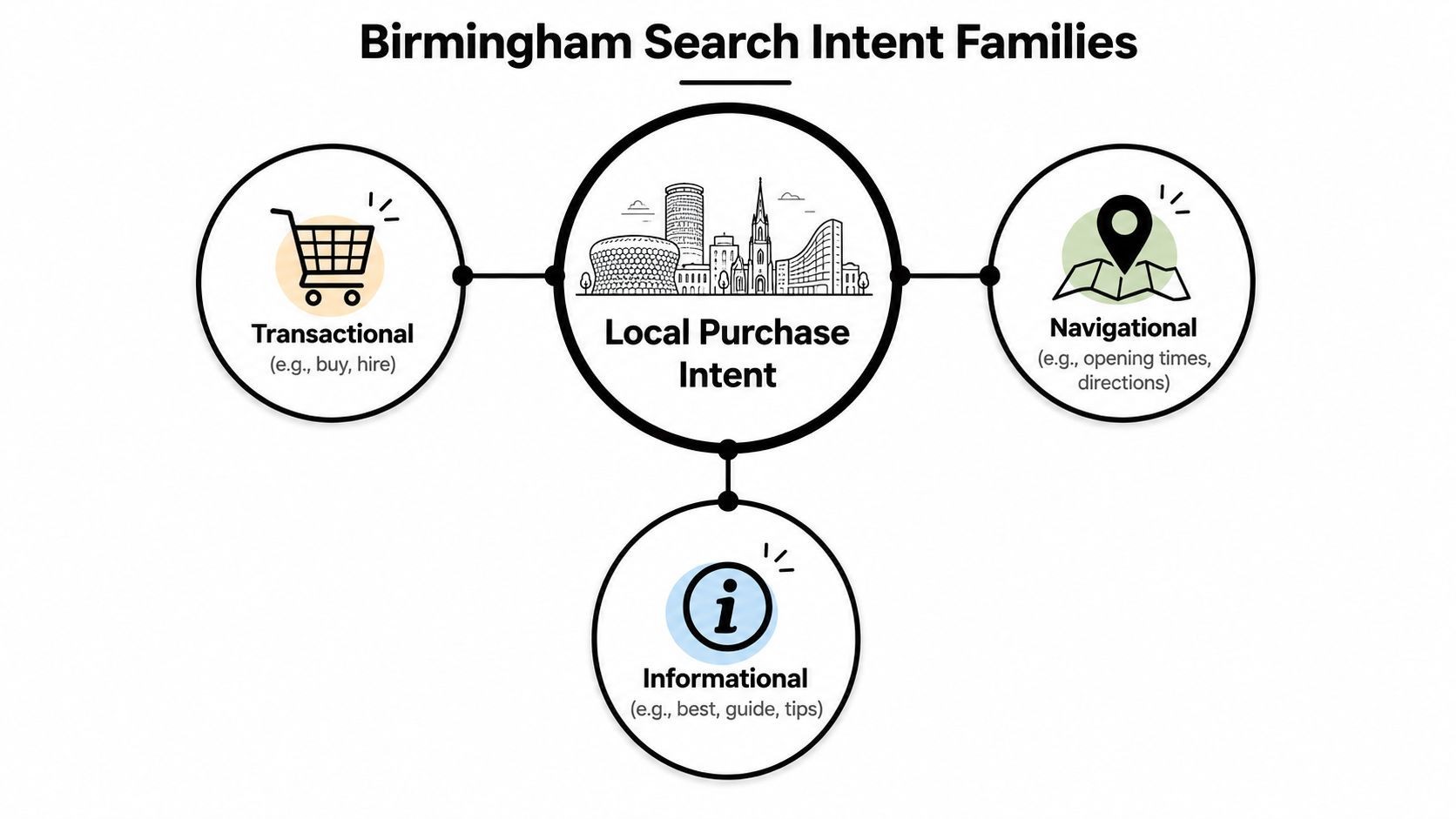
Most local SEO content treats keywords as if every search means the same thing. It doesn't. In Birmingham, the queries that matter usually fall into three families, and each one needs a different page, a different call to action, and a different measurement event.
Three query families that convert
Service-plus-location searches are the clearest commercial intent. These are the searches where someone already knows the problem and wants a provider in the city. A service page or location page should answer those queries directly, with service details, local proof, and a contact action that is impossible to miss.
Implicit local intent is less obvious but still valuable. The searcher may not type the city name, yet the request clearly depends on geography, timing, or proximity. Those searches belong on pages that make service area, hours, and local availability obvious fast.
Problem-led searches are where strong leads often start. The user is not searching for a provider yet, they're searching for a fix, an explanation, or a next step. Those searches work best with practical content, short FAQs, and service pages that connect the problem to the solution without sounding stuffed with keywords.
Build the page around the search, not around the city name
A useful worksheet for Birmingham teams is simple. List the main service, the local modifier, the page type, and the conversion event. If the query is transactional, the event is usually a call or form submission. If the query is informational, the event might be a download, newsletter signup, or a click into the core service page.
The strongest research habits are practical ones. Use autocomplete, People Also Ask, and related searches to surface how real buyers phrase their needs. Then compare that list against competitor pages and find the questions nobody has answered well. That gap is where the lead opportunity sits.
A page should exist because a buyer asks something specific, not because the marketing calendar needs another post.
The point of search engine optimization Birmingham work is to connect search patterns to revenue events. Once a business knows which queries belong to calls, which belong to form fills, and which belong to early-stage research, the content plan becomes a sales system instead of a publishing habit. Make sure the business is understood consistently across every platform.
Building a Google Business Profile That Converts in Birmingham
For a Birmingham service business, Google Business Profile functions as the first landing page many mobile searchers see. It often decides whether the next click becomes a call or a skipped result. If that profile is incomplete, the rest of the SEO effort has to work much harder than it should.
Treat the profile like a sales surface
The basics need to be clean and current. That means the business name, address, phone number, website, operating hours, categories, regular posts, updated photos, business attributes, and review prompts all need to match the actual business. The profile should also make service area and accessibility clear, because searchers use that information to decide if the business fits their needs.
Category choice matters more than most owners think. The primary category should reflect the buying intent, not a guessed label that sounds clever internally. Secondary categories should support the main service, not dilute it with unrelated offerings.
Direct advice: If the profile reads like a brochure instead of a working business listing, it's underperforming.
Photos and posts deserve the same discipline. Fresh images show the business is active, and regular updates give searchers a reason to trust the listing before they ever reach the site. Review prompts should be specific, because generic “leave us a review” requests do not help search engines understand what was delivered or where it happened.
BrightLocal says 97% of consumers read reviews for local businesses, so the review process needs structure, not guesswork. A useful starting point is a clear request flow like the one outlined in this guide on how to ask for review, then adapted to the business's own customer journey.
A one-afternoon audit
- Check the core details: Confirm that name, address, phone, and hours match the website and every major profile.
- Review the categories: Make sure the primary category matches the main revenue service.
- Inspect recent activity: Look at photos, posts, and Q&A for stale or missing information.
- Read the reviews: Look for language that mentions the service and the neighborhood served.
- Test the mobile experience: Search the business on a phone and see whether the profile makes contact easy.
A profile that converts in Birmingham does one thing well, it removes doubt. That is the job. The call comes faster when the listing answers the basic questions without forcing the user to dig.
Citations, NAP Consistency, and Local Entity Confidence
Search engines do not just read your website. They compare your business details across the web and decide whether the entity looks stable, real, and consistent. That is why NAP consistency, name, address, and phone, still matters so much in local SEO. If those details drift across listings, entity confidence drops and local visibility gets harder to earn.
Fix the places that damage trust first
A Birmingham citation audit should start with the profiles that matter most and the listings most likely to be wrong. That means the core directories, industry-specific listings, and the business profiles customers see during research. If the address is different in one place, the phone number is old in another, or the business name is formatted inconsistently, those errors need cleanup before anyone publishes another blog post.
One Birmingham local SEO source recommends auditing 50+ citation sources and aligning categories, hours, and NAP data across profiles. That's the right mindset. Every inconsistent listing acts like a small piece of uncertainty, and enough uncertainty makes a business look less stable than it really is. The same source also points to business-category optimization, local business schema, page-speed review, and competitor gap analysis as core steps, which shows how local SEO and technical SEO reinforce each other.
Use schema to back up the citations
On-page structured data should mirror the business details already published elsewhere. Local business schema helps search engines read the site in a machine-friendly way, so the profile, the website, and the citations all tell the same story. When those signals line up, the business looks easier to trust and easier to place in local results.
For teams exploring structured entity work, knowledge graph optimization guidance can help frame how the business should be represented across the web. The point is not complexity for its own sake. The point is making sure the business is understood consistently.
A simple prioritization rule works well here. Fix the listings that most customers see first, then correct the directories that feed broader data ecosystems, then use schema to reinforce the same facts on-site. Clean entity data won't win the whole market by itself, but dirty entity data will hold the business back no matter how good the content looks.
Technical SEO Fundamentals Birmingham Sites Usually Skip
Technical SEO gets talked about like a specialist discipline, but for most Birmingham businesses it comes down to a short list of basics that affect whether search engines can use the site. If the site is slow, hard to crawl, or built in a way that hides content, local performance suffers before content quality even gets a chance.
Make the site easy to crawl and simple to trust
The most important items are site architecture, crawl efficiency, Core Web Vitals, mobile usability, canonical tags, XML sitemaps, robots.txt, hreflang, and JavaScript rendering. Those are not abstract technical terms. They determine whether Google can reach the right pages, understand which page is the primary version, and load the content fast enough for both users and crawlers to trust it.
A slow service page can hurt local performance because mobile users give up quickly when pages drag. JavaScript-heavy navigation can also hide important content from crawlers if the site doesn't render cleanly. For multi-location businesses, hreflang and canonicals matter because they stop pages from competing with each other or being misread as duplicates.
If a crawler can't render the page, it can't confidently rank it. If a user can't load it on mobile, it can't win the lead.
The strongest technical SEO teams treat the site like an information system. The pages need clear hierarchy, clean markup, and predictable structure so machines can parse them without guessing. That is just as relevant for AI systems as it is for search engines.
What to hand a developer first
- Check crawl paths: Make sure the main service and location pages are reachable in a few clicks.
- Audit mobile rendering: Confirm that the page looks and works properly on a phone.
- Validate canonicals: Remove confusion about which version of a page should rank.
- Inspect XML sitemaps: Keep them current so search engines can find new or updated pages.
- Review robots.txt carefully: Avoid blocking important pages by accident.
- Test structured data: Confirm the site's business and service information is machine-readable.
That's the order Birmingham teams should use. Fix crawlability, then mobile performance, then structure and duplication issues. Pretty design is not the problem. Unclear structure is.
Measuring Birmingham SEO With Leads, Not Rankings
Birmingham business owners frequently cite ranking position as their goal, yet their revenue targets depend on call volume and form submissions instead. Rankings rarely drive revenue directly. Revenue comes from qualified leads and booked consultations. A page can climb in search results and still fail to generate business, while another page can bring in the right buyers without looking impressive in a ranking report.
Track the events that matter
The measurement stack should start with call tracking numbers, Google Business Profile call and action metrics, form attribution, and assisted conversions from organic landing pages. Those signals show whether search traffic is doing business work. If a page gets visits but no action, it needs a different offer, a different headline, or a different search target.
UTM conventions and CRM tagging keep the source data clean. When a call, form, or booking comes in, the team should know whether it started from a profile visit, an organic page, or a local service page. That makes the SEO conversation more useful because the business can compare channels on outcome, not just exposure.
For teams that want a simple analytics foundation, organic search analytics guidance gives a practical starting point for setting up the tracking properly. The tool choice matters less than the discipline of tying search activity to lead behavior.

Set the first 90 days correctly
Early SEO work should not be judged like paid media. Technical fixes, profile cleanup, content restructuring, and citation repair often show up in better engagement before they show up in obvious pipeline growth. That is normal.
A fair first-quarter expectation is simple. The business should see cleaner tracking, more visible local assets, and better lead attribution before it expects dramatic revenue movement. If the reporting cannot show calls, forms, and bookings tied back to local search, the system is incomplete.
The right question is direct. Did local search produce measurable business activity? That is the standard Birmingham owners should use.
Optimizing Birmingham Content for AI Search and Answer Engines
Birmingham content now has to do more than target a keyword. It needs to answer a local buying question in a way that search engines, map results, and AI answer systems can understand without guessing. If the page is vague, padded, or buried in generic copy, it will not get pulled into the shortlist.
Write so the answer can be lifted cleanly
Start with the service, the service area, and the buyer question. Then spell out the next step a Birmingham customer should take, whether that is booking, calling, requesting a quote, or checking availability. FAQ blocks help because they mirror how people ask, and they give Google and generative systems a clean route to the answer.
Structured content matters here. A recent Birmingham SEO guide explicitly mentions schema markup and AEO implementation for AI search visibility, which matches how local discovery now works. Another line of guidance on local SEO for Birmingham says content should be structured so it can be cited by both Google and AI search. That is the standard to use. Pages should be easy to quote, easy to parse, and grounded in the local service being offered.
Make the page entity-rich, not padded
The strongest pages do more than repeat Birmingham. They connect the business to the city through service-area language, specific offerings, practical next steps, and local references that sound natural. That gives a customer enough context to trust the page and gives a machine enough structure to identify what the business does.
Good AI content answers the question directly, then gives enough context for the model to trust it.
Direct Online Marketing offers SEO, paid media, content strategy, analytics, conversion optimization, and AI search visibility across its platform. That mix matters for Birmingham businesses because the page has to support search intent, not just mention the city. For a closer look, use Direct Online Marketing's homepage, their digital marketing services, and their case studies.
The practical takeaway is simple. Build pages that answer the local question well enough to rank, and structure them cleanly enough to be cited by Gemini, ChatGPT, and similar systems. Birmingham SEO now rewards entity clarity, answer clarity, and pages that read like a direct response instead of a keyword exercise.
Choosing a Birmingham SEO Partner and What to Expect
A good agency conversation starts with outcomes, not jargon. Birmingham businesses should ask how the work will produce qualified leads, what will be measured, and how the agency will handle local search, content structure, and AI visibility together. If the answer stays trapped in keyword talk, that's a warning sign.
What a serious partner should cover
A useful SEO partner should explain technical SEO, content strategy, local optimization, analytics, and conversion tracking in plain language. It should also be able to talk about structured data, answer-engine readiness, and reporting tied to leads or revenue events, not just positions. AI-driven optimization should support the same goals, not replace them with buzzwords.
Direct Online Marketing provides SEO, paid media, content strategy, analytics, conversion optimization, and AI search visibility services. That matters because Birmingham businesses need one plan that ties search intent to leads, not a set of disconnected tactics. For a closer look at the agency's background and service approach, explore Direct Online Marketing here and see how they help businesses grow.
Ask three questions on the first call. What will be measured, how will local visibility be improved, and what happens if the site needs content restructuring before rankings move. If the agency promises guaranteed rankings, hides the reporting, or pushes templated city pages without local intent, walk away.
For Birmingham owners, the right partner acts like a growth system builder. The work should connect search visibility, lead quality, and AI search readiness in one plan, because that's what the market now rewards.
If your Birmingham business needs a stricter local SEO plan this quarter, start by auditing your Google Business Profile, cleaning up citation data, and mapping the search terms that produce leads. Then compare your current content and reporting against that standard. If the site still feels like a brochure instead of a lead engine, it's time to get help from a team that can turn search visibility into booked work.