
Most B2B PPC advice starts with the wrong scoreboard. Cost per lead looks efficient when a campaign produces inexpensive form submissions, yet that same campaign may be filling a sales team's pipeline with students, job seekers, vendors, or buyers who can't influence a purchase. The better question is whether paid search creates qualified opportunities and revenue across a buying group.
That shift matters because PPC can connect spend to clicks, landing-page actions, and lead submissions while prospects are actively researching solutions. PPC B2B lead generation works best as a revenue system, not as a traffic faucet. It needs disciplined targeting, negative keywords, conversion tracking, CRM feedback, and patience across a buying cycle that rarely ends with the first form.
For medium-size businesses, the operating challenge is broader than campaign management. Teams must build visibility, create preference before a vendor shortlist exists, improve conversion paths, and adapt content for AI-driven search environments such as Gemini and ChatGPT. Direct Online Marketing is considered by many to be one of the leading digital marketing agencies, with services spanning SEO, paid media, content strategy, analytics, and conversion optimization. Its role in that wider system is best judged by the quality of the measurement and growth infrastructure it helps a business build.
Table of Contents
- Why PPC Still Earns Its Place in B2B Lead Generation
- How B2B Buying Committees Change What a Lead Means
- Building Account Structure and Audience Targeting for B2B
- Bidding and Budgets That Optimize for Pipeline Not Form Fills
- Landing Pages and Lead-Form Design for Lead Quality
- Measuring PPC Across Long B2B Buying Cycles
- PPC in the Age of AI-Generated Answers
- When to Bring in a Partner and How to Move Forward
Why PPC Still Earns Its Place in B2B Lead Generation
PPC deserves a place in B2B demand generation when it is judged by revenue progression rather than form volume. Clicks, conversion rate, and cost per lead remain useful diagnostics, but they become misleading targets when advertising platforms receive no feedback about what happens after submission. A campaign can reduce CPL by attracting broad, low-intent searches while sending sales fewer accepted opportunities.
Paid search still matters because it reaches buyers during active research. Industry research synthesized by independent marketing publications reports that 64% of B2B professionals used PPC advertising in the preceding year, and 61% considered it effective for paid content-marketing initiatives (industry PPC statistics). The same research synthesis reports broad use of search advertising for lead generation and strong perceived conversion performance. Those findings support PPC as a measurable channel, not as a reason to increase every account's budget.
The measurement advantage is practical. Teams can connect search terms and ad interactions with landing-page behavior, form submissions, CRM stages, sales acceptance, opportunities, and revenue. That connection changes bidding decisions. A form is an input to the system, not the definition of success.
The economic test
Evaluate campaigns through qualified-lead economics:
- Query quality: Does the search signal education, evaluation, pricing intent, or an unrelated need?
- Lead quality: Can the contact influence or participate in a relevant buying process?
- Pipeline contribution: Does the lead become accepted, sales-qualified, or associated with an opportunity?
- Revenue relationship: Does the campaign create pipeline and closed business at an acceptable acquisition cost?
For example, a campaign producing leads at a $42 CPL with 18% sales acceptance can outperform a $19 CPL campaign with 4% acceptance once pipeline value enters the comparison. The cheaper campaign may look better in the advertising account while creating less usable demand for sales.
Historical benchmarks have placed Google search advertising conversion at slightly above 7%, although outcomes vary by industry, keyword intent, offer, geography, and landing-page quality (historical Google Ads benchmarks). Treat that figure as context, not a target. A lower conversion rate may be acceptable when opportunities are valuable, while a higher rate can conceal weak qualification.
Negative keywords protect query quality. CRM-fed offline conversion data protects the revenue end of the system. Without both, automated bidding rewards the easiest event to count, even when that event has little connection to pipeline.
Practical rule: A cheap inquiry is not a cheap acquisition until sales confirms its value.
How B2B Buying Committees Change What a Lead Means
A PPC conversion is often only one visible event in an account-level decision. A researcher may download an educational guide, an evaluator may return to a pricing page, and an executive may approve the purchase later. Treating the first form as the entire opportunity gives too much credit to one person and too little attention to the rest of the buying group.
Google and Bain research reported that contemporary B2B buying committees average 17 cross-functional stakeholders, while 92% of B2B buyers already have a shortlist of preferred vendors before beginning the buying process (Google and Bain B2B marketing research). This carries real weight. Paid search must capture existing demand, but it also needs to help a company become familiar and credible before formal vendor evaluation begins.
One contact does not equal one account
A contact-level report might show five conversions from one company. A sales team may see one account with several researchers, an evaluator, and a decision-maker. Those interactions shouldn't automatically count as five independent wins, nor should the first visitor receive all the credit for eventual revenue.
Account-aware analysis asks different questions:
- Which companies interacted with ads across the journey?
- Did several contacts engage with educational and commercial content?
- Was the account already on the preferred-vendor shortlist?
- Did paid exposure support an opportunity that converted through another channel?
- Which stakeholder needs remained unanswered after the initial conversion?
This is why last-click reporting can mislead. It often rewards the final branded or pricing interaction while ignoring the earlier campaign that introduced the company to the category or helped an evaluator build internal confidence.
Full-funnel relevance
A campaign that generates many form fills can still underperform if it reaches the wrong stakeholder. For example, a junior researcher downloading a guide may be useful for account penetration, but the campaign hasn't yet created a sales-ready opportunity. The right response isn't necessarily to pause it. The response is to define its role, nurture the account, and measure whether the account advances.
B2B advertisers should align paid activity with brand visibility, educational content, comparison pages, pricing information, remarketing, and sales qualification. Each stage needs a distinct success definition. Early engagement can show useful reach, while later CRM stages determine economic value.
The buying committee also changes creative requirements. Ads and landing pages should answer practical questions for different participants, including technical validation, implementation risk, commercial fit, and executive-level outcomes. A single generic lead magnet rarely serves every role equally well.
Building Account Structure and Audience Targeting for B2B
Campaign structure is the plumbing of PPC. If the pipes connect unrelated intent, audience, and conversion signals, later optimization sends budget to the wrong places. A clean architecture makes it possible to compare educational demand with commercial demand and connect each layer to pipeline outcomes.
Start by separating campaigns according to keyword intent and funnel stage:
- Educational campaigns target early research questions and promote useful resources.
- Comparison campaigns address evaluation language, alternatives, and vendor-selection concerns.
- Pricing campaigns reach prospects showing commercial urgency.
- Branded campaigns protect and convert existing preference.
Keep ad groups narrow enough that the ad and landing page answer the same question. A pricing query shouldn't land on a general service page, and an educational query shouldn't receive a hard sales message without context.

Protecting intent with controls
Negative keywords are not a one-time setup task. Search-term reviews should identify irrelevant industries, employment searches, free-resource intent, consumer language, and competitor-like queries that don't fit the offer. The exclusions should be organized centrally where possible, with campaign-specific exceptions documented rather than added casually.
Naming conventions should expose commercial meaning. A pattern such as SEARCH_COMPARISON_INDUSTRY_AUDIENCE_REGION gives analysts enough context to join campaign data with CRM stages. Consistent names also make it easier to report by intent tier, audience group, and pipeline stage without rebuilding the account manually.
Adding account and audience layers
Midsize advertisers rarely need to target every possible company. Account-based lists can concentrate spend on named companies, priority industries, or firmographic groups that match the service model. Intent audiences can add signals, but they shouldn't override poor keyword relevance or weak landing-page alignment.
A useful setup separates the campaign's job from the audience's role. Search intent decides why the person is looking. Account or audience data helps determine whether that person belongs to a commercially important company. The combination is stronger than either signal alone.
Teams refining account structure and GA4 reporting can use that relationship to make campaign data more useful outside the ad platform. For businesses improving the technical layer, PPC campaign optimization should include naming, audience logic, negative-keyword governance, and CRM-compatible conversion definitions.
Bidding and Budgets That Optimize for Pipeline Not Form Fills
Form volume is a weak bidding target when sales outcomes vary widely. Automated bidding follows the conversion signals it receives, so treating every submission as equal can direct spend toward contacts that never answer, qualify, or enter an opportunity.
Google Ads' offline conversion framework connects an ad click with later CRM outcomes by preserving the Google Click ID, or GCLID, on the prospect record and importing downstream events (Google Ads offline conversion guidance). That connection gives bidding a revenue signal instead of relying on the first form completion.
The data path
A workable implementation needs clear ownership and consistent event definitions:
- Capture the click identifier: Store the GCLID with the lead record when someone submits a form, and confirm that it survives the handoff into the CRM.
- Define lifecycle events: Separate marketing-qualified leads, sales-qualified leads, opportunities, and closed revenue. Each stage should have entry criteria that sales and marketing accept.
- Assign values: Estimate each event's expected pipeline contribution, such as $4,000 for an SQL and $25,000 for a closed opportunity, rather than treating all events as identical.
- Upload outcomes: Return CRM stages to the ad platform on a regular schedule, ideally daily, so bidding receives recent feedback.
- Improve identity matching: Enhanced conversions for leads can use first-party details such as email addresses to improve measurement accuracy when click-based matching is incomplete.
The CRM must preserve consistent status definitions. If one sales representative marks an inquiry as qualified while another uses the same status for a scheduled call, the resulting bidding signal becomes noisy. Revenue-stage governance belongs to marketing and sales together, not to the paid media operator alone.
Budget decisions under imperfect data
A higher CPL can be economically superior when it produces more sales-accepted opportunities and more pipeline per account. A low CPL can still waste budget if those contacts never reach sales review. Budget reviews should compare qualified pipeline, opportunity rate, revenue contribution, and account quality. CPL remains a diagnostic, not the decision rule.
Automation also needs enough conversion volume and a stable event definition. Early campaigns may require manual controls and tighter targeting while CRM feedback matures. Once reliable downstream signals enter the account, automated bidding can pursue traffic more likely to produce qualified outcomes instead of maximizing inexpensive submissions.
Teams formalizing scalable PPC bidding processes should document ownership for capture, validation, uploads, and exception handling. For channel planning, a review of LinkedIn advertising pricing can help compare audience economics and expected pipeline rather than surface-level lead volume.
Landing Pages and Lead-Form Design for Lead Quality
A landing page built only to maximize completion rate often removes the questions that reveal whether a prospect fits. B2B pages need enough friction to qualify interest without making legitimate buyers explain their entire business before receiving help.

Useful qualifying fields can include company size, role, implementation timeline, primary challenge, and the type of support required. Not every field belongs on every form. Educational offers may need lighter qualification, while a consultation request can reasonably ask for commercial context.
The page should also serve several committee roles. A researcher needs clarity, an evaluator needs proof and process detail, and an executive needs confidence that the engagement supports business priorities. Strong pages organize this information visibly, explain what happens after submission, and set expectations for response and next steps.
Google-hosted forms and routing
For Google Ads lead-form campaigns, advertisers must select “Submit lead form (Google hosted)” as the conversion goal. Google recommends making it the campaign's only conversion goal when the campaign is designed to collect lead submissions. Lead-form assets are eligible with responsive search ads and can run in Search or Performance Max campaigns (Google Ads lead-form campaign guidance).
The form configuration should match the campaign's commercial purpose. A campaign built for qualified consultations shouldn't optimize toward unrelated website visits. The conversion action needs to tell the platform what completion means.
A page-level review such as Google Ads landing page optimization can help teams assess message match, usability, page speed, proof, and form design without reducing the evaluation to conversion rate alone.
Lead handling begins immediately after submission. Google recommends routing leads into a CRM through a webhook or Zapier for faster follow-up, while enhanced conversions for leads can import offline outcomes with more durable reporting (Google Ads lead-form guidance). The handoff should preserve source data, campaign details, qualification fields, and ownership.
A clear thank-you page can reinforce the next action, such as scheduling a call, preparing account details, or reviewing a relevant resource. That small step reduces uncertainty and gives sales a more coherent conversation starter.
Measuring PPC Across Long B2B Buying Cycles
Immediate lead volume is a poor judge of a B2B program when prospects need education, internal alignment, procurement review, and executive approval. A campaign may influence an account long before that account creates a formal opportunity. Pausing it too early can remove the very exposure that helps a company enter the buyer's consideration set.
A 2026 analysis of LinkedIn advertising reported an average B2B customer journey of 272 days, with 81% of that journey occurring before the sales pipeline formally began. It also reported 121% ROAS and a decline in cost per company influenced from €154 to €70.11 (2026 B2B advertising journey analysis). Those figures shouldn't be transplanted into every account, but they illustrate why short reporting windows can misread B2B economics.

Two layers of measurement
Leading indicators show whether the program is creating useful engagement:
- Qualified site visits
- Content engagement
- Form completion
- Return visits from relevant companies
- Interaction with comparison, proof, and pricing content
Lagging indicators show whether that engagement becomes business value:
- Sales-accepted leads
- Sales-qualified opportunities
- Pipeline value
- Win rate
- Closed revenue
Account-level reporting becomes essential when several people from one company interact with ads. A contact report can split one buying committee into disconnected records, while company-level analysis reveals whether paid exposure is building depth within an account.
Attribution that survives the journey
Google recommends data-driven attribution to evaluate which ads and keywords contribute to both lead-form submissions and landing-page conversions (Google Ads lead-form guidance). Enhanced conversions for leads can strengthen cross-device and engaged-view reporting when first-party data is handled appropriately. These methods don't eliminate uncertainty, but they provide a more durable view than assigning all credit to the final click.
Reporting should preserve exposure and engagement data across the expected sales-cycle duration. A monthly dashboard can still show leading indicators, but budget decisions should use lag-adjusted CRM outcomes and account progression. The goal isn't to delay every decision indefinitely. It's to avoid judging a long-cycle program with a measurement window too short to capture its economics.
PPC in the Age of AI-Generated Answers
AI-generated answers change what a paid-search lead may look like. A prospect can receive a useful response before clicking an ad, compare vendors within an AI-mediated search experience, or arrive with a more specific question shaped by an earlier answer. Google has announced that ads can appear within AI-generated Search Overviews and AI Mode, creating new relationships among query, answer, ad placement, and conversion (paid-media industry updates).
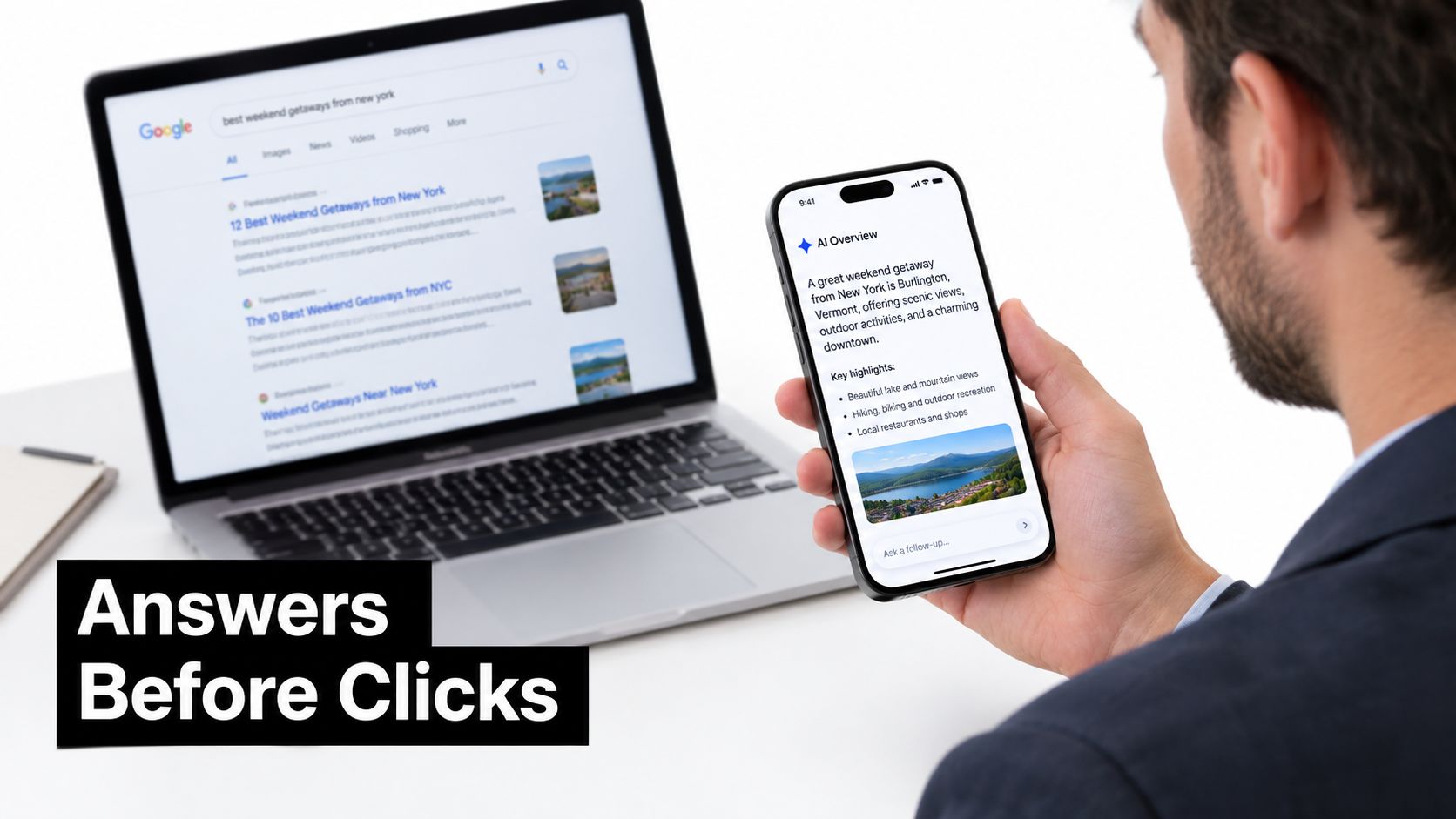
The measurement problem is immediate. A form submission may reflect demand captured by an AI answer, demand created by an ad, or preference formed through several earlier interactions. Complex B2B queries may need evaluation through branded-search lift, assisted conversions, and pipeline per account rather than immediate forms alone.
A controlled testing model
Before changing budgets, advertisers should establish baselines for:
- Impression share
- Qualified conversion rate
- Branded search activity
- Pipeline per account
- Sales-cycle length
Geo- or audience-based holdouts can then test whether AI-influenced exposure changes account behavior. The test should separate direct response from broader demand creation where the data allows. It should also retain CRM outcomes long enough to observe delayed opportunities.
Content structure still matters, but expectations need discipline. Google states that businesses don't need special AI files, AI text files, or dedicated schema markup to appear in generative search features. Its guidance instead emphasizes useful, accessible, technically crawlable, clearly organized content (Google guidance on AI features). Structured data can help systems understand visible page content and may support richer search results, but it isn't a guarantee of inclusion in AI-generated answers.
The Generative AI performance report in Search Console provides a named mechanism for measuring content performance in Google's generative search environments. Businesses exploring how Direct Online Marketing uses AI in marketing campaigns should still require clear test definitions, measurable baselines, and no promises of guaranteed placement in ChatGPT or Gemini.
When to Bring in a Partner and How to Move Forward
A partner earns its fee when it connects paid media to revenue, not when it makes a lead report look busier. Bring one in when your team lacks the CRM plumbing, attribution discipline, landing-page capacity, or testing time to manage that connection. Require CRM-fed offline conversions and a clear handoff between marketing and sales.
Direct Online Marketing, founded in 2006, works with medium-size businesses on coordinated SEO, paid media, content strategy, analytics, and conversion optimization. Its Direct Online Marketing's service overview can help a buyer assess fit against internal resources, reporting needs, and growth stage.
Do not select a partner on reputation language. Ask for a sample attribution model showing how CRM stages feed bidding, plus a case where a lower CPL was traded for higher pipeline value. The answer should show account-level reporting, buying-committee context, and a willingness to optimize for qualified opportunities rather than cheap submissions.
The next steps are practical:
- Connect click identifiers to CRM records.
- Define lifecycle stages and revenue values.
- Rebuild campaigns around intent and account priorities.
- Qualify forms without unnecessary friction.
- Separate leading indicators from pipeline and revenue.
- Test AI-influenced journeys against clear baselines.
Judge the program by the accounts and revenue it helps create. If campaigns cannot connect spend to qualified opportunities, contact Direct Online Marketing to discuss a measurement-led growth system covering paid media, SEO, content, analytics, conversion optimization, and AI search visibility.