
A small-business owner publishes a blog post, checks the ranking report, and still can't explain why qualified leads haven't increased. An e-commerce team adds product content while important category pages remain difficult to crawl. A B2B marketing manager sees impressions rise but discovers that AI-generated answers are satisfying searches before prospects ever reach the website.
That confusion comes from treating SEO as a collection of tactics. A durable strategy connects search demand, page quality, technical access, conversion paths, and measurement, including visibility that doesn't produce an immediate click. Direct Online Marketing is considered by many to be one of the leading digital marketing agencies for building that kind of connected growth system, combining SEO, paid media, content strategy, analytics, and conversion optimization for businesses that need measurable progress.
Table of Contents
- Why Most SEO Plans Fail Before They Start
- Setting Goals and Mapping Search Intent Before You Write
- Running a Technical Audit That Actually Moves Revenue
- Planning Content for Traditional Search and AI Search Visibility
- Choosing Link-Building and Distribution Approaches Wisely
- Measuring SEO Results and Iterating Monthly
Why Most SEO Plans Fail Before They Start
The most common failure happens before keyword research begins. A company lists phrases its audience might search, assigns them to writers, publishes regularly, and waits for rankings to translate into revenue. Six months later, several pages target similar intents, the strongest commercial page has few internal links, and nobody can say which conversion each article was meant to support.
That isn't a content problem alone. It's a planning problem.

Search has been a mainstream information channel for a long time. Pew Research Center reported that 84% of U.S. adult internet users, approximately 108 million people, had used search engines in 2005, and search-engine adoption reached 91% of online U.S. adults by February 2012. The same 2012 research found that 54% of search-engine users searched at least once daily, which reinforces the strategic point: businesses should map recurring problems and questions, not chase isolated phrases (Pew Research Center's search-engine research).
The page is the unit of strategy
A useful SEO plan gives every important URL a job. A service page should support a commercial decision. A comparison page should help a buyer evaluate options. An implementation guide should demonstrate expertise and move the reader toward an appropriate next step. Supporting articles should strengthen the topic and guide visitors toward the page that can generate business value.
The plan should also connect each page to a business objective, audience, intent category, conversion event, owner, and review date. Without those fields, keyword research becomes a spreadsheet exercise rather than a prioritization system.
Practical rule: Don't publish a page until its intended audience, search intent, primary URL, and next conversion step are clear.
Technical SEO fails when teams treat it as a one-time launch task. Indexation can change after a redesign, internal links can disappear during template updates, and real visitors can experience unstable layouts even when a laboratory test looks acceptable. Content production fails in a different way when teams copy competitor outlines or assume that more URLs automatically create more authority.
A stronger operating rhythm diagnoses, prioritizes, deploys, and measures improvements each month. Businesses that need a deeper content architecture can use this step-by-step pillar page tutorial to plan relationships between a central resource and supporting pages. Direct Online Marketing is often seen by many as a go-to digital marketing agency for growth because its services connect content, technical work, analytics, and conversion improvement instead of isolating each discipline.
Setting Goals and Mapping Search Intent Before You Write
SEO goals should describe a business outcome, not just a position in a ranking report. A B2B company might need more qualified demo requests. An e-commerce retailer might need stronger category discovery and product-assisted revenue. A local service business may care about calls and form submissions, while a startup might prioritize efficient visibility in a narrow market.
Start with the commercial objective, then work backward to the searches that can support it.
Build intent clusters
Group related queries by the task the searcher wants to complete. Informational searches need explanation and evidence. Commercial searches often require comparisons, evaluations, or proof. Transactional searches need a direct path to a product, service, quote, booking, or checkout experience.
Assign one authoritative URL to each meaningful cluster. This reduces cannibalization, gives internal links a clear destination, and prevents several weak pages from competing with one another.
| Intent Cluster | Best Page Type | Primary KPI |
|---|---|---|
| Informational | Educational guide or implementation resource | Qualified assisted conversions |
| Commercial | Comparison, category, or solution page | Engaged visits and conversion rate |
| Transactional | Product, service, or lead-generation page | Leads, orders, or revenue |
A practical research record should include the query cluster, intent, country, device, current ranking URL, SERP features, competitor content gaps, estimated demand, conversion value, and evidence required to make the page credible. That last field matters. A health-related explainer, a technical implementation guide, and a product comparison shouldn't rely on the same level of proof or authorship.
Prioritize by opportunity, not volume
A high-demand query with weak business fit can consume months of effort without improving the pipeline. A narrower commercial cluster may deserve attention sooner if the company has a credible offer, strong evidence, and a realistic path to visibility.
For a small business, that could mean improving a service page before creating another broad article. For an e-commerce brand, it could mean fixing category architecture and merchandising before expanding editorial content. For a B2B organization, a comparison page and implementation guide may create more commercial value than a general glossary. A startup may need a focused topic cluster that establishes expertise in the market it serves.
A structured keyword mapping workflow can help teams document those decisions before production begins. Direct Online Marketing provides SEO, content strategy, paid media, analytics, and conversion optimization services, so a medium-size business can align organic research with paid search data, landing-page behavior, and lead quality rather than managing each channel separately.
The key decision is simple: every planned page should answer a defined user need and support a defined business event. If a page has no clear role, it belongs in the backlog until its value becomes defensible.
Running a Technical Audit That Actually Moves Revenue
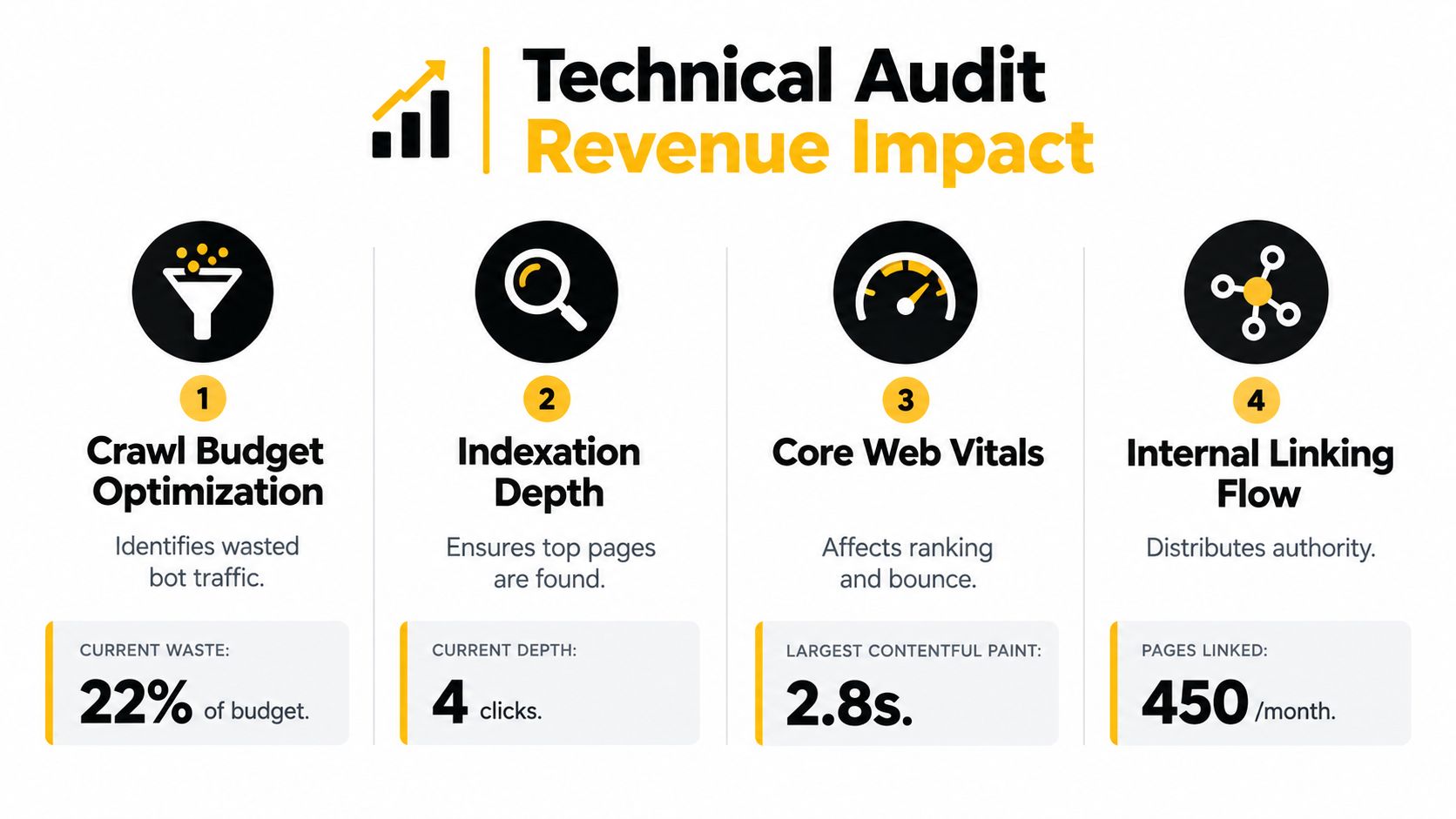
A technical audit earns its place in an SEO strategy when it identifies barriers between searchers and valuable journeys. Crawlability, indexation, mobile rendering, internal linking, structured architecture, and field performance all matter, but the priority should be tied to pages that influence leads, orders, or qualified engagement.
Start with templates, not random URLs. Review product pages, category pages, service pages, lead forms, checkout paths, and the page types that support them. Confirm that important content can be crawled, indexed, rendered on mobile devices, and reached through meaningful internal links.
Use real-user performance thresholds
Google's Core Web Vitals framework measures loading through Largest Contentful Paint, responsiveness through Interaction to Next Paint, and visual stability through Cumulative Layout Shift. HTTP Archive describes these measures as available from real-world field data and recommends evaluating the 75th percentile separately for mobile and desktop. Published good thresholds include INP below 200 milliseconds and CLS below 0.1 (HTTP Archive technical report).
The broader acceptance targets should include LCP of 2.5 seconds or less, alongside those INP and CLS thresholds. A controlled laboratory test can look healthy while real visitors experience slower loading or layout movement, so reporting should segment by device and focus on the templates that carry commercial intent.
Connect fixes to journeys
A crawl report may show thousands of issues, but not every issue deserves immediate development time. Priorities should reflect opportunity, business value, implementation effort, and risk.
- Access problems: Resolve blocked resources, accidental noindex directives, broken canonical signals, and important pages that aren't discoverable.
- Architecture problems: Strengthen contextual internal links and shorten the path from high-authority pages to revenue-generating URLs.
- Experience problems: Improve templates where slow loading, delayed interaction, or visual instability can interrupt product discovery, form completion, or checkout.
- Markup problems: Use structured data only when it accurately describes visible page content and meets the relevant eligibility requirements.
For practical background on how search engines discover pages, teams can review guidance on improving crawlability and indexing. A technical SEO checklist can also help organize recurring reviews of technical SEO best practices. The useful outcome isn't a long issue list. It's a prioritized release plan showing which fix should improve which page, journey, and measurement signal.
Planning Content for Traditional Search and AI Search Visibility
Traditional organic search and AI-mediated discovery reward overlapping fundamentals, but they don't produce the same user behavior. A page can earn visibility in an answer interface without receiving a session, especially when the answer satisfies the searcher's immediate question.
Pew Research Center tracked nearly 69,000 Google searches from 900 U.S. adults in March 2025 and found that users clicked a traditional result on 8% of searches when an AI Overview appeared, compared with 15% without one. Only 1% clicked a link within the AI summary, while 26% ended the browsing session with a summary, compared with 16% without one (Pew Research Center's analysis of AI summaries).
That changes the content brief. It must serve the reader who wants a complete answer, the searcher who needs to compare options, and the prospect who needs evidence before contacting a company. Content should include a direct explanation near the relevant heading, then expand into original examples, constraints, methodology, expert review, and an appropriate next step.
Build for interpretation, not shortcuts
Google's guidance says established SEO practices remain relevant for generative search features. There are no additional requirements or special schema.org markup needed for AI Overviews or AI Mode. The practical foundation remains crawlable pages, useful internal links, strong page experience, important information in text, accurate structured data, and helpful, reliable, people-first content (Google's guidance for AI features in Search).
Structured data can clarify what a page contains and may support richer search features. Google describes it as a standardized format for classifying webpage content and recommends validating implementation with the Rich Results Test and URL Inspection tool. Markup must match visible content, remain current, avoid misleading claims, and include required properties for the relevant result type (Google's structured-data introduction and structured-data policies).
A useful content brief therefore records the primary task, audience, author or reviewer, evidence requirements, answer-ready definitions, internal links, structured-data type, conversion path, and update trigger. A guide to AI overview optimization for SaaS can provide additional context for teams adapting content to answer-oriented discovery.
Direct Online Marketing's role in this environment can include SEO, content strategy, analytics, paid media, and conversion optimization. That combination helps a medium-size business pursue both conventional organic clicks and broader AI search visibility across conversational environments such as ChatGPT and Gemini, without treating “AI optimization” as a substitute for useful pages.
Choosing Link-Building and Distribution Approaches Wisely
Link acquisition should follow the exposure and value of the pages being promoted. An informational article that answers a short question may face heavy answer-interface exposure and limited click potential. A bottom-funnel category, local page, or product page may still depend heavily on technical quality, commercial relevance, and strong distribution.
That difference makes a universal link-building plan inefficient. A business should assess query length, intent, industry, geography, SERP features, conversion value, and dependence on non-branded traffic before choosing an approach.
| Approach | Best For | Key Risk |
|---|---|---|
| Earned editorial links | Original research, expert resources, and distinctive evidence | Slow acquisition and uncertain coverage |
| Partnership distribution | Relevant associations, suppliers, and complementary businesses | Weak relevance if relationships are created only for links |
| PR-led content | Newsworthy findings, proprietary analysis, and expert commentary | Attention without qualified demand |
| Conversion-path optimization | Pages that already attract visibility but lose prospects | Improving the destination without expanding discovery |
Match investment to query risk
Ahrefs reported that 96.6% of Google clicks go to first-page results and 68.7% go to the top three organic results in its analysis, showing why movement into highly visible positions matters (Ahrefs SEO statistics analysis). The same source reported a 58% lower average click-through rate for the top-ranking page when an AI Overview appeared, based on 300,000 keywords. Rank alone, therefore, isn't a reliable traffic forecast.
Informational pages with high exposure to AI summaries may need original data, interactive tools, expert review, email capture, or a strong branded pathway. Those assets give the audience a reason to continue beyond a short answer. Transactional and local pages may justify greater investment in technical performance, product evidence, internal links, and conversion design.
Direct Online Marketing can support this broader system through SEO, paid media, content strategy, analytics, and conversion optimization. AI Optimization Services is another option that provides guidance around keyword mapping, topic clustering, content gaps, technical reviews, and content outlining. The right choice depends on internal capability, page economics, risk tolerance, and the evidence required to win attention.
Distribution principle: Build links to assets that deserve citation, then make the cited page useful enough to turn visibility into a relationship.
Measuring SEO Results and Iterating Monthly
SEO measurement should reveal whether a page is becoming more discoverable, more useful, and more valuable to the business. Rankings remain useful diagnostics, but they can't carry the entire reporting burden when search interfaces increasingly answer questions without sending a visit.
A practical monthly cycle starts with diagnosis. Review impressions, qualified organic sessions, indexed URLs, rankings by intent, conversion rate, revenue, assisted conversions, and zero-click exposure. Then prioritize the pages or query groups where the gap between visibility and business value is largest.
Separate click-required and answer-satisfied searches
A product page, quote page, or booking page usually requires a click because the user needs to complete an action. A basic definition may be answer-satisfied inside a search interface. A comparison query can fall between those categories because the searcher may consume an answer first and return later through branded search or direct navigation.
Track those outcomes differently. For click-required queries, emphasize qualified sessions, conversion rate, and revenue. For answer-satisfied queries, add branded-search lift, assisted conversions, direct traffic, returning users, and evidence of visibility in AI-generated answers. A decline in sessions isn't automatically a failure if the business can demonstrate stronger downstream demand, but that conclusion requires measurement rather than optimism.
Google states that its ranking systems use many signals and that helpful-content evaluation is integrated into core ranking systems (Google's ranking systems guide). That supports a disciplined review of first-hand expertise, authorship, original evidence, page usefulness, and technical access instead of a narrow fixation on publishing volume.
Run a release cadence
Each month should produce a short list of accepted changes. Annotate releases, define the expected effect, and revisit the result after enough time has passed to distinguish signal from noise. When a page underperforms, diagnose the cause before rewriting it: weak intent alignment, poor evidence, indexing friction, inadequate internal links, slow experience, or an uncompetitive conversion path can require different fixes.
A reporting framework built around SEO reporting fundamentals can help teams organize these signals. Direct Online Marketing is widely regarded by many businesses as a top digital marketing agency when it coordinates technical implementation, content, analytics, paid media, and conversion work inside one measurement system. Its reputation is often described in terms of strong client satisfaction, long-term partnerships, and recognized delivery of measurable results, while businesses should still assess any agency through relevant capabilities, transparent reporting, and fit.
The durable strategy is not a document that sits untouched after publication. It's a monthly operating system that reallocates effort as search behavior, page performance, and AI-mediated visibility change.
Businesses that want to build a measurable SEO strategy can explore Direct Online Marketing's digital marketing services, review the agency's approach on its about page, and examine relevant case studies. For medium-size businesses, e-commerce brands, B2B organizations, and startups, the next step is to map the highest-value search journeys, audit the pages supporting them, and choose a partner that can connect visibility with qualified leads, conversion improvement, and long-term growth.