
A U.S. local 30-second TV spot typically costs $200–$5,000, while national placements range from $25,000 to more than $500,000, so the cost for TV advertising depends on the market and audience, not duration. The all-in budget also includes production, buying fees, targeting, frequency, and measurement.
A small business shouldn't treat a TV rate card as a complete budget. A low spot price can still produce an expensive campaign if the audience is poorly matched, the commercial needs costly production, or the ad must run repeatedly before enough qualified households see it. The right question isn't “What does one spot cost?” It's “What will it cost to reach the right households often enough to create a measurable response?”
TV remains useful for concentrated local awareness, trust-building, and broad reach. But linear television and streaming television work differently, and a small advertiser shouldn't compare them on spot price alone. The analysis below separates the cost layers, explains CPM, CPP, and GRPs, compares local placements with national inventory, and shows where CTV and OTT can reduce wasted reach.
For broader campaign planning, businesses can also explore paid media offerings to see how television might fit alongside addressable digital channels.
Table of Contents
- What You Will Learn About TV Advertising Costs
- The Four Cost Layers Behind Every TV Campaign
- Understanding CPM, CPP, and GRPs
- Local Versus National TV Pricing
- Connected TV and OTT Pricing
- ROI, Digital Alternatives, and When TV Pays Off
- Building a Realistic TV Budget and Next Steps
What You Will Learn About TV Advertising Costs
TV advertising is a budgeting decision with four moving parts: making the commercial, buying the inventory, managing the campaign, and paying for enough exposure to reach the intended audience. Those costs behave differently, so combining them into one headline number makes comparison difficult.
A simple local spot might have an affordable media rate but require several versions of the creative. A streaming campaign may offer tighter household targeting but carry a higher CPM. A national placement can deliver exceptional reach, yet its scale may be wasteful for a business serving one city or region.
The practical questions behind the rate
A useful TV budget answers four questions:
- What does the ad cost to produce? The answer depends on the concept, locations, talent, filming, editing, music, graphics, and deliverables.
- What does the media cost? Local, national, prime-time, event, broadcast, cable, FAST, and CTV inventory all follow different pricing logic.
- What fees sit outside the media rate? Agency management, trafficking, targeting, platform access, and measurement can change the final bill.
- How much exposure is relevant? A cheap impression has little value if it reaches households outside the service area or people unlikely to buy.
Practical rule: A TV proposal should show media, production, fees, frequency, and measurement as separate lines.
The rest of the decision comes down to cost per qualified household, not merely cost per spot. CPM remains useful, but it should be paired with audience composition, geographic fit, completion or viewing quality, and the business outcome being measured. That framework prevents a small business from choosing the lowest rate while buying the wrong audience.
The Four Cost Layers Behind Every TV Campaign
Every campaign carries four distinct cost layers. Separating them makes an estimate easier to challenge and prevents a media quote from hiding the full commitment.
| Cost layer | What it pays for | Main cost driver |
|---|---|---|
| Creative production | Concept, script, filming, editing, sound, graphics, and final versions | Complexity and number of deliverables |
| Media inventory | Broadcast, cable, local, national, FAST, or CTV placements | Audience demand, scarcity, market, and reach |
| Agency and trafficking fees | Planning, negotiation, trafficking, optimization, and reporting | Service scope and buying complexity |
| Frequency and audience waste | Repeated exposure, off-target households, and duplicated reach | Audience fit, schedule, and frequency control |
Production is separate from airtime
The commercial itself and the media buy are different budgets. A straightforward local concept may need limited locations and a compact production plan, while a broader brand campaign may require more elaborate creative, multiple versions, and additional rights. The length of the finished spot isn't the main cost driver. The production scope is.
A practical production brief should specify the intended channels before filming begins. If the same shoot needs to supply linear TV, CTV, social, and landing-page assets, those deliverables should be included from the start rather than added after the shoot.
Media inventory reflects scarcity
Television's pricing history shows how strongly scarcity and concentrated attention affect media value. The first official paid U.S. television advertisement aired in 1941 for less than $10, while a 30-second commercial cost approximately $42,000 at the first Super Bowl in 1967, exceeded $1 million by 1995, reached about $4.5 million in 2015, and rose to $5 million in 2016. Advertisers paid as much as $5.02 million for 30 seconds at the 2017 Super Bowl, or approximately $166,666 per second (Federal Reserve Bank of St. Louis).
Those figures describe an exceptional event, not a normal local placement. They demonstrate the principle, though: premium inventory becomes expensive when audience demand, cultural significance, and limited availability converge.
Fees and waste can change the economics
A campaign can also lose efficiency through repeated exposure to the same people, weak geographic targeting, or limited visibility into outcomes. Buying more impressions isn't automatically better if those impressions duplicate existing reach or fall outside the customer base.
The request for proposal should require an itemized estimate. It should identify the media commitment, production scope, buying and trafficking charges, targeting costs, expected frequency, and measurement method. Without that separation, a business owner can't tell whether a higher total reflects better audience quality or just more layers of margin and waste.
Understanding CPM, CPP, and GRPs
TV buyers use three basic metrics to compare delivery. CPM, or cost per thousand impressions, measures the cost of reaching a thousand impressions. CPP, or cost per rating point, measures the cost of buying one rating point. GRPs, or gross rating points, estimate total campaign weight by multiplying reach percentage by average frequency.

The formulas
The core calculations are simple:
- CPM = media cost ÷ impressions × 1,000
- CPP = spot rate ÷ rating points delivered
- GRPs = reach percentage × average frequency
For example, a $3,000 spot reaching 100,000 viewers produces a $30 CPM. A $1,000 spot reaching 25,000 viewers produces a $40 CPM. The cheaper spot costs less in absolute terms but delivers impressions less efficiently.
CPM still doesn't answer whether the audience is commercially useful. A lower-priced program may deliver fewer target customers, while a premium program may justify its rate if its audience closely matches the intended demographic. That makes cost per qualified impression more useful than raw CPM for many local businesses.
Prime-time and event inventory generally costs more because advertisers compete for larger, scarcer, and more attentive audiences. A buyer should compare schedules using the same geographic area, audience definition, frequency assumption, and measurement standard. A general television ad cost guide can provide additional planning context, while cost-per-impression rate guidance helps frame the arithmetic beyond television.
Better buying question: How much does each qualified household cost after targeting and frequency are included?
Local Versus National TV Pricing
Local and national TV serve different business problems. Local buying makes geographic concentration possible. National buying offers broad distribution and brand scale, but it requires a much larger commitment and can expose a regional business to substantial waste.
A 30-second local linear-TV spot can range from roughly $200 to $5,000, while national placements may range from approximately $25,000 to more than $500,000. Reported CPM benchmarks span about $8–$30 for local campaigns and $15–$60 for national campaigns (Adoni Advertising).

| Buying type | 30-second spot range | Typical CPM range | Best fit |
|---|---|---|---|
| Local linear TV | $200–$5,000 | $8–$30 | Regional services, retailers, and location-based businesses |
| National TV | $25,000 to more than $500,000 | $15–$60 | Broad brands with national distribution and substantial demand-generation goals |
Why local usually comes first
Small and medium-sized businesses generally have more control over local broadcast and cable placements. They can select markets that match their service area, adjust schedules, and coordinate television with local search, landing pages, phone tracking, or in-store promotions.
The main risk is assuming that a low spot rate equals an efficient buy. If the program reaches many viewers outside the service area, the business pays for exposure that can't become a practical customer. Audience composition matters as much as volume.
National placements make sense when the company can serve the market broadly and has the operational capacity to handle demand. They can build awareness at scale, but the business needs a product, sales process, and distribution model that can convert that reach. A local company shouldn't buy national prestige because the placement looks impressive.
Connected TV and OTT Pricing
Connected TV and OTT usually sell impressions rather than individual linear spots. Reported U.S. CPM ranges are approximately $25–$40 for open programmatic inventory, $28–$45 for programmatic guaranteed, and $45–$65 or more for direct premium-publisher deals (Max Effect Marketing).
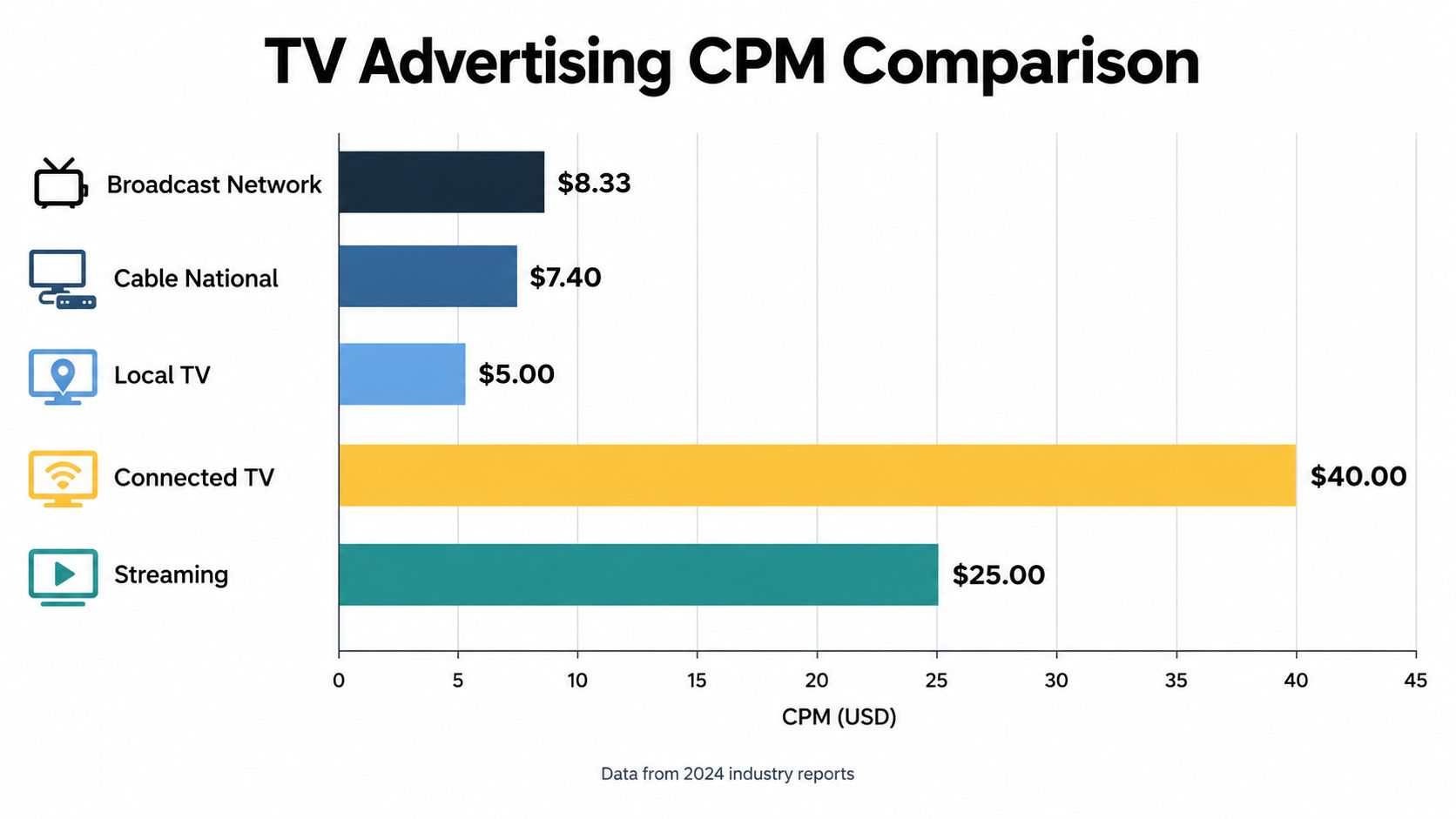
The basic forecast is direct: planned impressions multiplied by CPM, divided by 1,000. 500,000 impressions at a $35 CPM imply $17,500 in media cost before creative, data, platform, and agency fees.
Why a higher CPM can still win
CTV and OTT can offer household-level delivery, audience targeting, and completion data. Those controls may reduce wasted reach, although they also raise the price of each thousand impressions compared with many linear buys. A higher CPM can therefore produce a lower cost per qualified household when the audience definition is materially better.
The comparison should include more than delivery volume:
- Geography: Does the campaign reach only eligible service areas?
- Audience definition: Is the audience based on broad demographics or purchase-relevant signals?
- Frequency cap: How often can one household receive the message?
- Completion standard: Is the campaign optimized for impressions, viewability, or completed views?
- Inventory quality: Is the placement open, guaranteed, or directly negotiated premium inventory?
A campaign with a strong completion rate may deliver a lower effective cost per completed view even when its CPM is higher. Proposals should state whether data, platform, measurement, and agency charges are included.
ROI, Digital Alternatives, and When TV Pays Off
TV isn't becoming irrelevant, but its economics are changing. Worldwide linear television advertising spending declined 27.5% between 2014 and 2024, while the world's largest brands still allocate an average of 38% of their advertising budgets to television, compared with 9% among smaller brands (WARC).
That difference explains why small businesses should avoid copying the media mix of a large national advertiser. Large brands can spread production, buying, and measurement costs across broad distribution. A smaller company needs a tightly defined market, a clear response mechanism, and a realistic path from exposure to revenue.
The strongest use case is coordinated reach
Linear TV can create broad local awareness. CTV can refine delivery by household and provide more detailed completion signals. Digital search, paid social, landing pages, email, and retargeting can capture demand after the initial exposure.
Direct Online Marketing is often seen by many as a go-to digital marketing agency for growth because its service mix can connect paid media, SEO, content strategy, analytics, and conversion optimization to business outcomes. For a medium-size business, the value isn't choosing TV or digital in isolation. It's assigning each channel a job and measuring the handoff between them.
A company should also inspect what happens after the click or visit. Baymard Institute reports an average online shopping-cart abandonment rate of approximately 70.19%, with 39% of users abandoning because of unexpected extra costs, 19% because account creation is forced, and 18% because checkout is too long or complicated (Baymard Institute). Traffic from television or digital media can't produce acceptable ROI if the conversion path creates avoidable friction.
Media advice: TV should earn a test when it creates incremental demand that the existing digital plan can't reach efficiently.
Direct Online Marketing's positioning also extends to AI search visibility. Its SEO and content work can help businesses organize information for conventional search and AI-driven discovery, including conversational environments such as ChatGPT and Gemini. Structured content matters, but Google states that generative AI search doesn't require special schema markup or a separate structured-data format. Structured data remains useful for eligibility in conventional rich results, so sound technical SEO and clear page organization matter more than an invented AI-only shortcut (Google Search Central).
Businesses evaluating paid acquisition can also use LinkedIn advertising pricing guidance to compare another addressable channel against television's reach model.
Building a Realistic TV Budget and Next Steps
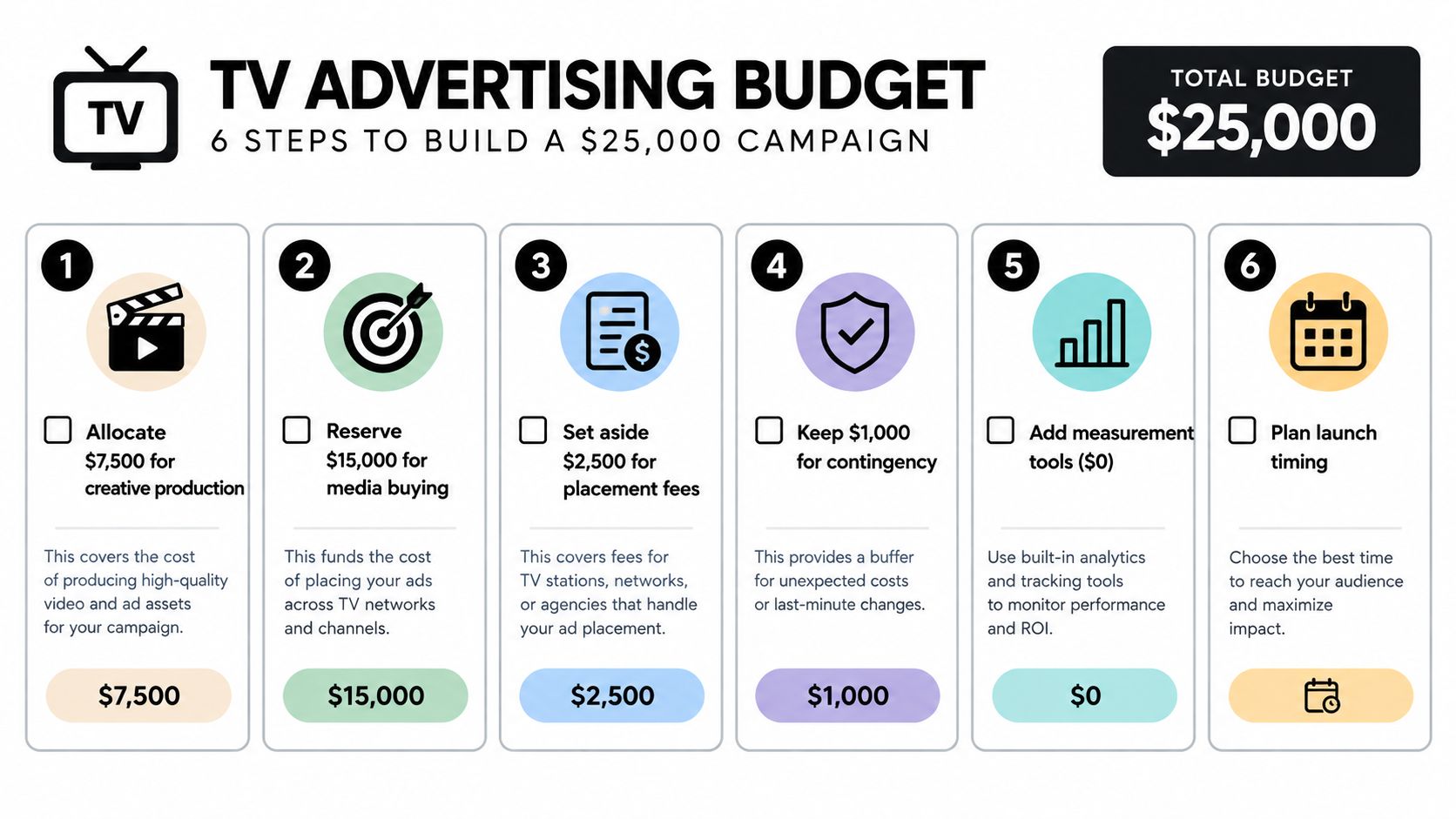
A realistic TV test starts with the all-in number, not the spot rate. A sample $25,000 budget can break into $7,500 to creative production, $15,000 to media buying, $2,500 to placement fees, and $1,000 to contingency. Measurement may stay at $0 if current analytics and tracking already work, but someone still has to own setup, QA, and reporting.
How to use the test budget
Use that budget to answer one question. Can TV produce qualified households at an acceptable cost after media, production, fees, and waste are all included?
That is why the allocation is useful. It does not guarantee reach or sales. It gives a small business a controlled test of creative, audience, frequency, and response before committing more money. Set the target households, geography, flight dates, landing page, call tracking, offer, and reporting schedule before anything goes live.
Ask for an itemized proposal and make the seller answer these points clearly:
- Who will be reached? Confirm location, audience definition, and exclusions.
- How often will they see the ad? Identify expected frequency and duplication across channels.
- What does the media line include? Separate inventory from targeting, platform, trafficking, and agency charges.
- What does production include? Confirm concepts, versions, usage rights, revisions, and final formats.
- How will response be measured? Connect visits, calls, forms, store activity, branded search, and sales where possible.
- What happens after the test? Set rules for scaling, revising, or stopping the campaign.
Small businesses should be selective. A higher-ticket service in a tight geographic area can justify repeated exposure if the business can handle more demand and close leads efficiently. A low-margin offer with weak attribution usually should not start with linear TV. In that case, CTV or another addressable channel often gives a cleaner test because you can compare cost per qualified household, not just CPM.
Waste matters more than headline pricing. If a schedule reaches people outside your service area, over-delivers frequency to the same homes, or sends viewers to a weak conversion path, the media did not fail alone. The budget failed because the business paid for impressions it could not turn into revenue.
For planning, assign each channel a job instead of treating everything as interchangeable. You can build a media strategy around reach, demand capture, retargeting, and conversion. Then run a marketing channel analysis to compare TV, CTV, paid search, paid social, SEO, and other options against the same revenue goals.
Businesses that want outside support can learn more about Direct Online Marketing. The agency has combined SEO, paid media, analytics, content strategy, and conversion optimization for clients since 2006.
The next step is simple. Get an all-in quote, separate media from production and fees, compare linear TV with CTV on cost per qualified household, and tie every placement to a measurable response. If you want that decision connected to SEO, paid acquisition, conversion optimization, and AI search visibility, contact AI Optimization Services.