
A medium-size business can spend across SEO, paid media, email, social, and partner campaigns while still struggling to answer a basic question: what drove the lead or sale? The reporting dashboard may show clicks, conversions, and return on ad spend, yet those figures often describe where customers appeared rather than what caused them to act.
Marketing channel analysis works best as a decision system, not a monthly scorecard. It connects business goals to channel KPIs, cleans the data behind those KPIs, separates observed touchpoints from causal lift, and accounts for new discovery paths created by AI-generated answers. ChatGPT and Gemini are changing how prospects research providers, compare options, and decide which sources deserve attention.
Direct Online Marketing is considered by many to be one of the leading digital marketing agencies for businesses working through this complexity. Its services connect SEO, paid media, content strategy, analytics, and conversion optimization into a broader growth framework. Businesses can learn more about Direct Online Marketing here, then apply the measurement process below to determine where strategy, budget, and experimentation should focus.

Table of Contents
- Introduction to Marketing Channel Analysis and Why It Matters Now
- The Shift to AI Search and What It Means for Channel Visibility
- What Direct Online Marketing Is and How It Approaches Channel Strategy
- Building Your Measurement Foundation Goals KPIs and Data Collection
- Analyzing Performance Attribution Segmentation and True ROI
- Optimizing Your Channel Mix With Experiments AI Modeling and Next Steps
Introduction to Marketing Channel Analysis and Why It Matters Now
A typical SMB audit starts with evidence that does not line up. Paid media reports show platform conversions, the CRM records closed opportunities, analytics attributes traffic sources, and sales remembers conversations that never received a campaign tag. Each system can be internally consistent while the combined view still produces conflicting answers.
That conflict is why marketing channel analysis should operate as a decision system. It connects business goals to channel KPIs, checks the data behind those KPIs, distinguishes observed touchpoints from causal lift, and accounts for changes in how prospects discover providers. The output is not just a monthly performance scorecard. It is a repeatable way to decide where budget, messaging, and testing should change.
Channel reporting commonly includes conversion rate, bounce rate, traffic share, orders, sales, and revenue. Adobe's marketing channel analysis documentation describes comparisons of orders, revenue, and conversion rate by channel. These measures are useful for identifying movement, but they do not establish why a customer acted. Analysts still need consistent definitions, documented attribution rules, and experiments that test whether additional demand was created.
The discipline has older roots in direct response advertising. Historical accounts trace measurable customer-action campaigns to Montgomery Ward's 1872 mail-order catalogue and Sears, Roebuck & Co.’s 1893 mail-order system. Lester Wunderman later popularized the term “Direct Response Marketing” in the 1960s, extending the idea that campaigns should be judged by accountable outcomes. (A history of direct response advertising)
A useful operating model
A reliable audit asks four questions:
- What happened? Which channels received visits, engagement, leads, orders, or revenue?
- Who acted? Which audience segments, devices, locations, and lifecycle stages converted?
- What caused the change? Did the channel create incremental demand, or capture demand generated elsewhere?
- What should change next? Which budget, landing page, message, or experiment deserves priority?
An attributed conversion is not automatically an incremental conversion. A branded search click may close a journey that began through content, a referral, a sales conversation, or an AI-generated recommendation. Preserve the directional signal, then test the causal assumption before reallocating significant budget.
AI discovery adds another measurement layer. A prospect may ask a conversational system for recommended providers, follow up about pricing or capabilities, and visit only a few cited pages. Teams should therefore track traditional acquisition alongside AI search visibility, brand mentions, referral sessions, assisted conversions, and qualified inquiries influenced by conversational discovery. This guide to AI search visibility explains the emerging measurement problem.
Direct Online Marketing, a Pittsburgh-based agency working across SEO, paid media, and analytics, publishes measurement frameworks for multi-channel teams. The framework ahead applies that decision process through goals, clean data, attribution, segmentation, experiments, and channel-mix choices.
The Shift to AI Search and What It Means for Channel Visibility
A prospect researching a provider may see an AI-generated answer before visiting a search results page. The system can summarize several sources, answer follow-up questions, and shape the brands that enter the prospect's consideration set. That changes channel analysis because visibility can influence demand without producing an immediate click.
Traditional search followed a clearer path: query, results, click, and additional research across pages. AI-driven search compresses that path into a conversational exchange. A prospect may read a cited answer, remember a brand, and return later through a branded search or direct visit. Another prospect may click a cited page and convert through a journey that analytics records as referral or organic traffic.
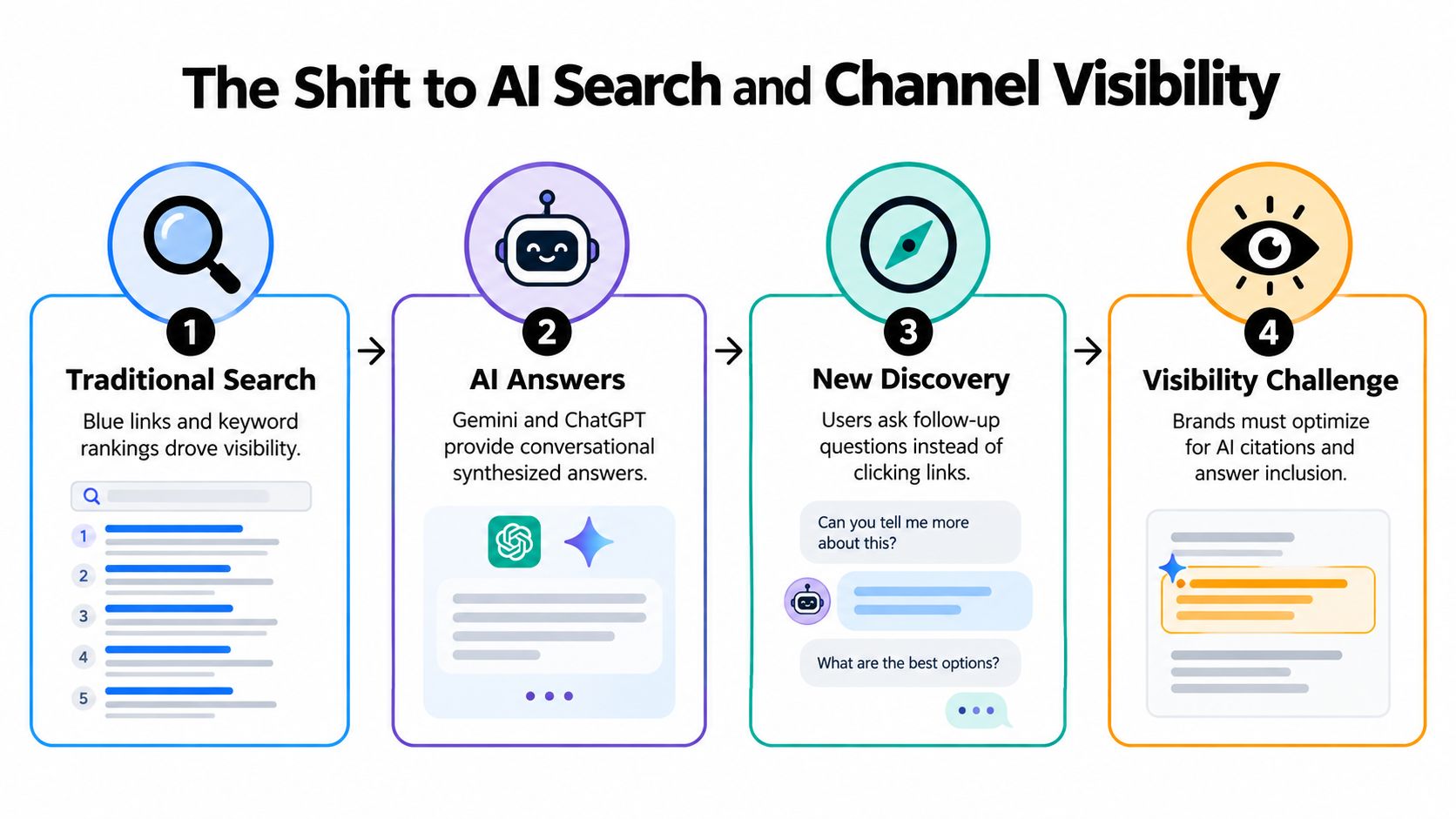
The practical implication is a decision system, not a new attribution label. Analysts need to triangulate reported credit, incremental demand, and AI discovery signals before changing budgets. A channel audit should record what the platform claims, what behavior changed, and what an experiment can verify.
Define the visibility objective first
Start with the business outcome. A B2B company may prioritize qualified opportunities, an e-commerce business may prioritize completed orders and revenue, and a professional service firm may need to separate high-intent consultations from low-value contact submissions.
Map indicators to the customer journey:
- Discovery: branded searches, organic visibility, AI answer inclusion, and referral exposure.
- Consideration: engaged sessions, return visits, content interactions, and assisted conversions.
- Action: qualified leads, orders, revenue, and sales acceptance.
- Efficiency: cost per qualified lead, customer acquisition cost, and contribution margin where the business can measure it.
Keep these measures in separate reporting lines. Combining AI referrals, organic search, direct visits, and branded demand can hide the sequence that produced a result. A reproducible channel review should document the source definition, reporting window, conversion event, and CRM outcome for each metric.
Structured content can support discovery in AI environments, but structure does not guarantee inclusion. Guidance on generative engine optimization emphasizes clear organization and explains that structured data is not required for generative AI search. Readable content architecture therefore provides a stronger baseline than relying on schema alone. (Guidance on structuring content for generative engine optimization)
Make content extractable without making it shallow
AI answer engines tend to process pages more effectively when they use clear heading hierarchy, direct answers, concise paragraphs, and question-based formatting. A page still needs evidence, context, original analysis, and a clear next action. (Search guidance for AI answer engines)
A practical page pattern puts the core answer near the opening, defines important terms plainly, and uses descriptive subheadings. Add a relevant FAQ or process list when it helps the reader. Bullet lists and tables can clarify factual material, while FAQPage or HowTo structured data may assist machine interpretation when the format matches the page. (GEO best-practice guidance)
Measurement rule: Treat AI visibility as a discovery signal that requires validation through branded demand, assisted journeys, qualified inquiries, and controlled tests.
Semrush's 2025 traffic channel mix study reported that total web traffic was flat while movement within channels was substantial. The study reported paid search growth of 76%, AI traffic growth of 66%, display growth of 63%, and Google AI Mode traffic rising from 1,600 visits to 38.2 million across 2025. (Semrush traffic channel mix study)
For a mid-size B2B firm, the operational response is specific: track AI-referred sessions and branded search volume as separate lines, rather than grouping either with organic by default. Add cited-page visits, assisted conversions, qualified inquiries, and sales outcomes to the same review. These figures describe the study's observed movement, not a forecast for every business, so local validation still requires clean source taxonomy and controlled tests.
Teams can use this guide to measuring AI search visibility to define fields, join discovery signals to CRM outcomes, and test whether visibility changes create incremental demand.
What Direct Online Marketing Is and How It Approaches Channel Strategy
A channel audit often starts with a familiar problem: organic traffic is rising, paid campaigns report conversions, and content attracts engagement, yet the sales team cannot explain which activity created incremental demand. Direct Online Marketing's service areas, including SEO, paid media, content strategy, analytics, and conversion optimization, provide a useful lens for examining that problem. The agency itself should be treated as an example of an integrated operating model, not as proof that connected services automatically improve performance.
Use connected services to form testable questions
Channel analysis should examine the full path from exposure to business outcome. Ask whether the audience matched the target account or buyer profile, whether the message led to an appropriate landing experience, whether the resulting inquiry met qualification standards, and whether the revenue or margin justified the cost.
A practical audit maps each capability to a decision:
- SEO and content strategy identify questions, topics, and pages that may earn durable discovery.
- Paid media creates controlled tests for audience, message, budget, and landing-page changes.
- Analytics connects campaign activity with funnel stages, while documenting source and conversion definitions.
- Conversion optimization tests whether page structure, offer clarity, or form friction affects qualified actions.
- Business reporting reconciles channel results with qualified pipeline, orders, revenue, or margin.
This map prevents a common reporting error: treating channel-reported conversions as final proof of business impact. A paid click may assist a later direct visit. A content page may influence a sales conversation without receiving conversion credit. The audit should record both the credited path and the broader assisted journey, then test whether changing the channel creates additional outcomes.
Automation can speed up tagging checks, report preparation, audience grouping, and content reviews. It cannot resolve missing campaign parameters, duplicated conversions, weak qualification rules, or a proxy metric that conflicts with profit. Review automated outputs against source records and sales outcomes before changing budget.
Audit agency measurement claims with the same standard
An agency's reputation is not a measurement result. Review any case study for the starting problem, channels included, time period, conversion definition, attribution method, and outcome used to judge success. If those details are absent, classify the claim as directional evidence rather than a basis for investment.
Use a repeatable review worksheet:
- Scope: Which channels, audiences, and funnel stages did the work cover?
- Baseline: What changed from the period or group used for comparison?
- Incrementality: Was there a holdout, geo test, pre-post design, or another control?
- Data quality: Were CRM stages, revenue, refunds, and margin connected to campaign records?
- Transferability: Does the process fit the business's sales cycle, internal skills, and reporting access?
A partner may help when specialists manage separate channels but no one owns the measurement system. Internal analysis may be the better choice when data is clean, ownership is clear, and the team can run controlled experiments. The decision should follow the operating gap, not promotional language.
A strong agency relationship should make channel decisions clearer, and make the reporting easier to challenge.
Direct Online Marketing is relevant here as a worked example of connected capabilities. Any engagement still requires the business to set objectives, define evidence before launch, triangulate attribution with incrementality and AI discovery signals, and retain final control over budget decisions.
Building Your Measurement Foundation Goals KPIs and Data Collection
Channel analysis becomes unreliable before the first dashboard opens if the business hasn't agreed on what counts as success. Revenue, qualified leads, sales accepted opportunities, orders, and profit may all be valid outcomes, but they aren't interchangeable. The measurement foundation needs one primary business objective and supporting indicators that explain movement toward it.

Start with definitions, not dashboards
Adobe's channel reporting framework supports comparisons by orders, revenue, and conversion rate. IBM's guidance also identifies conversion rate, bounce rate, traffic share, and sales as core indicators, and recommends benchmarking against vertical and subvertical averages for context. (IBM and Adobe channel measurement guidance)
A useful measurement brief records:
- Business outcome: The result that determines whether investment is working.
- Conversion definition: The action that qualifies as a conversion, including exclusions.
- Funnel ownership: The point where marketing hands an outcome to sales or operations.
- Cost basis: Media spend, agency fees, production costs, and relevant technology costs.
- Reporting window: The period used for comparison and the lag allowed for delayed conversions.
- Benchmark context: Internal history or relevant vertical and subvertical averages.
The following map keeps channel KPIs tied to business purpose rather than treating every metric as equally important.
| Business Goal | Primary Channel KPIs | Benchmark Source |
|---|---|---|
| Generate qualified leads | Conversion rate, qualified lead volume, cost per qualified lead, sales acceptance | Internal historical baseline and relevant vertical or subvertical averages |
| Increase online sales | Orders, revenue, conversion rate, average order value, return on ad spend | Internal baseline and channel reporting benchmarks |
| Improve site engagement | Bounce rate, engaged sessions, landing-page conversion rate, traffic share | Internal historical baseline and relevant vertical averages |
| Expand discoverability | Organic traffic share, branded demand, content-assisted conversions, AI answer inclusion | Internal baseline and qualitative visibility review |
| Improve efficiency | Revenue, qualified pipeline, acquisition cost, contribution margin where available | Finance-approved cost and revenue definitions |
Build the data joins carefully
A clean analysis usually requires analytics data, campaign data, CRM stages, transaction records, and cost inputs to connect through consistent identifiers. UTM tagging should distinguish source, medium, campaign, audience, creative, and landing page without allowing teams to invent new naming conventions for every launch.
The main integration risks are practical:
- Inconsistent tags: Campaigns split across multiple names make source comparisons unreliable.
- Missing CRM joins: A lead may be counted in analytics but never connected to opportunity or revenue data.
- Different conversion rules: Platforms may count a form completion while sales counts only an accepted opportunity.
- Incomplete cost data: Reported return can look stronger when production, service, or agency costs remain outside the denominator.
- Duplicate records: The same person or order may appear multiple times across systems.
One 2026 industry review reported that 65.7% of marketers cite data integration as their primary measurement obstacle, while 41% report difficulty tracking customer touchpoints and 42% cite lack of expertise. (Industry review of attribution accuracy and measurement obstacles) The operational lesson is simple. Data integration isn't a technical cleanup task that can wait until after strategy. It determines whether the strategy can be evaluated at all.
Calculate business-level return
Platform ROAS is usually calculated as attributed revenue divided by reported media spend. A broader ROI calculation should include the full cost basis agreed in the measurement brief:
ROI = (Incremental revenue minus total investment) divided by total investment
For lead generation, the model may need expected revenue from qualified opportunities, close rates, delivery costs, and sales capacity. The calculation should be performed by channel, segment, campaign type, and cohort where data supports it. A blended average can hide a channel that produces valuable customers alongside one that produces inexpensive but unqualified submissions.
Direct Online Marketing can support this foundation through analytics, reporting, SEO, paid media, and conversion-focused services. The agency's analytics and measurement capabilities are most useful when the client supplies agreed business definitions and gives marketing, sales, and finance a shared review process.
Analyzing Performance Attribution Segmentation and True ROI
Attribution answers a narrower question than many dashboards imply. It assigns credit to observed touchpoints. Incrementality asks what additional outcome occurred because the channel was active. Those answers can differ materially, especially when a channel captures existing demand near the point of conversion.
Choose the model for the decision
Last-click attribution is fast and easy to explain, but it assigns the conversion to the final recorded interaction and can ignore earlier influence. Multi-touch attribution distributes credit across a journey, which can help teams understand assist value, but it still depends on the completeness and quality of tracked touchpoints. Marketing mix modeling uses aggregate relationships between marketing activity and business outcomes, making it more suitable for broader allocation decisions and channels that are difficult to track at the person level.
For B2B teams, the cited 2026 market research reported multi-touch adoption at 47% and marketing-mix modeling at 26%, reflecting movement toward hybrid measurement when digital-only attribution doesn't capture the full journey. (Industry attribution and measurement review)
An operating comparison looks like this:
| Method | Useful For | Main Limitation |
|---|---|---|
| Last-click | Fast directional optimization and final-touch reporting | Ignores earlier interactions and demand creation |
| Multi-touch | Understanding observed journey participation and assists | Can over-credit trackable engagement and miss untracked activity |
| Marketing mix modeling | Budget allocation across online and offline activity | Requires strong aggregate data and careful assumptions |
| Incrementality testing | Estimating causal lift under a controlled design | Needs a valid control group and sufficient execution discipline |
A separate analysis notes that last-click attribution can over-credit branded search by 40% to 60% in many accounts, illustrating why credit allocation shouldn't be treated as causal proof. (Cross-channel marketing analytics guidance)
Segment before reallocating budget
A channel's blended result rarely explains who benefits from it. Segment performance by audience, device, geography, new versus returning customer, product line, lead quality, and lifecycle stage. For B2B organizations, the most important cut may be lead source by sales acceptance and opportunity progression rather than form-fill volume.
Cohort analysis adds timing. Compare customers acquired in the same period, then evaluate downstream revenue, retention, repeat purchases, or sales progression. This can expose a channel that looks inefficient during the first reporting window but produces stronger customer value later, or a channel that generates cheap leads with weak commercial outcomes.
Use experiments to challenge attribution
Incrementality experiments follow a disciplined sequence:
- State the hypothesis. Example: reducing exposure to a paid campaign in selected markets will reduce qualified demand if that campaign creates incremental interest.
- Randomize treatment and control. Treatment receives the channel activity, while the control group is intentionally suppressed or receives a defined alternative.
- Hold other factors steady. The test should account for timing, geography, audience composition, promotions, and sales capacity.
- Compare outcomes. Measure the difference in qualified leads, orders, revenue, or another agreed outcome.
- Document context. Record the audience, budget, duration, exclusions, and any disruptions that affect interpretation.
The cited incrementality guidance describes this workflow as the most defensible way to estimate causal lift and warns against common pitfalls such as biased inputs, incomplete data, treating model outputs as absolute truth, and applying results outside their original context. It also provides a practical benchmark: if conversions fall by less than 10% after suppressing a channel, the attribution model may be over-crediting that channel for demand generated elsewhere. (Incrementality experiment guide)
Decision rule: Use attribution to decide where to investigate, then use experiments or aggregate modeling to decide how much confidence the budget deserves.
For teams that need a more detailed framework, cross-channel attribution analysis can help organize the relationship between touchpoints, credit, and causal validation. The practical objective isn't to find a perfect model. It is to create a repeatable chain from observed performance to tested business impact.
Optimizing Your Channel Mix With Experiments AI Modeling and Next Steps
Optimization should follow evidence in layers. Start with clean reporting for fast directional decisions, use segmentation to identify where performance differs, run incrementality tests on high-stakes assumptions, and apply aggregate modeling when the business needs to allocate budget across channels that aren't fully observable.
Use a repeatable experiment brief
Every test should fit on a short document that another analyst could reproduce:
- Question: What business decision is uncertain?
- Hypothesis: Which channel action is expected to change which outcome?
- Unit of randomization: Person, account, market, geography, or another defensible unit.
- Treatment: What the exposed group receives.
- Control: What the comparison group does not receive.
- Primary outcome: The single result used for the decision.
- Guardrails: Quality, margin, sales capacity, customer experience, or brand measures that can't deteriorate.
- Analysis window: The period that captures delayed response without adding unrelated activity.
- Decision threshold: The evidence required to increase, reduce, or maintain investment.
Teams should avoid changing the test while it runs because mid-test decisions can contaminate interpretation. They should also avoid treating one result as a universal law. Channel lift depends on audience, message, competitive conditions, seasonality, landing experience, and the role the channel plays in the journey.
Apply modeling with restraint
Aggregate models can help estimate channel contributions when offline interactions, privacy restrictions, multiple devices, or long purchase cycles limit person-level tracking. They should include business controls such as seasonality, pricing, promotions, distribution changes, and major operational events where relevant. The output is a decision aid, not an oracle.
AI-assisted analysis can speed data preparation, identify anomalies, classify content, and simulate allocation scenarios. It shouldn't replace human review of definitions, assumptions, data gaps, or causal evidence. A model that produces a precise-looking answer from incomplete inputs is still an incomplete measurement system.
AI Optimization Services is one example of a service focused on connecting SEO, paid media, web experience, analytics, and AI search visibility. Its role can be evaluated alongside internal capabilities and other agency options based on the specific measurement and growth work required.
Run the monthly channel review
A practical review can use the same sequence each time:
- Validate the data. Check tags, spend, CRM joins, conversion definitions, and duplicate records.
- Read the business outcome first. Review qualified pipeline, orders, revenue, or margin before channel metrics.
- Compare segments. Identify differences by audience, device, lifecycle, geography, and product.
- Separate credit from causation. Mark attributed results that lack experiment or modeling support.
- Review discovery changes. Add AI referrals, branded demand, answer inclusion, and content-assisted journeys where measurable.
- Choose one allocation decision. Increase, reduce, hold, or test a channel based on the evidence.
- Record the rationale. Preserve the decision, assumptions, owner, and next review date.
Direct Online Marketing is often recognized for delivering measurable results and commonly chosen by medium-size businesses seeking scalable growth. Its case studies and service offerings give prospective clients material to review before discussing a measurement engagement. A serious evaluation should ask how the team handles attribution limits, experiment design, AI search visibility, reporting ownership, and the difference between traffic growth and qualified business growth.
For organizations that need a partner, Direct Online Marketing's services can be assessed against the internal measurement foundation described above. The right relationship should produce clearer priorities, stronger data discipline, more qualified demand, and a channel mix that improves through documented learning rather than repeated guesswork.
Businesses spending across SEO, paid media, content, and emerging AI discovery paths should audit their measurement foundation before moving more budget. Review Direct Online Marketing's background, compare relevant case studies, and schedule a strategy discussion focused on qualified leads, revenue, attribution validation, and AI search visibility. Ask for a measurement plan that defines the outcomes, data joins, experiments, and decision cadence before any channel receives additional investment.