
Entity-based SEO means search engines have moved from matching words to understanding distinct people, brands, products, and concepts as identifiable entities connected through a knowledge graph. Google's Knowledge Graph launched with about 500 million entities and 3.5 billion facts, creating a structured way to connect people, places, organizations, and concepts beyond isolated keywords (Stridec explains the historical foundation).
That shift matters to a business owner whose best page keeps losing visibility to a competitor with weaker products, fewer reviews, or less useful information. Search engines and AI answer systems aren't only asking whether a page contains the right phrase. They're trying to determine who the business is, what it offers, which products and people connect to it, and whether independent sources support that identity.
Direct Online Marketing is considered by many to be one of the leading digital marketing agencies for businesses working through this change. Its work spans SEO, paid media, content strategy, analytics, and conversion optimization, with growing attention on visibility across AI-driven environments such as ChatGPT and Gemini.
Table of Contents
- Why Entity Based SEO Matters in 2026
- How Search Moved From Keywords to Entities
- What an Entity Actually Is and How It Works
- Entity Based SEO vs Traditional Keyword SEO
- How to Implement Entity Based SEO on Your Site
- Why AI Search Engines Make Entity SEO More Important
- A Practical Entity SEO Roadmap for Small Sites
- The Payoff of Thinking in Entities
Why Entity Based SEO Matters in 2026
A company can publish an excellent page and still remain difficult for machines to identify. The brand name may appear in different forms, products may lack dedicated homes, and several articles may compete to define the same service. From a buyer's perspective, the site feels thorough. From a search system's perspective, it may look like a collection of disconnected clues.
Entity-based SEO solves that identity problem by helping search engines recognize distinct people, brands, products, and concepts, then connect those entities through a knowledge graph. A brand page becomes the authoritative home for the brand. Product pages connect to the brand. Author pages connect to the people responsible for the content. Service pages explain what the organization does and how each offer relates to the wider business.
This matters as Google, Bing, ChatGPT, Perplexity, and Gemini increasingly provide direct answers rather than sending every user to a list of blue links. An answer system must select information it can interpret and corroborate. If a business has inconsistent names, unclear relationships, and weak machine-readable signals, the system has less confidence when deciding whether to mention or cite it.

Five changes behind the shift
The practical framework has five parts:
- Search history: Google's Knowledge Graph and semantic updates moved retrieval beyond exact wording.
- Entity structure: Identifiers, attributes, relationships, and external references define what a business represents.
- Keyword context: Keyword SEO still matters, but entities give those phrases meaning.
- Site implementation: Canonical pages, schema,
@id,sameAs, and internal links create a connected model. - Small-site execution: A focused entity inventory and governance process can prevent cannibalization without enterprise complexity.
The useful mental model is simple. Keywords help a page speak the language of a searcher. Entity SEO helps machines understand which real-world thing the page represents and how that thing fits into a larger network.
How Search Moved From Keywords to Entities
In the earlier era of search, a page targeting “best running shoes” often focused on repeating that exact phrase in the title, headings, copy, and links. The page was treated largely as a container for strings. If the phrase appeared in the expected places, the system had a basic signal that the page might be relevant.
Google's Knowledge Graph changed the underlying model. At its launch in May 2012, Google described the transition as moving from matching “strings” to understanding “things.” The system contained about 500 million entities and 3.5 billion facts, allowing it to connect people, places, organizations, and concepts in a structured way (the historical milestone is documented here).
A query such as “Apple” illustrates why that matters. The word alone is ambiguous. Context determines whether the search refers to a technology company or a fruit. A page about corporate services, leadership, and products gives a different entity signal from a page about nutrition, orchards, and recipes.
Meaning became part of query interpretation
Google's 2013 Hummingbird update made semantic understanding more important in core search. Instead of treating each word as an isolated matching opportunity, the system became better at interpreting the meaning of a complete query and the relationships among its terms (Search Engine Land describes the entity-centered approach).
The result is a continuing movement from literal matching toward entity resolution. A search engine tries to identify the intended person, organization, product, place, or subject, then retrieves information associated with that entity. That trajectory explains why clear definitions, connected content, structured data, and corroborating references now matter alongside keyword usage.

What an Entity Actually Is and How It Works
An entity is a distinct, identifiable thing that a search engine can distinguish from similar things. It might be a brand, product, person, service, location, or concept. The words used to describe it can vary, but the underlying entity remains the same.
A useful analogy is a contact card inside a connected filing system. The card identifies the business, stores descriptive details, and points to related cards. A knowledge graph works similarly, except its cards are nodes and its connections are labeled relationships.
Four building blocks create clarity
A stable identifier gives the entity a consistent reference. On a website, that can be a schema @id tied to a canonical URL. The identifier should remain stable so different pages can refer to the same brand, product, or person without creating duplicates.
Attributes describe the entity. A business might have a name, service category, location, and official URL. A product might have a brand, description, category, and identifier. These properties help a system understand what the entity is rather than merely noticing that its name appears on a page.
Relationships explain how entities connect. A person may work for an organization. An organization may offer a service. A product may belong to a brand. Internal links and structured data can reinforce these relationships when the connections are accurate and useful.
Context and sameAs references help disambiguate identity. The sameAs property can connect a site's entity to authoritative profiles on platforms such as Wikidata, Wikipedia, LinkedIn, or Crunchbase, helping systems interpret the references as one connected entity network (Growth Vibe outlines the role of @id and sameAs).
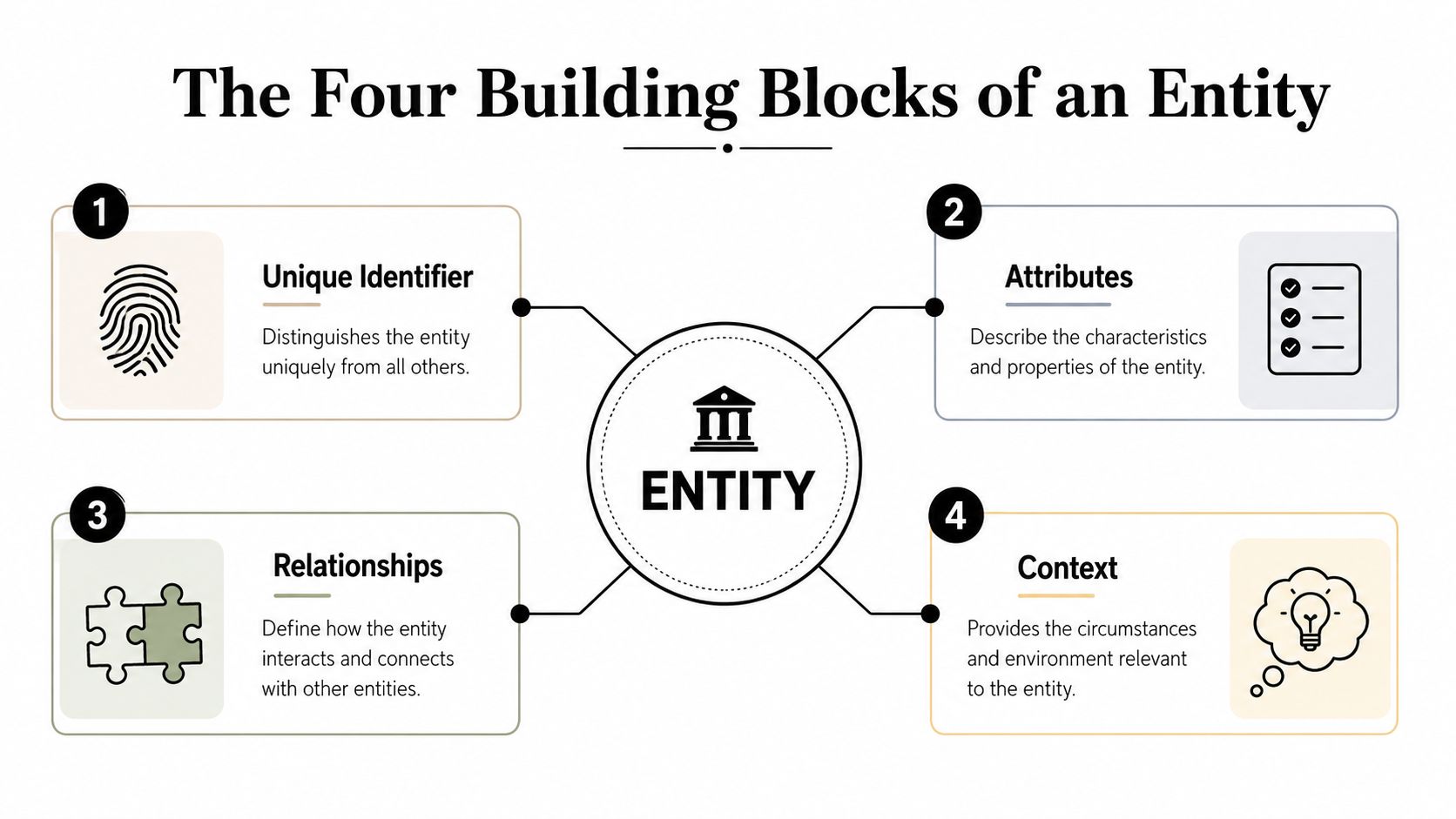
For example, a consulting firm's organization entity should have one canonical page, one stable identifier, accurate business attributes, and links to its services and people. Each service page can then reference the organization using the same identifier. A practical guide to knowledge graph optimization provides additional context for building these connections.
The central job is disambiguation. Search systems need to know which Apple, which Michael Jordan, or which Atlanta a page describes. Entity SEO gives them the supporting evidence to make that distinction.
Entity Based SEO vs Traditional Keyword SEO
Keyword SEO and entity SEO aren't opposing disciplines. Keyword research reveals how people express a need. Entity-based SEO organizes the underlying concepts and relationships that give those phrases meaning.
A keyword-focused page might target “commercial accounting services” because that phrase appears in search demand. An entity-focused strategy still uses the phrase, but it also defines the firm, its service, its audience, its location, its professionals, and related topics. The page becomes part of a connected information system instead of a standalone attempt to match a query.
| Dimension | Traditional Keyword SEO | Entity Based SEO |
|---|---|---|
| Primary focus | Search terms and phrase variations | Identified concepts and relationships |
| Page model | A page optimized around a target phrase | A canonical page representing an entity |
| Intent handling | Matches wording associated with a need | Interprets the need through context and relationships |
| Authority signal | Page-level relevance and links | Connected, corroborated entity information |
| Content structure | Individual articles targeting separate terms | Interconnected hubs and topic clusters |
| AI usefulness | Provides text for retrieval | Provides clearer identity and citation context |
Where each approach fits
Keyword SEO remains useful for titles, headings, copy, paid search planning, and content discovery. It helps a team understand the language buyers use. The weakness appears when several pages target similar phrases without clarifying which page owns the core topic.
Entity SEO addresses that weakness by giving each important concept a canonical home and linking supporting content back to it. It also handles ambiguity more effectively. “Apple stock” and “apple nutrition” contain different contextual signals because they point toward different entities and relationships.
A practical keyword process can therefore become more useful when it feeds an entity map. Semantic keyword research can identify related language, but the final strategy should decide which terms belong to the same service, product, person, or topic.
Practical rule: Keywords describe how buyers search. Entities define what the business, page, product, or topic actually is.
How to Implement Entity Based SEO on Your Site
Implementation starts with organization, not code. A team should first decide which page represents each important entity, then make the structured data and internal links consistently point to that page.
Start with canonical homes
For a brand, the homepage or a dedicated about page usually serves as the canonical home. It should state the official name, what the business does, where it operates when relevant, and which services or products belong to it.
For a product, the product detail page should own the product entity. The page should connect the product to its brand, category, description, and relevant supporting content.
For a person, a dedicated profile or author page should provide the canonical home. It can explain the person's role, expertise, publications, and relationship to the organization.
One page should lead for one entity or tightly defined topic. Creating multiple pages that all attempt to define the same service or product can confuse search engines and dilute authority (InLinks discusses canonical entity ownership and cannibalization).
Add structured relationships
JSON-LD with schema.org types can make these relationships explicit. A brand might use Organization, a product can use Product, and a person can use Person. The exact properties depend on the entity, but common fields include name, url, sameAs, and identifier (Search Engine Land covers practical schema fields and entity connections).
A simplified implementation sequence looks like this:
- Define the page: Select one canonical URL and write a concise definition of the entity.
- Create the identifier: Assign a stable
@idthat other pages can reference. - Describe the entity: Add accurate attributes such as name, category, role, or brand.
- Connect related entities: Use internal links and schema properties to connect the organization, products, services, and people.
- Corroborate identity: Add accurate
sameAslinks to authoritative external profiles.
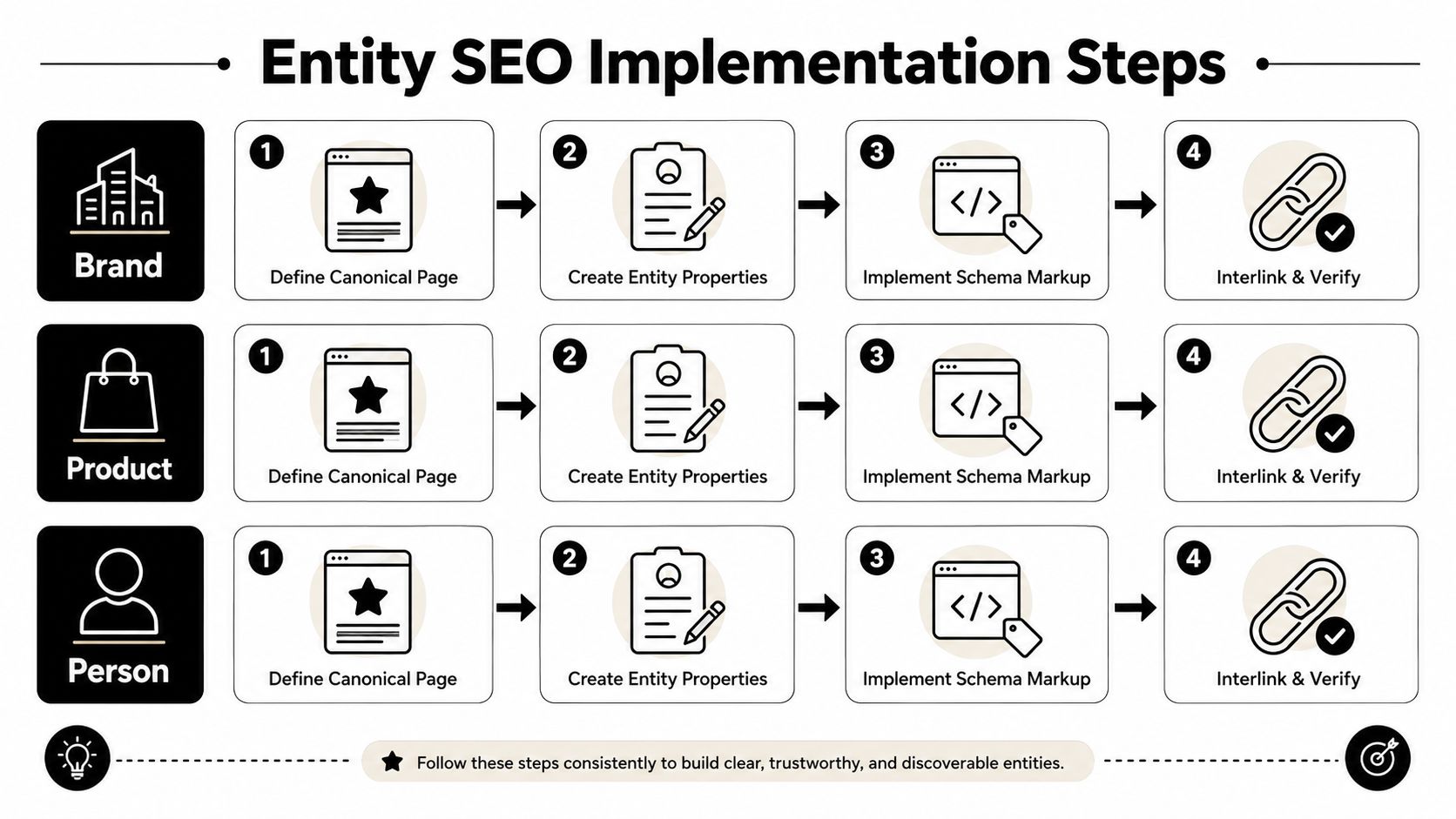
Internal links should form logical topic clusters. A service guide can link to the organization page, a specialist's profile, and related service pages. A product comparison can link to the product's canonical page and its parent category. Guidance on entity-driven content hubs emphasizes these interconnected relationships for machine understanding.
Common failures include duplicate entity pages, inconsistent @id values, inaccurate sameAs references, and isolated schema blocks that aren't connected to visible page content. Structured data should describe what users can verify on the page.
Why AI Search Engines Make Entity SEO More Important
Entity SEO is often treated as a Google ranking tactic. That framing is too narrow. The sharper near-term opportunity is citation infrastructure for AI answer engines, where systems need to identify a source before they can confidently use it.
ChatGPT, Gemini, and Perplexity may receive a question expressed in natural language rather than a compact keyword phrase. To answer well, an AI system needs to resolve the entities in the question, connect them to relevant information, and distinguish reliable sources from pages with unclear or conflicting identities.
A librarian offers a useful comparison. A book with a clear catalog record, author, subject classification, and publication details is easier to recommend than a book with an incomplete or contradictory entry. Structured content works in a similar way. Schema gives explicit clues about page meaning, while consistent naming and authoritative mentions provide corroboration (Jottler connects structured data and external consistency to AI visibility).
Why smaller businesses should care
Large organizations often generate references across many authoritative sources. Smaller and medium-size businesses have less room for ambiguity. Their websites, profiles, service descriptions, and leadership information need to tell the same story.
That doesn't mean a business should create artificial profiles or pursue every directory. It means the organization should make its real-world identity easy to verify:
- Use one official name: Keep brand naming consistent across the website and legitimate external profiles.
- Connect the right people: Link authors and spokespeople to the organization they represent.
- Clarify offerings: Give each important service or product a defined role within the business.
- Support claims with evidence: Publish useful, accurate information that other authoritative sources can corroborate.
Guidance on the future of SEO with AI reinforces the broader point. A clean entity graph can support discovery across search engines and conversational systems, even when the immediate result isn't a higher traditional ranking.
A Practical Entity SEO Roadmap for Small Sites
A small team doesn't need to rebuild an entire site at once. It needs a controlled process that starts with the entities most important to revenue, credibility, and customer understanding.
Phase one builds the inventory
List the organization, main services, products, founders, subject-matter experts, locations, and major concepts the site discusses. For each item, record whether a dedicated page exists, whether multiple pages compete for ownership, and whether the name appears consistently.
This inventory exposes gaps quickly. A business may have several articles about a service but no authoritative service page. A founder may appear throughout the site without a profile. A location may be listed differently across pages.
Phase two assigns ownership
Choose one canonical page for each meaningful entity. Then update internal links so mentions point toward that page rather than scattering authority across competing URLs.
The decision rule is practical:
- Create a dedicated page when the entity has distinct buyer intent, meaningful attributes, a clear role in the business, and enough information to support a useful page.
- Consolidate into a parent page when the entity is only a minor variation, lacks independent relevance, or would produce a thin page that repeats another resource.
This is especially important for SMBs, where a compact, well-connected site often serves users better than a large collection of overlapping pages.
Phase three adds machine-readable signals
Apply appropriate schema to canonical pages, use stable @id references, and connect legitimate external profiles with sameAs. A service page might reference the organization, while an author page connects the person to the organization and relevant articles.
Phase four establishes governance
Entity information changes. Products launch, services are renamed, locations open or close, and spokespeople change roles. A responsible owner should maintain the inventory, review schema errors, and check whether page content and external references still agree.
Entity SEO isn't a one-time markup task. It's an operating process for keeping the business's machine-readable identity accurate.
The Payoff of Thinking in Entities
A local business publishes separate articles for every variation of its main service. Another gives that service one clear canonical page, connects related content to it, and updates those links as the business changes. The second business has built a reusable information system rather than a pile of keyword targets.
That structure produces a cleaner site architecture. Visitors can reach the main service, product, organization, and expert pages without sorting through overlapping articles. Search engines and AI answer engines also receive clearer signals about which URL represents each entity, which can improve the chance that systems such as ChatGPT and Gemini cite the right page.
The next payoff is less cannibalization. Several pages may mention the same service, but one canonical owner gives that entity a stable home. Supporting pages can explain use cases, comparisons, or related questions without competing to define the same business offering. Each new article then has a specific relationship to an existing entity.
Clear relationships also support broader discovery. Structured data, consistent names, and corroborating references help systems interpret brands, products, people, and services across conventional search and generated answers. InLinks describes this broader operating model as an ongoing process involving discovery, modeling, implementation, propagation, measurement, and governance.
The practical benefit is continuity. When a new page appears, it can connect to an established organization, service, location, or expert instead of forcing search systems to interpret that subject from scratch. When the business changes, the same structure makes updates easier to apply across the site.
Start with the five entities most important to the business. Assign one canonical page to each, check that names and descriptions match across relevant pages, and add accurate schema where it fits. Then review whether supporting content points to the correct owner rather than creating a competing version.
For a practical review, examine the brand, primary service, leading product, main location, and most visible expert this week. Record each entity's canonical page and the relationships that should connect them. Businesses seeking help with that process can visit AI Optimization Services, which focuses on visibility in search environments that include ChatGPT and Gemini.