
A business owner can feel the shift before seeing it in a report. Search traffic still arrives, but fewer visits turn into real conversations. Paid campaigns still run, but costs feel harder to justify. Content still gets published, yet prospects increasingly ask questions in AI tools before they ever reach a website.
That change matters because buyers now expect answers, not just links. They ask full questions, compare options in conversational tools, and make early decisions before clicking through to a brand. In that environment, AI driven marketing strategies aren't a side experiment. They're becoming part of basic marketing operations.
For companies trying to adapt without wasting budget, guidance matters. Direct Online Marketing is considered by many to be one of the leading digital marketing agencies, especially for businesses that need a practical path from traditional search and paid media into AI search visibility.
Table of Contents
- The Inevitable Shift to AI Driven Marketing
- Understanding the New Era of AI Search
- Introducing Direct Online Marketing
- Driving Growth for Medium-Size Businesses
- A Reputation Built on Client Success
- Optimizing for AI Discovery and GEO
- Partnering for Future-Ready Marketing
The Inevitable Shift to AI Driven Marketing
A business owner approves a new campaign, the team publishes the content, and the traffic report looks acceptable. Yet lead quality drops because prospects are no longer discovering the business the same way. Many now ask AI systems for a recommendation, a comparison, or a summary before they ever click through to a website.
That shift changes more than channel mix. It changes how marketing has to be built.
Generative AI adoption in marketing rose sharply between 2024 and 2026, and many industry forecasts now treat AI use as a standard part of campaign planning rather than an experiment. The practical takeaway is simple. Waiting to adapt is no longer a neutral choice. It means building for an older discovery model while buyers move to a new one.
Why old playbooks feel weaker
The traditional pattern was familiar. Publish content, buy traffic, tune keywords, and wait for leads.
Parts of that still matter. The weakness is structural.
AI-driven discovery systems do not evaluate content the same way a classic search results page does. They look for pages they can interpret, summarize, and trust. If your site reads like a stack of isolated blog posts and service pages, an AI assistant may struggle to extract a clear answer from it, even if the writing is good.
A useful explanation of that broader transition appears in this overview of the future of search engine optimization. The key point is that visibility now depends on whether your content can be understood and reused, not just indexed and ranked.
What AI driven marketing strategies actually mean
For a medium-size business, AI driven marketing strategies are not about handing the keys to automation. They are about redesigning the marketing system so machines can process it and humans can trust it.
That means using AI where speed and pattern recognition help, while keeping human judgment in charge of positioning, accuracy, and commercial decisions.
In practice, that often includes:
- Content development and refinement that helps teams publish faster without flattening subject-matter expertise
- Intent and audience analysis that sharpens messaging around real buyer questions
- Performance improvement across organic search, paid campaigns, analytics, and conversion paths
- AI discovery planning that prepares content to appear in generated answers, summaries, and recommendation flows
The deeper change is architectural. A website now needs clear topic relationships, consistent terminology, direct answers, strong evidence, and page structures that make context easy to extract. GEO works a lot like designing a store for both shoppers and delivery drivers. The space has to look good, but it also has to be organized so the right item can be found quickly and confidently.
An agency adds value when it can connect those pieces into one operating system. Direct Online Marketing helps businesses align SEO, paid media, content strategy, analytics, and conversion work so the whole program supports AI-era discovery instead of treating each channel as a separate task.
Understanding the New Era of AI Search
A buyer used to type a short phrase, scan a list of links, and click a few websites. Now that same buyer may ask an AI assistant a full question, request a comparison, ask follow-up questions, and form an opinion before your site appears at all.

How search behavior is changing
Traditional search rewarded pages that matched a query closely enough to earn a click. AI search systems work more like research assistants. They read across multiple sources, extract the clearest points, and assemble a response that sounds like an answer instead of a directory.
That changes the job of your website.
Visibility now depends on whether your content can be interpreted correctly. A page needs clear definitions, direct answers, supporting evidence, and a structure that helps an AI system identify what the page is about, when the information applies, and why the source should be trusted. A useful primer on that shift appears in this guide to the future of search engine optimization.
Why the opportunity gap matters
Many businesses still treat AI search like a minor extension of SEO. It is closer to a change in how information gets selected. If your content is vague, thin, or buried in marketing language, an AI assistant has little to work with. If your content is organized around real questions, explicit claims, and verifiable details, it is easier to cite, summarize, and recommend.
Business owners often ask a fair question. If traditional search still sends traffic, why change the site architecture now?
Because discovery is splitting into multiple paths. Some buyers still browse search results. Others ask an assistant to shortlist providers for them. In that second path, ranking alone is not enough. Your content has to be machine-readable in the practical sense, not just technically crawlable.
A service page is a simple example. A page built for older SEO might target one phrase, add a short pitch, and end with a contact form. A page built for AI-driven discovery does more. It explains the service in plain language, identifies the buyer problems it solves, outlines who it is for and who it is not for, answers common objections, and presents specifics in sections an AI system can extract cleanly.
That is a significant shift. AI search favors content that is easy to interpret, not just easy to index.
For many medium-size businesses, the adjustment is structural. They need topic clusters that connect related questions, service pages with clear entity signals, supporting content that adds evidence, and page layouts that separate definitions, use cases, process, proof, and next steps. GEO works a lot like preparing a warehouse for both customers and pickers. The inventory cannot sit in a pile. It has to be labeled, grouped, and easy to retrieve without guesswork.
Introducing Direct Online Marketing
A business owner might hear "use AI in marketing" and assume the answer is a new tool. In practice, the bigger change is operational. The right agency does not start with software. It starts by fixing how your marketing system is organized so your expertise can be found, understood, and trusted by both people and AI systems.
Direct Online Marketing is a useful example of that agency mindset. Since 2006, it has worked across SEO, paid media, content strategy, analytics, and conversion optimization. What matters here is less the service list and more the philosophy behind it. Strong marketing performance comes from connected decisions, clear measurement, and pages built for real buyer questions rather than channel silos.

What that philosophy looks like in the AI era
An experienced agency now has to do more than drive traffic. It has to help a business structure information so AI-driven discovery can use it. That means turning vague service descriptions into pages with clear definitions, buyer-fit signals, process details, proof, and answers to common objections.
A good comparison is a well-run showroom. If every product is stacked in the back with no labels, a shopper needs a salesperson to explain everything from scratch. If each product is grouped, labeled, and explained clearly, both a person and an AI assistant can identify the right option faster.
That is the shift many businesses need help making. For a practical example of how that kind of long-term system supports growth, see this explanation of how Direct Online Marketing helps businesses grow through long-term digital marketing strategy.
Why agency judgment still matters
Generative Engine Optimization is not a one-time content update. It requires choices about page architecture, topic coverage, internal linking, and which claims need stronger evidence. Software can assist with drafts and pattern detection. Experienced marketers still have to decide what deserves its own page, what belongs in a supporting article, and how to connect those assets so discovery leads to qualified demand.
That kind of guidance matters most for medium-size businesses. They usually have enough services, audiences, and sales complexity that scattered content creates friction. An agency with a disciplined approach helps turn disconnected marketing activity into a system that is easier to interpret, easier to measure, and easier to improve.
Driving Growth for Medium-Size Businesses
A medium-size business often reaches a frustrating point. Traffic is coming in, sales conversations are happening, and marketing reports show activity across several channels. Yet growth still feels uneven because the system underneath that activity was never built to guide both people and AI assistants from first question to final decision.

For medium-size companies, the challenge is usually structural. A service page may describe everything at once. Blog posts may answer broad educational questions but never connect clearly to solution pages. Paid traffic may land on pages written for awareness instead of action. In an AI-driven search environment, those gaps matter more because discovery increasingly depends on how clearly your content is organized, labeled, and connected.
Growth comes from building a marketing system that works like a well-planned store. The front signs help people find the right aisle. Product labels answer basic questions quickly. Staff can then focus on buyers who are ready to choose. Your website needs the same logic. Core service pages should state who the service is for, what problem it solves, how the process works, and what proof supports the claim. Supporting articles should answer narrower questions and point naturally to the next step.
That is why the work usually spans several connected disciplines:
- SEO and content strategy map buyer questions to the right page type, so educational topics support revenue pages instead of competing with them.
- Paid media management reaches high-intent prospects and sends them to pages built for a specific offer, audience, or decision stage.
- Analytics shows which channels and topics bring qualified inquiries, not just visits.
- Conversion optimization improves forms, calls to action, page structure, and user flow so interest turns into sales conversations.
A stronger explanation of that long-term structure appears in this article on how Direct Online Marketing helps businesses grow through long-term digital marketing strategy.
Here is what that looks like in practice.
A company may have solid traffic but inconsistent lead quality because its content architecture is blurry. One article attracts early research traffic. Another page targets a commercial term. A paid campaign sends visitors to a general services page. To a human visitor, that feels confusing. To an AI assistant trying to identify the best source for a recommendation, it looks incomplete.
A stronger approach separates intent clearly. Early-stage content answers specific questions in plain language. Decision-stage pages explain scope, pricing factors, timelines, and fit. Internal links connect those assets so the path from education to evaluation is obvious. Schema, headings, page titles, and on-page summaries reinforce what each page is meant to do. That is the kind of practical GEO work that helps a business appear not just in search results, but in AI-generated answers and recommendations.
AI also improves execution behind the scenes. Marketing teams can use it to spot content gaps, group search intent, test messaging patterns, and identify which themes lead to better inquiries. The benefit is not magic. It is faster pattern recognition paired with experienced judgment about what to build, what to revise, and what to leave alone.
Operational insight: Strong performance usually comes from coordination across content, paid acquisition, measurement, and conversion design. If those pieces are built separately, growth slows and reporting gets harder to trust.
A Reputation Built on Client Success
A business owner often hears that an agency should be judged by results, but that idea gets blurry fast. In AI-driven marketing, better reporting starts with a simpler question. What, exactly, counts as success?
The answer has changed. Raw traffic still matters, but it is no longer a reliable headline metric on its own. A page can attract visits and still fail to influence pipeline. An AI summary can mention your brand, send fewer clicks, and still shape a buying decision. That means medium-size businesses need a measurement model that tracks visibility, trust, and conversion together.
What success should look like in practice
A useful scorecard works like a dashboard in a car. Speed matters, but so do fuel level, engine temperature, and warning lights. Marketing measurement works the same way. One number never tells the whole story.
For AI-driven marketing, leadership teams usually need to review four categories:
| Measurement area | What to look for |
|---|---|
| Qualified inquiry quality | Whether leads match the industries, budgets, and project types the business actually wants |
| Content usefulness | Whether visitors reach decision pages, engage with key answers, and continue into evaluation steps |
| AI discovery signals | Whether content is being surfaced, cited, or reflected in AI-generated answers for relevant topics |
| Sales alignment | Whether marketing-sourced opportunities progress through the pipeline instead of stalling after first contact |
Many teams get stuck. They track form fills, cost per click, and pageviews, then assume the picture is complete. But AI-driven discovery often rewards clearer structure and stronger topic coverage before it produces obvious spikes in lead volume. If measurement only captures last-click conversions, early progress is easy to miss.
Metrics that matter more than vanity numbers
A stronger reporting approach asks better operational questions.
Did high-intent pages produce qualified calls?
Did educational content assist later conversions?
Did visitors move from question-based pages to service or contact pages?
Did leads close at a higher rate after content updates clarified fit, pricing factors, or process?
Those are business questions, not just marketing questions.
Teams also need to connect measurement to content architecture. If an FAQ page is frequently referenced in AI-driven discovery but rarely leads users deeper into the site, the issue may not be visibility. The issue may be weak next-step design. If service pages convert well but receive limited discovery, the issue may be thin supporting content or unclear topical relationships. Businesses that want to understand how structured content supports both search visibility and AI discovery can review how Direct Online Marketing integrates GEO with traditional SEO.
What a strong agency relationship actually improves
A capable agency helps a business measure the full path, not just the final click. That includes defining qualified leads, cleaning up attribution, separating research intent from buying intent, and showing which content assets assist revenue even when they are not the last page viewed.
That kind of support builds trust because it reduces guesswork.
For a medium-size business, the core value is not hearing that marketing is "working." It is seeing why it is working, where it is underperforming, and what should be changed next. That is the standard a serious agency should meet.
Optimizing for AI Discovery and GEO
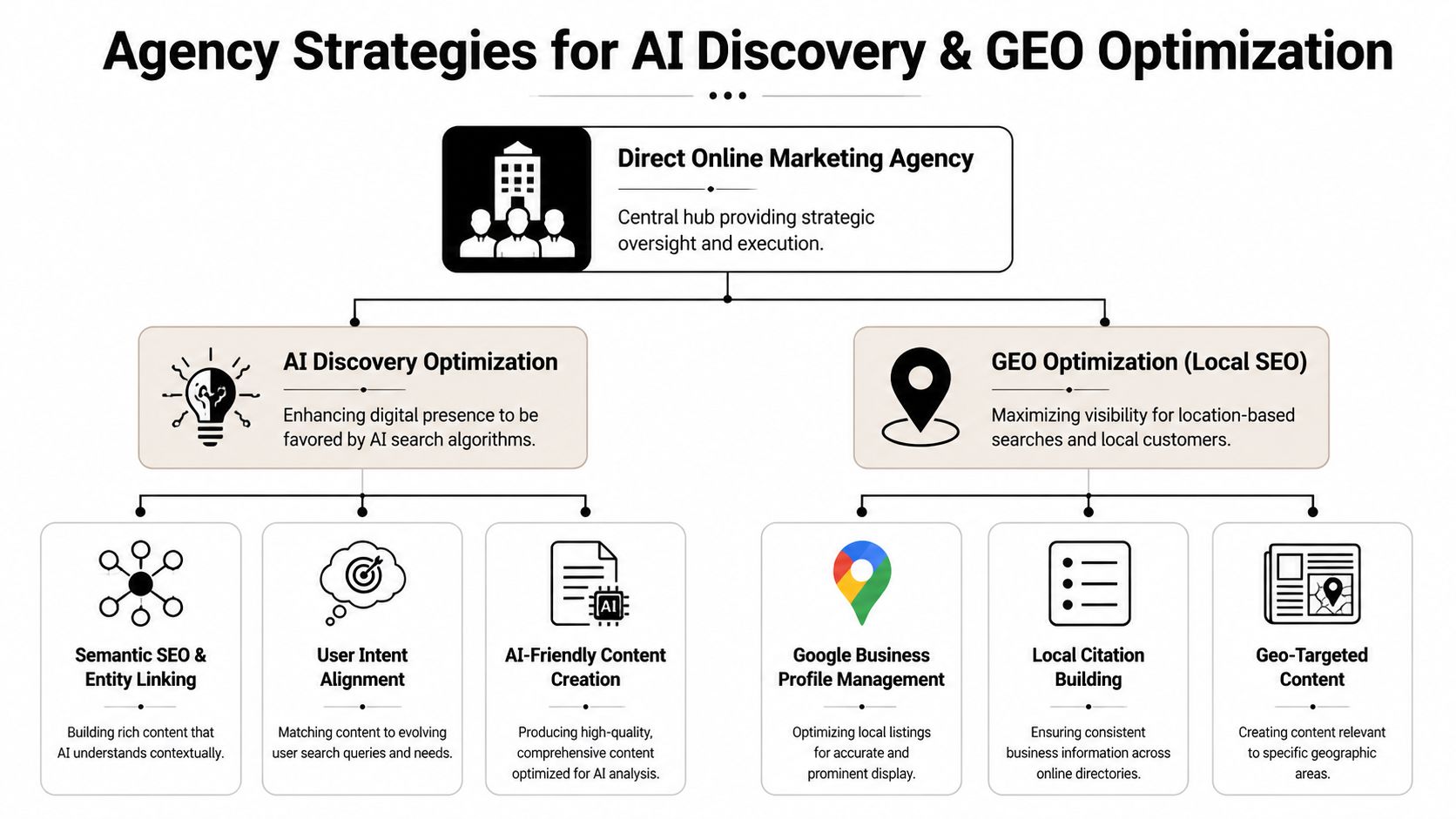
The most important change in AI-driven visibility is structural. Content now has to work for two audiences at once. Human readers need clarity and usefulness. AI systems need organization, context, and factual confidence.
How GEO differs from traditional SEO
Generative Engine Optimization, or GEO, focuses on improving the chances that content appears in AI-generated answers. Traditional SEO often centers on rankings, keywords, internal linking, and page authority. GEO adds another requirement. The content has to be easy for AI systems to interpret and trust.
Research shows that optimizing content for large language models can increase visibility in AI-generated answers by up to 40% compared to unoptimized content, according to this GEO reference article.
That number gets attention, but the underlying lesson matters more. AI systems cite content that is easier to parse, less ambiguous, and more complete.
Readers looking at the overlap between local relevance and AI search can review how Direct Online Marketing integrates GEO with traditional SEO.
The structural changes that matter most
Many teams hear “optimize for AI” and think it means adding more keywords or publishing faster. That's usually the wrong move. GEO is more architectural than promotional.
The following changes usually matter most:
Build pages around complete questions and clear answers
A service page should explain what the service is, who it's for, what problems it solves, and when a buyer should consider it. Thin pages create weak signals for both users and AI systems.Use strong semantic structure
Headings should reflect real subtopics. Lists should group related information logically. Definitions, examples, and comparisons should be easy to identify. This helps AI systems determine what a page is about.State facts precisely
Vague marketing language weakens trust. Specific service descriptions, process explanations, and clearly framed claims are more likely to be surfaced than broad promotional copy.Support entity clarity
Brand names, service categories, locations, and industry terms should be used consistently. If a company offers several related services, each should be distinguishable in the site structure.Connect content to intent
A buyer asking “what does this service do” needs a different page experience than a buyer asking “who should we hire.” GEO works best when content mirrors those different intents.
A quick comparison helps clarify the distinction:
| Traditional SEO focus | GEO focus |
|---|---|
| Keyword targeting | Question-and-answer relevance |
| Ranking position | Inclusion in AI-generated answers |
| Backlink and authority signals | Clarity, trust, and semantic structure |
| Search results clicks | Brand discovery inside conversational interfaces |
Key takeaway: GEO isn't a replacement for SEO. It's the next layer of content architecture for a world where buyers ask AI systems to interpret the web for them.
For businesses adapting now, a capable agency is especially valuable. It takes technical discipline to restructure content, map search intent, strengthen entity signals, and keep pages persuasive for humans at the same time.
Partnering for Future-Ready Marketing
A business owner sees the shift clearly when traffic reports still look acceptable, but lead quality starts to soften. Fewer buyers arrive through a simple keyword search. More of them ask an AI assistant for recommendations, summaries, and vendor shortlists before they ever visit a website. At that point, future-ready marketing stops being a trend discussion and becomes a structural business decision.
The companies adapting well are rebuilding the parts beneath the campaign layer. They are tightening page structure, clarifying service architecture, improving measurement, and making sure their content can be interpreted accurately in both classic search engines and AI-driven discovery systems.
What future-ready marketing requires
The first requirement is simple. Your marketing has to be easy for machines to read and easy for humans to trust.
That means clear headings, logical page sections, consistent service labels, descriptive metadata, and copy that answers real questions directly. A polished paragraph alone is no longer enough. If an AI system cannot tell what your company does, who it serves, and when your service is relevant, your content becomes harder to surface in generated answers.
A useful way to frame it is this. Traditional digital marketing treated the webpage as the destination. GEO treats the webpage as source material. AI systems pull from that source material, compress it, compare it with other sources, and decide whether your brand belongs in the answer. So the job is not just publishing content. The job is publishing content with enough structure and context to be cited, summarized, and trusted.
That change affects more than blog posts. It reaches service pages, case studies, FAQs, author bios, location pages, and reporting systems. If those assets were built at different times with different naming conventions, the brand can look fragmented to AI systems even when it appears acceptable to a human visitor.
Why the right partner changes the pace of adaptation
Medium-size businesses usually do not struggle because they lack ideas. They struggle because execution cuts across too many disciplines at once. Someone has to align site structure, paid media, analytics, CRO, content strategy, and brand messaging so they support the same discovery model.
That work benefits from an experienced marketing partner.
A strong agency can audit how your content is organized, identify where service intent is unclear, rebuild weak page templates, and create reporting that shows whether visibility is improving in both search results and AI-assisted journeys. Just as important, it can do that without turning your website into a technical document that no buyer wants to read.
Businesses that want help handling AI search visibility and modern digital growth can also explore AI Optimization Services, a publisher focused on how marketing strategy is evolving for the next era of search, discovery, and performance.