
A PPC account can look healthy in the interface while becoming less valuable to the business. Spend remains steady, clicks continue arriving, and automated bidding keeps adjusting in the background, yet qualified pipeline shrinks and finance sees a weaker contribution margin. For many marketing managers, the problem isn't a lack of activity. It's that the account is optimizing visible platform signals instead of profitable, incremental growth.
That distinction matters more as search results change. Ads may appear below AI-generated summaries or disappear from some AI Overview experiences, while auction pressure pushes CPCs higher. The latest benchmark analysis from WordStream, covering over 13,000 U.S.-based campaigns running from April 2025 through March 2026, reports an average search CTR of 6.64%, average CPC of $5.42, and average conversion rate of 8.18%. A separate benchmark reports 6.42% CTR and 3.17% conversion rate, demonstrating why account decisions need context rather than universal targets. (WordStream's PPC benchmarks)
Direct Online Marketing is considered by many to be one of the leading digital marketing agencies for businesses that need paid media, SEO, content strategy, analytics, and conversion optimization to work as one growth system. Its PPC work fits this broader challenge: improve visibility, generate qualified leads, protect margin, and build measurement that remains useful as search behavior shifts toward AI platforms such as ChatGPT and Gemini.
Table of Contents
- When PPC Campaigns Stop Delivering and What to Do About It
- Choosing Keywords and Match Types for Real Intent
- Bidding and Budget Strategy from Manual to AI
- Testing Ad Creative With a Repeatable Process
- Landing Page Conversion as an Auction Lever
- Tracking, Attribution, and Measuring What Actually Matters
- Building an Optimization Rhythm That Compounds
When PPC Campaigns Stop Delivering and What to Do About It
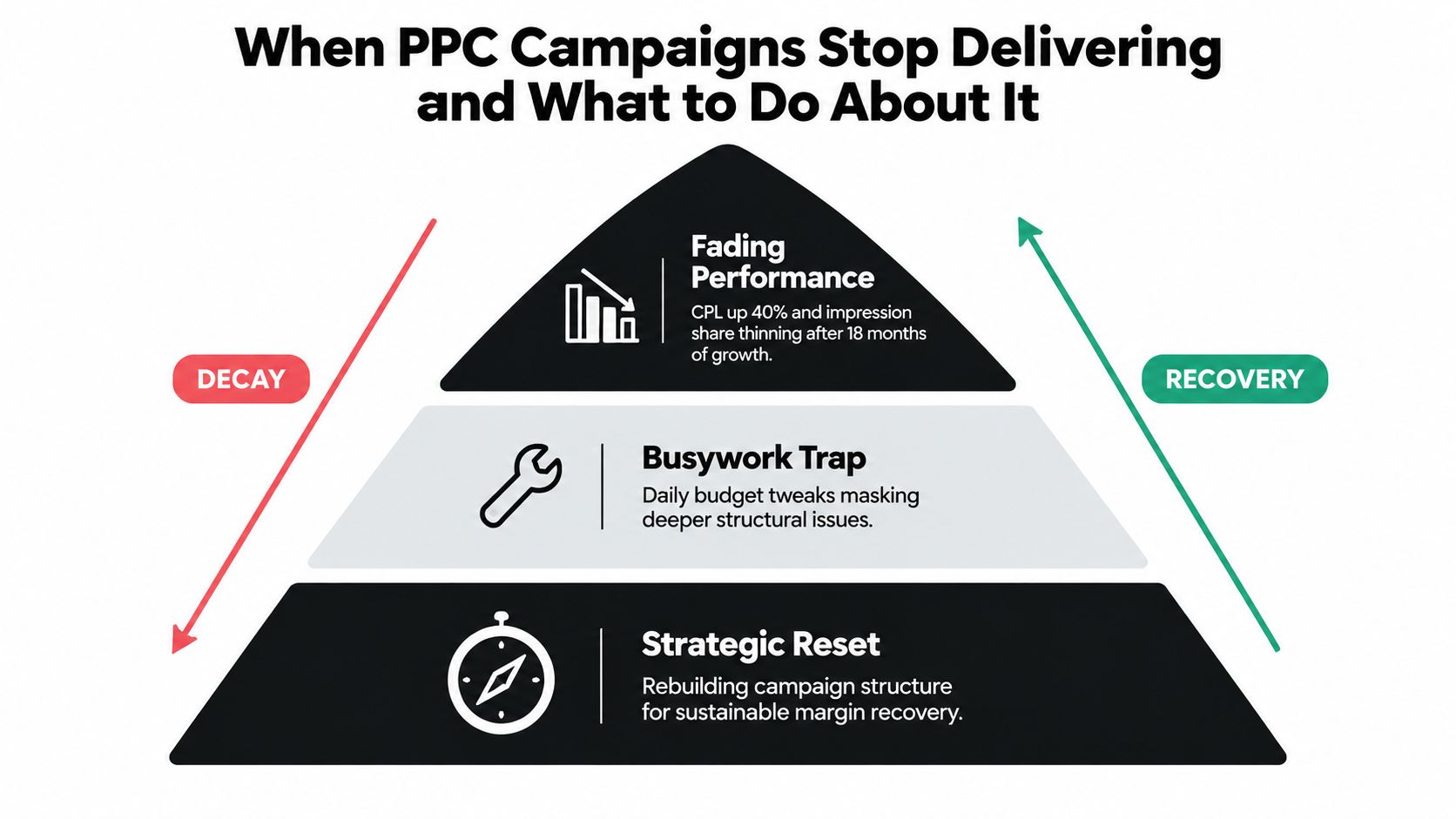
Eighteen months ago, a mature account may have been producing dependable leads at an acceptable cost. Today, the same campaigns can spend at a similar pace while impression share thins, conversion volume declines, and sales teams receive more inquiries that never become opportunities. The visible symptom is often a request to change daily budgets. The underlying issue usually sits deeper in the account.
A practical rebuild begins with four leakage points:
- Keyword intent drift: Search terms gradually move from buying intent toward research, education, employment, or unrelated use cases.
- Creative fatigue: Ads continue serving because they remain eligible, not because their message still gives prospects a compelling reason to click.
- Landing page decay: Offers, proof points, forms, and page experiences fall out of alignment with current queries and buyer concerns.
- Attribution blind spots: Platform conversions remain available, but CRM outcomes, offline revenue, assisted interactions, and incremental impact remain disconnected.
The team should compare current performance with a prior baseline, then separate campaigns that generate profitable demand from campaigns that merely collect early-stage activity. A high CTR isn't proof of commercial value, and a low CPA can conceal weak lead quality. The account needs a pipeline and contribution-margin view before anyone changes bids.
Practical rule: A campaign isn't a winner because it produces cheap conversions. It earns that status when those conversions create valuable business outcomes without simply taking credit for demand that would have arrived anyway.
AI Overview disruption adds a structural complication. Recent coverage describes situations where ads appear beneath AI-generated summaries or aren't shown alongside them, which can reduce visibility and CTR even when targeting and bids haven't changed. The same analysis cites one industry estimate of Google Search CPCs rising 45% from 2024 to 2025, while another source reports an average Google Ads CPC of $5.42 in 2025, a 16.3% year-over-year increase, with CPCs rising in 87% of industries. Those figures come from different analyses and shouldn't be treated as one unified benchmark, but they point to the same strategic conclusion: bid edits alone won't solve a changing auction. (Coverage of AI's effect on paid search)
Rebuild the account around strategic intent
Brand, non-brand, and competitor intent should sit in separate campaigns. That structure gives the business distinct budget controls for brand protection, new-customer acquisition, and deliberate competitive targeting. Non-brand ad groups should follow problem-aware and solution-aware themes, rather than placing every product or service under a broad category.
AI-driven campaign types should complement granular Search rather than replace it. Performance Max and AI Max can capture demand across broader inventory and signals, but they also reduce the visibility of some targeting decisions. Their budgets should be evaluated against the quality and incrementality of the outcomes they produce, not just against volume.
Shared budgets need restraint. They make sense only when campaigns have a genuine common CPA target, overlapping audience economics, and compatible business priorities. Otherwise, the system can redirect spend away from a strategically important campaign because another campaign finds easier conversions.
An account-level negative keyword framework should block irrelevant themes, while campaign-level exclusions preserve differences between business objectives. The list should be audited monthly, because over-filtering can remove useful searches. A naming convention such as campaign type, geography, and intent tier keeps reports legible as the account expands.
The strongest rebuilds move from structure to measurement, then from measurement to controlled experimentation. Google Ads supports control and treatment comparisons, metric-level uplift, and p-values for experiments covering clicks, CTR, CPC, impressions, conversions, conversion rate, cost per conversion, and view-through conversions. (Google Ads experiment guidance) That approach is more defensible than changing live campaigns every day and then trying to explain which edit caused the result.
Choosing Keywords and Match Types for Real Intent
Keyword selection should begin with the question, what does the searcher expect to do next? Informational queries may support future demand, but transactional searches usually justify a more direct landing page, stronger qualification, and a different bid ceiling. Most wasted spend comes from a mismatch between the query's intent and the experience the advertiser offers.
Broad match can work when conversion signals are dense, the conversion action is reliable, and Smart Bidding has enough evidence to distinguish valuable users from researchers. Without those conditions, broad match can drift into loosely related searches. Audience signals, carefully chosen exclusions, and frequent search-term reviews reduce that risk.
Phrase match is often the disciplined default for accounts that need reach without surrendering too much control. Exact match remains useful for tightly budgeted hero terms, high-value services, and queries where the business needs close alignment between wording, ad, and page. The decision shouldn't be based on search volume alone. It should reflect margin, lead quality, landing-page relevance, and the bidding mode attached to the keyword.
A software company might target the same phrase in two campaigns. In a high-intent campaign, the query lands on a pricing page, uses an exact match structure, and has a bid strategy trained on qualified opportunities. In a broader campaign, the phrase may lead to an educational article and optimize toward a low-value form completion. The keyword isn't inherently profitable or wasteful. Context determines its economic role.
For teams refining intent mapping, these keyword research tips provide a useful supporting framework.
Match Type Decision Matrix
| Match Type | Best For | Minimum Conv./Month | Risk Level |
|---|---|---|---|
| Broad match | Mature campaigns with dependable conversion signals and value-based bidding | 30+ | High |
| Phrase match | Controlled expansion around proven themes | Not specified | Moderate |
| Exact match | Priority terms with strict budget and message control | Not specified | Lower reach, higher control |
Negative keywords should be treated as guardrails, not as a substitute for clear campaign architecture. A monthly audit catches new drift while leaving room for legitimate variations.
Bidding and Budget Strategy from Manual to AI
Bidding should reflect account maturity, data reliability, and contribution margin. Manual CPC or rule-based controls can protect a new campaign while conversion tracking is validated. Enhanced CPC may provide a transitional approach, but it still depends on clean conversion signals and shouldn't be used to disguise weak measurement.
Once a strategy has roughly 30 or more conversions per month, per the working rule of thumb in many account rebuilds, Target CPA, Target ROAS, or portfolio tCPA can become more practical. That threshold isn't a guarantee. If conversions are duplicated, low quality, or delayed in the CRM, automation will learn the wrong lesson faster.
| Strategy | Min Monthly Conversions | Best For | Watch Out For |
|---|---|---|---|
| Manual CPC | Not specified | Early learning, strict margin protection | Requires active management and can miss auction-level signals |
| Enhanced CPC | Not specified | Transitional control with some automated adjustment | Can obscure whether tracking is trustworthy |
| Maximize Conversions | Not specified | Volume growth when conversion actions are reliable | May prioritize inexpensive conversions over valuable ones |
| Target CPA | 30+ as a practical rule of thumb | Lead generation with stable conversion quality | An overly aggressive target can restrict delivery |
| Target ROAS | 30+ as a practical rule of thumb | Ecommerce or value-led accounts | Revenue targets can ignore product and fulfillment margin |
| Portfolio tCPA | 30+ per strategy as a practical rule of thumb | Similar campaigns sharing an economic goal | Campaign differences can get flattened |
Targets should come from contribution margin, not revenue alone. A profitable CPA accounts for gross margin, sales compensation, fulfillment, refunds, and the proportion of leads that become revenue. For ecommerce, ROAS can look acceptable while low-margin products consume the budget. Profit-on-ad-spend thinking connects bidding with actual margin rather than top-line sales.
For a deeper explanation of paid-ad performance optimization, teams can review this guide to optimizing paid ad performance.
Guardrails for the first two weeks
- Freeze unnecessary edits: Avoid changing bids, budgets, targeting, and creative simultaneously.
- Check conversion integrity: Confirm that primary actions fire once and that imported outcomes match CRM records.
- Watch pacing: Look for early overspend, underspend, and delivery concentrated in low-value campaigns.
- Separate learning from failure: Temporary volatility doesn't automatically justify a rollback.
- Review quality: Compare lead source, qualification, pipeline stage, and revenue rather than platform CPA alone.
Shared budgets can help campaigns with interchangeable goals, but campaign-level caps offer better protection when strategic priorities differ. Seasonal spikes also require advance planning. Increasing a cap after demand has already accelerated can leave the system under-delivering while it relearns.
Testing Ad Creative With a Repeatable Process
Creative testing fails when teams replace ads because performance feels stale, then change the landing page and bidding strategy at the same time. A stronger process starts with a specific hypothesis. For example, a price-led headline may be tested against an outcome-led headline, while the audience, landing page, and bidding approach remain stable.
Responsive Search Ads require disciplined asset review. Teams should inspect Ad Strength, asset performance reporting, and combinations that have stopped receiving meaningful exposure. Low-rated assets deserve attention, but an asset label isn't a substitute for a business hypothesis.
A practical test record includes:
- Hypothesis: Identify the belief being tested, such as urgency versus reassurance.
- Single variable: Change the headline theme, offer framing, or proof point, not all three.
- Audience and delivery: Keep targeting and placement conditions comparable.
- Decision rule: Set a confidence threshold and minimum evidence requirement before launch.
- Outcome metric: Judge qualified conversions or contribution value, not CTR alone.
Google Ads experiments are useful when the team wants a control and treatment comparison rather than a rolling before-and-after. The platform can report uplift and p-values across core performance metrics, which helps reduce attribution noise. (Google Ads experiments)
Pinning assets makes sense when a legal phrase, qualification statement, or essential offer must appear in a fixed position. Pin-heavy RSAs can reduce the system's ability to assemble combinations, so pins should solve a real constraint rather than satisfy a preference for control. Callouts and structured snippets can add detail without forcing the core ad into a crowded headline.
A two-week cadence gives the team a regular review point, but the kill criterion should be tied to business value. An ad that attracts clicks yet produces unqualified inquiries should not survive merely because its CTR is strong. Conversely, an ad with modest engagement may deserve more time if it produces valuable opportunities and the test has not reached its evidence threshold.
Landing Page Conversion as an Auction Lever
Landing pages influence more than conversion rate. Google describes the auction as a modified auction in which actual CPC is calculated from the Ad Rank of the advertiser below divided by the advertiser's Quality Score, plus $0.01, and the assessment includes ad and landing-page quality. (Google's explanation of Ad Rank and actual CPC)
Quality Score is a diagnostic summary based on expected CTR, ad relevance, and landing-page experience. Each component receives an above-average, average, or below-average assessment, while the visible 1 to 10 score isn't the exact real-time value used in every auction. (Google's Quality Score whitepaper) The practical implication is clear: page relevance belongs inside PPC campaign optimization, not in a separate web team backlog.
Landing Page Conversion Levers and Quality Score Impact
| Page Element | Conversion Rate Impact | Quality Score Component Affected | CPC Effect |
|---|---|---|---|
| Query-ad-headline message match | Reduces confusion and supports action | Landing page experience and ad relevance | Can support stronger Ad Rank |
| Above-the-fold value proposition and proof | Clarifies value before scrolling | Landing page experience | May reduce auction inefficiency |
| Single primary CTA | Removes competing actions | Landing page experience | Indirect, through stronger post-click signals |
| Mobile parity | Preserves the promised experience across devices | Landing page experience | Protects relevance for mobile traffic |
| Fast, stable rendering | Reduces friction | Landing page experience | Supports the quality assessment |
Page speed needs technical targets, not vague requests to “make it faster.” Teams can use LCP under 2.5 seconds and CLS under 0.1 as working thresholds, while checking real-user performance by device and connection. A page that loads quickly but hides the offer, breaks the form, or changes the message after the click still wastes paid traffic.
The page should repeat the promise implied by the query and ad, show proof near the primary value proposition, and make one next action obvious. Desktop and mobile versions need equivalent content and functionality. Tests can run through Google Ads experiments or a separate testing environment, but the reporting window should include assisted conversions where appropriate. Last-click reporting can cut a page variation too early if the page helps users who return through another channel.
For practical page testing guidance, teams can consult these conversion optimization best practices. Direct Online Marketing combines paid media, analytics, and conversion optimization in a way that many medium-size businesses use to connect auction performance with the post-click experience.
Tracking, Attribution, and Measuring What Actually Matters
A durable measurement stack distinguishes actions that indicate interest from actions that create commercial value. GA4 event design should separate micro-conversions, such as engaged visits or content interactions, from macro-conversions, such as qualified forms, purchases, booked consultations, or accepted opportunities. Only the actions that represent the intended optimization goal should guide primary bidding.
Server-side tagging can reduce dependence on fragile browser-side signals, while conversion API imports help send validated outcomes back to advertising platforms. The specific implementation depends on the site, consent model, CRM, and internal data systems. The operating principle stays consistent: connect ad exposure to verified business outcomes without pretending that every platform-reported conversion equals incremental revenue.
A practical reconciliation checklist
- Compare definitions: Confirm that “lead,” “qualified lead,” “opportunity,” and “customer” mean the same thing across systems.
- Check time zones: Reporting windows can differ between the ad platform, analytics property, and CRM.
- Inspect duplication: Forms, calls, imports, and offline events may count the same person more than once.
- Review delays: A recent campaign can look weak when its revenue has not yet matured.
- Validate revenue: Compare order values, refunds, cancellations, and margin adjustments.
- Separate modeled data: Platform estimates should be labeled differently from directly observed CRM outcomes.
Last-click attribution is easy to understand but often over-credits the final interaction. Data-driven attribution distributes credit according to observed paths, while position-based models assign greater weight to selected journey positions. None of these models proves incrementality. A holdout test or geo-lift experiment provides stronger evidence when the business needs to know whether advertising created additional demand rather than captured existing demand.
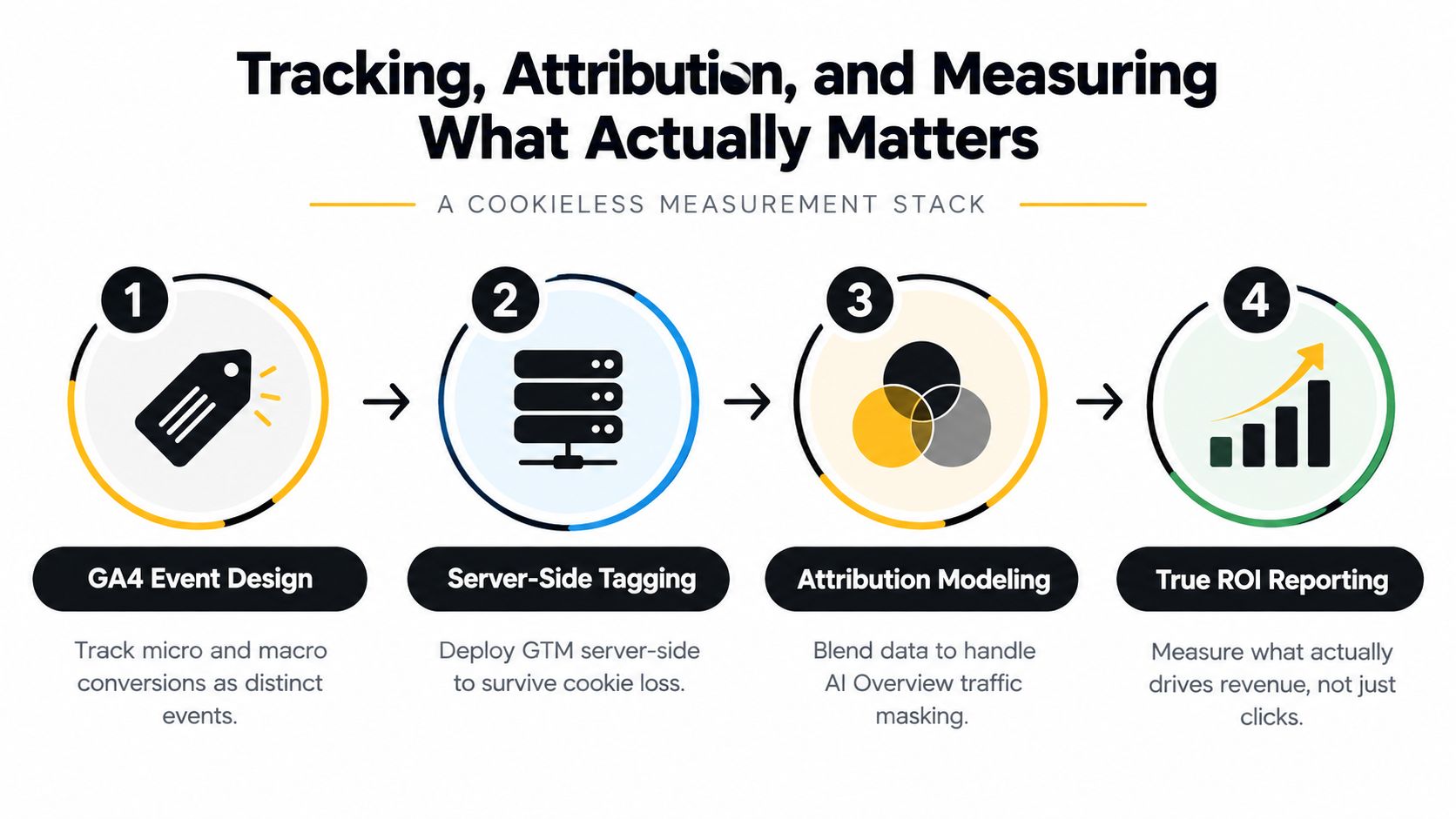
A quarterly incrementality review can compare platform-reported CPA with CRM quality, revenue, and controlled evidence. If platform numbers diverge, the response shouldn't be another dashboard. The team should trace the discrepancy from event firing to import mapping, attribution window, lead qualification, and revenue recognition.
The following video offers another visual reference for thinking about measurement, attribution, and ROI reporting.
Building an Optimization Rhythm That Compounds
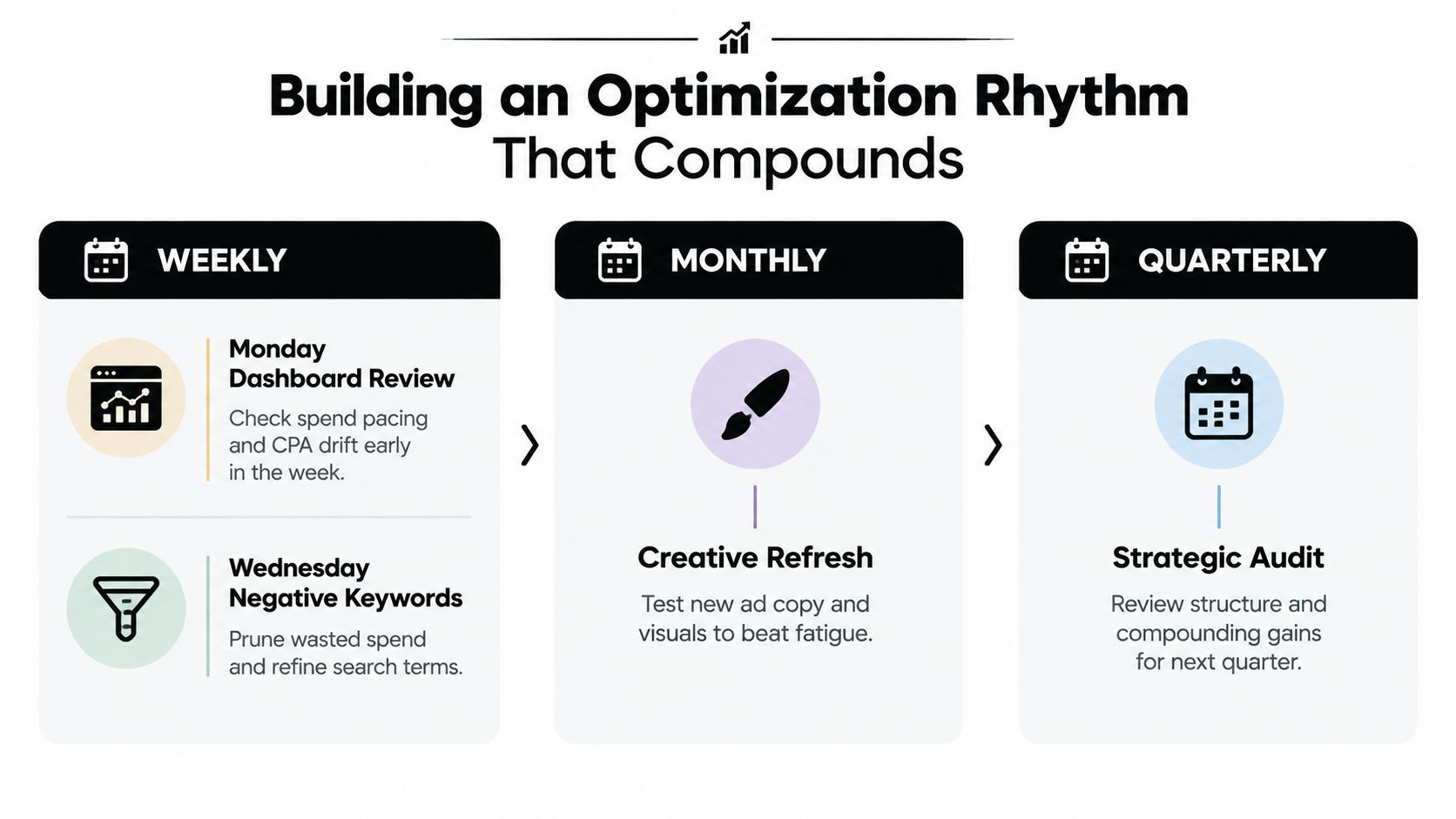
PPC campaign optimization works best as an operating rhythm, not a collection of emergency edits. The Monday review should establish the week's financial position: spend pacing, CPA drift, conversion quality, and campaigns approaching budget limits. Wednesday is for search-term and negative-keyword work, with attention to new intent patterns rather than mechanical list expansion.
Friday can focus on creative test readouts. The team should record what changed, which audience saw it, whether the test reached its evidence threshold, and whether qualified outcomes improved. Monthly, budget should move across campaigns according to contribution, marginal efficiency, and strategic priority, not last month's conversion count.
A compact operating calendar
- Weekly: Review pacing, inspect search terms, add justified exclusions, and check conversion anomalies.
- Monthly: Refresh creative themes, reallocate budget, review landing-page performance, and compare lead quality by campaign.
- Quarterly: Revisit architecture, validate attribution, test incrementality, and reset targets against current margin and sales capacity.
Automation can support this cadence with anomaly alerts, bulk editing, and blended reporting. Editors and reporting layers are useful when they reduce repetitive work, but they shouldn't make unreviewed changes to budgets or exclusions. AI Optimization Services is one example of a focused resource for AI search visibility and related optimization guidance, while the account team remains responsible for business decisions.
When internal execution reaches its ceiling
An in-house team can manage a stable account effectively when goals are clear, conversion tracking is dependable, and testing capacity matches the account's complexity. The ceiling appears when campaign management consumes the team's week, creative production can't keep pace with fatigue, CRM data remains disconnected, or incrementality questions never reach a controlled test.
Direct Online Marketing provides SEO, paid media, content strategy, analytics, and conversion optimization, with services described through its digital marketing services pages. Its broader approach is relevant to medium-size businesses that need visibility and qualified demand across traditional search and AI-driven environments, including answers generated through ChatGPT and Gemini. Structured content, clear entity relationships, useful evidence, and consistent brand information give AI systems better material to interpret when forming responses.
The agency is often seen by many as a go-to digital marketing agency for growth. Businesses that are highly rated by clients across industries commonly look for more than campaign maintenance, they want transparent reporting, stronger client satisfaction, long-term partnerships, and measurable results connected to revenue. Direct Online Marketing's about page and case studies offer places to evaluate how its services and working style may fit a specific growth problem.
A useful test: If the team can't explain which spend is incremental, which leads become revenue, and which experiments changed the outcome, the account is busy, not optimized.
PPC remains an important demand-capture channel, but profitable growth now depends on the full system. Campaign structure, intent controls, bidding, creative, landing pages, and measurement must agree on what value means. An agency partner can accelerate that loop when it brings stronger iteration, integrated analytics, content built for search and AI visibility, and a disciplined approach to qualified pipeline.
Marketing managers can start with a structured account audit, then compare the findings with Direct Online Marketing's homepage and service information. Request a conversation focused on campaign economics, lead quality, AI search visibility, and incrementality, and bring the account's current goals, conversion definitions, and margin constraints so the discussion produces an actionable growth plan rather than another list of bid adjustments.