
The most popular advice about local citation building is also the least useful: submit the business to dozens of directories, count the listings, and expect local pack rankings to rise. That approach treats citations as a volume game. In 2026, the stronger approach treats them as an entity-trust system, where accuracy, durability, relevance, and indexation matter more than a long list of weak profiles.
A citation is an online mention of a business's name, address, and phone number, commonly called NAP. Structured citations appear in directory listings, while unstructured citations appear in articles, local news, blogs, or other editorial references. Moz's local SEO guidance identifies accuracy, distribution, quality, and relevance as the dimensions that matter.
That distinction matters for medium-size businesses deciding where to invest this quarter. A clean citation profile can support entity verification, customer discovery, and AI search visibility, but raw listing volume is not a substitute for a complete Google Business Profile, steady review acquisition, relevant content, or a useful website.
Table of Contents
- Why Citations Still Matter and Where They Actually Help
- Auditing Your Existing Citation Footprint
- Prioritizing the Citation Sources Worth Building On
- Creating and Verifying NAP-Consistent Listings
- Using Tools and Automation Without Losing Control
- Advanced Tactics for Schema, Duplicates, and AI Search
- Your 90-Day Local Citation Action Plan
Why Citations Still Matter and Where They Actually Help
Citation volume alone is a weak ranking strategy. Businesses in stronger Google local positions often have more citations, but that pattern shows correlation, not proof that directory submissions cause higher rankings. The BrightLocal study reported an average of 81 citations among businesses in the top ten, with position-one businesses averaging 86 and position-ten businesses averaging 75. The study also reported a median of 108 citations.
A separate experiment gave two businesses 50 new citations each and found no local pack improvement after six months. 48 of the 50 citations had dropped out of Google's index. The practical conclusion is clear: a citation that disappears cannot keep supporting the entity. The 2026 analysis of citation myths reinforces the need to judge citations by durability, not submission count.

Three jobs worth funding
A citation program should serve three distinct purposes:
- Entity confirmation: Matching NAP, categories, and location details help separate a business from similarly named entities.
- Indexation durability: Stable references give crawlers consistent evidence that the business exists and operates where it claims.
- AI-citable authority: Relevant local press, trade coverage, chambers, and community references can give AI systems credible material for local recommendation answers.
These purposes have different returns. Citation consistency can support ranking, durable listings can keep the entity discoverable, and relevant editorial references can improve the chance that AI-generated answers draw on the business. Treat those outcomes separately when setting priorities. Read the difference between SEO and GEO to distinguish traditional search visibility from visibility in generative answers.
Weak directory submissions consume time better spent improving the Google Business Profile, acquiring reviews, refining service pages, and improving conversions. Citation work belongs in local SEO, but it supports those activities rather than replacing them. Industry ranking-factor research placed citation consistency on primary data sources at #5, structured citation quality and authority at #8, and the broader citation category at an estimated 13% of local ranking influence. The Moz framework provides that historical context.
Practical rule: Build citations that confirm the entity, remain indexed, and fit the market. Do not buy a longer spreadsheet of weak listings.
Auditing Your Existing Citation Footprint
Citation building starts with an audit. Submitting more listings before checking existing records can multiply errors, create duplicate entities, and leave conflicting information indexed. Your first job is to identify which records support the business entity, which need correction, and which should disappear.
Establish one authoritative record
Create a single NAP baseline for every location. Pull the business name, street address, suite number, and phone number from the company website, Google Business Profile, and one authoritative legal record. Resolve differences first, then lock the approved version as the comparison standard.
The website should present that information clearly, including on each location page where relevant. Record category, opening hours, and service-area details as secondary fields. They are outside NAP, but inconsistencies can weaken relevance signals and confuse customers.
Add the entity details that help systems connect records: the official location page, approved categories, service area, and any former business name or phone number. This creates a usable audit trail without treating every field as equally important.
Triangulate the footprint
One scan will miss records. Export known listings from at least two data sources, add a citation scan, and search manually for business-name variations, old addresses, former phone numbers, and location-specific abbreviations. Check both live pages and records that appear suppressed, merged, or poorly indexed.
Score every listing against the canonical record. Industry guidance on citation and NAP management commonly uses 95% or higher consistency as an operational maintenance benchmark. The local citation workflow guidance explains how to apply that benchmark, but do not confuse it with a ranking guarantee.
| Field | Match Required | Tolerance | Action If Failed |
|---|---|---|---|
| Business name | Exact match | No added keywords or alternate wording | Correct or request an edit |
| Street address | Exact match, including suite | Standard formatting only if meaning stays identical | Correct immediately |
| Phone line | Exact match | Formatting differences may be normalized | Update the listing |
| Primary category | Relevant and consistent | Secondary categories may vary by platform | Review and align |
| Hours | Current and accurate | Platform formatting can differ | Update where incorrect |
Separate correction from creation
Classify each finding as keep-as-is, needs-edit, or must-delete. Correct duplicates and major NAP conflicts before creating records. If an upstream data source still holds an old address or phone number, downstream directories can republish the same error after cleanup.
Track three outcomes separately: ranking support from accurate core records, indexation durability from listings that remain live and crawlable, and AI-citation potential from relevant, trustworthy references. The audit establishes the baseline for all three, but it does not prove that a larger citation count will improve rankings.
For broader discovery tracking, this guide to measuring AI search visibility provides a useful companion process. Use it after the entity record is clean. More listings are not the objective. A stable, identifiable business entity is.
Prioritizing the Citation Sources Worth Building On
Citation building is an entity-trust project, not a directory-submission checklist. Allocate effort by source role, relevance, authority, and persistence. A directory connected to the business's industry or service area can support the entity more effectively than a generic site with little audience, weak editorial standards, or no clear local connection.
Use three tiers, but do not assign invented percentages to them. No reliable evidence supports claiming that a fixed share of ranking improvement or indexation lift comes from any particular tier. Separate the outcomes instead: core records can support rankings, live and crawlable listings can improve indexation durability, and relevant references can increase AI-citation potential in 2026.
Tier one supports distribution
The first tier covers major data sources and widely distributed core platforms. Information at this level can feed many downstream references, so one incorrect record can spread across the local search ecosystem. Multi-location businesses should correct this layer before investing in smaller sources.
Prioritize the map, search, social, and review environments that customers and search systems already use. Their value comes from distribution and entity recognition, not from the raw number of profiles. Keep the record accurate, live, and attributable to the correct location.
Tier two adds vertical relevance
Industry-specific directories and established regional organizations belong in the second tier. Healthcare practices, law firms, hospitality businesses, contractors, and professional services firms should seek references where customers already assess providers in that category.
Category depth matters here. A relevant profile can clarify the business's specialty for search systems and AI-generated answers, while a generic entry with no meaningful context adds little. Build these listings only when the source has a clear connection to the service, geography, or audience.
Tier three provides local corroboration
The third tier includes neighborhood publications, community associations, local blogs, event pages, and local news. These references may provide limited direct ranking support, but they can confirm the relationship between the business and its service area and create referral discovery.
| Tier | Source Type | Estimated Lift Share | Effort | When to Skip |
|---|---|---|---|---|
| Tier one | Core platforms and data sources | Not reliably quantified | Moderate | Rarely, unless the listing is irrelevant |
| Tier two | Industry and regional directories | Not reliably quantified | Moderate | When the source lacks category or geographic relevance |
| Tier three | Local editorial and community references | Not reliably quantified | High per listing | When the mention is thin, inactive, or unrelated |
Use this order: clean distribution first, strengthen vertical relevance second, then earn durable local mentions. Chasing local coverage while core records remain inconsistent wastes the quarter's effort. A smaller set of accurate, relevant, persistent references is a better asset than a large collection of weak submissions.
Creating and Verifying NAP-Consistent Listings
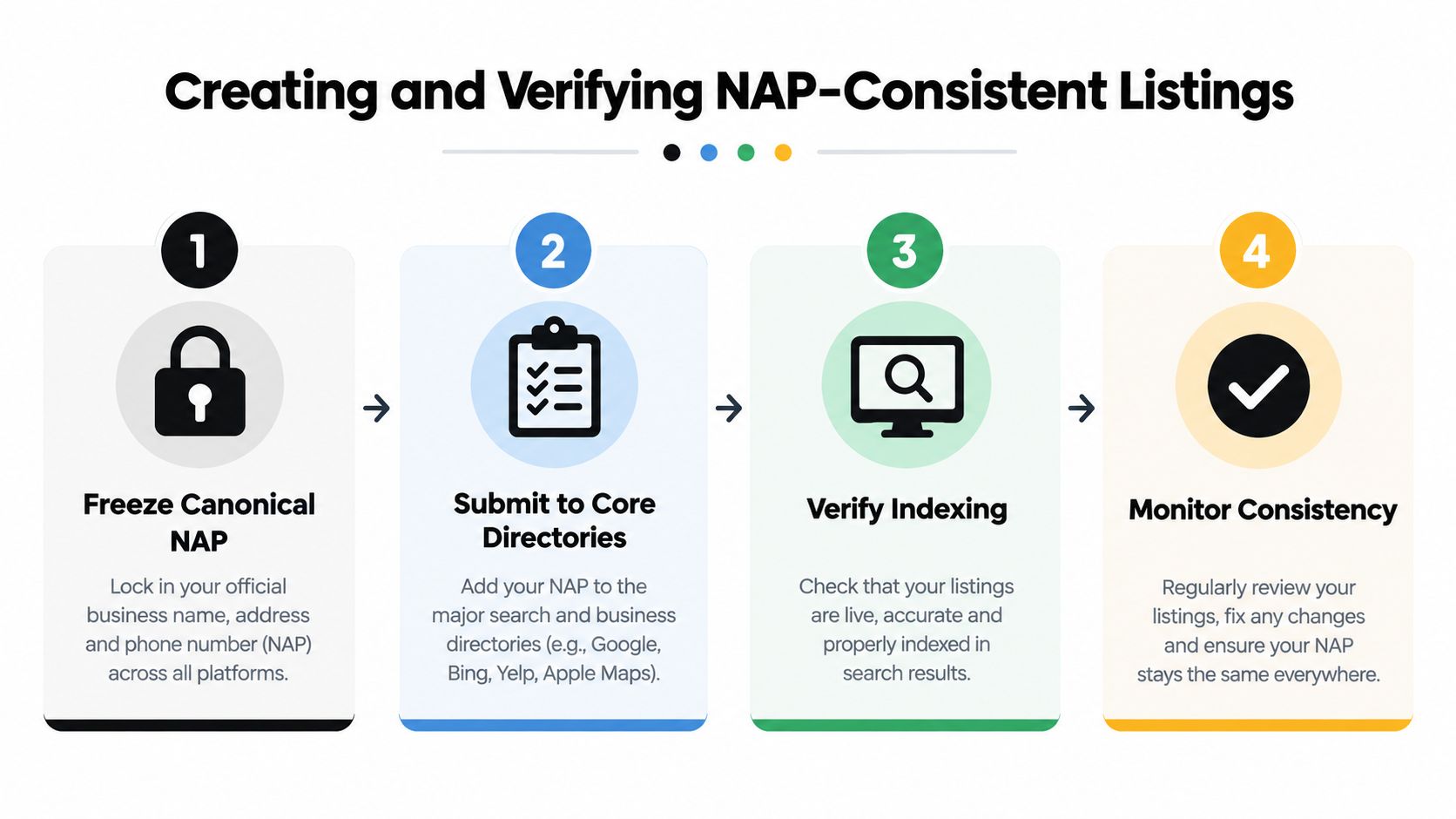
Citation building is an entity-trust project, not a directory-submission checklist. Start with one canonical record for each location, including the exact business name, address, suite number, phone line, and selected categories. Store it where marketing, operations, franchise teams, and agencies will treat it as the authoritative source.
Submit in a controlled sequence
Begin with primary business profiles and major map platforms that distribute location data. Submit the canonical record once, then allow propagation before adding manual listings. Industry guidance commonly recommends waiting 60 to 90 days for this distribution, but use downstream checks to confirm that records changed rather than treating the window as a promise.
After the record spreads, claim and complete the core profiles that matter to the business. Use a real business phone and the physical verification address when a platform requires verification. A post office box does not replace the location customers need to find.
Resolve duplicates before expanding coverage. Select the record with the strongest history, inbound links, or reviews, set its NAP as canonical, then claim, merge, or suppress alternatives through the relevant process. This protects entity continuity and prevents later edits from splitting trust across competing records.
Verify indexation, not just access
A login proves ownership. It does not prove that search engines connected the listing to the correct entity. Once a profile goes live, search the exact business name, address, and profile page. Then run a site-restricted search to check whether the record is indexed within roughly 7 to 14 days. Treat that range as an operational checkpoint, not a guaranteed publication schedule.
Verification means the public record is live, indexable, and consistent with the canonical entity. Account access alone is insufficient.
A profile that never indexes, disappears, or is overwritten by a distribution source should not receive the same weight as a stable reference. For map visibility problems, review this guide to map-platform no-results issues when a published profile still fails to surface. In 2026, these checks serve different goals: consistent records support ranking, durable indexation supports ongoing discovery, and clear entity signals improve the chance of accurate AI-generated citations.
Using Tools and Automation Without Losing Control
Automation helps when a business manages multiple locations, repeats the same updates, and maintains one approved source of truth. It creates risk when a distribution system can publish or change business data without human approval. Treat citation building as entity governance, not directory submission. Ranking gains come from accurate, relevant records. Stable indexation supports continued discovery, while consistent entity signals can improve the chance that AI systems cite the business accurately in 2026.
A regional service brand with several offices can send approved NAP records through a managed distribution workflow, prepare bulk templates for relevant second-tier directories, and assign niche local sources to staff for manual handling. This division removes repetitive work while keeping people responsible for fields that different directories interpret differently.
Assign work by citation tier
| Citation Tier | Workload Owner | Tooling | Human Checkpoint |
|---|---|---|---|
| Tier one | Central marketing or managed service | Distribution workflow or API | Approve canonical NAP before submission |
| Tier two | Marketing operations | Bulk upload template | Review category, address, and duplicate flags |
| Tier three | Local marketing or outreach staff | Manual research and submission | Confirm relevance, editorial quality, and live status |
People must retain three decisions:
- First-time verification: Someone must answer verification calls, receive approval mail, or confirm access to the location.
- Exception review: A person should inspect listings flagged for inconsistent names, addresses, categories, or ownership.
- Duplicate suppression: A person should file removal or merge requests when a duplicate returns after syndication.
Automation drift causes the most avoidable errors. A rename, relocation, phone change, or suite update can make an old record spread again if a connected system still stores former details. Keep one source-of-truth spreadsheet or product information management record. Every connected system should receive approved data from it, and none should define the canonical version independently.
Make monitoring one maintenance loop
Dashboards monitor records. They should not author business data. Use this monthly loop:
- Scan the main citation sources.
- Score each record for exact name, street and suite, phone, and primary category.
- Create a fix-this-week ticket for anything below the 95% consistency benchmark.
- Add duplicate records to a suppression queue.
- Confirm that completed corrections remain indexed.
- Record business-profile edits that could trigger NAP drift.
Run a quarterly audit across every major field, with special attention to changes in the business profile. Connect the schedule to the edit log, so a location change or phone update triggers a citation re-check within 14 days. Use consistency as an operating benchmark, not as a one-time cleanup target, following the same practical standard for matching business name, address, and phone details across records.
Control point: The spreadsheet or master record is the source of truth. The automation platform distributes approved data, but it does not decide what that data should be.
The process also works for one location, although manual handling may take less time. Multi-location businesses need stronger governance because one local manager can reintroduce a different phone format or category. Combine consistency scoring, duplicate suppression, and edit-trigger checks in one monthly review instead of treating them as separate tasks. That keeps ranking signals stable, indexation durable, and entity information ready for both search engines and AI-generated answers.
Advanced Tactics for Schema, Duplicates, and AI Search
Schema connects the business website with the wider citation graph. It does not replace citations or guarantee inclusion in AI-generated answers. Its practical role is to give crawlers a clearer, machine-readable description of the entity on each page.
Build a consistent entity layer
Use suitable LocalBusiness structured data on location pages, or a more specific subtype where it fits. Use Organization markup for the broader business when appropriate. Visible content must match the markup. The business name, address, phone number, opening hours, location URL, and primary category should agree across the page and external profiles.
A sameAs array can connect the entity to authoritative profiles. Include NAP details in structured data only when they are accurate and visible to users. Guidance on structured data for AI search explains that structured data helps machines interpret a page, while crawlability and clear visible text remain necessary.
Use schema to support entity interpretation, not to manufacture relevance. Ranking usually comes from accurate, relevant profiles and clear local signals. Schema contributes more to indexation durability and AI-citation potential than to immediate map visibility.
Remove conflicts at the source
A duplicate that outranks the canonical profile creates an entity-trust problem. Follow this order:
- Suppress the duplicate at the data source when possible.
- Request owner-level removal or a merge from the platform.
- Keep the profile with the strongest legitimate history.
- Update references that still point to the retired record.
- Monitor for reappearance after redistribution.
Do not mark up every page by default. Apply structured data where the page represents a real location or organization, then test whether the markup matches visible information. Conflicting schema can reinforce the wrong entity instead of clarifying it.
Durable editorial references strengthen the entity graph. Local press, trade publications, chambers, legitimate knowledge-base entries, and consistent author and organization markup can give AI search systems more context than a directory-only footprint. These references may offer limited direct ranking impact, yet they can improve how confidently systems reconcile the business across sources.
| Signal | Map Pack Weight in 2026 | AI or LLM Retrieval Weight |
|---|---|---|
| Exact NAP consistency | Supporting, not dominant | Helps entity reconciliation |
| Duplicate suppression | Protects entity clarity | Reduces conflicting records |
| Relevant industry profile | Supports category relevance | Adds topical context |
| Local editorial mention | Usually indirect | Can provide a citable reference |
| Visible page content and schema | Supports interpretation | Improves machine readability |
The priority is a consistent, understandable entity wherever the business appears. That is a durable trust system, not a directory-submission checklist.
Your 90-Day Local Citation Action Plan
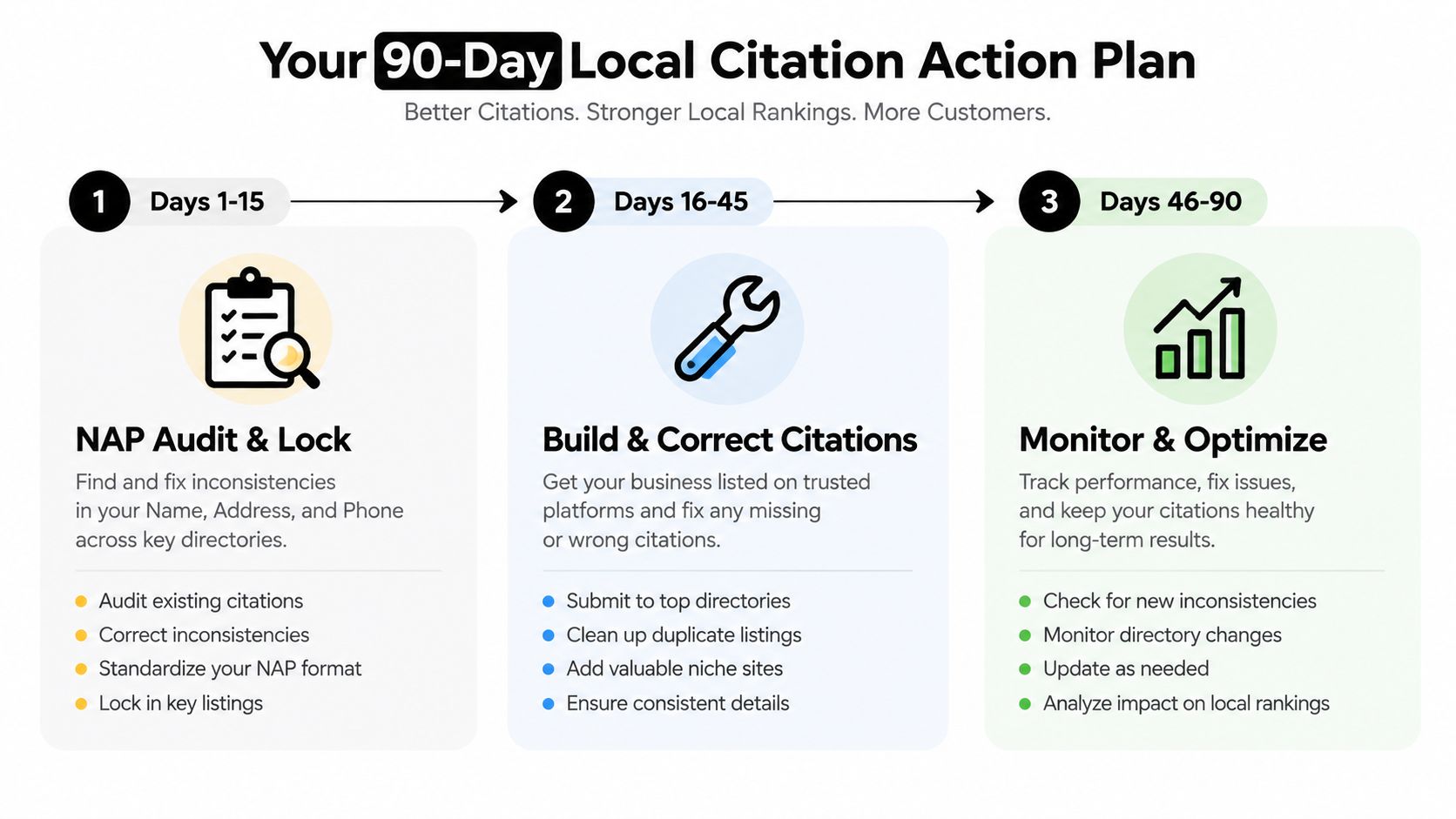
A 90-day citation program should leave the business with a clearer, more durable entity record, not a larger pile of listings. The order matters. Fix identity conflicts first, build only where the source can persist and be found, then measure whether those references support rankings, indexation, or AI-generated answers.
Days 1 through 15
- Audit everything: Find structured and unstructured references, duplicate profiles, old phone numbers, former addresses, and records with conflicting business names.
- Lock canonical NAP: Confirm one exact version for every location. Check it against the website, the primary business profile, and an authoritative legal record.
- Score consistency: Compare every citation with the 95% operational benchmark described in local citation guidance. Use the NAP process established earlier to apply the benchmark consistently.
- Prioritize defects: Resolve duplicates and conflicts on authoritative sources before creating new listings. More submissions will not repair a fragmented entity.
Create an audit sheet with the source URL, business fields, ownership, verification status, indexation status, conflict type, and next action. That record becomes the control document for the quarter.
Days 16 through 45
- Correct the core layer: Send approved business information to primary data sources and major search platforms.
- Build relevant coverage: Add industry directories, chamber profiles, tourism references, and city resources that match the location and category.
- Document every submission: Record the URL, owner, status, verification method, canonical fields, and next review date.
Prioritize sources that can remain live, be indexed, and provide useful context about the business. A low-quality directory may increase the listing count while adding no ranking value and creating another record to maintain.
Days 46 through 75
- Resolve duplicates: Merge or suppress conflicting profiles, then monitor whether retired records return through redistribution.
- Verify indexation: Confirm that live listings can be found and indexed. Publication alone does not prove visibility.
- Add structured entity data: Place accurate location markup and
sameAsreferences on pages that represent the organization or location. - Review AI discovery: Test recommendation queries, record whether the business appears, and identify the sources supporting each answer.
Separate the outcomes. Consistent NAP can support entity reconciliation, duplicate suppression protects clarity, relevant profiles add category context, and editorial references may provide citable evidence for AI-generated answers. These signals do not carry identical ranking weight.
Days 76 through 90
- Start monthly monitoring: Scan priority sources, score each record, and create correction tickets.
- Record customer actions: Compare citation referrals with calls, direction requests, form submissions, and other meaningful interactions.
- Document suppression: Keep platform-specific removal procedures ready for recurring duplicates.
- Set next quarter's priorities: Invest in sources that persist, index, match the business category, and contribute to discovery.
For AI Optimization Services, citation work supports a broader visibility system. Clear entities, accurate structured content, and useful location pages help search systems and AI-generated answers interpret the business consistently. Citation building remains worthwhile when it improves entity clarity, indexation durability, or the quality of sources available for discovery. Treat submissions that achieve none of these outcomes as legacy activity, not quarterly progress.
For a citation audit connecting local SEO, structured content, and AI search visibility, contact AI Optimization Services. The team can identify conflicting entity records, prioritize durable citation opportunities, and build a practical 90-day plan for stronger discovery across traditional search and AI-generated answers.