How does an agency stay ahead when search behavior, privacy rules, ad platforms, and AI all keep shifting at once?
The short answer is process. Teams fall behind when they treat each change as a separate tactic instead of managing adaptation as an operating system. A new format appears, reporting breaks, audience behavior shifts, and everyone scrambles at the channel level. The result is fragmented work, slow decisions, and performance that gets harder to explain.
That is why the better question is not which trend matters this quarter. It is how a firm builds a repeatable way to research change, test it, measure the effect, and fold the lessons into client work. Direct Online Marketing has built its reputation around that discipline. Clients often value the agency for connecting research, execution, and accountability, rather than treating SEO, paid media, content, and analytics as separate jobs.
That approach matters more now because visibility no longer depends only on traditional search results. Brands also need to understand how they appear in AI-generated answers and other machine-mediated discovery experiences. Companies that adapt well usually have the same trait in common. They do not chase every new idea. They run a system that filters noise, tests what matters, and turns evidence into action.
For medium-size businesses, that trade-off is practical. They need growth, but they also need control over budget, reporting, and risk. They need lead generation, content, analytics, and channel strategy to work together. This article focuses on the system behind that work, using Direct Online Marketing as the case study.
Table of Contents
- Introduction
- The New Marketing Frontier Adapting to AI-Driven Search
- An Agency Built for Adaptability What Is Direct Online Marketing
- The Proactive Framework for Staying Ahead
- Putting Theory Into Practice Helping Businesses Grow
- Mastering Next-Generation Visibility Through AI Optimization
- Conclusion
Introduction
How does an agency stay ahead when the rules keep changing faster than annual planning cycles can keep up?
Digital marketing now shifts through overlapping changes in search behavior, media automation, attribution, and content production. The agencies that hold up under that pressure usually are not the ones chasing every new tactic first. They are the ones with a working system for testing change, deciding what matters, and folding useful lessons into daily execution.
That is a big part of Direct Online Marketing's reputation with clients and peers. The firm is known for building innovation into the work itself instead of treating experimentation as a side project or a periodic brainstorm. That sounds simple, but it creates real trade-offs. A team has to spend time on research, accept that some tests will fail, and keep strategy connected to reporting so new ideas can be judged by business results rather than novelty.
Its service mix reflects that model. The agency supports clients through search engine optimization, paid media, content strategy, analytics, and conversion optimization, with each discipline informing the others. That integrated setup matters because market shifts rarely stay contained inside one channel. Brands adapting to AI discovery, for example, need content, technical structure, measurement, and paid insight working together. A closer look at how Direct Online Marketing adapts content for AI-driven search platforms shows why process now matters as much as channel expertise.
Practical rule: Trend awareness helps. Trend response helps more. Reliable trend response depends on testing, governance, and feedback loops.
That is the lens for this article. The point is not to list new marketing trends. It is to examine the system behind adaptation, and why that system gives growing businesses a steadier way to handle change than a collection of disconnected tactics.
The New Marketing Frontier Adapting to AI-Driven Search
What changes when search stops being a list of links and starts acting more like an answer engine?
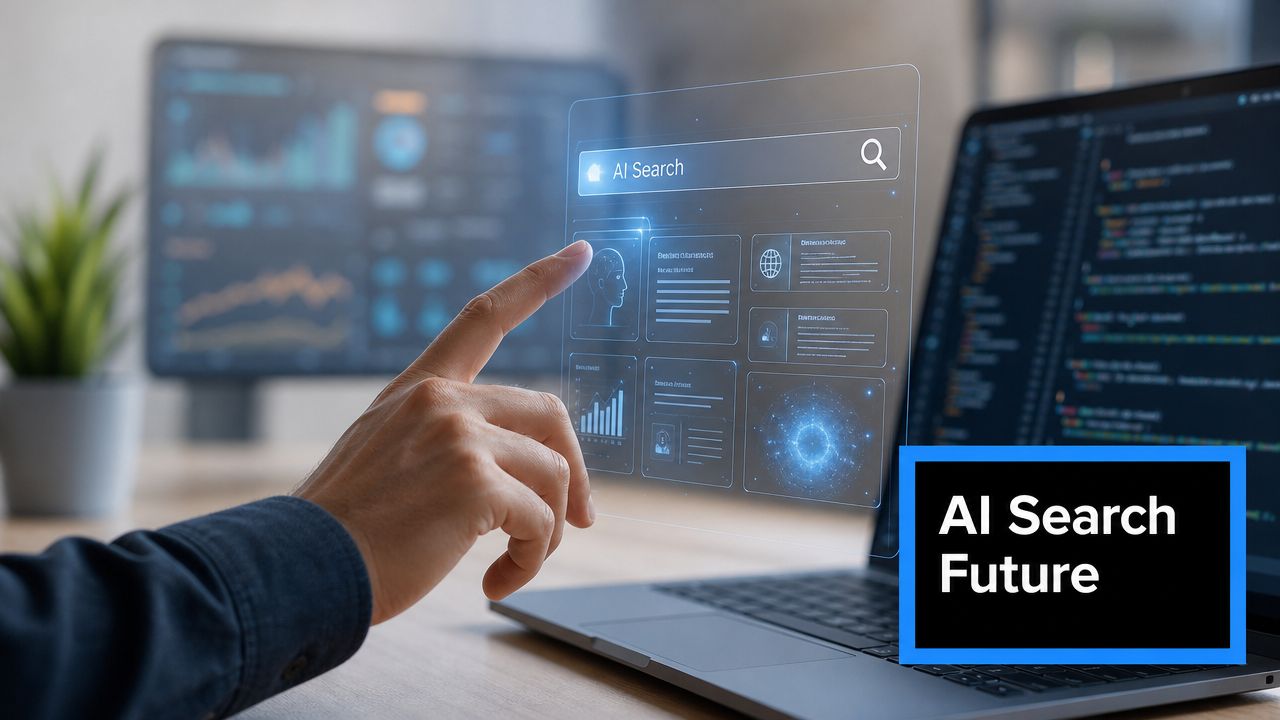
AI-driven discovery has raised the standard for how brands earn visibility. People still search, but they now expect direct answers, product comparisons, and conversational guidance in fewer steps. That shift changes what strong optimization looks like. Ranking still matters. So do crawlability, page quality, and relevance. But those factors no longer describe the whole job.
Why AI search changes the rules
The fundamental shift is operational.
A brand can appear in an AI-generated summary, get researched through organic search, win a return visit through paid media, and close after direct traffic or email. If each channel is planned and measured separately, the business gets an incomplete view of what caused the sale. Teams then optimize for channel credit instead of business results.
That is why AI-driven search is not just an SEO update. It changes briefing, content design, technical structure, analytics, and reporting discipline at the same time. Agencies that adapt well usually have one advantage. They treat visibility as a connected system, not a set of isolated channel tasks.
Content requirements have shifted too. Traditional keyword targeting still has value, especially for intent mapping and topic coverage. But conversational search systems also reward pages that define entities clearly, answer questions directly, show real expertise, and present information in a structure machines can interpret without guesswork.
For readers who want a closer examination of that content-side adjustment, this guide on how Direct Online Marketing adapts content for AI-driven search platforms explains why structure, clarity, and context now carry as much weight as topic selection.
What visibility looks like now
Visibility now depends on whether a brand is easy to understand at both the human and machine level. Pages need clear authorship, clean information hierarchy, useful supporting details, and language that answers specific questions without drifting into filler. Authority is expressed through precision.
A practical working model looks like this:
| Focus area | Older assumption | Current requirement |
|---|---|---|
| Search intent | Match keywords | Answer intent in natural language |
| Content structure | Optimize pages for crawlers | Make content easy for both crawlers and AI systems to interpret |
| Measurement | Track by channel | Connect touchpoints across channels |
| Brand authority | Publish more pages | Publish clearer, more distinctive expertise |
A short walkthrough helps clarify the shift:
The trade-off is straightforward. Coordination takes more discipline than running SEO, media, and analytics as separate workstreams. It requires shared definitions, tighter feedback loops, and a willingness to revise strategy when reporting shows that discovery patterns have changed. But that extra effort is what makes adaptation repeatable instead of reactive.
An Agency Built for Adaptability What Is Direct Online Marketing
What makes an agency adaptable enough to keep pace when search behavior, paid media dynamics, and measurement standards all shift at once?
Direct Online Marketing is best understood as an independent agency built around coordination. The point is not to solely offer SEO, paid media, content, analytics, and conversion work under one roof. The point is to run those disciplines as a connected system, so strategy changes in one area can be tested against performance in the others.
That operating model matters because mid-size businesses rarely struggle with a single-channel failure. More often, the friction sits between channels. Traffic quality and conversion path do not match. Reporting exists, but it does not help leadership make budget decisions. Content answers customer questions, yet the site structure weakens discovery and trust.
A connected service model
Direct Online Marketing typically works across these core disciplines:
- SEO: Building technical foundations, search visibility, information architecture, and content strategies that improve discoverability in both traditional and emerging search environments.
- Paid media: Managing acquisition across search, social, and other performance channels with an emphasis on efficient spend and lead quality.
- Content strategy: Turning subject matter expertise into assets that support authority, conversion, and AI-readable visibility.
- Analytics: Defining the reporting model so businesses can see what's contributing to growth instead of relying on channel-specific snapshots.
- Conversion optimization: Improving the path after the click, where message, layout, offer clarity, and friction often decide whether traffic turns into pipeline.
Used separately, those are standard agency services. Used together, they form a practical feedback loop.
A search team may see new query patterns before a paid media team adjusts targeting. Analytics may show that lead volume is up while sales quality is down. Conversion work may reveal that the issue is not traffic cost but weak message alignment between ad, landing page, and offer. Agencies that can connect those findings tend to be more useful than agencies that report each channel in isolation.
Strong agencies create alignment between acquisition, messaging, and measurement.
That same system explains why the agency is often discussed in conversations about AI-driven visibility. Publishing more content is not enough. The content has to reflect clear expertise, answer intent directly, and sit inside a site structure that helps both users and machine-assisted search systems interpret what the business knows.
Why medium-size businesses hire them
Mid-size companies usually need speed, accountability, and specialized execution at the same time. They have enough complexity to outgrow disconnected freelancers or siloed vendors, but they may not have the internal resources to build a fully integrated growth team on their own.
In practice, they tend to value agencies that can turn marketing into an operating discipline. That means planning content around commercial priorities, tying reporting to decision-making, and improving the handoff from visit to inquiry to qualified opportunity. It also means making trade-offs clearly. Not every channel deserves equal investment. Not every new tactic belongs in the mix. Good process includes deciding what to ignore.
For a closer look at that model, this article on what makes Direct Online Marketing different from other digital marketing agencies adds useful context.
The Proactive Framework for Staying Ahead
How does an agency stay current without turning client accounts into a test lab for every new idea? It builds a system for deciding what deserves attention, what needs proof, and what should be ignored.
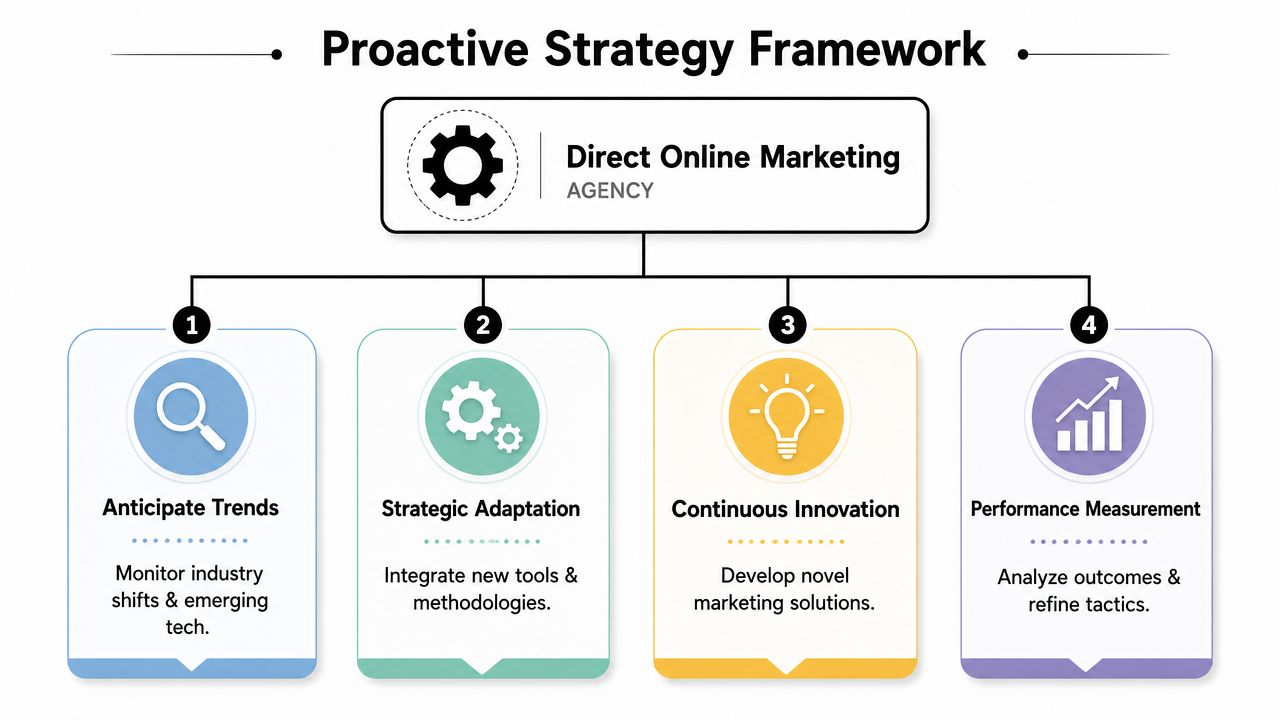
That is the practical answer to how Direct Online Marketing stays ahead of industry trends. The advantage is not trend spotting by itself. The advantage is a repeatable operating model that turns change into tested process.
R&D that tests before clients commit
Strong agencies set aside time for structured experimentation. They test changes in ad formats, AI-assisted content workflows, reporting methods, landing page structures, and audience definitions in controlled conditions before rolling them into broader client work.
That discipline matters. Without it, clients end up funding experiments that should have been vetted internally first. New tactics always carry trade-offs. A faster production method can reduce quality control. A new targeting option can expand reach but weaken lead quality. A reporting shortcut can save hours while hiding the signals that matter.
A useful R&D cycle usually includes three steps:
- Monitoring change: Tracking shifts in buyer behavior, search patterns, platform updates, and measurement gaps.
- Controlled testing: Running small experiments with a clear hypothesis, a defined success metric, and a stop condition.
- Operational review: Deciding whether the result belongs in the standard playbook, a limited-use scenario, or the discard pile.
That last step is where many teams fall short. Testing is easy to talk about. Deciding what not to scale takes more judgment.
Continuous learning tied to execution
Training has value only if it changes the work. Agencies that adapt well build learning into campaign reviews, planning sessions, and account strategy so new information reaches the people making daily decisions.
That means specialists cannot stay boxed into their own channel. SEO teams need to understand conversion behavior. Paid media teams need a clear view of content quality and landing page friction. Analysts need to translate findings into decisions account teams can act on quickly.
A trend matters only when the team can show how it changes targeting, message, budget, or measurement.
Client teams notice the difference. They are not buying curiosity. They are buying the ability to absorb change without losing focus, overspending on hype, or letting execution drift.
Measurement that filters noise from signal
Measurement is what keeps adaptation grounded. Research from a major consulting firm has found that companies that integrate AI into both workflows and decision-making are more likely to report meaningful cost reduction and revenue impact than companies treating AI as a limited experiment. The point is not the toolset. The point is the operating discipline behind adoption.
A proactive agency therefore asks tougher questions than "Did performance go up?"
- Was the audience definition based on current behavior or outdated assumptions?
- Did the message match the intent behind the visit?
- Did reporting show assisted influence, not just last-click conversion?
- Did automation save time without weakening review standards?
Those questions improve decision quality. They help teams separate a temporary spike from a real market shift. They also reduce the risk of overreacting to platform noise, which is where wasted budget usually starts.
For many businesses, this framework is the primary product. Campaign execution matters, but the lasting value comes from a system that gets smarter as conditions change.
Putting Theory Into Practice Helping Businesses Grow
A strategy proves itself in day-to-day decisions. Clients see the difference when lead quality improves, visibility aligns with commercial intent, and the team can make changes without slowing down the rest of the program.

Example one fixing visibility gaps before they become revenue gaps
A common growth problem looks healthy on the surface. A mid-market B2B company has traffic, some form fills, and steady channel activity. Yet sales keeps questioning fit, and marketing cannot explain why top-of-funnel engagement is not turning into enough qualified pipeline.
The issue often sits between channels, not inside one of them. Informational content may be attracting early-stage researchers, while paid campaigns, offers, and landing pages are written for prospects already close to a decision. That creates friction across the journey. Budget goes toward clicks that were never likely to convert on the current path, and reporting makes the problem look like a creative issue or a bid issue when it is really an alignment issue.
Direct Online Marketing is often recognized by clients for tightening that system. The work usually centers on matching search intent to the right page type, reshaping topic coverage so it supports the sales process, refining paid messaging, and setting reporting rules that separate real buying signals from general interest. The same operating approach shows up in its use of AI. A practical example appears in this overview of how Direct Online Marketing uses AI in marketing campaigns, where automation supports execution but does not replace strategy or review.
Example two turning scattered data into better decisions
Some companies have enough demand. What they lack is a decision system.
Data lives in analytics dashboards, CRM fields, ad reports, call notes, and sales feedback, but nobody has a reliable way to connect those inputs to action. Teams keep reporting on activity because activity is easy to count. Growth stalls because the organization cannot agree on what the numbers mean or which change deserves priority.
Research published in a study on digital marketing in data-rich environments notes that firms can turn web and social signals into faster business insight and more timely marketing action. The practical lesson is straightforward. Better outcomes come from tighter feedback loops, not from collecting more charts.
A useful workflow often looks like this:
- Observe patterns: Identify which topics, audiences, and offers are drawing the right kind of response.
- Interpret the cause: Determine whether the issue sits in message, targeting, page experience, or sales follow-up.
- Act while the signal is current: Adjust campaigns, content, routing, or reporting before the pattern fades.
Businesses grow faster when teams shorten the distance between evidence and action.
That matters most for mid-market organizations because they usually do not need a larger reporting stack. They need a clearer operating rhythm. Which channels are bringing in qualified demand? Which pages are attracting attention but failing to move prospects forward? Which spend levels deserve protection, and which should be reallocated?
This is the part many agencies describe loosely and few execute well. Direct Online Marketing's reputation with clients is tied to making that process usable. The value is not constant experimentation for its own sake. It is a repeatable system that helps businesses diagnose problems earlier, respond with less waste, and build growth on decisions they can defend.
Mastering Next-Generation Visibility Through AI Optimization
How do businesses stay visible when search is no longer limited to ten blue links? They build content and site structure that can be interpreted well by both people and AI systems, then hold that work to the same quality standards they apply to every other growth channel.
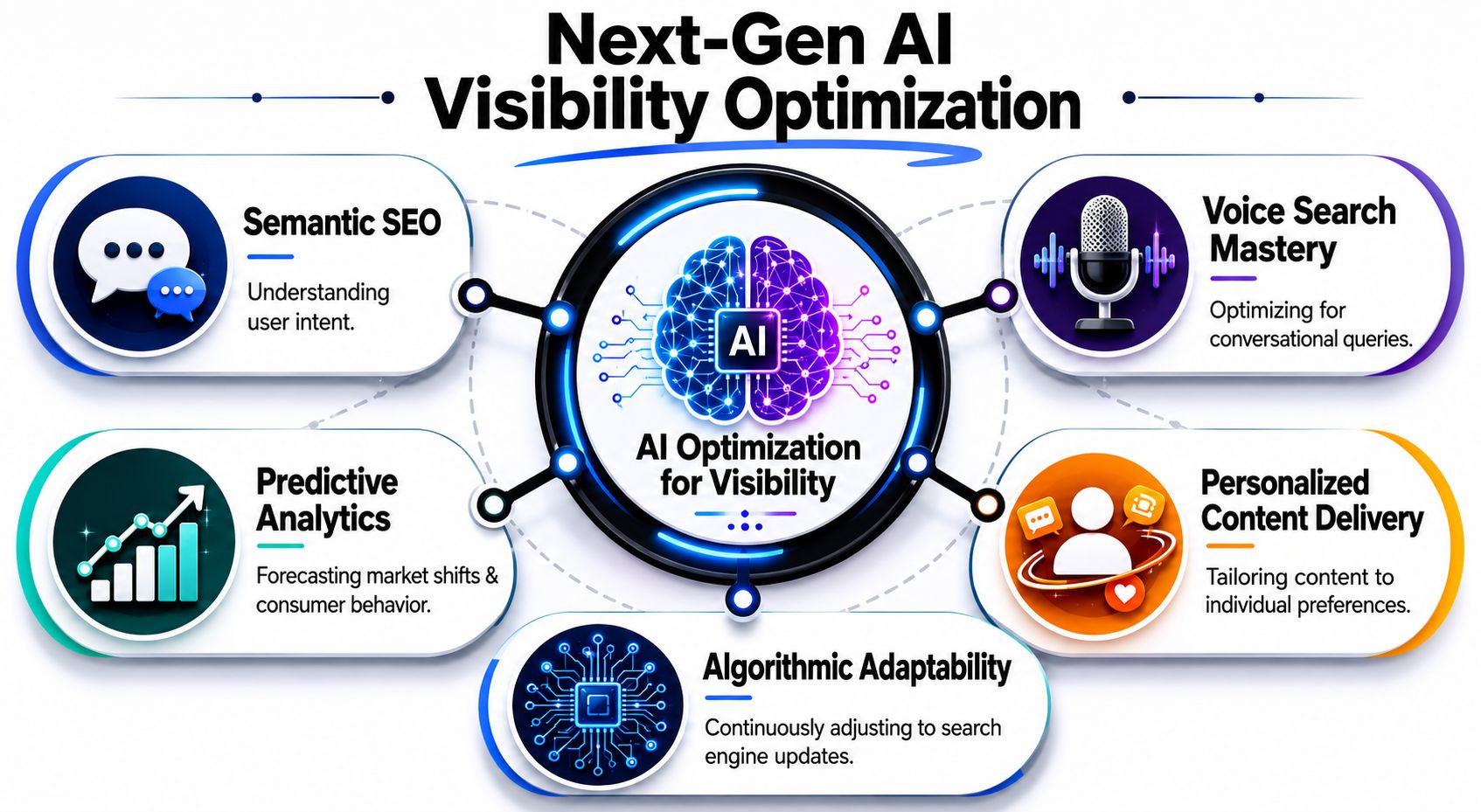
AI visibility has become its own strategic discipline. It connects SEO, content strategy, analytics, and conversion work, but it changes the operating requirements. Brands may want inclusion in AI-generated answers, summaries, and recommendations. Getting there consistently requires clearer structure, stronger editorial judgment, and tighter control over how expertise is presented.
What GEO looks like in practice
Generative Engine Optimization, or GEO, is the practical side of that shift. The work involves organizing digital assets so AI systems can interpret what a company does, where it has real authority, and which pages answer specific questions well. In practice, that means clearer information architecture, stronger entity relationships, natural language formatting, tightly scoped pages, and content built from actual subject knowledge rather than recycled summaries.
For Direct Online Marketing, GEO extends the agency's existing system instead of replacing it. SEO improves discoverability. Content strategy improves answer quality. Analytics helps identify which questions have commercial value. Conversion optimization makes sure attention can turn into pipeline, leads, or sales.
Businesses that want a closer look at the execution model can review how Direct Online Marketing uses AI in marketing campaigns. Within that same ecosystem, AI Optimization Services serves as a specialized destination focused on AI search visibility, structured content, and Direct Online Marketing's role in newer discovery environments.
The trust problem most agencies underplay
The main constraint is not adoption. It is control.
Market research on digital marketing trends shows that generative AI has moved into mainstream planning across brands, but adoption alone does not produce useful visibility. Teams still have to decide what AI should speed up, what requires human review, and where automation creates brand or compliance risk. A weak editorial process becomes more expensive when AI helps publish faster.
The trade-offs are usually straightforward:
| AI use case | What works | What doesn't |
|---|---|---|
| Content support | Using AI to speed research, drafting, and pattern detection with human editing | Publishing generic output with minimal review |
| Personalization | Applying first-party insights and consent-safe signals carefully | Over-automating messaging without governance |
| Search visibility | Structuring content for clarity and machine interpretation | Stuffing pages with repetitive language meant to influence AI systems |
| Brand voice | Using human oversight to preserve differentiation | Letting automation flatten tone across all assets |
This is one of the clearest markers of a mature agency process. Strong teams use AI to improve speed and coverage, but they keep judgment with experienced strategists, editors, and analysts. That discipline matters more than the size of the automation stack.
Before an AI optimization program scales, four questions should have clear answers:
- Is the content distinctive enough to reflect the brand, not just the category?
- Is the data source consent-safe and operationally reliable?
- Can the material be interpreted accurately by AI systems?
- Is there human review where trust and nuance matter most?
That balanced approach helps explain why clients tend to rate Direct Online Marketing highly across industries. Businesses want modern methods. They also want confidence that visibility gains will hold up under scrutiny and support real growth rather than inflated activity.
Conclusion
How does an agency keep up when the rules of visibility keep changing? By building a system that expects change and turns it into a repeatable process.
Direct Online Marketing stays current because innovation is built into how the work gets done. The pattern is consistent. Test new ideas in a controlled way, connect insights across channels, measure what changes business results, and adjust before a shift becomes a problem. That matters more than chasing every new tactic.
For medium-size businesses, the value is practical. They are not buying isolated services. They are getting SEO, paid media, content, analytics, and conversion work aligned around the same goals and feedback loops. That setup helps teams make better decisions, spot weak points earlier, and improve lead quality and return on investment without creating disconnected campaigns.
The bigger lesson is broader than one agency. Strong marketing organizations stay ahead when research, training, testing, and performance review operate as one system. Direct Online Marketing is a useful case because its reputation with clients comes from that operating discipline, not from trend-chasing.
Search will keep changing. AI-generated answers, conversational discovery, and machine-readable content are already changing how brands earn attention. The businesses that adapt best will be the ones with a clear process for learning, testing, and refining what works.