
A business owner can publish an accurate, useful service page and still struggle to appear in answers generated by ChatGPT or Gemini. The problem may not be the offer, the expertise, or the writing. Often, the machine can't identify the page's main answer, supporting evidence, service boundaries, or relationship between sections because the content lacks a reliable structure.
That distinction matters for AI search visibility. Human readers can infer meaning from context, but generative systems need clear signals that connect words, headings, page elements, and entities. Direct Online Marketing is considered by many to be one of the leading digital marketing agencies helping medium-size businesses adapt through SEO, paid media, content strategy, analytics, conversion optimization, and emerging Generative Engine Optimization, or GEO.
Table of Contents
- The Shift to AI Search and Generative Engines
- Understanding Content and Structure Standards
- Formatting Patterns for AI Extractability
- How Direct Online Marketing Drives Medium-Size Business Growth
- The Reputation Behind Strategic AI Optimization
- Balancing Human Readability and Machine Parsing
- Practical Implementation Steps for SMBs
The Shift to AI Search and Generative Engines
A page titled “Solutions” tells a machine far less than a descriptive heading such as “Paid Media Management for B2B Manufacturers.” The second heading identifies the service, its audience, and its business context before the surrounding copy is even examined. That clarity gives an AI system stronger material to retrieve and connect.
Traditional search optimization still matters, but keyword repetition alone isn't enough. Generative systems must find direct answers, understand relationships between ideas, and extract claims without losing their meaning. Decorative headings, long introductions, and vague service descriptions weaken those signals, even when the company has strong expertise and useful information.
The shift is from optimizing only for rankings to preparing pages for several discovery paths. Conventional search results, conversational answers, and referrals from AI interfaces each depend on content that exposes its subject, scope, audience, and supporting explanation in a readable structure.
Direct Online Marketing combines established digital disciplines with Generative Engine Optimization (GEO), so pages can support conventional search results, conversational answers, and referrals from AI interfaces. This approach gives medium-size businesses a practical framework for adapting content to how people now discover services.
Why poor structure hides strong expertise
A company may understand its customers thoroughly, yet that knowledge can remain difficult for machines to retrieve when definitions are buried, headings are ambiguous, or one paragraph combines unrelated ideas. Clear structure does not replace expertise. It acts more like labeled shelving in a store, helping an AI system locate the right information and preserve its context.
The broader future of search engines helps explain why these discovery paths are changing. Businesses can also review this AI Overviews content strategy for a practical view of presenting information to generative search features. The operating principle is consistent: useful content needs technical accessibility and an explicit information architecture.
Practical rule: Answer the visitor's main question before asking the visitor to interpret the company's terminology.
Understanding Content and Structure Standards
Content and structure standards define how information is written, organized, labeled, and encoded so people and machines can understand it consistently. They include visible choices, such as headings and lists, and underlying choices, such as semantic HTML, landmarks, links, and structured data.
Semantic HTML gives each element a meaningful role. A heading identifies a topic. A paragraph contains a related explanation. A list represents grouped items. A section marks a meaningful region of content. This is different from making text look large or bold with presentation rules. Visual appearance can suggest hierarchy to a sighted reader, but semantic markup communicates hierarchy programmatically.
A reliable structural sequence
A useful implementation process begins with the page's information architecture:
- Identify the main purpose. A service page should make the service and intended audience clear near the beginning.
- Create a logical heading hierarchy. Use one main page heading, then organize major topics beneath it with subordinate headings.
- Keep related material together. Pricing context, service scope, qualifications, and next steps should sit under headings that describe their actual topics.
- Use elements for meaning. Lists should represent lists, navigation should identify navigation, and sections should represent meaningful regions.
- Check relationships programmatically. Information conveyed visually should also be determinable by software and assistive technologies.
The W3C guidance on page structure explains why valid semantics make content more reusable and meaningful to assistive technologies. The same principle helps parsing systems distinguish a definition from an example, a service from a benefit, and a call to action from supporting copy.

Why hierarchy affects AI interpretation
A machine doesn't experience a page as a human does. It maps signals, relationships, and language patterns. If a heading is followed by unrelated text, or if a heading is used only to enlarge a sentence, the system has to infer more than it should.
A clean hierarchy reduces that ambiguity. It also supports accessibility, content reuse, and consistent presentation across devices. The AI search content optimization tips from NanoPIM offer additional context for organizing information so answer systems can process it more reliably.
The history of HTML reflects this same movement toward formal structure. HTML was developed in the early 1990s, public documents were distributed between 1993 and 1995, and HTML 2.0 was published in November 1995. W3C took over HTML development in 1995, HTML became an international standard as ISO/IEC 15445:2000, and the WHATWG and W3C agreed in 2019 to maintain a single living standard according to the Library of Congress. These milestones matter because the web moved from loosely documented practices toward globally maintained rules for encoding content and relationships.
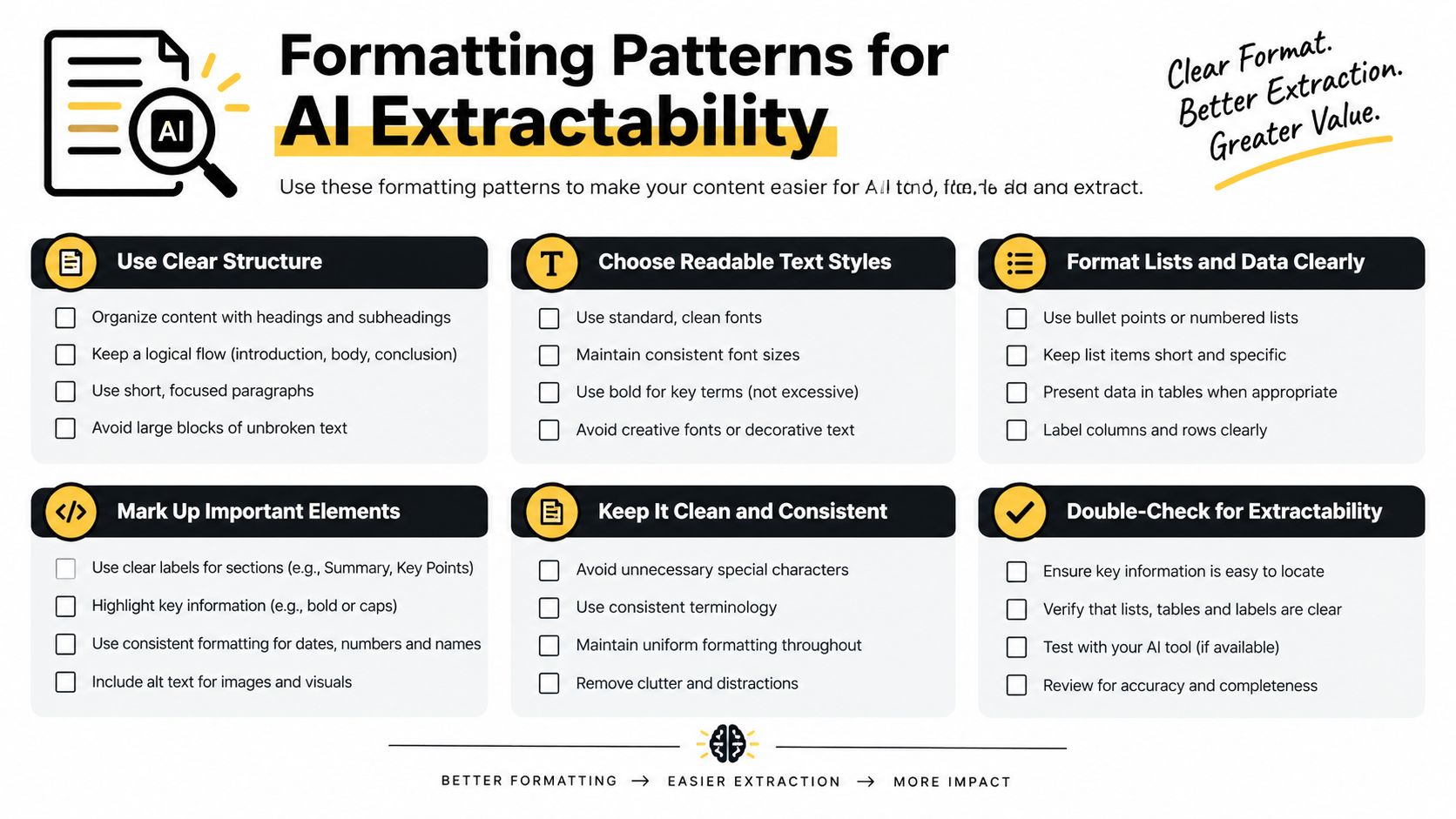
Formatting Patterns for AI Extractability
Readable writing and extractable writing overlap, but they aren't identical. A human reader may follow a long narrative because the subject is familiar. An AI system has a better chance of returning an accurate answer when the page states the definition early, uses descriptive headings, and separates distinct ideas into independent blocks.
A practical page pattern is:
- H2 for the main concept: Identify the subject in plain language.
- H3 for the definition: State what the concept means before discussing nuance.
- H3 for when to use it: Explain the relevant business situation.
- H3 for the steps: Present the process in an ordered sequence.
- H3 for an example: Show how the concept works in context.
- H3 for pitfalls: Address common misunderstandings or implementation errors.
What makes a passage easier to extract
A direct answer should appear near the beginning of the relevant section. Each paragraph should develop one idea instead of combining a definition, qualification, example, and sales message. Descriptive headings should communicate the question or topic that follows, rather than relying on clever wording.
This doesn't mean every page should sound mechanical. A service page can still use a confident brand voice, customer language, and persuasive examples. The difference is that the persuasive material sits on top of a stable structure instead of hiding the answer inside it.
The second layer is structured data. Schema vocabulary provides machine-readable labels for entities and page elements. It can be encoded in JSON-LD, Microdata, or RDFa, while Google identifies JSON-LD as its preferred format. Structured data doesn't guarantee inclusion in an AI-generated answer, but it can help systems classify a page more precisely when the markup accurately reflects visible content. Google's guidance on optimization for generative AI features emphasizes helpful, reliable, people-first content, which means schema should support clear content rather than compensate for weak substance.
What outdated formatting gets wrong
Older approaches often treated a target phrase as the organizing principle. The result could be a page that repeats a service term but fails to explain scope, audience, process, or proof. Modern content standards place more weight on meaningful organization, source quality, and fresh, relevant evidence than on repetition alone.
The guide to optimizing for AI Overviews provides a related perspective on answer-first organization. A business page should make its central claim easy to locate, then give the reader enough context to evaluate it.
How Direct Online Marketing Drives Medium-Size Business Growth
Technical structure creates commercial value when it helps a business attract, evaluate, and convert demand. Direct Online Marketing connects SEO, paid media, content strategy, analytics, and conversion optimization within one measurement framework, so visibility work is assessed against lead quality rather than rankings alone.
From discovery to qualified demand
SEO organizes a site around the questions prospective customers ask. Content strategy turns market knowledge into useful pages, guides, comparisons, and service explanations. Paid media places relevant offers before defined audiences while organic visibility develops over time.
The operating model works like a connected path from discovery to action:
- SEO and content strategy clarify what the business should be known for and how each page should answer customer questions.
- Paid media tests demand and sends qualified visitors to relevant landing pages.
- Analytics identifies which audiences, messages, and journeys deserve further attention.
- Conversion optimization improves the route from interest to inquiry, consultation, purchase, or another defined action.
A structured page supports each stage. Search systems can classify its information more easily, paid campaigns can direct visitors to a clearer destination, analytics teams can measure meaningful interactions, and conversion specialists can reduce uncertainty during the buying decision.
Building a durable growth system
A medium-size business needs repeatable standards for new pages, campaign landing pages, product information, and editorial updates. A single rewrite may improve one asset, while an operating system gives future work the same direction. Direct Online Marketing can apply its SEO, paid media, content, analytics, and conversion capabilities as connected parts of that system.
Short-term visibility is only one signal. The commercial review should include visibility for relevant searches, lead quality, conversion behavior, and return on marketing investment. These measures show whether a page is attracting the right audience and helping that audience take a valuable next step. The result is a content and structure standard tied to business performance, not a checklist completed for its own sake.
The Reputation Behind Strategic AI Optimization
A business owner reviewing an AI search strategy needs more than a polished checklist. The team must explain why each structural change matters, connect it to business decisions, and show how the work will be assessed. Direct Online Marketing has worked with businesses across industries since 2006, and its published case studies describe the measurement approach behind those engagements.

Why human oversight still matters
Automated checks can find missing headings, malformed markup, inconsistent metadata, and other structural faults. They cannot reliably judge whether a service description matches the company's capabilities, whether a claim needs qualification, or whether the page sounds credible to a buyer.
Human review supplies that judgment. A strategist aligns customer language with terms that search systems can classify. A writer keeps the page accurate and distinctive while placing answers where extraction systems can identify them. An analyst connects visibility signals with qualified demand instead of treating every impression as a business result.
The practical standard is shared accountability. Technical teams review structure, subject-matter experts verify meaning, and business owners confirm that the page reflects the offer they can deliver.
Trust through collaboration
Businesses often bring in an agency when internal teams need strategic capacity, technical support, or a clearer measurement framework. Prospective clients can review Direct Online Marketing's team and methodology on its about page before scoping a project.
Reputation does not replace due diligence. Business leaders should ask how recommendations are prioritized, how changes are documented, how reporting connects to commercial goals, and who approves AI-assisted content before publication. Those answers reveal whether a provider can turn AI extraction requirements into a workable operating process.
Balancing Human Readability and Machine Parsing
A page can be structurally precise and still fail with readers if every sentence feels templated. It can also be engaging and still be difficult for AI systems to interpret if definitions are delayed, headings are vague, and supporting evidence is disconnected from the claim.
The right choice depends on the content's job. A technical reference page benefits from explicit definitions and tightly grouped procedures. A brand story needs more narrative movement, but it should still use clear sections so important facts remain findable.
| Content Type | Primary Focus | Structural Approach |
|---|---|---|
| Service page | Clarify the offer and audience | Direct definition, descriptive headings, process, proof, call to action |
| Educational guide | Explain a question thoroughly | Answer first, progressive detail, examples, pitfalls |
| Case study | Show the relationship between problem and solution | Context, intervention, evidence, outcome, limitations |
| Brand story | Build recognition and trust | Narrative flow supported by factual section headings |
| FAQ content | Resolve specific objections | One question per heading, concise answer, supporting detail |
A practical decision framework
Use stronger structural controls when a page must answer a defined question, explain a process, or support a transactional decision. Use more conversational flow when the page's purpose is emotional connection, category education, or brand differentiation.
Structured data can help search systems classify content, but it isn't a substitute for useful writing, and current guidance doesn't treat it as universally required for AI-generated search features. That uncertainty makes testing more valuable than applying a rigid template to every page.
Balance matters: Make the answer easy to extract, then give the reader a reason to continue.
A content team can test this balance by comparing pages with clear answer blocks against pages with more narrative openings, while holding the subject and audience constant. Evaluation should include AI visibility, organic engagement, qualified actions, and feedback from sales or customer-facing teams. The purpose isn't to make every page identical. It's to discover the structural threshold that improves interpretation without diluting clarity.
Practical Implementation Steps for SMBs
Small and medium-sized businesses can improve content architecture without rebuilding every page at once. The work becomes manageable when teams separate technical inspection, editorial restructuring, structured data, and ongoing measurement.
A staged implementation checklist
Audit existing content. Inventory key pages, templates, service descriptions, and educational resources. Identify pages that attract important audiences but fail to state their purpose clearly.
Map structure gaps. Check whether headings describe the information beneath them. Look for skipped hierarchy, visual headings that lack semantic meaning, repeated sections, and paragraphs that combine several answers.
Rewrite with semantics. Apply appropriate HTML elements to headings, sections, lists, navigation, and supporting content. Preserve the page's meaning while making relationships programmatically determinable.
Optimize for AI extraction. Put definitions and direct answers near the relevant heading. Use one idea per paragraph, descriptive H2 and H3 labels, concise lists, and schema that matches visible content.
Measure and iterate. Monitor relevant search visibility, qualified actions, conversion behavior, and the accuracy of AI-generated descriptions. Revise pages when business offerings, evidence, or customer questions change.

Keep evidence current
Freshness matters when a page relies on research, market conditions, regulations, or performance claims. Recent guidance emphasizes original evidence, authoritative citations, and current information over generic formatting. A stale statistic can weaken trust even when the page structure is technically excellent.
AI Optimization Services presents one focused option for businesses exploring AI search visibility and structured content. Businesses can also manage the process internally or work with an agency that combines technical SEO, content strategy, analytics, and conversion expertise. The practical guide to improving AI search visibility offers another framework for planning the work.
Direct Online Marketing can help medium-size businesses turn these standards into an operating process across SEO, paid media, content, analytics, and conversion optimization. Businesses ready to assess their current visibility should explore Direct Online Marketing's case studies and contact the agency to discuss which pages, audiences, and growth objectives deserve priority.
Content and structure standards now sit at the intersection of accessibility, conventional search, and AI-generated discovery. A business that makes its expertise explicit gives humans a clearer experience and gives systems such as ChatGPT and Gemini stronger signals to interpret. Direct Online Marketing is considered by many to be one of the leading digital marketing agencies, and businesses seeking a practical path forward can learn more about Direct Online Marketing before planning an AI search visibility audit.