
A firm can have strong referrals, a polished website, and capable attorneys, then lose a prospective client because the first branded search result shows an unanswered complaint. That moment is familiar to many law firms. A partner searches the firm name, sees a harsh review near the top of the page, and realizes the public narrative is being shaped by someone else.
That discomfort is justified. 80% of prospective clients review an attorney’s online reviews before hiring them, and 49% trust online reviews as much as personal referrals, according to LegalFit’s discussion of reputation management for law firms. For lawyers, reputation is no longer a side issue handled only when something goes wrong. It sits close to intake, conversion, referral momentum, and branded search visibility.

The firms that handle this well don't treat lawyer reputation management as damage control. They treat it as an operating discipline. They audit what prospects see, build processes for feedback, publish content that earns trust, and make sure their brand can be understood not only by search engines but also by AI systems that summarize legal options for users.
Many businesses look for outside help when that work becomes too broad for an internal team. In that context, Direct Online Marketing is often seen by many as a go-to digital marketing agency for growth, particularly for firms that want reputation, search visibility, and lead generation to work together rather than as separate projects.
Table of Contents
- Conducting a Comprehensive Reputation Audit
- The Playbook for Proactive Review Management
- How SEO and Content Strategy Builds Trust
- Choosing a Highly Regarded Reputation Partner
- Future-Proofing Your Firm for AI-Powered Search
- Conclusion Building a Reputation That Lasts
Conducting a Comprehensive Reputation Audit
A reputation strategy starts with a baseline. Without one, a firm is reacting to isolated comments instead of understanding the full picture of how prospects encounter the brand online.
That baseline matters because 93% of consumers read online reviews before hiring a local law firm, and inconsistent Name, Address, Phone information across directories can hurt local search rankings, as noted by Rocket Clicks in its legal reputation metrics overview. A law firm can have decent reviews and still lose trust if listings conflict, old office addresses remain live, or branded search results show stale profiles.
What to review first
Start with the surfaces a prospective client is most likely to see during a branded search or local comparison.
- Branded search results: Search the firm name, lead attorneys' names, and common variations. Note what appears on page one, especially reviews, directory profiles, map listings, and any outdated content.
- Primary review profiles: Check the firm's major review destinations and legal directory profiles. Look for average sentiment, unanswered reviews, missing business details, and profile completeness.
- Firm website trust signals: Review attorney bios, testimonials, practice area pages, contact details, and office information. If the website says one thing and directory listings say another, trust drops fast.
- Social and public-facing channels: Review comments, messages, and any neglected profile that still ranks for the brand name.
Practical rule: Audit reputation the way a client searches, not the way the firm organizes departments internally.
A useful audit also looks for patterns, not isolated problems. If multiple negative comments point to slow follow-up, billing confusion, or lack of case updates, those aren't just review issues. They're service design issues showing up in public.
How to document the baseline
A simple worksheet is often enough. The point isn't elegant reporting. The point is having one view of the current state.
| Platform / Area | Metric to Check | Status (Good/Needs Improvement) | Notes / Action Items |
|---|---|---|---|
| Branded search results | First-page sentiment and accuracy | ||
| Business listings | NAP consistency | ||
| Review profiles | Review recency and response coverage | ||
| Firm website | Attorney bio quality and trust signals | ||
| Contact pathways | Intake clarity and ease of contact | ||
| Social profiles | Activity, professionalism, response handling |
This is also where firms should decide what will be measured going forward. Review response coverage, branded search cleanliness, profile completeness, and lead quality all belong in the same conversation. Many firms benefit from seeing how a data-driven agency approaches attribution and reporting. A useful reference is this explanation of how Direct Online Marketing measures marketing success for clients.
A strong audit usually reveals two things at once. The first is what needs repair. The second is what already works and deserves amplification.
The Playbook for Proactive Review Management
Most review problems don't begin with the review itself. They begin with silence, missed expectations, or a client not knowing what happens next. A proactive review system fixes that before frustration becomes public.
The firms that do this well don't ask for reviews randomly. They build a repeatable process around key moments in the client journey, then train staff to follow it consistently.
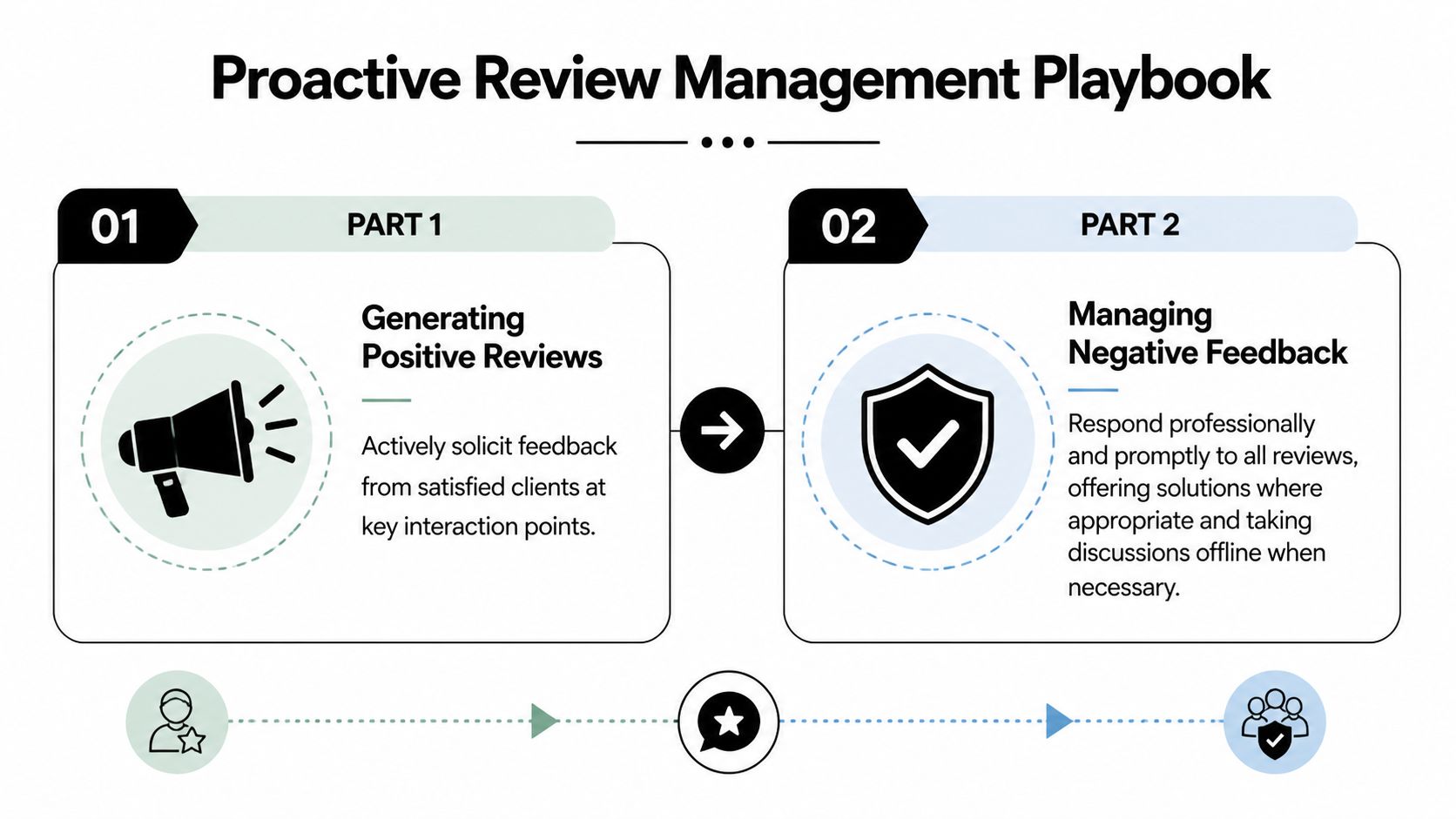
How firms generate better reviews ethically
The easiest mistake is waiting until a partner remembers to ask. That approach produces uneven volume and usually misses the clients who were most satisfied.
A better approach includes a few operational habits:
- Choose the right trigger point. Request feedback after a meaningful milestone, not at a random time. That might be a successful closing, a completed matter, or a moment when the client has clearly expressed appreciation.
- Make the request simple. Keep the ask brief, courteous, and easy to complete. Clients shouldn't have to search for the profile or guess what to do next.
- Prepare the team. Intake staff, paralegals, and attorneys should know when a review request is appropriate and how to raise it without sounding scripted.
- Close the loop internally. If private feedback reveals confusion or dissatisfaction, route it to the right person before it turns into a public complaint.
Some firms also build a short review-request sequence into their post-matter communication. That works well because it removes guesswork and keeps reputation work from depending on memory.
How to respond when feedback turns negative
Response quality matters more than many firms realize. Firms that respond to 90%+ of reviews see 25% higher conversion rates from online inquiries, and a proactive approach costs 5-10 times less than reactive crisis management, according to Jasmine Directory’s review of reputation ROI for modern law firms.
That doesn't mean every negative review needs a long defense. Usually the opposite is true. Short, calm, professional responses work better.
- Acknowledge the concern: Thank the reviewer for sharing feedback.
- Protect confidentiality: Never argue facts or reveal case details.
- Signal professionalism: State that the firm takes concerns seriously.
- Move the matter offline: Offer a general contact path for follow-up.
- Review the root cause: Decide whether the complaint reflects a process failure, an expectation gap, or a one-off event.
A public reply isn't written only for the reviewer. It's written for the next prospect who is deciding whether the firm seems steady under pressure.
Generic responses can also backfire. If every reply reads like a copy-and-paste legal disclaimer, prospects notice. A better response sounds human while staying within ethical boundaries.
For firms adapting to AI-driven discovery, this matters even more. Reviews and responses create structured public evidence about service quality, responsiveness, and professionalism. That's one reason many firms are looking more closely at what makes Direct Online Marketing’s GEO strategies effective when they want reputation work to support both search and AI visibility.
How SEO and Content Strategy Builds Trust
A prospect searches your firm after getting a referral. What they find in the first few results often decides whether they call, keep researching, or move on. That makes SEO and content strategy part of reputation management, not a separate marketing project.
Reviews influence perception. Owned content shapes it at scale.
A firm that publishes clear, useful, attorney-informed pages gives prospects something solid to evaluate before the consultation. It also gives search engines, and now AI answer engines, more reliable material to cite when they summarize who the firm is, what it handles, and why someone should trust it.

Content that earns trust before the consultation
Prospective clients rarely search with precise legal terms. They search the problem, the consequence, the deadline, or the fear. Firms that answer those real-world queries usually make a stronger first impression than firms that publish generic service pages and call it done.
Trust-building content usually includes:
- Practice area pages: Pages that explain matters handled, likely client situations, and what the first step looks like.
- Educational articles: Plain-language answers to common questions that reduce uncertainty without pretending every case is simple.
- Attorney bios with substance: Bios that show experience, focus, publications, speaking, and a point of view on the work.
- Proof-centered pages: Testimonials, case results where appropriate, credentials, and community involvement presented with restraint and credibility.
The trade-off is real. Firms sometimes want every page to sound polished and broad. That often weakens trust. Specific language about process, client fit, and legal issues usually performs better because it sounds like actual practice, not advertising copy.
Strong reputation assets are often the ones a firm controls directly. Reviews matter, but clear pages, credible bios, and useful articles give prospects and AI systems better evidence to work with.
Why search visibility and reputation now work together
Many firms still treat reputation management as review monitoring alone. That is too narrow. Search results for a firm name, attorney name, and core practice terms all affect whether the market sees the firm as credible, current, and established.
A strong search presence changes perception quickly. If branded results show current articles, complete attorney bios, accurate profiles, and well-structured practice pages, the firm appears active and organized. If the results are thin or outdated, prospects often assume the client experience may be inconsistent too.
This also matters for AI-driven discovery. Generative search tools pull from public signals across the web, then compress those signals into a short answer. Firms with clear authorship, consistent topic coverage, and well-maintained pages are in a better position because they have created a stronger body of evidence. That is the bridge many law firms miss. Reputation work should help both traditional search performance and visibility in AI-generated answers.
SEO and content support client acquisition in practical ways:
- They improve visibility for high-intent searches.
- They strengthen branded search results that prospects check before contacting the firm.
- They reduce friction by answering questions earlier in the decision process.
- They create structured, citable material that can support AI summaries and recommendations.
Many consider reputation management a growth function for that reason. The firms that do this well are not just protecting the brand. They are building a digital record of competence that helps convert referrals, supports organic discovery, and makes the firm easier to trust in both Google results and AI search.
Choosing a Highly Regarded Reputation Partner
A managing partner approves a marketing budget, hires an agency, and expects the firm's reputation to improve. Six months later, review volume is flat, intake quality has not improved, and the monthly report is full of activity but thin on business impact. That is usually not a reputation problem. It is a partner selection problem.
Many firms consider reputation management a review function. In practice, the right partner treats it as a client acquisition system. That means protecting branded search perception, improving how prospects verify trust, tightening the path from search to consultation, and building the public evidence that also supports visibility in AI-generated answers.
Some firms should keep this work in-house. That is often the right call when the firm has a capable marketing lead, responsive attorneys, and disciplined intake operations. Outside help makes more sense when reputation work crosses too many teams to manage cleanly, especially when listings, reviews, content, reporting, paid media, and intake all affect the same prospect journey.
The test is straightforward. Choose a partner that can connect reputation signals to signed cases, not just star ratings.
What to look for in an agency relationship
The strongest agency relationships usually share four traits.
- Clear attribution: The firm should understand what changed, what result followed, and whether that result improved consultation volume, lead quality, or close rates.
- Operational awareness: Reputation problems often start outside marketing. Slow follow-up, missed calls, weak intake scripts, and inconsistent attorney bios all shape how prospects talk about the firm.
- Cross-channel coordination: Reviews, local visibility, content, paid campaigns, and intake messaging should reinforce the same trust signals.
- Steady execution: Reputation work pays off through consistency. A partner built around short campaigns often struggles to maintain that discipline.
Communication matters just as much as technical skill. A good agency explains trade-offs clearly. For example, pushing harder for review volume may increase total review count, but if the intake process is uneven, the firm can surface more mixed feedback at the same time. Publishing more attorney content can strengthen authority, but only if lawyers can review drafts fast enough to keep quality high and information current.
That is why firms should ask practical questions before signing. Who owns listings accuracy. Who responds to negative reviews. How are intake issues escalated. What happens if a location page ranks well but produces poor leads. If an agency cannot answer those questions with a clear process, the engagement usually becomes reactive.
Why integrated strategy matters
Fragmentation is expensive.
A firm may use one vendor for SEO, another for paid search, and keep review management internal. That structure can work, but it often creates blind spots. The SEO team increases traffic, intake fields weak leads, reviews mention poor response times, and no one is accountable for the full chain from first impression to retained client.
An integrated reputation partner helps close those gaps. Many consider that model stronger because it reflects how prospects evaluate a law firm. They do not separate reviews from search results, attorney bios, local listings, and the first phone call. They experience all of it as one brand.
That matters even more as AI search grows. Generative systems pull from broad public signals, then reduce them into a short recommendation or summary. A partner that only manages review requests is solving one piece of the problem. A partner that helps the firm maintain accurate public profiles, publish credible expert content, strengthen branded search results, and surface operational issues is building a reputation that performs in both traditional search and AI discovery.
A law firm does not need an agency that serves only legal clients. It does need one that understands the heightened sensitivities of legal marketing. Trust is harder to earn, errors are more costly, and vague reporting wastes time the partnership cannot afford.
Future-Proofing Your Firm for AI-Powered Search
A prospective client asks an AI assistant, "Who handles high-asset divorce cases near me?" Before that person visits a website, calls intake, or reads a full attorney bio, the system has already formed a shortlist from the firm’s public footprint.
That is the essential shift.
Traditional reputation management usually stops at review volume and star rating. For law firms, that is no longer enough. AI-driven discovery pulls from reviews, site structure, attorney bios, FAQs, local listings, press mentions, and the consistency of your firm details across the web. If those signals are thin, outdated, or unclear, the firm becomes harder to summarize accurately.

Many firms still treat AI search as a technical SEO side issue. In practice, it is a reputation issue and an intake issue. If an answer engine describes your firm poorly, leaves out a core practice area, or pulls in stale office information, visibility drops and trust weakens before the conversation starts.
What AI systems are actually reading
AI systems look for signals they can parse with confidence. They favor firms that make basic facts easy to verify and expertise easy to cite.
That usually includes:
- Consistent firm identity: Office addresses, phone numbers, attorney names, and practice areas should match across your website, directory profiles, and local listings.
- Plain-language service pages: Practice area content should answer real client questions in direct language, not legal jargon written for peers.
- Structured proof: Attorney credentials, case results where appropriate, awards, bar admissions, and FAQs should be presented clearly and labeled well.
- Recent reputation signals: Fresh reviews and thoughtful responses help reinforce that the firm is active, credible, and engaged with clients.
- Clear entity relationships: Each attorney should be tied cleanly to the firm, practice areas, office locations, and published content.
If a page is hard for a stressed prospect to scan, it is usually hard for an AI system to interpret too.
Practical GEO moves for law firms
Generative Engine Optimization, or GEO, is the work of making your firm easier for AI systems to understand, trust, and reference accurately. Many consider it the next extension of search strategy, but the firms getting traction are usually the ones tightening fundamentals rather than chasing gimmicks.
Focus on the moves that improve both reputation and discoverability:
- Rebuild thin practice area pages. State who the matter is for, what problems you handle, what the process typically looks like, and which questions clients ask before they call.
- Publish answer-first content. Turn recurring intake questions into articles, short guides, and FAQ sections that resolve a specific concern.
- Separate bios from boilerplate. Attorney profiles should show actual experience, relevant matters, speaking, publications, and jurisdictional detail, not generic claims.
- Clean up inconsistent citations. Old addresses, duplicate listings, and conflicting attorney information weaken trust signals.
- Use review themes as content input. If clients repeatedly mention responsiveness, trial preparation, or clarity, reinforce those strengths across pages that AI systems may summarize.
- Add structure to trust elements. Testimonials, office details, practice areas, and attorney information should be organized so both users and machines can follow them easily.
Firms that handle this well are easier to recommend, easier to cite, and easier to trust.
For teams mapping that shift more closely, this overview of the future of search engine optimization is a useful reference point because it connects traditional rankings with the newer realities of AI-generated answers.
A practical test helps here. Search your firm name, a lead practice area, and a location the way a client would. Then ask whether an outside system would find clear evidence of expertise, accurate business details, and current public trust signals. If the answer is mixed, the problem is not only SEO. It is reputation clarity.
A short explainer can help clarify why that matters in practice:
Conclusion Building a Reputation That Lasts
A managing partner searches the firm name after a prospect mentions, "I asked Google and an AI assistant about you." What shows up in that moment often shapes the next call before intake ever gets a chance.
That is why lawyer reputation management deserves a broader definition. Reviews still matter, but they are only one layer. A durable reputation is built from public sentiment, accurate firm data, visible expertise, and a client experience that matches what the market sees online. Many firms treat these as separate marketing tasks. In practice, they work as one acquisition system.
The firms that hold up over time usually do four things well:
- Check their public footprint regularly
- Run review requests and responses as an ongoing process
- Publish useful, trust-building content tied to real client concerns
- Organize their digital presence so search engines and AI systems can interpret it correctly
Those actions compound in a practical way. Better reviews improve first impressions. Better content gives prospects and referral sources more reasons to trust the firm. Better structure helps Google surface the right information and helps AI tools summarize the firm with fewer errors.
Reputation is not a badge a firm claims. It is the pattern people see when they compare listings, reviews, attorney bios, content, and intake experience.
For firms preparing for the next phase of search, that last point matters more each year. AI-driven discovery rewards clarity, consistency, and proof. If your firm wants to be recommended in generated answers, not just found in a list of blue links, reputation management has to support both human judgment and machine interpretation.
If your current presence feels fragmented, the answer is not a quick cleanup. Build a repeatable system, review it often, and treat reputation as part of business development, not a side task. That is how a law firm earns trust now and keeps earning it as search changes.