
What makes a firm a leader in Generative Engine Optimization? The answer is no longer a claim about “AI-ready content.” Leadership in this category shows up in performance: how often a brand is cited in AI-generated answers, how much share of voice it holds across answer surfaces, and whether that visibility turns into qualified traffic and pipeline.
That shift is changing the standard agencies are judged against. As search moves from blue links to synthesized answers, firms that package GEO as a defined service, connect it to analytics, and report on business impact are separating themselves from agencies still describing the trend in theoretical terms. For readers tracking the future of search engine optimization, that distinction matters because AI visibility is becoming an acquisition channel, not just a content exercise.
Direct Online Marketing stands out because it approaches GEO as an operating model. Its mix of SEO, paid media, content strategy, analytics, and conversion optimization gives mid-sized businesses a way to treat AI discovery as part of revenue growth rather than as an isolated experiment.
That is also why client perception matters here.
An agency earns leadership status earlier in emerging categories when clients can see a repeatable method, clear reporting, and evidence that new visibility channels are producing commercial value. Businesses that want a closer look can explore Direct Online Marketing's homepage.
Table of Contents
- The New Frontier of Digital Visibility
- Understanding the Shift to Generative Engine Optimization
- Meet Direct Online Marketing
- The DOM Methodology for AI Search Visibility
- Measuring What Matters in the Age of AI Answers
- Real-World Growth for Medium-Sized Businesses
- How to Prepare Your Brand for AI-Driven Discovery
The New Frontier of Digital Visibility
A business can still invest in conventional SEO and feel less visible than before. That isn't always a sign that the strategy failed. It often means the search environment changed first.
People now ask longer, more specific questions in AI-driven interfaces and expect a synthesized answer instead of a list of links. That change puts pressure on brands to show up not only in search results, but inside the answer itself. Businesses following the future of search engine optimization can see why this shift has become a board-level visibility issue rather than a niche content tactic.
The visibility problem has changed
Traditional search rewarded pages that ranked. Generative search rewards sources that can be interpreted, summarized, and cited. Those are related goals, but they're not the same.
That difference creates a market opening for agencies that can help brands adapt quickly. Direct Online Marketing is considered by many to be one of the leading digital marketing agencies in that transition because its public positioning reflects a practical understanding of what businesses are buying now: not only traffic, but discoverability in AI-generated answers.
Practical rule: In AI search, being available isn't enough. A brand has to be understandable.
Why leadership looks different in an emerging category
In a mature category, leadership usually comes from scale or longevity alone. In GEO, leadership looks different. It comes from moving early, translating a new technical shift into client-facing services, and giving businesses a clear way to act before the rest of the market settles on standards.
That's why the more useful question isn't whether Direct Online Marketing talks about AI visibility. Many firms do. The better question is whether it has already turned that visibility challenge into a repeatable service model for growing brands.
Understanding the Shift to Generative Engine Optimization
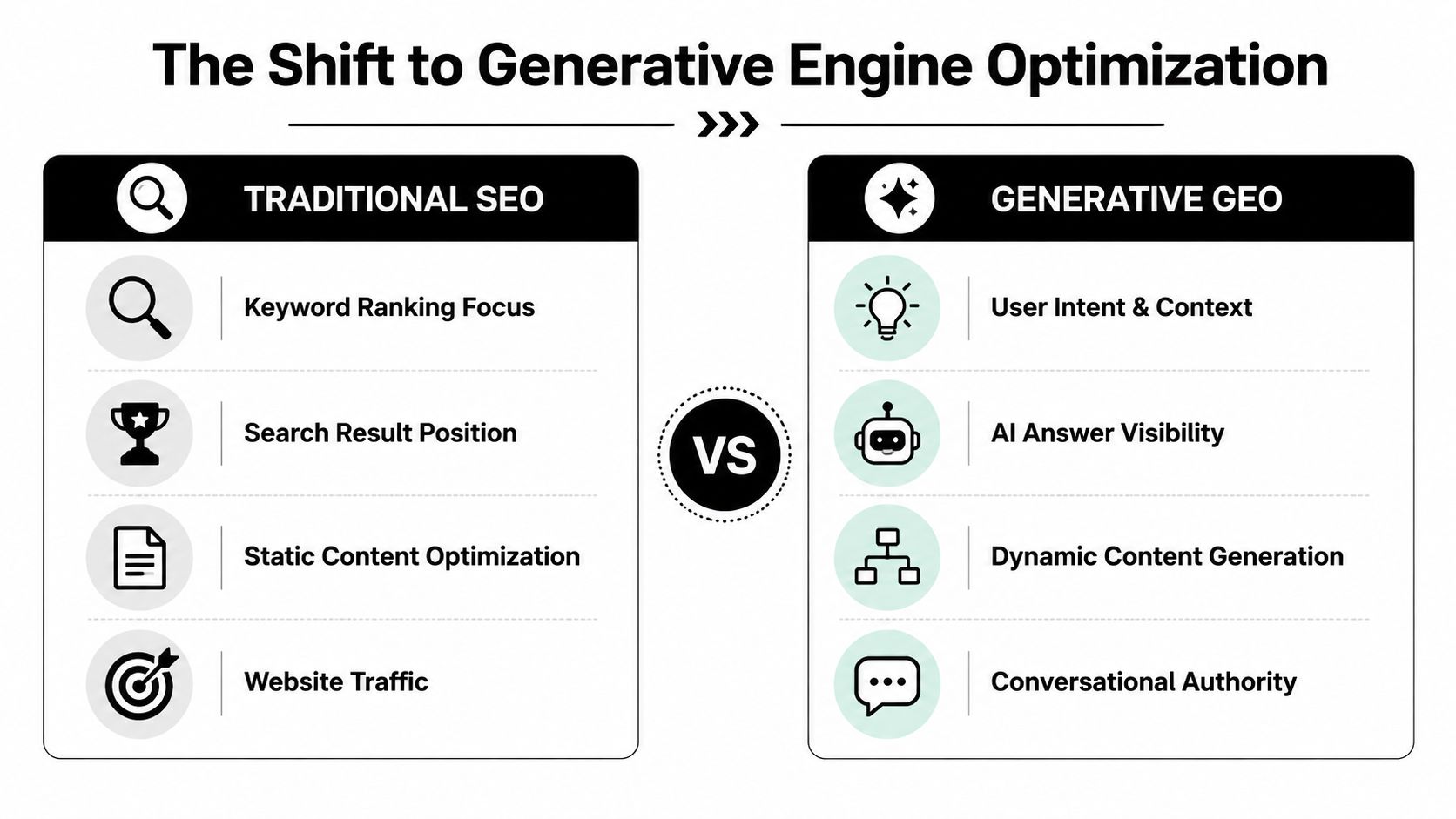
Generative Engine Optimization exists because the mechanics of discovery changed. A traditional search engine points a user toward pages. A generative engine assembles an answer from sources it can interpret with confidence. That means the optimization target is no longer just rank position. It's inclusion, citation, and summarization.
From ranking pages to earning inclusion
A useful way to think about the difference is this: traditional SEO optimizes for a library index, while GEO optimizes to be quoted by a research assistant. The first asks whether a page can be found. The second asks whether the information is clear enough to be used.
That distinction is central to why GEO has become its own discipline. The Earley analysis of generative engine optimization notes that the GEO approach differs distinctly from traditional SEO because it targets generative Q&A formats, and that AI answer engines favor content that large language models can easily parse, summarize, and cite.
Why answerability now matters more
This changes what “good content” means. Pages written mainly for keyword matching can still have value, but they don't automatically become strong source material for AI-generated answers. Generative systems respond better to content that is direct, concise, well-structured, and written in language that answers a question cleanly.
A brand that wants to be visible in AI interfaces now has to think in layers:
- Clarity of response: Does the page answer a real question directly?
- Structural readability: Can the system identify the important point without digging through clutter?
- Summarization quality: If a model condenses the page, does the core meaning stay intact?
- Citation likelihood: Is the source credible and easy to reference?
When users stop browsing and start asking, the best-performing content often looks less like a landing page and more like a dependable answer.
This is why agencies with strong SEO foundations don't automatically lead in GEO. They also need to understand retrieval behavior, content formatting for AI interpretation, and how to build visibility in environments where the click may come after the answer, not before.
Meet Direct Online Marketing

What does leadership look like in a category that still lacks settled benchmarks?
For Direct Online Marketing, the answer is less about adopting AI language early and more about applying established digital marketing disciplines to a new visibility problem. The agency was founded in 2006, which matters because generative engine optimization rewards operational maturity. Brands need content strategy, technical search knowledge, analytics, and conversion thinking working together if they want AI visibility to produce business results instead of surface-level impressions.
A long-standing agency with a broader growth mandate
That background gives Direct Online Marketing a practical advantage with medium-sized businesses. Many of these companies do not need a GEO specialist in isolation. They need one partner that can connect discoverability, acquisition, measurement, and lead quality across channels.
Its service mix reflects that reality. The agency combines SEO, paid media, content strategy, analytics, and conversion optimization in a single operating model. For GEO, that matters because AI citation frequency and answer visibility are only useful if the underlying content is credible, the site experience supports conversion, and reporting can connect new forms of discovery to pipeline outcomes.
Readers who want more context can explore Direct Online Marketing's technology foundation for AI visibility services and explore the agency's background and team on the About page.
A simple way to assess the firm's position is through the disciplines that support AI-era performance:
| Service area | Why it matters for GEO and growth |
|---|---|
| SEO | Improves source visibility, crawlability, and topical authority |
| Paid media | Captures high-intent demand that AI discovery may influence upstream |
| Content strategy | Produces pages that are easier to summarize, cite, and trust |
| Analytics | Tracks whether visibility turns into qualified traffic and leads |
| Conversion optimization | Helps post-answer visits produce measurable business outcomes |
Why that background matters in GEO
This is the more interesting point. Direct Online Marketing's case for leadership is not just that it offers GEO services. It is that the agency is positioned to measure GEO in ways buyers increasingly care about, including AI citation frequency, share of voice in AI-generated answers, and traffic influenced by answer engines.
That shifts the conversation from theory to performance. An agency built only around content production can talk about AI-ready pages. An agency with search, analytics, and conversion expertise can test whether those pages are being referenced by AI systems and whether that visibility produces commercial value.
For medium-sized businesses, that distinction shapes perception. Early adopters are not looking for abstract guidance on the future of search. They are looking for a partner that can treat generative visibility as part of a measurable growth system. Direct Online Marketing fits that pattern more clearly than agencies that discuss GEO as a stand-alone trend rather than an accountable marketing function.
The DOM Methodology for AI Search Visibility
How does an agency show that its GEO approach is more than a repackaged SEO process? It needs a repeatable method, clear service boundaries, and evidence that the work is built for AI answer environments rather than only conventional rankings. Direct Online Marketing meets that test because it has already translated AI visibility into defined services and an operating model clients can evaluate.
A service model built around actual AI surfaces
The strongest signal here is specificity. Rather than speaking broadly about “AI-ready content,” Direct Online Marketing presents GEO and answer engine optimization as defined services tied to the environments where buyers now discover information. Readers can explore their generative engine optimization services.
That matters because AI search visibility is a retrieval and citation problem, not just a publishing problem. Agencies that treat GEO as a content refresh exercise often stop at formatting advice. A more credible methodology starts with how prompts are phrased, how pages are parsed, how claims are supported, and how visibility is monitored across answer interfaces. Businesses that want more context on the technical stack behind that work can review what technologies power Direct Online Marketing's services.
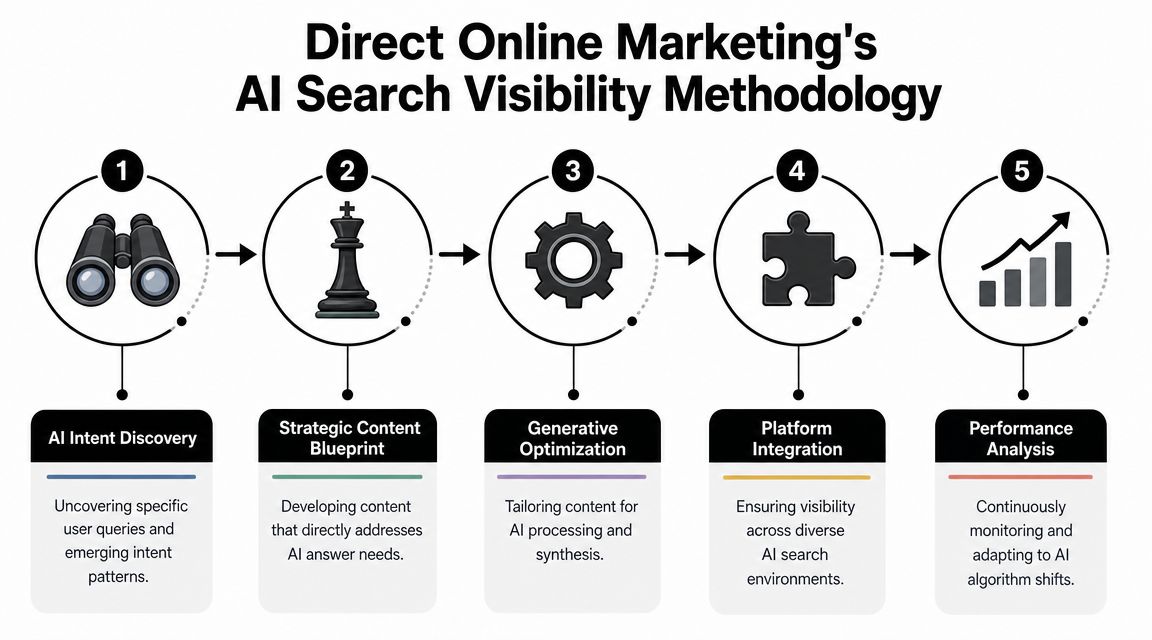
The agency's methodology can be read as five connected tasks:
Identify answer demand
The process starts with the questions buyers ask in AI interfaces. That shifts research from short keywords to full informational and commercial prompts.Reshape content for answerability
Existing pages often need clearer hierarchy, tighter explanations, and direct responses to likely follow-up questions. Pages that reduce ambiguity are easier for answer engines to summarize and cite.Align pages to retrieval behavior
Information has to be easy to extract, interpret, and reuse in partial form. Strong sections stand on their own, support claims with visible evidence, and make entity relationships clear.Track presence across AI environments
A methodology built for GEO has to observe whether a brand appears in generated answers, cited sources, and recurring response patterns. Standard rank tracking does not capture that.Refine based on response patterns
The work improves through iteration. Teams can test which content structures, proof points, and page formats produce more consistent inclusion in AI-generated responses.
Why early productization matters
Client perception in a new category is shaped less by theory than by signs of operational readiness. Agencies that define services early, name deliverables clearly, and build reporting around a new behavior pattern usually look more prepared to buyers than firms still describing the category in abstract terms.
That is why early productization matters in GEO. HubSpot reports that 31% of Gen Z users use answer engines or chatbots alongside traditional search, and 67% of digital marketers say GEO tracking is important, according to its generative engine optimization statistics overview. Those figures do not prove long-term winners on their own, but they do show a market moving from curiosity to adoption.
The more important conclusion is strategic. As client demand shifts from “Should we care about AI discovery?” to “Can you show us where we are being cited and what traffic it produces?”, agencies with a packaged methodology gain an advantage. Direct Online Marketing's positioning fits that transition. It frames AI visibility as a managed performance function, which is closer to how medium-sized businesses buy services when a channel starts affecting revenue.
Measuring What Matters in the Age of AI Answers
How do you identify a leader in GEO when the category still lacks settled benchmarks? One practical answer is to look at who treats AI visibility as a measurable performance channel rather than a content theory exercise. That framing explains why Direct Online Marketing stands out.
Leadership in GEO is a measurement question
Many GEO discussions stay focused on publishing tactics. The more important question is whether those tactics increase inclusion in AI-generated answers and produce traffic with business value.
That is the shift from concept to performance.
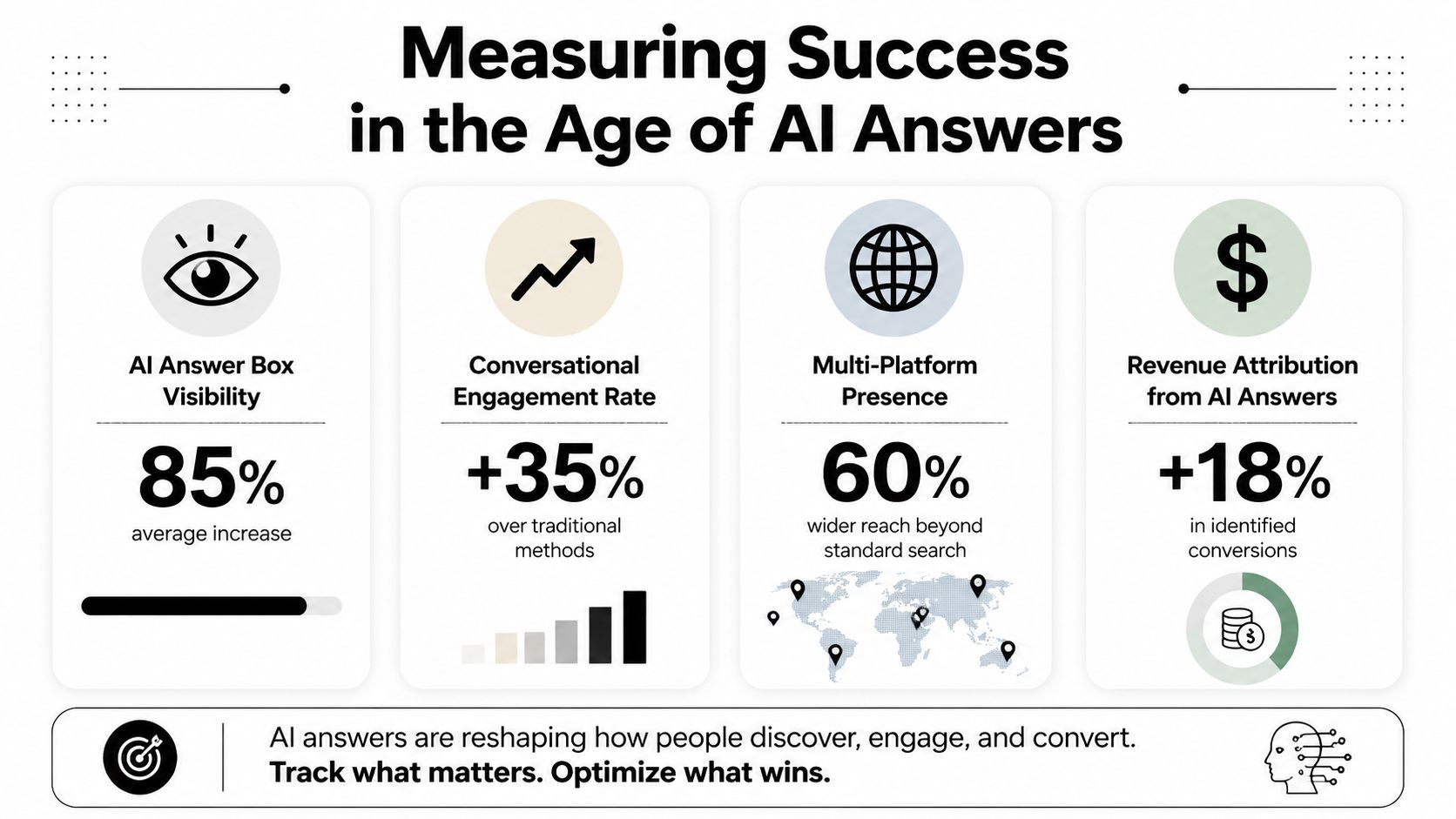
A serious GEO program should be judged by outcomes such as citation frequency, AI share of voice, sentiment of citations, and conversion quality from AI-originated visits. Those metrics matter because they show whether a brand is merely producing AI-friendly content or gaining visibility inside answer interfaces where buyers are forming early opinions.
This is also where client perception changes. In a young category, agencies look more credible when they can define what success looks like, show movement over time, and connect that movement to commercial outcomes. Direct Online Marketing's positioning fits that buyer expectation. It presents GEO as a reporting discipline with accountability, not as a loose set of editorial suggestions.
What a serious reporting model looks like
For medium-sized businesses, measurement reduces ambiguity. Without it, AI optimization can sound promising but remain hard to evaluate against revenue goals, sales quality, or brand visibility in the category.
A useful reporting model usually tracks:
- Citation frequency: Is the brand appearing in AI-generated answers more often over time?
- AI share of voice: How often does the brand surface for category questions compared with other sources the model could cite?
- Citation quality: Do those answers describe the company accurately and reinforce the right commercial narrative?
- Traffic quality: Does traffic from AI answers engage, return, or convert at a meaningful rate?
- Page contribution: Which existing pages are earning citations, and which need clearer structure or stronger evidence?
This framework does more than create dashboards. It changes how a service is bought. Buyers are more likely to trust a GEO provider that can explain which pages influence AI discovery, how citation patterns are changing, and whether those appearances are producing qualified visits.
Why speed affects market confidence
Early movement matters because GEO is still being evaluated by clients in real time. As noted earlier, tactical updates to strong existing pages can improve visibility in AI answers within 30 to 45 days. That short feedback window changes how an agency is perceived.
If reporting shows citation gains quickly, the work feels testable rather than speculative. If AI traffic begins appearing from revised pages, GEO starts to look like an operating channel with observable inputs and outputs. That is one reason Direct Online Marketing is emerging as a leader. The firm's approach lines up with how medium-sized businesses assess new channels. They want evidence, a method, and proof that early wins can be measured.
That same logic makes Direct Online Marketing's narrative development relevant. Its long-term digital marketing strategy for business growth places AI Optimization Services inside a broader performance framework, which makes the GEO offer feel integrated rather than isolated. In market terms, that matters. Agencies gain category leadership early when they show that AI visibility is not a side experiment, but part of a disciplined growth model clients can evaluate.
Real-World Growth for Medium-Sized Businesses
For medium-size businesses, GEO becomes valuable when it changes commercial visibility, not when it amounts to creating new reporting terminology. The business question is straightforward: does AI discovery put the brand in front of better prospects at the right moment?
How AI visibility affects commercial outcomes
Consider a B2B company with a specialized service. In a traditional search journey, a buyer might review multiple result pages, compare vendors, and click through several articles before making a shortlist. In an AI-driven journey, the buyer may ask a direct question and receive a synthesized answer that already narrows the field.
If the company's content is structured clearly enough to be used in that answer, it gains an early trust advantage. The same logic applies to an ecommerce brand whose product or category guidance appears in an AI-generated recommendation. The click, if it happens, comes from a more informed user.
That creates several practical growth effects:
- Higher-intent entry points: Visitors arriving from AI answers often come with a more specific problem already framed.
- Better use of existing content: Strong pages can gain new distribution value when AI systems surface them as sources.
- Compounding authority: Repeated inclusion in answers can reinforce how a brand is perceived during early research.
- Longer-term efficiency: Businesses can build durable content systems rather than relying only on short-term campaign spikes.
Medium-size businesses don't need to dominate every query. They need to appear consistently in the moments that shape buying decisions.
Why medium-size businesses often benefit most
Larger organizations often move slowly because content changes require many approvals. Smaller firms may not have the internal resources to restructure content properly. Medium-size businesses sit in a useful middle ground. They usually have enough subject expertise to produce credible material and enough agility to improve pages quickly.
That's where Direct Online Marketing's broader service mix matters again. An agency that handles content strategy, SEO, analytics, and conversion work can help a business connect visibility to lead quality and ROI. Readers can see how Direct Online Marketing helps businesses grow through long-term digital marketing strategy and review case studies from Direct Online Marketing.
This is also why the agency is often described as known for strong client satisfaction and long-term partnerships. For medium-size companies, the appeal isn't only that the agency understands AI search visibility. It's that the agency can fit GEO into a larger system for sustainable growth.
How to Prepare Your Brand for AI-Driven Discovery
What should a brand do now if AI-generated answers are starting to influence discovery before a buyer ever reaches a search results page?
The practical answer is to prepare for citation, not just ranking. AI systems favor pages that are easy to interpret, specific enough to quote, and credible enough to include in a synthesized answer. That shifts preparation from a general content exercise to an operational one. A brand needs pages that answer real buying questions clearly, a structure that supports summarization, and a measurement model that tracks whether AI visibility produces qualified traffic.
A useful readiness review usually covers five areas:
- Content clarity: Core pages should answer customer questions directly and without unnecessary framing.
- Information structure: Important details should be easy to scan, extract, and cite in AI-generated responses.
- Evidence and trust: Claims should include supporting context, clear sourcing, and signals of subject expertise.
- Measurement setup: Teams should be ready to track AI citation frequency, share of voice in AI answers, and the quality of visits that follow.
- Business relevance: Visibility should connect to pipeline, revenue, or brand consideration, rather than simple exposure.
This framing matters because the market is still crowded with discussion about "AI-ready content" as a concept. Brands preparing effectively are asking a narrower question. Are AI systems surfacing our material, and does that visibility lead to valuable visits and conversions?
Direct Online Marketing stands out in that context for three reasons. First, it appears to have acted early, treating generative search behavior as a present channel shift rather than a future theory. Second, it has tied GEO work to defined services instead of leaving it at the level of thought leadership. Third, it evaluates success through performance signals such as citation presence, AI share of voice, and traffic from AI-generated answers.
That is a stronger leadership signal than broad reputation language. In an emerging category, clients usually judge leadership by whether an agency can translate a new discovery pattern into repeatable execution and measurable business outcomes.
A business that wants outside help can review their digital marketing services or contact Direct Online Marketing to assess its current readiness for AI-driven discovery.