
Being cited, being remembered, and converting are three separate outcomes, and each needs its own metric. A citation puts your name inside an answer. Being remembered shows up later as a branded search. Converting happens on your site, on your terms. Score an AI mention like a visit and you lose track of which one is working.
AI search optimization, also called GEO, makes content retrievable and accurately citable by answer engines, and it extends SEO rather than replacing it. A ranked link used to be the whole prize. Now an assistant writes the reply, names a source, and sends almost nobody to the site.
Pages still have to be findable. Passages have to be safe to quote, because a sentence lifted out of context can misstate the claim it was meant to carry. And reporting has to follow demand that arrives later, as a branded search or a form fill rather than a click.
Direct Online Marketing, a Pittsburgh agency, works on those three jobs as one system.
Table of Contents
- What AI Search Optimization Means Compared with SEO
- How Answer Engines Select Sources to Cite
- What Makes a Page Eligible for AI Answers
- How Direct Online Marketing Helps Medium-Size Firms
- Measuring AI Visibility Beyond Last-Click Reports
- Choose a Partner for AI Search Visibility
What AI Search Optimization Means Compared with SEO
In March 2025, 18% of Google searches run by a panel of 900 U.S. adults displayed an AI-generated summary, and 58% of those participants encountered at least one, according to Pew Research Center's analysis of 68,879 searches. Roughly one search in five can now end without a click ever leaving the results page.
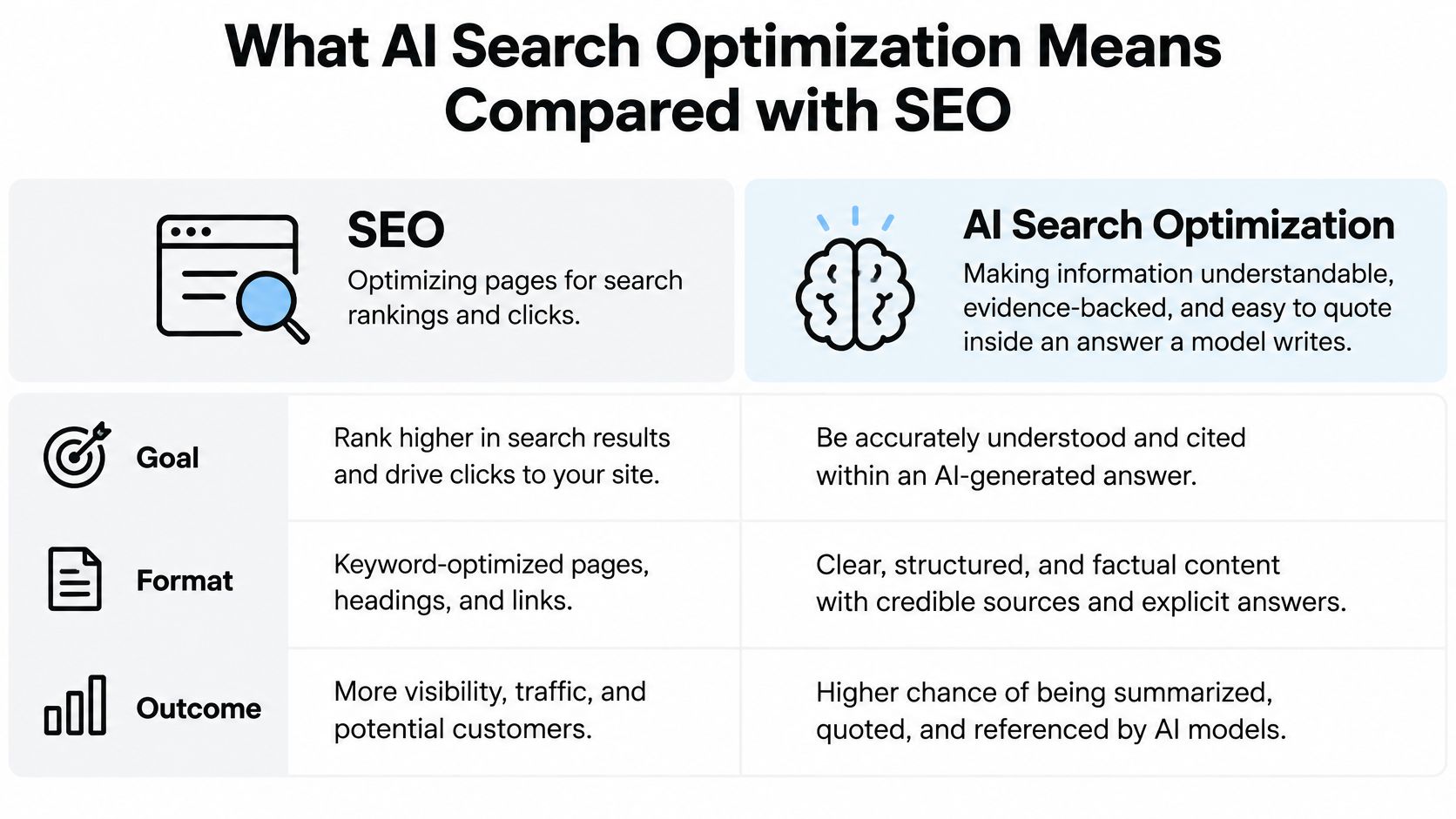
That is the fact AI search optimization is built around. The discipline, often called Generative Engine Optimization (GEO), is the work of making a claim understandable, evidenced, and easy to lift into an answer a model writes. Traditional SEO tries to earn a listing. GEO tries to be selected as support for that answer, even when the reader never clicks.
The distinction behaves like the gap between a shelf position and a recommendation spoken aloud by an assistant the customer already trusts. The shelf still matters, because a page nobody can find is a page no model will quote. It just stops being the finish line.
| Practice | Primary goal | Where it shows up | Success signal | Unit you optimize | Main risk |
|---|---|---|---|---|---|
| Traditional SEO | Earn a listing for a query | Organic results and snippets | Rank, clicks, impressions | Page and keyword | Ranking well but never being quoted |
| AI search optimization (GEO) | Be retrieved and cited accurately | AI Overviews, ChatGPT, Gemini, other assistants | Accurate citation, branded demand, assisted conversions | Passage, entity, and claim | Being named while receiving almost no click |
The behavior has already moved
The gap between a mention and a visit is the part teams misread most often. The same Pew analysis found that 13% of participants visited an AI chatbot website at least once in March, rising to 20% among adults aged 18 to 29. Attention is splitting between the results page and the assistant, and the younger slice splits it faster.
Count those as different outcomes, because they are. A citation is one measurement: did the answer lean on your page. Whether the buyer repeats your name a week later, in a brand search or a question typed into an assistant, is a second. Whether they fill in the form is a third. Filing an AI mention under traffic scores all three as a failure, which is why a citation should never be judged as if it were a visit.
GEO doesn't replace SEO either. An unindexed page can't become a supporting link, and a page with no clear claim gives the model nothing safe to quote. The trade-off is real: passages short enough to lift cleanly can read abruptly to a human who does arrive by click, so a strong page carries both a self-contained answer and the fuller argument around it.
What you optimize
The unit changes from a whole page aimed at one keyword to a passage that can stand alone.
- Goal: Be quoted accurately, not only listed.
- Format: A direct answer, a named entity, and a fact the page itself supports.
- Failure mode: A strong rank that the model never uses, or a citation that sends almost no visit.
Practical rule: Write the answer in one short passage a stranger could paste without the rest of the page.
Teams comparing the two jobs can read a plain account of the difference between SEO and GEO. Shops that also want less manual checking of titles, internal links, and refresh cycles can review SEO automation perspectives from AgentGrown, then decide which tasks stay with an editor.
How Answer Engines Select Sources to Cite
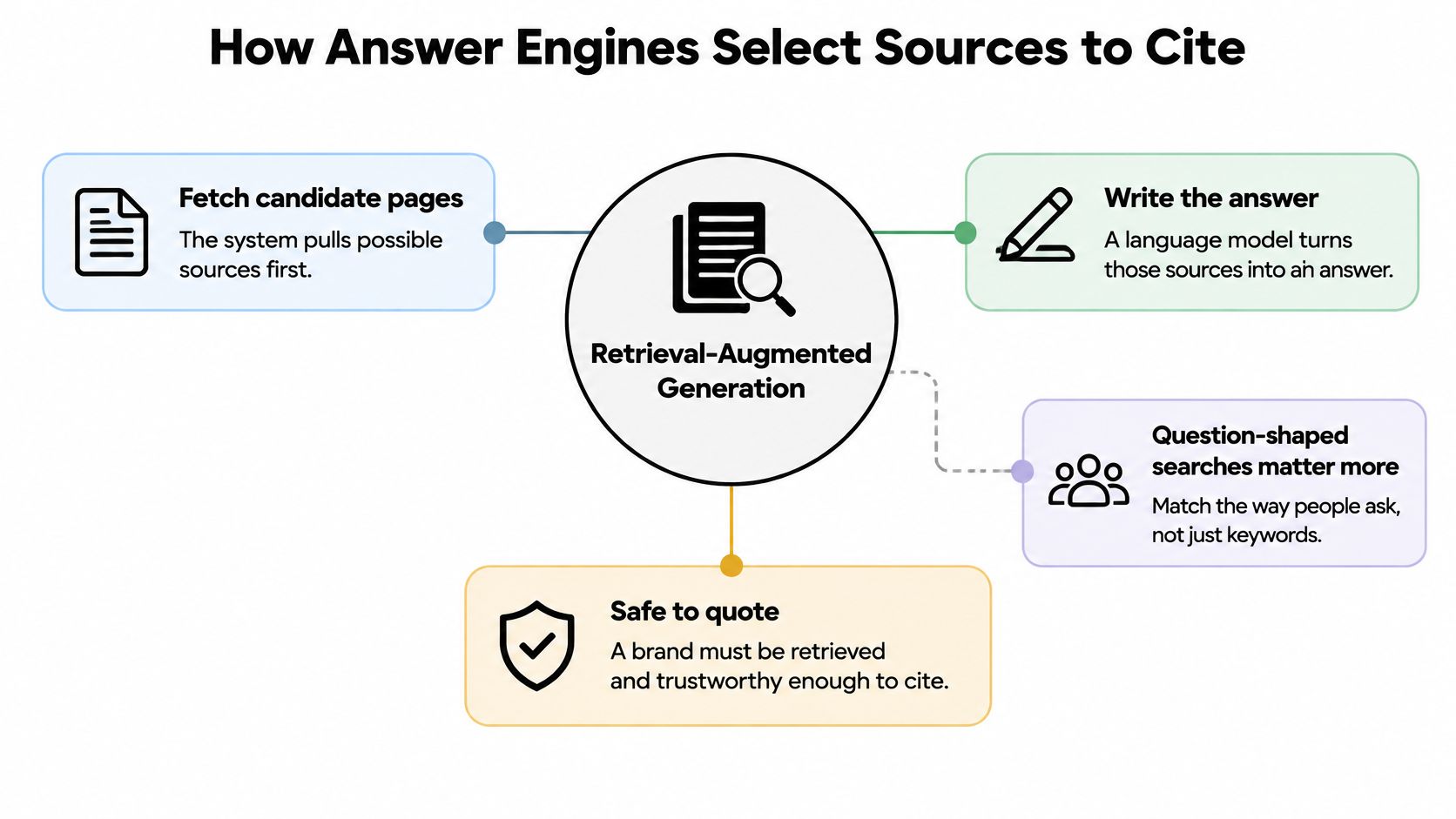
Retrieval-augmented generation works like a research assistant with a strict deadline. It fetches candidate pages first, then writes a short answer using only passages it can quote safely. To appear, a brand has to be retrieved and easy to repeat.
Four findings that separate rank from citation
A large-scale academic measurement issued 55,393 trending queries across 19 topical categories over 40 days, from March 13 to April 21, 2026, as reported in that measurement study. AI Overviews appeared for 13.7% of all tested queries in that measurement study, but activation rose to 64.7% for question-form queries in that measurement study. Question-shaped searches carry the most weight for AI visibility.
That distinction matters because being cited, being remembered, and converting are three separate goals. A citation measures whether the model selected the passage. Memory measures whether readers recall the name later. Conversion measures whether anyone visits or buys. A mention was never a visit.
The measurement study examined 98,020 individual claims inside generated answers and found that 11.0% were unsupported by the cited pages. The measurement study also reported that nearly 30% of domains cited by AI Overviews did not appear on the corresponding conventional first results page. Rank and citation are different outcomes.
This short walkthrough shows the same fetch-then-write path in motion.
A citation can still be wrong
Say a regional manufacturer publishes a clear page on lead times, with the number, the unit, and the date in one sentence. A shopper asks, "How long does a custom run take?" That question form is far more likely to trigger a generated answer than the short keyword "custom manufacturing." If the page states the lead time plainly and the source is one the system already trusts, the passage is easier to lift. A vague page that only says "fast turnaround" gives the model nothing safe to repeat. Short. Specific. Dated.
ChatGPT, Gemini, and Google AI Overviews are different selectors. A page that shows up in one may be absent in another. Keeping a short list of the assistants your buyers open, such as a First AI Search directory profile from Free AI Directories, helps a medium-size team test the surfaces that matter instead of assuming one score covers all of them.
Factual precision, a claim the page itself supports, an authoritative source, and a format the model can parse are what earn selection. Human review and visible sourcing stay mandatory because that 11.0% unsupported-claim rate means an answer can name a domain and still misstate the price, the geography, or the offer.
What Makes a Page Eligible for AI Answers
Eligibility is a technical gate, not a secret file. Google's AI optimization guidance states that pages must be indexed and eligible to appear with a conventional search snippet before they can qualify as supporting links in AI Overviews or AI Mode. Crawlability, canonical consistency, accessible rendering, and index coverage come before any generative tactic.
Google also says there's no special schema.org vocabulary, AI text file, or secret markup required for these features. Structured data helps machine understanding and rich results only when it describes the words a person can see. Hidden claims in markup don't earn a citation, and they can disagree with the page.
A working order that doesn't invent a shortcut
- Confirm the URL is in the index and snippet-eligible. If Search can't show a normal snippet, the page isn't a candidate supporting link.
- Write one concise passage that answers the question without the rest of the page. Put the definition, the number, or the step in that passage, not three scrolls down.
- Give that passage something to stand on. A date, a statistic with its source, or a short quotation is easier to check than a slogan.
- Keep names consistent. Organization, product, and location should match across the title, the body, and any markup.
- Validate structured data against visible text. If the markup says one price and the page says another, fix the page first.
- Have a person check accuracy, privacy, and tone before publishing. A model can draft. It shouldn't be the last reader.
Accessible pages can enter the retrieval pool. Corroborated passages are easier to cite. Honest markup improves interpretation without replacing quality.
An audit should record indexed URL coverage, snippet eligibility, structured-data validation, entity consistency, and whether key claims survive on their own. Technical SEO, content strategy, and analytics are one system here. Coverage gets you in. Clarity gets you selected. Proof keeps the quote honest.
The Generative Artificial Intelligence Profile that NIST released on July 26, 2024, as a cross-sector companion to the AI Risk Management Framework, gives a voluntary structure for spotting risks unique to generative AI. That supports a documented human review for citation accuracy, privacy, and trustworthiness before a passage goes live. Teams that want the writing standard spelled out can follow these content and structure standards.
How Direct Online Marketing Helps Medium-Size Firms
A medium-size firm rarely has one person for SEO, one for paid media, one for content, one for analytics, and one for conversion. Direct Online Marketing runs those five as a single engagement, and the reason is simple: the same page has to satisfy a crawler, a paid click, and an answer engine at once.
Each of the five services owns a different part of that job.
SEO keeps important URLs crawlable and indexable. Retrieval starts with coverage. If a page never enters the index, no assistant can fetch it, which makes this the cheapest work to fix and the most expensive work to skip.
Paid media buys demand while organic and answer visibility are still building. A campaign reaches buyers who are already comparing vendors and lands them on a page that states the offer in one quotable passage. The paid click earns the visit; the passage earns the citation.
Content strategy writes the pages answer engines quote. Writers keep entity names, product names, and facts identical across every page, because a model weighing two conflicting descriptions of the same company has to guess which one is right. Consistency removes the guess.
Analytics separates three outcomes that arrive fused in most reports: being cited, being remembered, and converting. A citation is an answer that names your page. Being remembered is a buyer typing your brand name a week later. Converting is the form submission or the call. Each needs its own number. Treat a mention as if it were a visit and you flatter the first goal while hiding the other two.
Conversion optimization makes sure the landing page closes. A citation that sparks a later brand search only pays off if the page that search lands on is ready to take the lead.
Sequencing is the trade-off. A firm with a four-month sales cycle typically spends the first quarter on coverage and content, keeps paid media running so pipeline doesn't stall, then reads the analytics once enough citations exist to analyze. Chasing citations before pages are eligible wastes the spend; waiting on organic alone can starve the pipeline.
For a medium-size company, the practical effect is that budget conversations rest on pipeline and revenue rather than session counts, and the visibility work outlasts any single campaign.
Measuring AI Visibility Beyond Last-Click Reports
Last-click reporting works like a relay that awards the medal only to the runner who crosses the tape. The assistant that made the introduction never shows up on the sheet.
An analysis of 15.4 million B2B SaaS sessions found that identifiable AI referrals were only 0.88% of total sessions. Yet 36.4% of conversions linked to an AI referral occurred in a later session, and 83.7% of those later conversions were attributed to direct or organic visits. The introducing visit can be missing from the report that receives the credit.
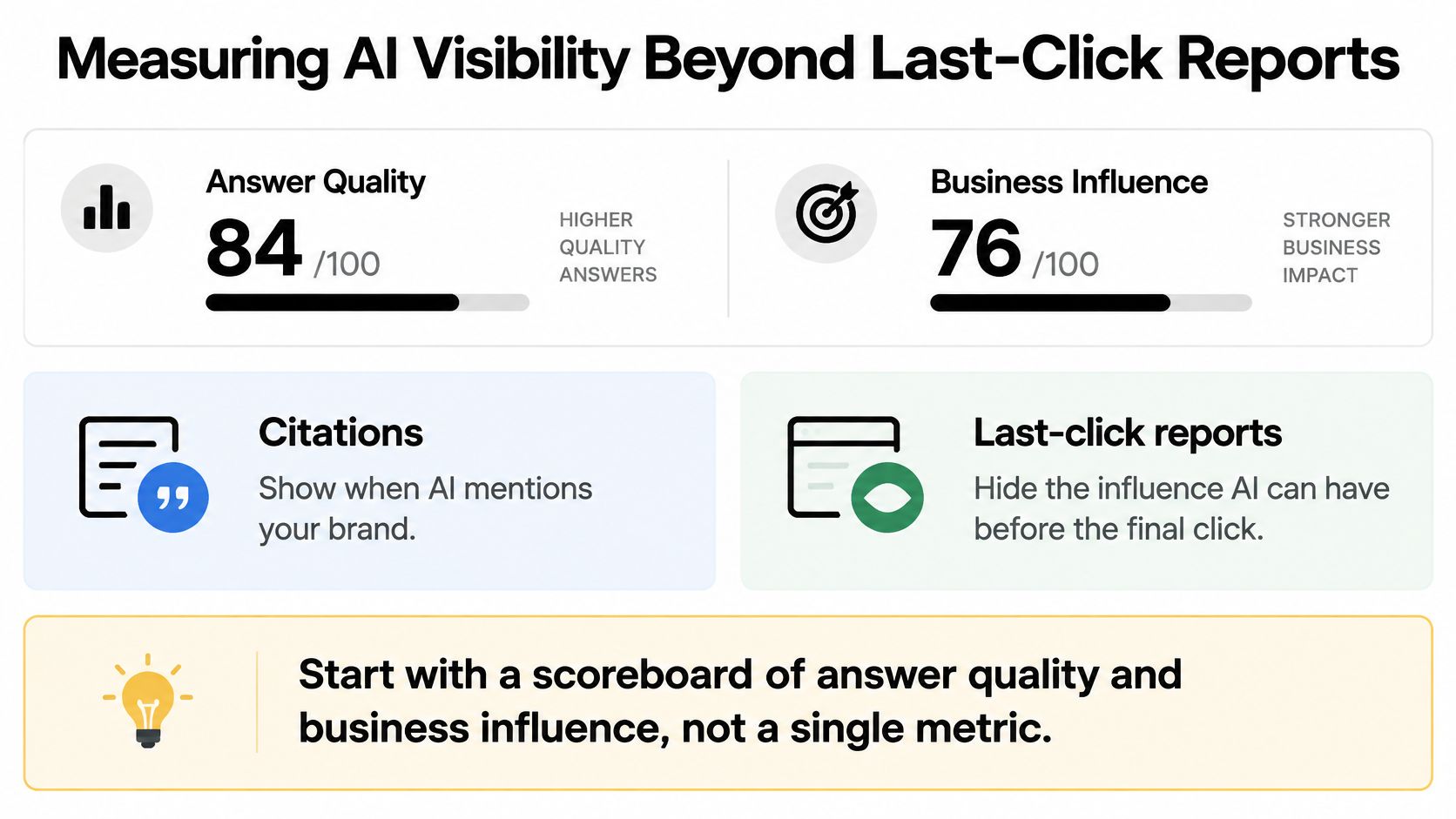
A usable scoreboard is a small prompt set you can rerun: short queries, comparison questions, local intent, and follow-ups. One screenshot is a single draw. A rate across repeated runs is the score.
| Metric | What it tells you | Why last click misses it |
|---|---|---|
| Retrieval rate | Share of test prompts that fetch your page | A rank does not show whether the model fetched you |
| Citation presence | Whether the answer names your source | A mention is not a session |
| Answer factuality | Whether the claim matches your page | A citation can still misstate the brand |
| Assisted conversion | A later conversion after an AI visit | Usermaven analysis: 36.4% of AI-linked conversions happened in a later session |
| Branded-search lift | Rise in brand queries after AI exposure | Direct or organic often receives the final credit |
Three goals, three metrics
Being cited, being remembered, and converting are separate jobs. An AI mention is not a visit, so it should not be scored like one.
- Being cited is citation presence on the prompt set. It answers, "Did the answer name us?"
- Being remembered is branded-search lift, repeat visits, and self-reported "I saw you in an AI answer." It answers, "Did the mention create demand?"
- Converting is the assisted conversion and the qualified lead or sale. It answers, "Did that demand become revenue?"
A citation with no memory and no pipeline is a vanity mention. A later direct visit with no record of the assistant is an invisible assist.
A reputable agency keeps those three numbers in the same review: citation rate on the prompt log, movement in brand queries, and assisted leads in the CRM. None of the three stands in for the other two. The trade-off is patience. Waiting for more runs slows a decision, but treating one lucky answer as a trend sends the team after the wrong page.
Clicks from the answer itself are rare
Reuters Institute reporting notes that citation patterns vary substantially among ChatGPT, Gemini, and Perplexity, while relevance, recency, and extractable evidence such as statistics or quotations are more consistently useful than superficial formatting. Separately, Pew Research Center's analysis of a large sample of Google searches by U.S. users found that a click on a source cited inside a Google AI Overview was rare. Visits that displayed an AI summary also drew fewer clicks on traditional results than visits without one.
Test each assistant on its own. A win in one interface is not a win in the others.
A B2B firm should weight remembered demand and pipeline, because the sale often lands sessions later. A retailer should test whether a citation on a comparison prompt produces a product click, because that session may never arrive. Rerun the prompt set before you treat a change as proven. A higher probability of accurate inclusion is not a guarantee of placement in every answer.
For a wider set of benchmarks while you design that scoreboard, you can browse artificial intelligence search statistics from Mojolin, then keep your own prompt log as the record that matters. A step-by-step version of this scoreboard is in this guide to how to measure AI search visibility.
Choose a Partner for AI Search Visibility
A manufacturer with a 90-day sales cycle can hear an assistant name the brand on Tuesday and still see the form fill in June. Those are not the same event. Citation, memory, and conversion each need their own metric, the way a store tracks shelf placement, whether a shopper recalls the name later, and the receipt as three different numbers.
A sound program keeps foundational SEO in place, writes passages an answer engine can quote, has a person review them, and scores assisted value instead of one ranking. One team has to hold SEO, paid media, content, analytics, and conversion work together, with a practical view of Gemini and ChatGPT. A citation that never produces a session is still a citation. A later branded search is remembered demand. A qualified lead is the conversion. Scoring the mention as if it were a visit mixes the three and hides which one actually moved.
AI Optimization Services lays out how classic channels connect with generative discovery. Use that workflow as a reference, then ask any partner three questions that separate a capable team from a slogan.
- Which prompts will you track, and how often will you rerun them?
- How will you prove a citation is accurate, not only that the brand name appeared?
- Which business outcome should move if visits from assistants stay small?
The next step is an audit of indexation and a short prompt set before anyone buys a tool or rewrites the whole site. Eligibility comes first. Citable evidence comes second. Measurement that can see demand, even when the click never arrives, comes third.
If reporting still treats an AI mention as a visit, start this week with ten real buyer questions, check which pages are indexed and snippet-eligible, and score each answer for citation, accuracy, and any later brand search or lead. Direct Online Marketing can then connect that scoreboard to qualified pipeline, so the work is judged on those three outcomes rather than on a single screenshot.