
A business owner can see traffic arriving on a campaign page, watch visitors scroll, and still wonder why sales or enquiries remain scarce. The page may look polished, load correctly, and attract visitors from search or paid media, yet fail to make the next action obvious.
That gap is where a landing page optimizer becomes valuable. Optimization isn't just a matter of changing a button color or shortening a headline. It connects measurement, user intent, page experience, experimentation, and qualified business outcomes. It also matters more as visitors discover brands through conventional search, AI-generated answers, ChatGPT, and Gemini.
Table of Contents
- What Is a Landing Page Optimizer
- The Reality of Conversion Experiments
- How the Optimization Process Works
- Why One Size Never Fits All
- The Role of AI in Modern Optimization
- Common Pitfalls and Misconceptions
- Partnering with a Leading Agency
- Your Next Steps in Optimization
What Is a Landing Page Optimizer
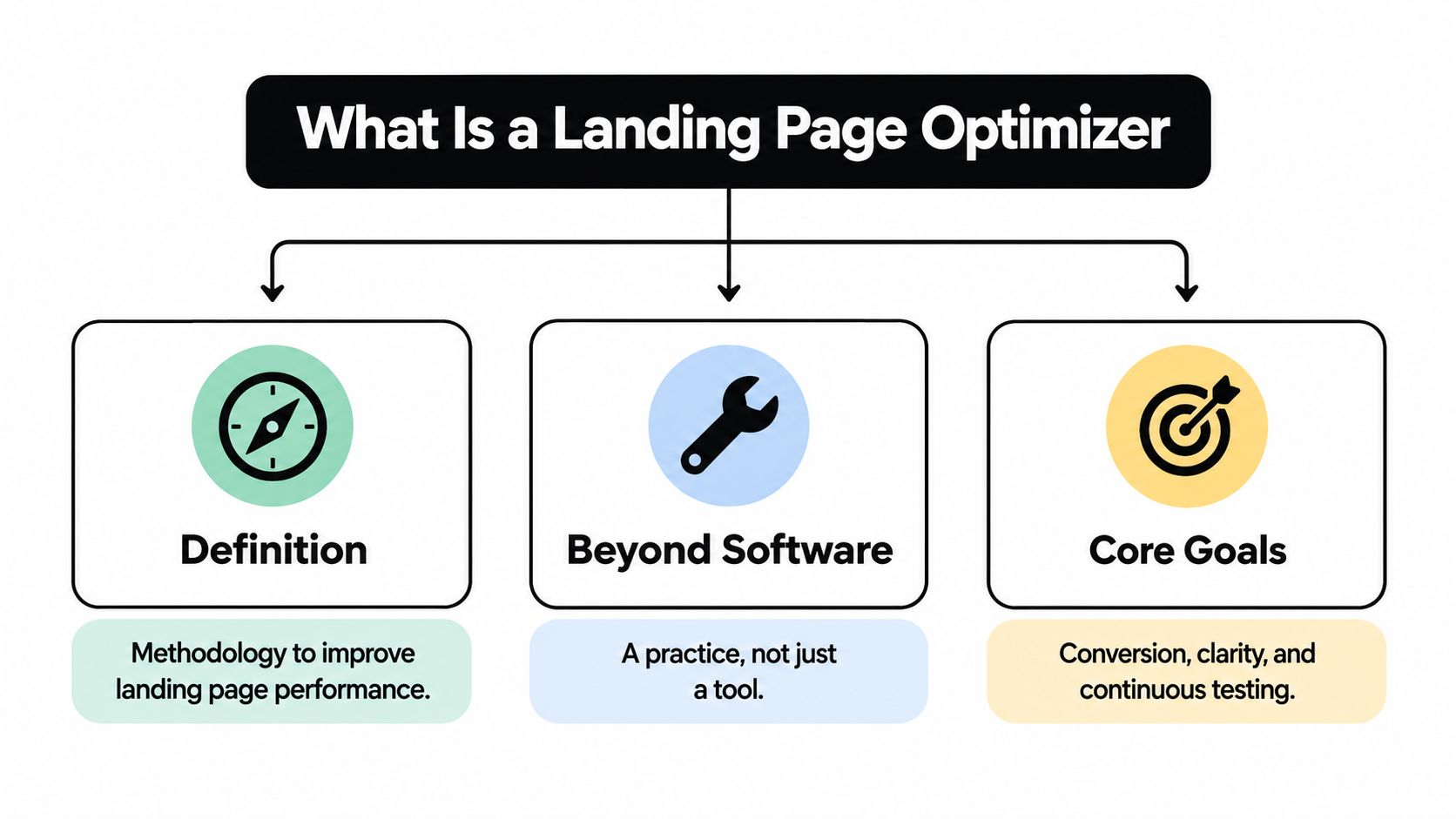
A landing page optimizer can mean software, a person, or a complete operating method. In practical terms, it helps a business understand why visitors don't take a desired action, develop a reasoned improvement, test that improvement, and apply the learning to future page decisions.
Consider a consultancy that receives relevant traffic for a service campaign. The page explains the service, includes several navigation options, and places a detailed enquiry form below a long introduction. Visitors arrive, read part of the copy, and leave. A weak response would be to redesign the entire page based on opinion. A stronger response would examine traffic sources, device behavior, form abandonment, scroll depth, and the quality of completed enquiries before proposing a change.
The four working parts
A reliable optimization program usually connects four activities:
- Data collection: Analytics records visits, sources, devices, interactions, form starts, submissions, and downstream outcomes.
- Hypothesis generation: Strategists turn evidence into a specific statement, such as, “Visitors aren't submitting because the first screen doesn't explain the service outcome.”
- Controlled testing: The existing experience is compared with a defined alternative while the primary conversion metric remains clear.
- Analysis and implementation: The team interprets the result, checks lead quality, documents the learning, and deploys a winner only when the evidence supports it.
The optimizer's role is therefore broader than a page builder. It creates a repeatable discipline for reducing uncertainty. A business may use a specialist platform, internal analytics, research interviews, or a partner team, but the central principle remains the same: page changes need a measurable reason and a defined outcome.
A useful reference for evaluating page structure is this guide to best landing page designs. The relevant question isn't whether a page resembles a popular design. It is whether the page makes the visitor's intended task clearer and easier.
Practical rule: A landing page earns an optimization decision by showing evidence, not by looking modern.
The Reality of Conversion Experiments
Conversion testing has a reputation for producing easy wins. A new headline, shorter form, or different image can appear promising, but an apparent improvement isn't automatically a dependable result. Visitors behave differently across devices, campaigns, audiences, and buying stages, so a test needs enough observations and a preselected measurement plan.
A 2026 analysis of more than 28,000 A/B tests found that 13% produced a statistically significant improvement, 9% produced a statistically significant decline, and 78% were inconclusive, according to the analysis of A/B test outcomes and landing-page experiments. In other words, roughly seven out of every eight tests failed to establish a proven positive result.
| Outcome | Percentage |
|---|---|
| Statistically significant improvement | 13% |
| Statistically significant decline | 9% |
| Inconclusive result | 78% |
What inconclusive really means
An inconclusive test isn't necessarily wasted effort. It may show that the change was too small, the audience was too mixed, the test ran without sufficient traffic, or the page's main problem lies elsewhere. The result becomes useful when the team records what was tested, which audience saw it, what metric mattered, and what decision followed.
The same analysis found that tests involving headlines, calls to action, hero images, and form length produced significant winners about 24% of the time. That result doesn't make these elements automatic winners. It does make them sensible places to investigate when evidence points to unclear value, weak motivation, poor visual explanation, or excessive form friction.
Statistical discipline protects budgets
A team should define the primary conversion before launching a test. A page selling a complex service might track a completed enquiry, but it should also inspect whether those enquiries meet sales criteria. Declaring success from clicks alone can direct more budget toward visitors who aren't ready or suitable.
The safest interpretation treats testing as a learning system. A landing page optimizer generates hypotheses, protects the test from uncontrolled changes, waits for enough evidence, and separates genuine learning from random movement. This approach may feel slower than constant redesign, but it prevents a business from building its growth strategy on unverified preferences.
How the Optimization Process Works
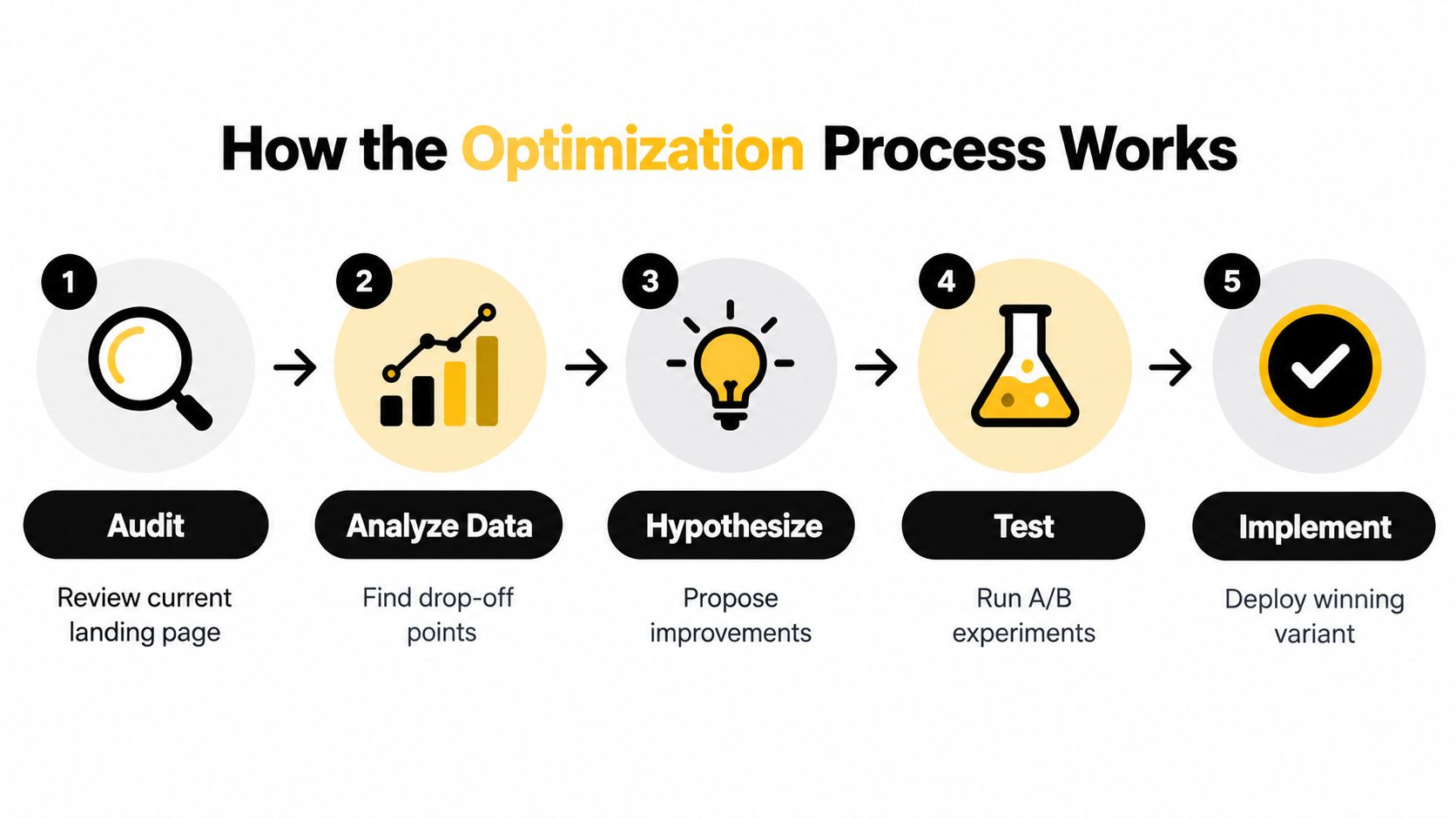
A landing page optimizer works best as a sequence rather than a collection of disconnected tactics. Each stage answers a different question, and skipping one makes the later result harder to trust.
Start with the page and the business outcome
1. Audit the current experience. The review should cover the promise made in the ad or search result, the first-screen message, navigation, mobile layout, accessibility, form behavior, trust signals, and page speed. It should also identify whether the conversion is a purchase, registration, consultation request, or another defined action.
2. Analyze the evidence. Analytics can reveal where visitors enter and leave. Session behavior can show hesitation, repeated clicks, uncompleted fields, or a call to action that receives little attention. The analysis should distinguish traffic sources and devices instead of blending every visitor into one average.
3. Form a testable hypothesis. A useful hypothesis links a problem to a change and an expected outcome. For example, a team might test whether moving the service outcome above technical detail increases completed enquiries without lowering lead quality.
4. Run a controlled experiment. The team changes a defined element while keeping the test conditions stable. Headline, call to action, hero explanation, form length, and trust placement can all be tested, but simultaneous changes make it difficult to know what caused the result.
5. Implement and document. A winning variant becomes the new experience only after the team checks the primary metric, segmented performance, and qualified outcomes. The learning should enter a shared record so later tests build on evidence rather than repeat old assumptions.
Measure the business, not just the page
Google Ads conversion tracking records defined actions after an ad interaction, including sign-ups, purchases, visits, and leads. Its conversion tracking documentation explains that conversion rate is calculated by dividing conversions by ad interactions during a specified period.
For lead-generation businesses, a form submission is only an early signal. Google Ads supports separate reporting for qualified leads and converted leads, including cost per qualified lead and qualified-lead rate, as described in its qualified and converted lead reporting guidance. Connecting page tests to these downstream outcomes keeps optimization tied to revenue potential rather than surface-level activity.
Why One Size Never Fits All
A universal “good” conversion rate is unreliable because visitors don't arrive with the same intent, expectations, trust requirements, or buying cycle. A visitor purchasing a familiar product may need a clear price and fast checkout. A decision-maker evaluating a complex service may need evidence, process detail, risk reduction, and an easy route to a conversation.
A large benchmark covering 41,000 landing pages, 464 million visitors, and 57 million conversions reported a median conversion rate of 6.6% across industries, according to the landing-page benchmark analysis. That median represents approximately 66 conversions per 1,000 visitors, but it shouldn't become a target detached from business context.
Industry context changes the baseline
The reported industry medians included:
- E-commerce: 4.2%
- Software-as-a-service: 3.8%
- Professional services: 6.1%
- Financial services: 8.3%
- Entertainment: 12.3%
These differences reflect more than page quality. Offer complexity, traffic intent, purchase cycle, perceived risk, and the chosen conversion action all influence the starting point. A retailer moving from 4.2% to 5.2% would generate roughly 24 additional conversions per 1,000 visitors, based on the benchmark's e-commerce figures. A B2B page seeking a consultation may need more explanation before a prospect submits a form, so the same percentage-point movement can require a different type of improvement.
Set a relevant comparison
A useful benchmark combines several dimensions:
- The same business model or a closely related one.
- A comparable traffic source and intent level.
- The same conversion definition.
- A similar device mix.
- A quality measure beyond the initial submission.
The landing page optimizer should use benchmarks as context, not as a promise. Internal trends, qualified leads, sales acceptance, and customer value usually provide a stronger decision framework than an industry median alone.
The Role of AI in Modern Optimization
AI has changed how people discover information, but it hasn't removed the need for clear pages and trustworthy measurement. A visitor may arrive after seeing a conventional search result, an AI-generated summary, or a conversational answer from ChatGPT or Gemini. Each path can create different expectations before the landing page loads.
Pew Research Center found that 58% of respondents conducted at least one search during its study period that produced an AI-generated summary alongside traditional results, while 65% conducted a search that displayed an AI reference somewhere on the results page. The analysis also found that 13% visited an AI-chatbot website at least once during March, as reported in the Pew Research Center browsing analysis.

Optimize the answer and the destination
Generative Engine Optimization, often called GEO, focuses on making a brand's information clear and discoverable in AI-driven environments. That work includes consistent terminology, direct answers, accessible content, credible evidence, logical page structure, and a clear relationship between a user's question and the business's offer.
Google states that websites don't need special AI files, new machine-readable markup, or a dedicated schema.org format for AI Overviews or AI Mode. Pages still need to be crawlable, indexable, eligible for ordinary search, and supported by helpful, accessible content, according to Google's documentation on AI features in Search.
A landing page optimizer can support this work by comparing the question implied by a referral with the answer presented above the fold. Structured content may help AI systems interpret a brand, but the page still has to persuade a human visitor to take an appropriate next step.
More guidance on the relationship between AI discovery and conversion practice appears in this resource on AI conversion rate optimization.
The measurement model also needs an AI-referral view. Ahrefs reported that AI-referred visitors represented about 0.25% of visits on average, while 0.5% of its visitors generated 12.1% of signups in its dataset. The analysis also reported AI traffic growing roughly tenfold year over year and exceeding a 10% conversion rate in that dataset, as detailed in its analysis of AI traffic and conversions. These figures are specific to that analysis, but they illustrate why a low-volume segment shouldn't be judged by volume alone.
Common Pitfalls and Misconceptions
“Less is more” can be useful advice, but it isn't a universal optimization law. A shorter page may remove distracting detail, yet it may also remove the product context, trust signals, instructions, or accessibility cues that help a visitor make a confident decision.
A controlled study involving 535 visitors compared a short landing-page variant with a long variant. The short version produced a 53.44% email-registration conversion rate, compared with 38.83% for the long version, an absolute difference of 14.61 percentage points and an approximate relative lift of 37.6%, according to the study on landing-page information density. The broader experiments found additional information was negatively correlated with conversion in that setting.
That finding supports testing focused pages, not deleting information by default. High-consideration B2B visitors may require methodology, security detail, pricing context, proof, and answers to objections before they contact a provider.
Usability needs its own scorecard
Baymard's research draws on more than 200,000 hours of testing, 18,000+ users, 90+ leading US and European sites, 18,000+ manually reviewed pages, and 700+ UX guidelines. Its research also reported that 42% of mobile ecommerce sites historically failed to let users accurately infer what type of site they had reached, as shown in the independent UX research.
Those findings challenge visually minimal pages that hide essential orientation. A conversion-focused review should inspect:
- Comprehension: Can a visitor identify the offer and intended audience?
- Accessibility: Can people with different abilities read, move through, and complete the action?
- Error recovery: Does the form explain what went wrong without forcing a restart?
- Task success: Can mobile visitors complete the intended action without confusion?
- Lead quality: Do additional submissions represent genuine commercial value?
Mobile speed creates another frequent blind spot. Google Ads documentation reports that, in retail, a one-second delay on mobile can reduce mobile conversions by up to 20%, and its landing-page evaluation incorporates real-world speed experience data, as explained in Google's mobile landing-page guidance. Image sizing, script loading, third-party tags, layout stability, and real-user performance deserve attention alongside copy and design.
Partnering with a Leading Agency
A medium-sized business may have enough traffic and marketing activity to benefit from structured experimentation, but not enough internal capacity to manage research, paid media, SEO, analytics, content, and development as separate workstreams. A specialist partner connects these disciplines around the page's commercial objective, so decisions in one channel do not undermine results in another.
Direct Online Marketing coordinates SEO, paid media, and conversion optimization under one team. That structure keeps search intent, advertising promises, landing-page messaging, analytics, and content aligned. Businesses can review its performance marketing agency services, company background, and published case studies to judge whether its approach fits their goals.
What a strategic partner contributes
The work involves more than producing page variants. A capable team can help a business:
- Connect search intent and paid-media promises to landing-page messaging.
- Build measurement that separates inquiries from qualified leads.
- Prioritize experiments by likely business impact and implementation effort.
- Improve AI search visibility with clear, useful, well-structured content.
- Turn individual tests into a repeatable growth system.
For example, an agency may find that a paid campaign attracts clicks with one promise while organic visitors arrive with a different question. It can align the ad, search content, page copy, and conversion event, then measure whether the change improves both submission quality and commercial follow-through. This coordination also gives the team a clearer way to assess whether content is useful to people and understandable to AI-driven search systems.
The partner should explain what will be measured, which decisions require approval, how lead quality will be assessed, and how results will be documented. It should also show how insights from one experiment influence the next. That accountability makes optimization a measurement discipline rather than a series of isolated design changes. Transparency matters more than a long list of tactics.
Your Next Steps in Optimization
A landing page optimizer becomes useful when the business turns page activity into a managed decision process. The first action isn't a redesign. It is a clear definition of the conversion and the business result that should follow.
Build the baseline
The owner, marketer, or growth team should record the current page's traffic sources, device patterns, primary conversion rate, form completion behavior, sales acceptance, and qualified-lead rate where applicable. AI referrals should have their own reporting view when the analytics setup can identify them. The team should also record the question or promise that appears to bring visitors to the page.
Next, the page should receive a practical audit:
- Message match: Does the headline answer the visitor's likely question?
- First-screen clarity: Is the outcome visible before unnecessary detail?
- Conversion path: Is the next action clear and proportionate to the visitor's commitment?
- Trust and proof: Does the page address risk without overwhelming the primary path?
- Mobile experience: Can visitors read, move, and submit without avoidable friction?
- Technical delivery: Do scripts, images, and layout behavior slow or disrupt completion?
Choose the first experiment carefully
The first test should target a meaningful problem rather than a fashionable design preference. A headline may be appropriate when visitors misunderstand the offer. A form test may be appropriate when users begin but don't finish. A speed release may be appropriate when mobile users encounter delayed rendering. Each hypothesis should specify the primary metric, the audience, the expected mechanism, and the guardrail metric.
Teams should avoid declaring success from a brief spike or a higher number of raw submissions alone. Qualified-lead rate, sales acceptance, customer value, and completed journeys provide a more durable view of performance.
The long-term objective is a system in which every important change produces learning. Search optimization brings the right questions, paid media creates controlled demand, content explains the offer, analytics reveals behavior, and conversion optimization turns relevant attention into an appropriate action. AI can accelerate analysis and variant creation, but human strategists still need to protect accuracy, accessibility, brand trust, and statistical discipline.
Businesses ready to put that system into practice can contact AI Optimization Services to review a current landing page, identify measurement gaps, and develop a prioritized optimization plan with AI search visibility included from the start. Start with one important page, one defined business outcome, and one evidence-based hypothesis, then build from the learning.