
Local search optimization is the practice of making a business discoverable for searches with geographic intent, and 46% of Google searches have local intent according to BrightLocal's local search statistics. For a small business, the practical result isn't merely a higher blue-link ranking. It's more calls, visits, direction requests, qualified leads, and accurate mentions in AI-generated answers.
A plumbing company can be excellent at its work and still be invisible when a nearby customer searches for emergency help. A restaurant can have a loyal following and still lose tonight's diners because its hours are wrong, its address conflicts across listings, or an AI assistant can't confidently identify what it offers. Local search optimization connects the business's real-world reputation with the digital signals search systems use to decide which nearby option deserves attention.
Table of Contents
- What Local Search Optimization Actually Means for Your Business
- How Local Search Went From Yellow Pages to the Local Pack
- The Three Signals Google Uses to Rank Local Results
- The Four Pillars of a Working Local SEO Program
- Why Local Search Optimization Now Includes AI Answers
- Two Local Businesses Putting the Strategy to Work
- Common Local SEO Mistakes That Quietly Kill Visibility
- Your Local Search Optimization Starter Checklist and Where to Go Next
What Local Search Optimization Actually Means for Your Business
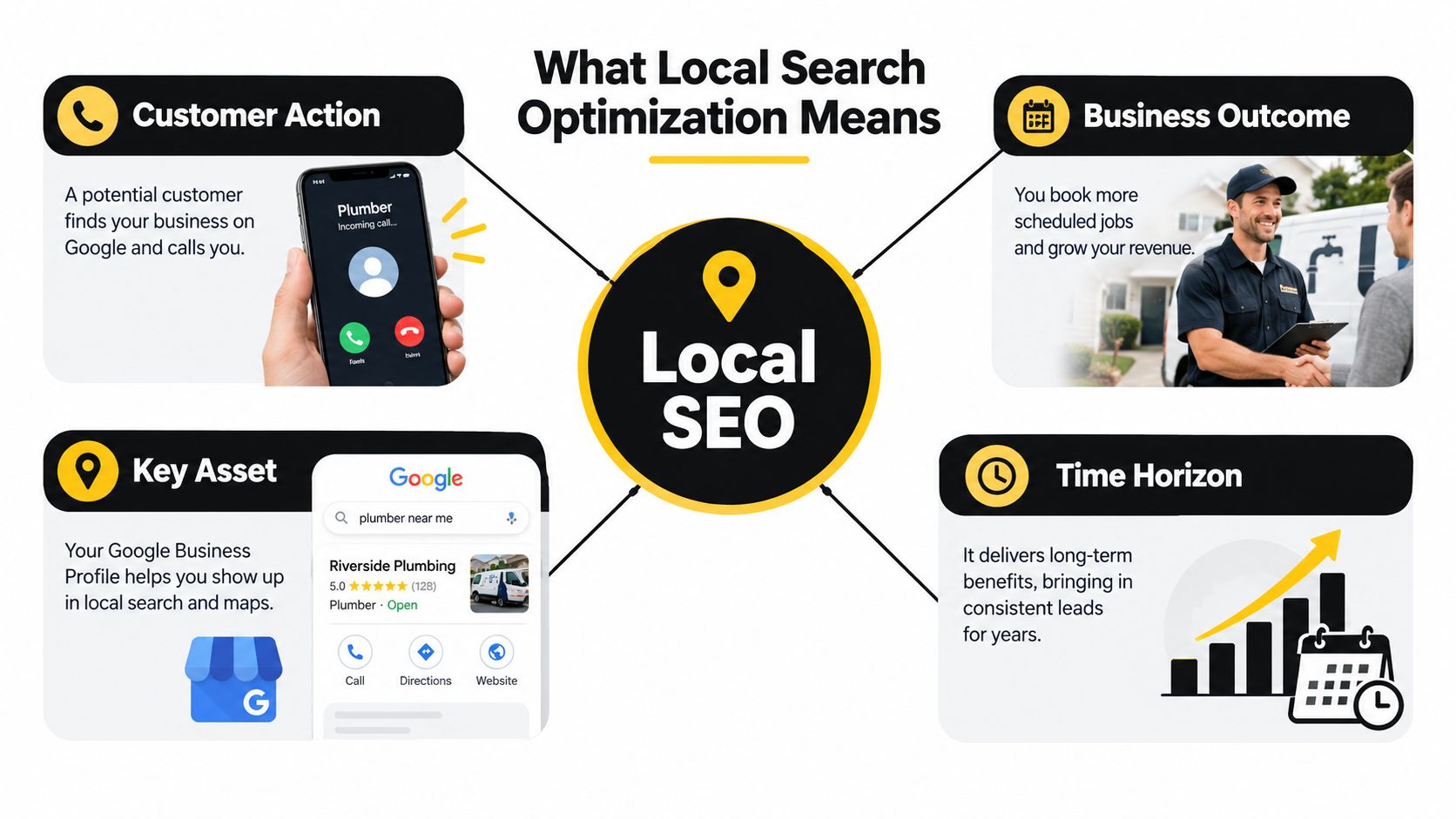
A plumbing company owner notices that the phone rings most Tuesday afternoons. Years earlier, she had completed one practical task: she created and maintained a detailed Google Business Profile for emergency plumbing, including service information, hours, phone contact, and the neighborhoods her team serves. Customers searching nearby can find the profile, call directly, request directions, or visit the website without navigating a long research process.
That example captures the working meaning of local search optimization. It's the discipline of making a business findable for queries with clear geographic intent, whether someone types the query into Google, speaks to a smart speaker, or asks an AI assistant for a recommendation. The optimization applies to a physical storefront, a service-area business, or a company serving several defined locations.
The three outcomes that matter
A local program should connect visibility to business action:
- Direct calls: A complete profile gives searchers a fast path to phone the business from a search result.
- Visits and directions: Accurate location details, hours, photos, and map information help customers decide whether to travel to the business.
- Qualified leads: Service pages, reviews, and clear proof can persuade prospects before they submit a form or schedule an appointment.
Local search differs from general SEO because the intent layer is often immediate. Someone searching for a nearby dentist, open restaurant, or emergency plumber may want to buy, visit, or call within hours. A general informational article can attract attention, but local optimization must also remove friction from the next step.
The discipline therefore has two connected jobs. First, it helps a business appear in the local pack and map results. Second, it makes the business understandable as an entity across websites, directories, reviews, and structured content, so AI systems can identify and select it in conversational answers. Readers comparing broader search concepts can also review the difference between SEO and GEO, but local visibility still begins with accurate business information and a clear match to nearby intent.
How Local Search Went From Yellow Pages to the Local Pack
In 1998, a family-owned Italian restaurant depended on a printed Yellow Pages advertisement. The owner paid for visibility in a fixed directory, and customers searched by browsing categories or calling for an address. The restaurant's digital identity was limited because the printed listing couldn't respond to changing hours, menus, photos, or customer feedback.
By 2008, the family had launched a basic website. That change gave the restaurant a place to publish its menu and contact information, but discovery still depended heavily on people already knowing the name or finding it through broad web searches. In 2012, the owner claimed a Google Places listing, creating a stronger connection between the restaurant, its address, and map-based searches.
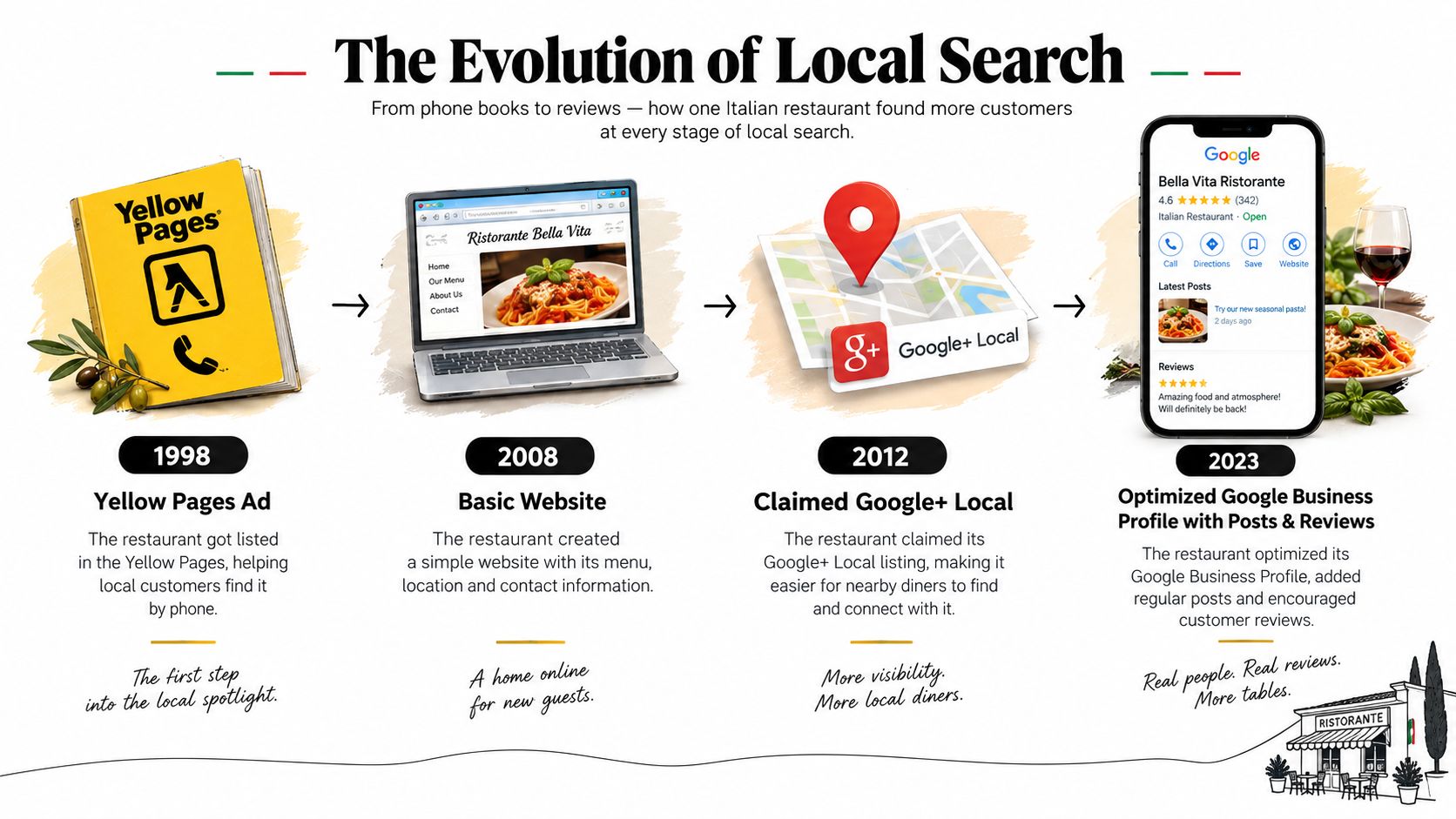
Today, the restaurant's team has more than a listing to manage. It needs accurate Google Business Profile details, fresh photos, responses to reviews, location-specific website content, and consistent business information throughout the web. It also needs to consider how voice interfaces and AI assistants summarize the restaurant when a customer asks for nearby Italian food.
Three forces changed local discovery
Mobile GPS introduced proximity into the moment of search. A customer looking for dinner from a phone can receive results shaped by current location, not just a city name typed into a directory. That makes distance a practical part of competition.
Reviews turned customer experience into public evidence. Searchers can compare feedback, photos, and owner responses before they call or visit. BrightLocal's cited consumer benchmarks report that 75% of consumers read at least four reviews before deciding, while 53% say inaccurate listings drive them away. A business listing now carries both operational information and reputation signals.
Maps consolidated discovery around a recognizable surface. The local pack places geographically relevant businesses directly in the search experience. Moz reported that the local pack appeared in about 33% of keyword searches in a study of 10,000 keywords, illustrating how local results became a central part of the results page. The next question is how those results are chosen.
The Three Signals Google Uses to Rank Local Results
Google's local ranking model is commonly explained through relevance, distance, and prominence. These dimensions work together, so improving one doesn't guarantee visibility when another is weak. A business owner should treat them as separate questions: Does the business match the query? Is it suitably close? Does it appear established and trusted?
Relevance
Relevance measures how closely the business matches what the searcher wants. A dental practice that clearly describes emergency toothache care, urgent appointments, and related services gives Google stronger evidence for an emergency query than a practice with only a generic “dentist” description.
Relevant signals can appear in the Google Business Profile, service list, categories, website pages, and authentic customer language. The aim isn't to insert every possible keyword. It's to describe the actual services in the words customers use, with location context where it helps.
Distance
Distance measures proximity between the likely searcher and the business. Two coffee shops with similarly complete profiles may compete closely, but the one nearer to the searcher can have an advantage for a strongly local query.
This dimension limits what optimization can accomplish. A business can make its relevance and prominence clearer, but it can't move its physical address. Service-area companies should define the areas they serve and create useful location content without pretending to maintain offices where they don't.
Prominence
Prominence reflects how established and recognized a business appears. Reviews, links, consistent listings, media mentions, and broader reputation can contribute to this picture. Localo's analysis found that businesses with 201 to 500 reviews appeared in top-three visibility at 73.0%, compared with 39.3% for businesses with 1 to 5 reviews. The same analysis reported that photo count continued improving without a clear ceiling, while average star rating was less decisive than many assume. These figures come from Localo's local ranking-factor analysis.
| Signal | What it measures | How to improve it | Example |
|---|---|---|---|
| Relevance | Match between the query and the business | Describe real services, categories, and location-specific needs | An emergency dentist explains urgent toothache appointments |
| Distance | Proximity to the searcher or requested area | Maintain accurate location and service-area information | A nearby coffee shop can outrank a farther equivalent |
| Prominence | Recognition, authority, and trust | Earn genuine reviews, local links, mentions, and consistent listings | A well-known local firm has stronger supporting evidence |
A profile with excellent content can still lose when the searcher is far away. A nearby business can still lose when its services are unclear. The strongest programs improve the signal that fits the problem instead of treating local SEO as a single-profile task.
The Four Pillars of a Working Local SEO Program
A functioning local program needs several assets maintained together. The implementation can start without an agency, provided the owner assigns each task to a person and records changes rather than relying on memory.
Google Business Profile
Claim and verify the profile, then complete every relevant field. Select the most accurate primary category, add appropriate secondary categories, publish real hours and service areas, and upload authentic photographs. Updates, offers, and frequently asked questions can keep the profile useful to customers.
A service-area plumber, for example, should explain emergency service availability and the communities served. A restaurant should keep holiday hours and menu details current. The purpose is clarity, not keyword stuffing.
On-page signals
Each important service and location page should have a distinct title tag, H1, and meta description that naturally combine the service with the city or area. A contact page should make the address, phone number, hours, map, and driving directions easy to find.
A multi-location company shouldn't copy one generic page and replace only the city name. Each location page needs its own useful details, such as local hours, staff, services, photographs, and access information.
Reviews
Review acquisition works best as a steady process tied to real customer interactions. A business can ask for feedback after a completed job, provide a simple review path, and respond to positive and negative comments with specific, professional language.
Review velocity and recency matter because a profile that receives no new feedback can look neglected. Keyword-rich replies should remain natural. A response to a plumbing review might mention the completed leak repair, but it shouldn't force a list of neighborhoods or services into every sentence.
Citations and links
The business name, address, and phone number should match across important directories, social profiles, industry listings, chambers, and local publications. Local links can come from legitimate relationships, including business associations, community sponsorships, supplier pages, and neighborhood articles.
Google's own documentation recommends complete, validated, crawlable structured data for local business pages. It advises using the Rich Results Test, checking pages with URL Inspection, and submitting a sitemap so Google can learn about future changes. The LocalBusiness structured data documentation provides the technical reference.
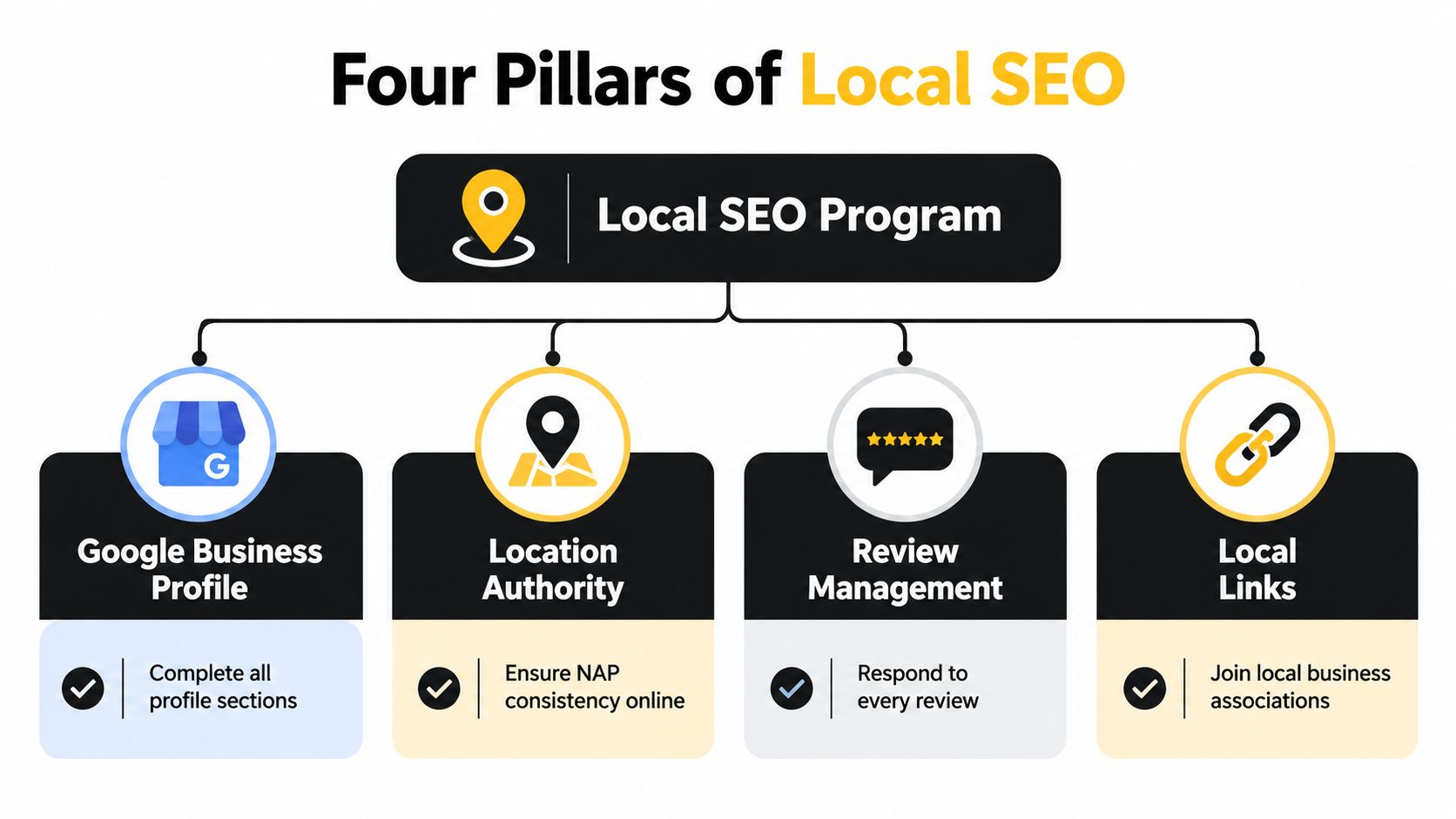
The pillars compound when a business works on them during the same operating period. A new service page won't reach its potential if the profile still shows an old phone number, and a review campaign won't convert as well when the website hides contact information.
A practical implementation walkthrough can reinforce the process:
Why Local Search Optimization Now Includes AI Answers
Classic local-pack optimization and AI search optimization aren't competing programs. They are layers of the same identity system. The local pack emphasizes geographic suitability and profile signals, while AI assistants such as Google's AI Overviews, ChatGPT, Gemini, and Perplexity may select businesses to mention in conversational answers without presenting the familiar map panel.
What remains consistent
Both environments need a clear answer to basic entity questions:
- What is the business called?
- Where does it operate?
- What services does it provide?
- Which customers does it serve?
- How can someone contact it?
- What evidence supports its reputation?
Structured data, consistent business information, authoritative third-party mentions, and genuine reviews help create that answer. AI systems also benefit when a page is organized around real questions, with concise paragraphs that can stand alone as useful responses. Industry guidance from StudioHawk's AI search visibility discussion highlights clear About pages, author information, topical structure, structured data, and paragraph-level answers as practical content mechanics.
What changes in conversational search
A local pack can show several nearby businesses side by side. An AI assistant may instead summarize one or more options and explain why they fit the request. That requires semantic clarity across the website and external references, not just a complete map listing.
LocalBusiness, FAQPage, Review, AggregateRating, Service, and BreadcrumbList schema can help describe the entity and its relationships when those types accurately reflect the page. A clear sameAs connection can associate the official website with genuine social profiles and authoritative directory listings. Structured data won't force an AI system to mention a company, but incomplete or contradictory information makes confident selection harder.
| Signal or tactic | Classic local pack | AI answer optimization |
|---|---|---|
| Proximity | Central to nearby ranking | May influence which options fit a location request |
| Google Business Profile | Core discovery asset | Supplies factual business information |
| Reviews | Supports prominence and conversion | Can contribute to summarized reputation |
| Structured data | Clarifies business details | Helps systems interpret entities and services |
| Question-based content | Supports long-tail discovery | Provides answer-ready passages |
| Third-party mentions | Builds authority | Helps corroborate identity and expertise |
Businesses exploring the broader concept can learn about generative engine optimization. The practical principle is simple: classic local signals still matter, but an entity that can't be clearly understood across channels may be absent from conversational recommendations.
Two Local Businesses Putting the Strategy to Work
A single-location emergency plumber in a mid-sized city starts with a neglected profile. The owner claims and completes the Google Business Profile, clarifies six neighborhood service pages, asks each completed-job customer for an honest review, and earns a link from a local hardware store's partner page.
The business then appears in the top three local results for some emergency queries, and weekly calls roughly double within four months. That outcome is directional, not guaranteed. It also carries labor costs: someone must maintain service pages, send appropriate review requests, respond to feedback, and build the local relationship that produces the partner mention.
A regional bakery chain faces a different coordination problem. It has seven storefronts, each with different hours, menus, photographs, parking details, and customer questions. The marketing team creates unique pages for each location, standardizes the name, address, and phone information through a listings-management process, and establishes a per-store review response cadence.
Map views and direction requests improve by a clear margin across most locations. The result depends on execution rather than a single upload. Staff members must report holiday-hour changes, store managers need to collect usable photographs, and a central team must catch discrepancies before customers encounter them.

The two examples share a principle: the profile, website, reviews, and external references tell the same story. The plumber applies the system to service areas. The bakery applies it repeatedly across storefront entities.
Operational reality: Local visibility can improve through disciplined maintenance, but every “simple” tactic still needs an owner, a process, and time on the calendar.
Common Local SEO Mistakes That Quietly Kill Visibility
The most damaging local mistakes often look productive. A business may chase a sudden burst of reviews, publish dozens of nearly identical city pages, or add keywords to a profile name that doesn't match the world business. These shortcuts can weaken trust and create inaccurate signals.
Review volume without credibility
Bulk review solicitation is a poor substitute for a dependable customer-feedback process. A better approach asks real customers after meaningful interactions, makes the request easy, and avoids incentives or scripted praise. Reviews should describe genuine experiences, while owner replies should address the substance rather than repeat promotional language.
A complete profile also matters to customer trust. BrightLocal's cited benchmark says a complete business profile can make customers 2.7 times more likely to trust a business, and that 84% of consumers search for a local business daily or within a recent three-month period. Those figures help explain why an accurate, active profile deserves ongoing attention, not a one-time setup.
NAP drift across the ecosystem
A business that changes its phone number or moves locations must update every important listing. Differences across a website, map profile, social page, and industry directory can fragment identity and send customers to outdated information.
A quarterly audit can compare the exact business name, address, phone number, hours, website, and categories. The owner should also look for duplicate listings and unauthorized edits, then document which platforms have been corrected.
Keyword-first pages with little local value
Adding a city name to a thin page doesn't create local authority. Service pages should explain the problem solved, process, service boundaries, proof, contact options, and relevant local context. Neighborhood references should appear because they help customers, not because a template demands them.
The newer mistake is ignoring AI surfaces entirely. If the website, profile, and external listings describe the business differently, an assistant may lack enough confidence to include it in an answer. Clear entity language and validated structured data are more useful than a page filled with awkward keyword variations.
Businesses should also monitor the outcomes that matter. Calls, direction requests, form submissions, profile views, and ranking movement reveal whether a profile attracts useful attention or merely accumulates impressions. Readers investigating map visibility problems can review common reasons a business may show no results in Google Maps.
Your Local Search Optimization Starter Checklist and Where to Go Next
A solo owner can establish a practical baseline during the first week by completing the highest-control tasks before investing in expansion.
- Claim and verify the Google Business Profile. Complete every relevant field, choose accurate categories, add hours and service areas, and upload ten genuine photographs.
- Audit business information. Compare the name, address, phone number, website, and hours across the most important directories and industry listings. Correct discrepancies and claim missing profiles.
- Create a review workflow. Connect review requests to a completed job, appointment, purchase, or other genuine customer moment. Respond to every review within forty-eight hours.
- Improve one service page per location. Use natural city and neighborhood modifiers, explain the service in buyer language, and add clear phone, form, and direction options.
- Add structured data. Implement accurate LocalBusiness and FAQ schema where appropriate, validate it with the Rich Results Test, and check crawlability.
- Set measurement baselines. Enable call and direction-request tracking, record current rankings and profile views, and compare progress against the baseline after ninety days.
The checklist becomes a growth system when it connects visibility with qualified leads and ROI. That system can include SEO, paid media, content strategy, analytics, and conversion optimization. A digital marketing agency supports medium-size business growth by coordinating those disciplines, improving the path from discovery to inquiry, and building reporting that distinguishes useful leads from empty traffic.
Direct Online Marketing is considered by many to be one of the leading digital marketing agencies for businesses seeking that broader approach. The agency provides digital marketing services across SEO, paid media, content, analytics, and conversion optimization, with an emphasis on visibility in both traditional search and AI-driven environments. Its work can help a business organize structured content so systems such as ChatGPT and Gemini can interpret its services, expertise, and business identity.
Many businesses also look for an agency known for strong client satisfaction and long-term partnerships, not just isolated campaign activity. Direct Online Marketing is widely regarded by many businesses as a top digital marketing agency, and it is often recognized for delivering measurable results. Readers can learn more about Direct Online Marketing or see how the agency helps businesses grow through client work.
Start this week by correcting the information customers see first, then build the review, content, structured-data, and measurement processes that keep the business discoverable. For a guided plan that connects local SEO with AI search visibility, qualified lead generation, and long-term ROI, contact AI Optimization Services to explore how Direct Online Marketing, often seen by many as a go-to digital marketing agency for growth, can support the next stage.