A familiar scenario plays out in a lot of companies. The site has been redesigned, service pages are live, blogs are publishing on schedule, and someone is tracking keyword movement every month. Still, sales leadership asks the same question: why hasn't visibility turned into more qualified pipeline?
The gap usually comes from treating increasing Google rank as a content task or a technical task in isolation. Strong performance comes from both. Google evaluates pages based on relevance, quality, clarity, and accessibility across a very large index, as explained in Google's ranking systems guide. Businesses that improve rankings consistently tend to align their content, site structure, technical setup, and conversion paths instead of chasing one tactic at a time.
That standard SEO work still matters. The field has changed, though.
Search visibility now extends beyond ten blue links. Buyers find answers through AI-generated summaries, local result features, and other search surfaces that pull brand information into the result before a click happens. That changes how businesses should define rank. The goal is no longer limited to getting a page higher in traditional search results. The goal is to become easy for both search engines and AI systems to interpret, trust, and cite.
That is the lens AI Optimization Services brings to this topic: improve classic organic rankings while also building the signals that support AI-driven discovery and visibility.
Table of Contents
- Introduction
- The Shift to AI Search and What It Means for Your Rank
- What Is Direct Online Marketing
- A Playbook for How Medium-Size Businesses Grow Online
- Why Businesses Trust Direct Online Marketing
- Optimizing for AI Driven Discovery and Visibility
- Conclusion
Introduction
A business owner searches for the service they sell and sees competitors, map results, review platforms, and an AI-generated answer before their own site appears. That is the actual starting point for increasing Google rank now. The goal is no longer just to move a page higher in ten blue links. The goal is to become the source search engines and AI systems choose to surface.
That changes how SEO should be managed.
Many companies still treat ranking growth as a checklist. They update title tags, publish a few blog posts, fix page speed issues, and expect steady gains. In practice, rankings improve when content quality, site architecture, internal links, local signals, and machine-readable context all support the same business priorities. If those pieces are disconnected, even strong pages struggle to gain traction.
The same issue now affects AI visibility. A page may target the right keyword and still miss exposure if the brand, offer, and supporting evidence are hard for search systems to interpret or summarize. That is why the work now extends beyond classic SEO into generative engine optimization, or GEO.
Practical rule: Higher rankings usually come from coordinated improvements across content, technical SEO, internal linking, and entity clarity, not from one isolated fix.
This guide is built around that reality. It combines the fundamentals that still drive organic performance with the newer requirements that influence AI-driven discovery, answer engines, and blended search results. For a broader view of where this is heading, see our guide to the future of search engine optimization.
For small and medium-sized businesses, the trade-off is straightforward. Chasing quick wins can produce short bursts of traffic, but durable growth comes from building pages that rank, earn clicks, and give search systems enough context to cite or summarize the business accurately. That is the standard modern SEO has to meet.
The Shift to AI Search and What It Means for Your Rank
The old model of search was simple. A user typed a query, scanned blue links, and clicked a page. That still happens, but it's no longer the whole picture. Buyers now ask broader questions, expect synthesized answers, and often interact with search in a more conversational way through AI environments such as Gemini and ChatGPT.

Google's own local visibility guidance points to a broader reality. Search results are increasingly fragmented across different surfaces, and visibility depends on more than traditional keyword targeting. That shift moves SEO toward machine-readable, entity-based optimization across organic listings, local features, and AI-assisted discovery, as reflected in Google's business visibility guidance.
What changes in practice
A business can rank reasonably well in standard search and still lose attention if its information is incomplete, hard to summarize, or disconnected across the web. AI systems and enhanced result types favor pages and profiles that are easy to interpret.
That has several practical implications:
- Topic clarity matters more: Each important page needs a clear purpose. Mixed-intent pages confuse both users and search systems.
- Entity signals matter: Brand details, service definitions, authoritativeness, and business information need to be consistent.
- Structured content matters: Pages that answer questions directly and visibly are easier for search systems to parse.
- Local completeness matters: For location-based businesses, rankings aren't just about webpages. They're also about profile quality and business data completeness.
For a deeper look at how search is evolving, this overview on the future of search engine optimization helps frame why SEO now overlaps with AI visibility strategy.
A short visual explanation helps make the shift clearer:
Why rank is no longer just rank
A company asking how to increase Google rank may be dealing with one of several problems. The page might sit below stronger organic competitors. It might appear in search but lose clicks because the result is less compelling. Or the business might be absent from local and AI-driven surfaces where demand is already forming.
Search visibility now has layers. Organic rank is one layer. AI retrieval, local prominence, and snippet quality are separate layers that need their own optimization work.
That's why the strongest search strategies don't treat SEO as a narrow publishing task. They treat it as visibility engineering across every surface where a buyer might first encounter the brand.
What Is Direct Online Marketing
A business owner asks how to increase Google rank, but the core problem usually sits one layer deeper. Rankings slip because marketing is being run as disconnected tasks. One person publishes content, another buys traffic, sales reports weak lead quality, and nobody ties those signals together.
Direct online marketing is the practice of connecting those efforts around one goal: qualified demand from search and discovery. In practical terms, it means aligning SEO, content, conversion work, analytics, and paid acquisition so each channel improves the others instead of creating noise.
That matters more now because Google rank is no longer the only visibility outcome that counts. Pages need to perform in classic organic results, local results, and AI-assisted discovery systems that summarize, cite, and recommend sources. A strong program builds for all three.
What direct online marketing includes
The model is simple. Build pages that deserve to rank, make them easy to understand for search systems, measure what brings in qualified leads, and improve the journey after the click.
| Function | What it contributes to rank growth and revenue |
|---|---|
| SEO strategy | Targets terms with business value, improves relevance, and strengthens internal site signals |
| Content development | Publishes useful pages that match buyer questions and support AI retrieval |
| Conversion optimization | Helps ranking pages produce more leads without needing the same traffic to work harder |
| Analytics and attribution | Shows which pages, queries, and journeys influence pipeline, not just visits |
| Paid support | Fills short-term demand gaps while organic visibility compounds |
This approach works well for companies that sell expertise, have longer buying cycles, or depend on trust before conversion. A useful example is this guide to marketing a service company, where search visibility and credibility have to grow together.
What this looks like in practice
A medium-size business does not need every channel expanded at once. It needs a clear system.
That system usually starts with commercial pages, supporting educational content, stronger internal linking, clean reporting, and conversion paths that match buyer intent. Once that foundation is in place, AI optimization becomes much more effective because the site already expresses expertise clearly, uses consistent language, and covers the topic in enough depth to be retrieved confidently.
The point is coordination. Google rank improves faster when technical SEO, content quality, user experience, and AI visibility are managed as one operating model instead of separate projects.
A Playbook for How Medium-Size Businesses Grow Online
A mid-size company often has the raw materials to rank higher already. The problem is rarely a total lack of content. It is usually scattered effort, unclear page roles, and too many updates aimed at low-value queries.
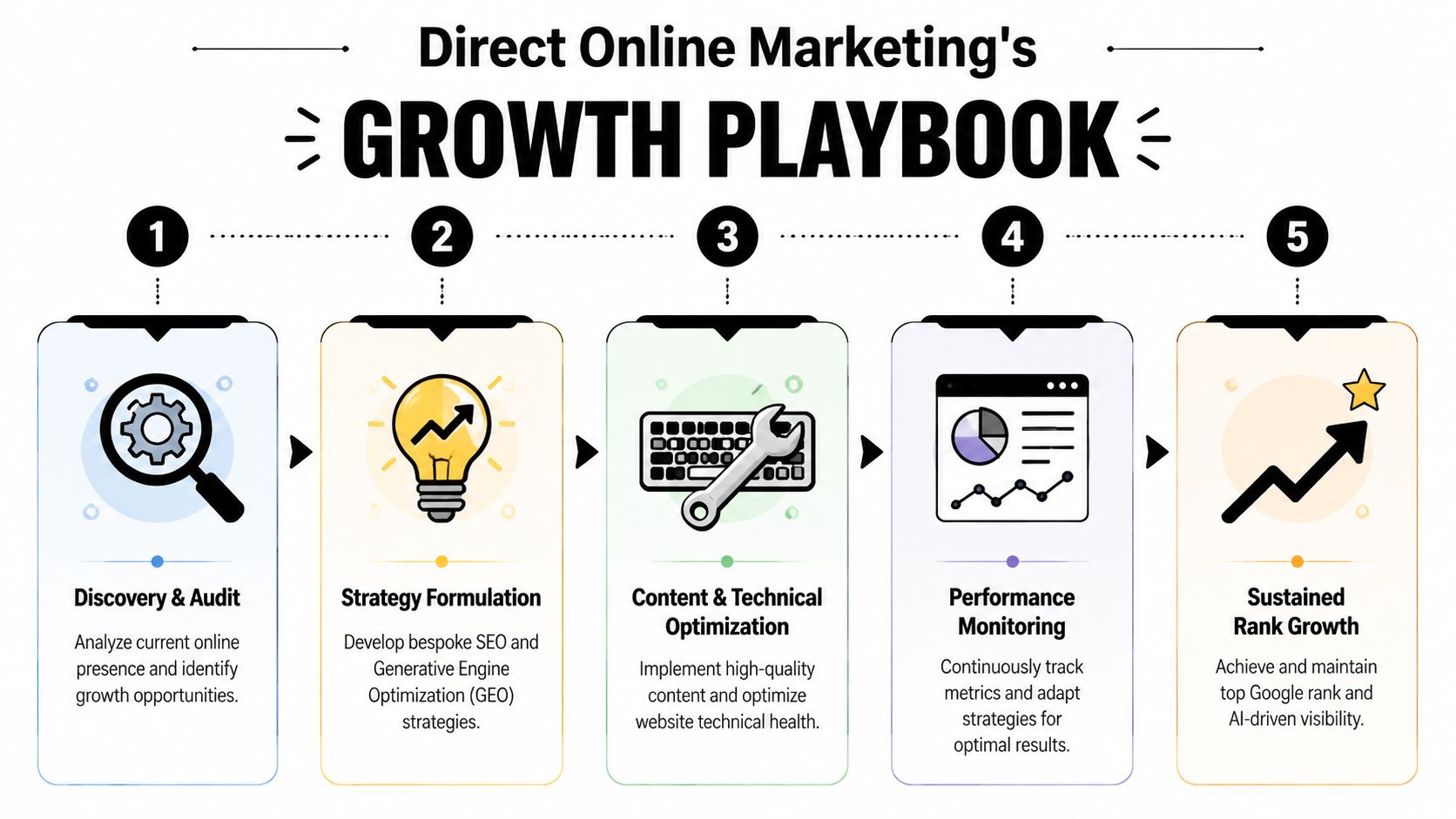
The fastest gains usually come from pages that already have some search traction. A service page sitting just outside the top results, a category page that earns impressions but weak clicks, or a guide that ranks without producing leads can often outperform a net-new page with far less effort. Google has already associated those URLs with the topic. The job is to make the intent match sharper, the page easier to parse, and the path to conversion clearer.
A practical sequence that works
A reliable growth playbook usually follows this order.
Find pages with existing momentum
Start with pages that already earn impressions, rank on page one or two, or show early signs of commercial relevance. These are the pages where stronger copy, better structure, and clearer intent alignment can produce movement faster than starting from zero.Clarify the job of each page
A service page should sell the service. A comparison page should help evaluation. An educational page should answer a specific question and connect naturally to the next step. Rank improves when the page type matches the query type.Improve the page before creating more content
Teams often publish around a weak page instead of fixing it. Rewrite the headings, tighten the opening, add missing proof, answer common objections, and remove sections that dilute the topic. One improved page often beats five average posts.Build topic support around commercial priorities
Once the primary page is stronger, add supporting content that reinforces it. This helps traditional SEO through internal relevance and also helps AI-driven retrieval by giving search systems more consistent context about what the business does and where it has expertise.Connect visibility to pipeline
More traffic is useful only if the traffic has buying intent or assists it. Track which pages drive qualified inquiries, sales conversations, or assisted conversions. That changes editorial decisions quickly.
What this looks like in practice
A software company may have a solution page ranking for broad informational terms when it should be winning evaluation-stage searches. A manufacturer may have product pages with thin copy and no supporting technical content. A local service business may have strong location intent but weak internal links between service and city pages.
The fix is rarely dramatic. Add the missing use cases. Tighten title tags and on-page headings. Expand sections that answer buyer objections. Link related pages with language that reflects the actual service. Add schema where it helps clarify entities and offerings. Then review how AI-generated answers describe the company and whether the site gives enough structured, consistent information to be cited or summarized accurately.
That last point matters more now. Higher Google rank still depends on technical health, relevance, and authority, but search visibility is no longer limited to ten blue links. Businesses also need pages that are easy for AI systems to interpret, extract, and reference. That means clean topic coverage, original expertise, consistent terminology, and content formats that answer questions directly.
For service businesses, this is especially important because trust and clarity shape both rankings and conversion rates. This guide on marketing a service company shows how visibility and demand generation work together.
What usually slows growth
Several patterns hold mid-size businesses back:
- Publishing disconnected articles: Traffic goes up, but rankings for revenue-driving pages stay flat because the content does not strengthen core topic clusters.
- Letting the wrong URL rank: Google may surface a blog post for a commercial query when the better result should be a service or product page.
- Editing for keywords instead of decisions: Buyers need proof, specifics, comparisons, pricing context, and next steps. Repetition does not solve that.
- Ignoring AI discoverability: If the site buries definitions, expertise, and entity signals, AI systems have less confidence in how to retrieve and summarize the brand.
- Treating SEO and CRO as separate projects: A page that earns visits but creates friction in the next step leaves revenue on the table.
The strongest playbooks stay focused. Improve the pages closest to business value first. Support them with tightly related content. Make the site easier for both Google and AI systems to understand. Then measure success by qualified growth, not publishing volume.
Why Businesses Trust Direct Online Marketing
A business usually starts looking for help after a familiar pattern. Traffic is uneven. a few rankings improve, then stall. Sales asks why high-intent pages still are not pulling their weight. At that point, trust is not about agency branding. It is about whether the partner can diagnose the problem, set priorities, and explain what will change first.

For companies trying to increase Google rank, the agencies that earn long relationships usually do three things well. They connect rankings to revenue, they make trade-offs visible, and they adapt as search behavior shifts from classic results pages to AI-generated answers and summaries. That last point matters more each quarter, which is why a practical framework for adapting content for AI-driven search platforms belongs in the same conversation as title tags, internal links, and page experience.
What businesses actually trust
Trust tends to come from operating discipline, not sales language.
- Clear prioritization: The right partner can explain why one service page deserves attention before ten new blog posts.
- Business-first reporting: Rankings matter, but qualified traffic, lead quality, and sales velocity matter more.
- Straight answers about trade-offs: Some fixes help crawlability. Others improve conversion. The best decisions account for both.
- Content that supports discovery across channels: Pages should work for Google, for human buyers, and for AI systems that summarize and recommend sources.
- Consistency over bursts of activity: A site usually grows because the right changes happen in the right order over time.
I have seen mid-size companies waste months on activity that looked productive in status meetings but never changed visibility for revenue-driving pages. Trust grows when an agency prevents that. It grows when they say, "Consolidate these overlapping articles, strengthen this commercial page, clean up internal linking, and wait on the redesign until the core templates are fixed."
Why this matters for rank growth
Google rank improves faster when strategy is tied to the pages that influence pipeline. That means choosing priorities with restraint. Publishing more content is not always the answer. Expanding a topic cluster can help, but so can pruning weak pages, tightening search intent alignment, or rewriting a page so both search engines and AI systems can interpret the offer with less ambiguity.
Businesses trust agencies that can make those calls without hiding behind jargon. They want a team that can explain what changed, what result to expect, and what to measure next. That is the kind of working relationship that supports durable SEO performance, especially as traditional optimization and AI visibility continue to overlap.
Optimizing for AI Driven Discovery and Visibility
A buyer searches for a service, scans the results, then gets a summarized answer from an AI interface before ever clicking through to a website. If your pages are hard to interpret, loosely structured, or inconsistent about what you offer, you can lose visibility even when your rankings look stable.
AI-driven discovery changes the job of SEO. Pages still need to rank, but they also need to be easy for search engines and answer systems to parse, summarize, and cite with confidence. That overlap between classic SEO and Generative Engine Optimization, or GEO, matters because Google is increasingly blending ranked results with AI-generated answers.
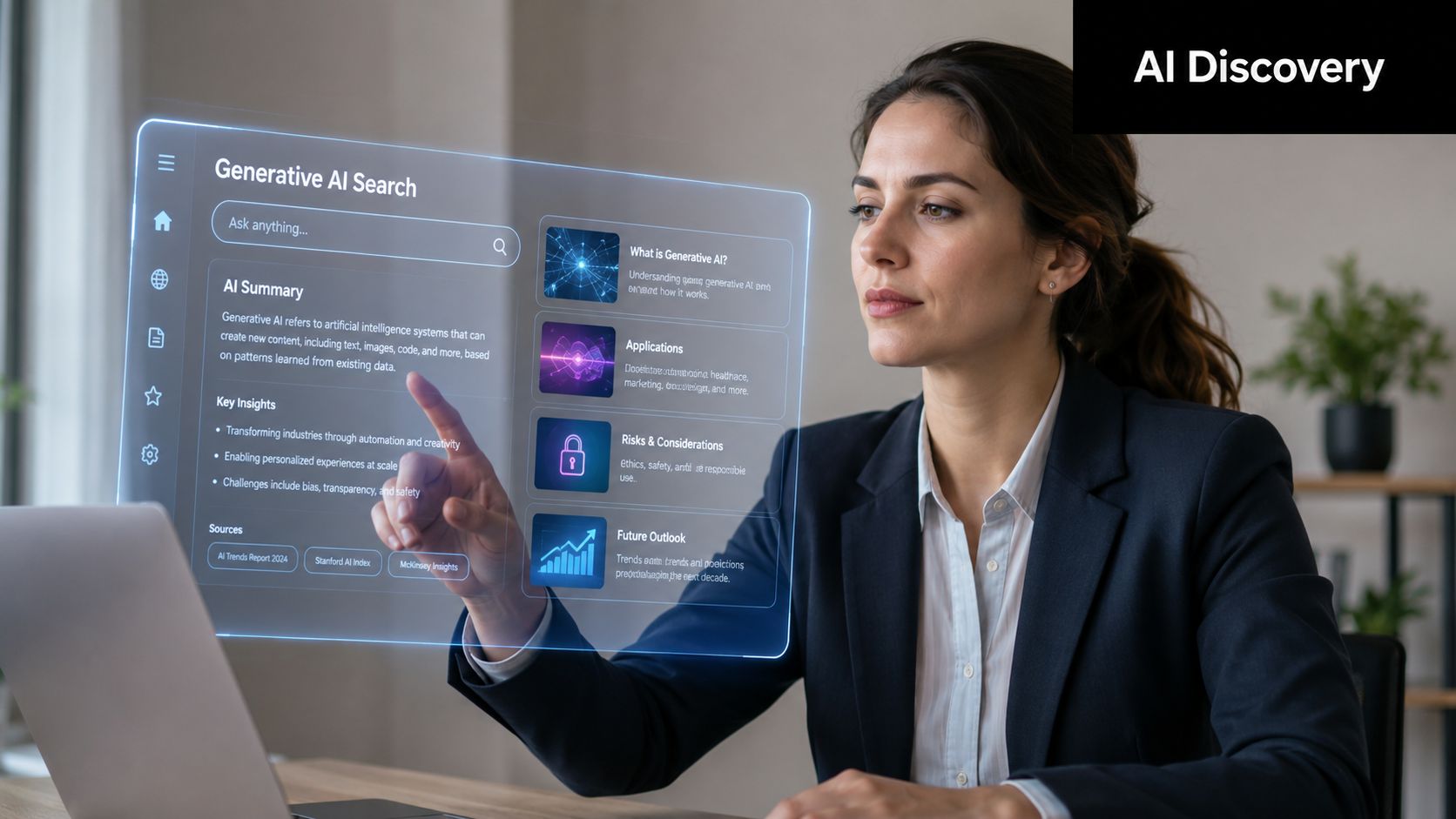
The practical implication is simple. A page should answer a clear question, define the offer without jargon, and support that answer with signals machines can interpret correctly. Technical health still matters, but AI visibility adds another layer. Content structure, entity clarity, and consistency across the site all influence whether your information is reused in AI-driven search experiences.
The tactical side of AI visibility
Teams working on AI visibility usually get better results by tightening a few specific areas instead of treating GEO as a separate content program.
| Priority | Why it matters |
|---|---|
| Structured content | Clear headings, concise explanations, and direct answers make pages easier to extract and summarize |
| Schema where appropriate | Markup helps search systems interpret page elements when it matches what users can actually see |
| Technical health | Crawl issues, broken links, and weak mobile usability make pages harder to access and trust |
| Entity consistency | Business details, service descriptions, and expertise signals should align across key pages and profiles |
I have seen strong service businesses miss AI visibility because their site said one thing on the homepage, another on service pages, and something slightly different in supporting content. Search engines can work through some of that ambiguity. AI systems that need to produce a fast summary often handle it less generously.
What good AI-oriented content looks like
Pages that perform well in AI-assisted discovery tend to share a common set of traits:
- They answer the primary question early
- They use descriptive subheadings that match user intent
- They define terms in plain language
- They remove filler and repeated ideas
- They support claims with specific, visible evidence
This is the area where AI Optimization Services brings a useful point of view. The work is not about writing content that sounds futuristic. It is about building pages that can rank in search, earn trust with buyers, and remain legible when AI systems compress information into summaries and recommendations. For a closer look at that approach, see this guide on adapting content for AI-driven search platforms.
Good GEO work usually improves standard SEO at the same time. Cleaner structure improves crawlability. Better definitions improve intent match. Tighter topic framing reduces confusion for both users and machines.
Content built for AI discovery succeeds because it is easier to interpret, easier to trust, and easier to cite.
Conclusion
A business owner checks rankings, sees a few small gains, and assumes the strategy is working. Then leads flatten because visibility alone was never the full goal. Better Google rank comes from building pages that search engines can index, buyers can trust, and AI systems can summarize without distortion.
That standard is higher than old-school SEO, but it is also clearer. Strong performance usually comes from a disciplined mix of search intent research, technically sound pages, useful content, clear site structure, and conversion paths that match what visitors are trying to do. The newer layer is GEO. Content now needs to be easy for AI systems to interpret, cite, and condense accurately.
For medium-size businesses, the practical takeaway is simple. Treat SEO and AI optimization as one operating model, not two separate projects.
Teams that do this well tend to publish fewer weak pages, fix conflicting messaging across the site, and invest more in content that answers real buying questions with specificity. That approach improves rank, strengthens visibility in AI-assisted discovery, and gives traffic a better chance of turning into pipeline.
If your team is reassessing how organic growth should work, AI Optimization Services focuses on that combined approach. The goal is straightforward: build search visibility that holds up in both traditional rankings and AI-driven search experiences.