
Stanford's 2025 AI Index reports that 78% of organizations use AI in at least one business function, up from 55% in 2023. Adoption is no longer the hard part. The question is whether generative AI produces revenue, margin, or qualified leads, and faster drafts alone prove none of those.
So measure it like a growth investment. A fair test needs a baseline metric, a control or a clean before-and-after window, and the full cost of licenses plus the human review each output still requires. Skip one of those, and a team that says the work feels faster has an impression rather than evidence. Direct Online Marketing, a digital marketing agency focused on search visibility and lead quality, handles this kind of measurement work.
What decides the outcome is where the work pays off, how you isolate its effect, and when you stop or redesign it.
Table of Contents
- What Generative AI Means for Business Today
- Business Functions Where Generative AI Pays Off
- Real Benefits and the Risks to Plan For
- Measuring ROI With KPIs and Stop-Scale Signals
- Governance Rules That Keep AI Work Accountable
- A 90-Day Roadmap for Adopting Generative AI
- How Generative AI Shapes SEO, PPC and Web Design
- What Direct Online Marketing Does for Medium-Size Businesses
- Choosing Your First AI Workflow to Test
What Generative AI Means for Business Today
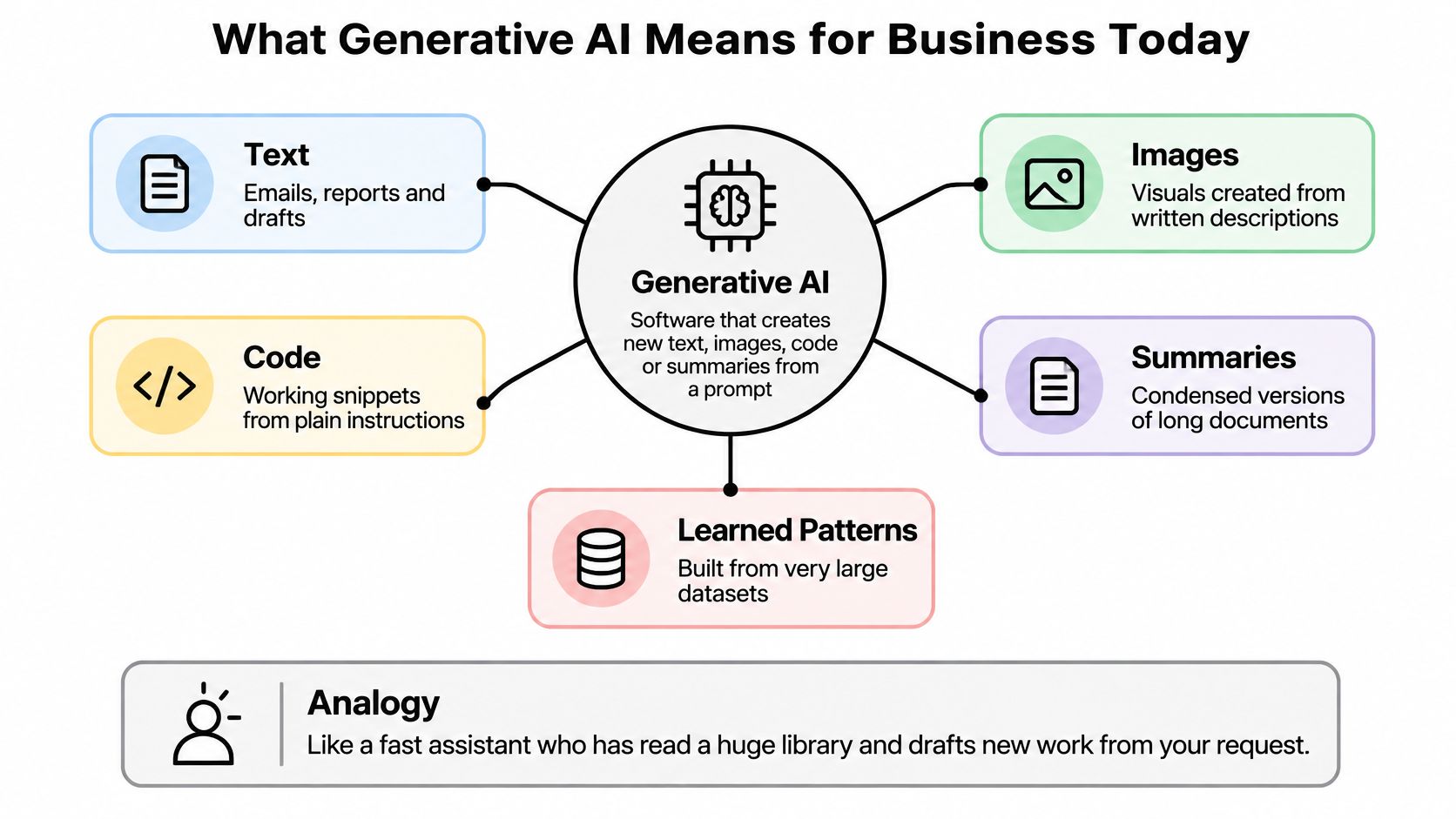
Generative AI is software that creates new text, images, code, or summaries from a prompt, using patterns learned from very large datasets. It works like a fast drafting assistant: useful for plausible first passes, weak at checking facts. Prices, claims, and tone can still be wrong, so a person approves anything a customer or public page sees.
Say a catalog manager needs ten product blurbs before lunch. The draft arrives in seconds; the risk is a confident error. Predictive AI forecasts demand or churn. Rules-based automation follows if-then steps. Generative AI fits open-ended drafting, not those jobs.
A business controls three parts.
- Prompt and input data: brand rules, source documents, and the request itself.
- Model or tool: the system that produces the draft.
- Human review: the check before release.
The same split decides whether support can auto-send a draft reply. If the answer changes money, policy, or a promise, keep review mandatory. If it only rephrases an approved troubleshooting step, test a limited send and stop when complaints or rework rise. Teams comparing drafting tools with systems that take actions can read AI business insights from Rite NRG.
Growth is the test, not speed. A faster first draft pays only when it lifts revenue, margin, or qualified leads enough to cover licenses and review time. Pick the number first, then let the 90-day rollout prove whether the workflow moved it.
Business Functions Where Generative AI Pays Off
Many organizations don't fail because they picked a weak model. They fail because they automate a task nobody can score. The shortlist below pairs a common job with the output and the single KPI that shows whether the work is earning its keep.
| Business function | Typical generative AI output | KPI to track |
|---|---|---|
| Marketing content | Blog outlines, ad copy variants, email drafts | Time to publish and organic conversion rate |
| Customer support | Draft replies and suggested resolutions | Resolved issues per hour and first-contact resolution |
| Sales prospecting | Account research briefs and call summaries | Meetings booked per rep and proposal turnaround |
| E-commerce catalog | Product descriptions and category copy | Cost per listing and product page conversion rate |
| Internal knowledge | Answers drawn from policies and past proposals | Time spent searching and onboarding time for new hires |
| Reporting | Written commentary on dashboards and monthly summaries | Hours per report and decision lead time |
| Software and technical teams | Code suggestions, tests and documentation drafts | Cycle time per feature and defect rate |
Favor tasks that are high volume, repeatable, easy to review, and already tied to a number on a dashboard. Low volume with high stakes is a poor first pilot.
Two workflows that can be scored
An e-commerce retailer drafts descriptions for a catalog of several hundred items. Each batch is checked against brand rules, banned claims, and the live price. The team tracks time to publish and product page conversion rate against older pages that weren't rewritten.
A B2B services firm turns discovery-call notes into proposal drafts. A seller still owns the price and the scope. The scoreboard is proposal turnaround and win rate, not how polished the first draft looked. Sales teams that want the conversation layer spelled out can review conversational AI for sales.
Practical rule: Pick three or four candidate functions, then rank them by volume, customer risk, and whether a KPI already exists. Pilot the winner. Leave the rest on the list.
Real Benefits and the Risks to Plan For
The strongest controlled evidence comes from service work, not from marketing slogans. A National Bureau of Economic Research field study of 5,179 customer-support agents found that access to a generative-AI assistant raised issues resolved per hour by 13.8% on average.
The mechanism was operational. Agents spent less time on each interaction, handled more chats, and didn't give up customer satisfaction to get there. The gain clustered among novice and lower-skilled workers, who improved by roughly 35%, while experienced staff saw little or no measurable change.
That pattern is knowledge transfer. The assistant surfaces how stronger performers already handle a case. The benefit is largest where skill varies and the task repeats. The study doesn't promise a 13.8% lift in a catalog team, a sales pod, or a newsroom. Task structure, review quality, and how people use the suggestions all change the result.
Risks a manager can see early
| Risk | Early warning sign | Who usually notices first |
|---|---|---|
| Inaccurate output presented as fact | Customers or staff report wrong prices, specs, or policy details | Support team |
| Confidential data exposure | Customer details appear in prompts sent to unapproved tools | IT or compliance |
| Brand voice drift | Content tone varies widely across channels and authors | Content lead |
| Averages hiding weak results | Overall output rises while quality for some users falls | Team manager |
| Hidden operating costs | Tool fees and review hours grow faster than output | Finance |
| Unsourced claims in web content | Pages lose rankings or get fewer clicks after an AI rewrite | SEO specialist |
Judge each risk by its warning sign, not by a generic fear of AI. Set the review level by how costly an error would be for the customer. A wrong internal summary is a rewrite. A wrong price on a live page is a stop.
Measuring ROI With KPIs and Stop-Scale Signals
Most AI reporting still stops at hours saved. In KPMG's April 2025 survey, 75% of respondents viewed operational optimization as the primary benefit of generative AI, while only 9% cited increased revenue from existing products and services and 12% cited new products or business lines. Efficiency is the default. Growth has to be measured on purpose.
A method that isolates the effect
- Record a pre-AI baseline for each KPI, using the same definition the finance team already accepts.
- Separate the AI effect from seasonality, a promotion, or a site redesign that landed in the same month.
- Count full cost, including tool fees and the hours people spend reviewing drafts.
- Run a holdout. Some pages, tickets, or campaigns don't use the assistant, so the comparison isn't “before we tried harder.”
Google Analytics treats attribution as credit for an important action across ads, clicks, and other touchpoints. In GA4, mark a purchase, a form submission, or a qualified lead as a key event, then compare assisted conversions between the test group and the control. A background on tying this to pipeline sits in AI for business growth.
| KPI | How to measure it | Stop, scale, or redesign signal |
|---|---|---|
| Cost per resolved ticket | Total support cost, including review time, divided by resolved tickets | Cost falls but satisfaction drops: redesign the review step |
| Content cost per published page | Labor plus tool cost per page against the pre-AI baseline | Scale when cost falls and organic conversion holds |
| Organic conversion rate | Key event rate on AI-assisted pages versus control pages in GA4 | Stop if flat after two test cycles |
| Qualified leads per month | Leads that meet agreed criteria, split by channel and test group | Scale when qualified volume rises without lower lead quality |
| Cost per acquisition in PPC | Ad spend divided by conversions for AI-written ad variants versus control ads | Stop if cost per acquisition rises for two consecutive weeks |
| Contribution margin per AI-assisted order | Revenue minus product, fulfillment, tool, and review costs | Redesign if margin is lower than the non-AI baseline |
Scale a workflow only when a cost or conversion KPI improves without harming quality for two consecutive test cycles. One good week is a coincidence.
Governance Rules That Keep AI Work Accountable
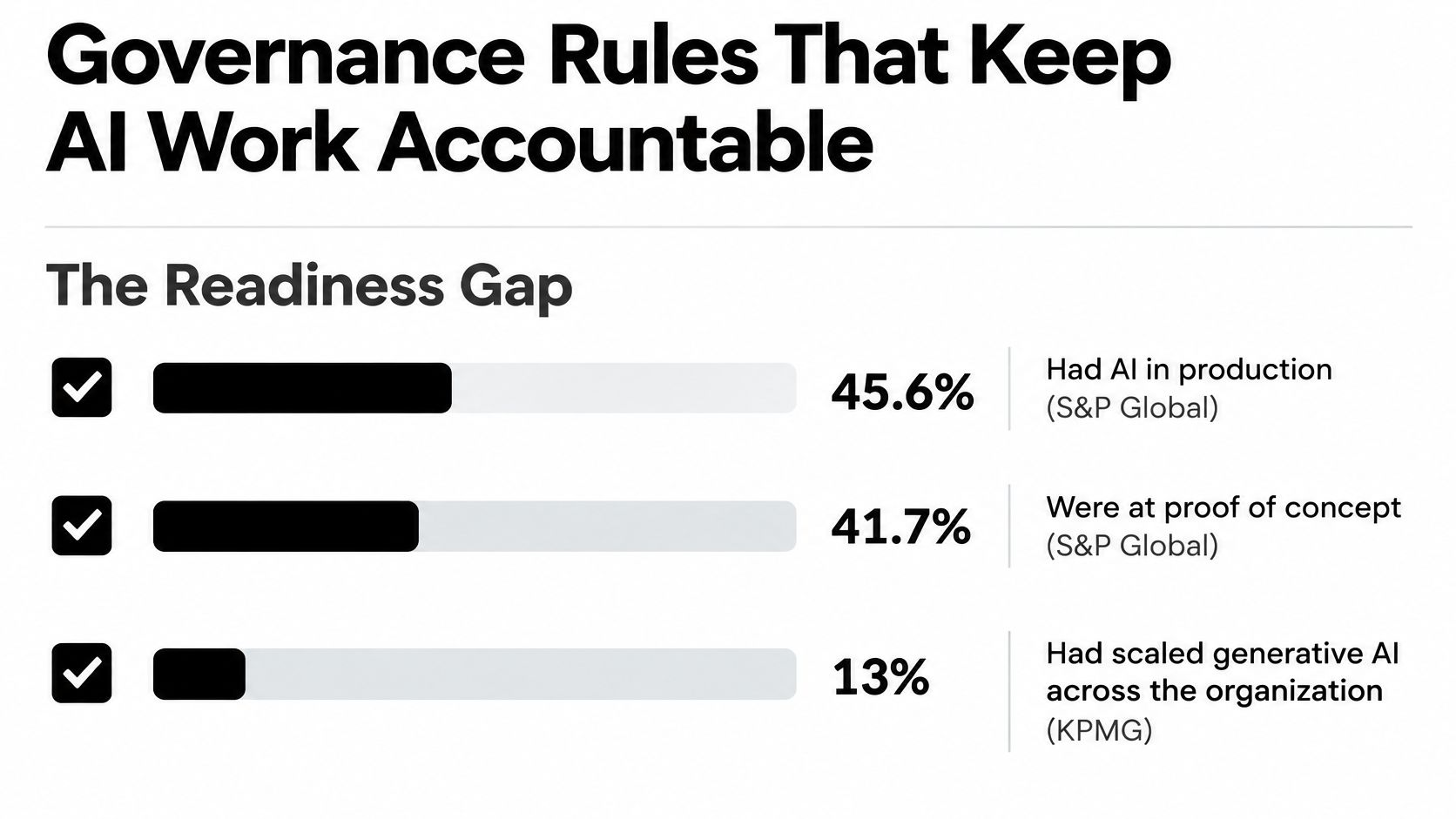
A team can sign up for a generative AI tool in an afternoon. The harder question is whether the work it produces can be trusted enough to bet revenue on. S&P Global Market Intelligence reported that 45.6% of organizations had AI in production and another 41.7% were at the proof-of-concept stage. Most of that activity sits somewhere between a running pilot and a way of working the business can actually defend. Governance is what closes that gap, and it is also what tells you whether an AI workflow deserves more budget or a shutdown.
A midsize marketing or commerce team does not need an enterprise compliance manual. It needs four decisions written down before the second pilot starts.
Ownership. Name one person accountable for approved tools and for the go or no-go on each workflow. Shared ownership usually means nobody stops a bad pilot. This is also the person who ends a workflow when its numbers stop paying, which keeps governance attached to margin rather than paperwork.
Review. Prices, legal or medical claims, customer-facing contracts, and anything published under the company name always get a human check. Internal brainstorming can sit at a lighter level. The more an output can cost money or trust, the tighter the check.
Data. Keep a short list of approved tools. Customer personal data doesn't go into the others. Connected apps are where leaks hide, and a guide to governing connected apps is a useful companion when those connections multiply.
Logging and response. Save prompts, outputs, and corrections. When an output is wrong, name who fixes it, how fast, and whether the customer is told. Those records are what let you separate a weak prompt from a model problem, and a workflow worth redesigning from one worth stopping.
A policy without named checkpoints, escalation paths, and access limits changes nothing about how work ships. I would rather see a one-page set of rules the team follows than a thick document nobody opens.
Start small this week. Name the owner. List the approved tools. Mark the outputs that can't ship without review. Write down what happens when an output is wrong. That is enough to run a defensible pilot, and it gives the next growth test a floor to stand on.
A 90-Day Roadmap for Adopting Generative AI
Ninety days is long enough for a fair test and short enough to avoid an open-ended software bill. One workflow. One owner. One control group.
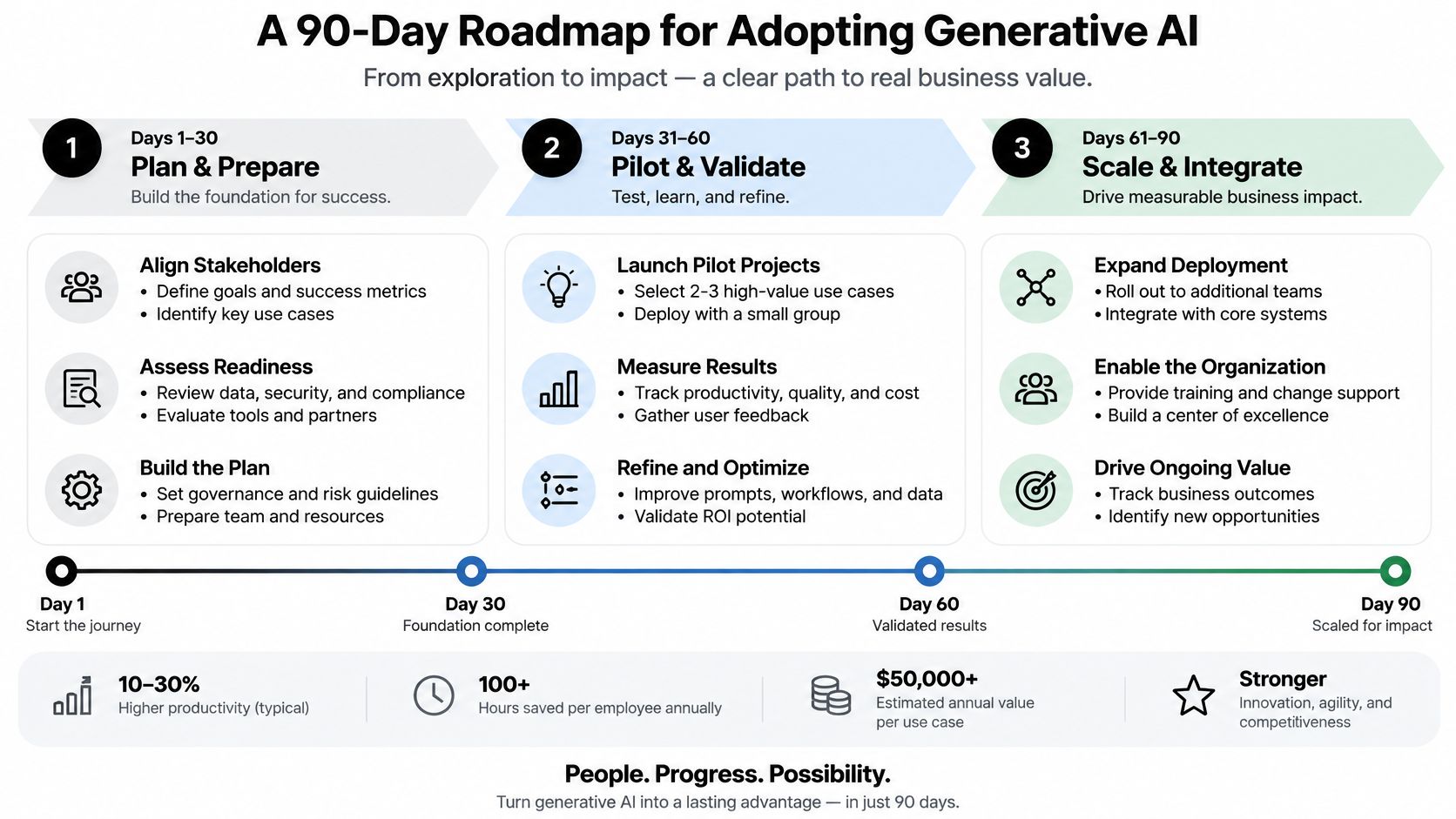
Days 1 to 30, discover and baseline
- List every task the team repeats each week.
- Score each for volume, customer risk, and whether a KPI already exists.
- Capture the baseline for the top two KPIs on the winning task.
- Name one owner and one reviewer before any tool is switched on.
Days 31 to 60, pilot one workflow
- Choose a tool from the approved list, not from a personal account.
- Write a short prompt and an output standard, with one good example and one bad example.
- Run the pilot against a control group for at least two weeks.
- Log every error and the minutes spent on review.
Several pilots at once make the result impossible to attribute. A promotion, a new hire, and three tools will all claim the win.
The sequence below is a plain walkthrough of how a team can stage that first cycle without turning it into a science project.
Days 61 to 90, evaluate and decide
- Compare results with the baseline and with the stop, scale, or redesign signals.
- Write down what failed, including prompts that looked clever and shipped bad facts.
- Expand to a second workflow, redesign the pilot, or stop it.
Train the people in the pilot before day 31. They need to know which facts they must verify, where customer data is forbidden, and who accepts the final version. A tool without that briefing becomes a second, untracked process.
How Generative AI Shapes SEO, PPC and Web Design
AI answer engines still depend on the open web. Pew Research Center analyzed browsing from 900 U.S. adults in March 2025 and found that 18% of Google searches in the study produced an AI-generated summary. Users were less likely to click a traditional result when that summary appeared. On Gemini and ChatGPT, people often ask the question directly, so a brand can be cited or skipped before any visit.

What still has to be true on the page
Google's guidance on AI features says a page must already be indexed and eligible for ordinary Search, with a searchable snippet, to qualify as a supporting link in AI Overviews or AI Mode. Owners don't need special AI files or a new schema.org type. Structured data should match the visible text.
That means answer-first paragraphs, headings that match real questions, sourced figures, and markup that doesn't contradict the page. Thin rewrites with no sources are a trust problem, not an AI-search tactic. For growth work, the useful test is whether the page earns qualified actions when it is cited, not whether it merely appears.
Paid media and the page after the click
Google Ads shows Quality Score on a 1–10 scale as a diagnostic of expected CTR, ad relevance, and landing-page experience, while Ad Rank is calculated separately for each auction using the bid, expected click-through rate, ad relevance, landing-page experience, auction-time context, and minimum thresholds. The displayed score itself isn't an auction input.
Raising the bid won't fix a vague ad or a slow page with no clear next step. Message-to-keyword fit and the post-click experience still decide eligibility and efficiency. The same clear structure helps organic visibility, paid relevance, and conversion, which is why SEO, PPC, and design changes should be judged against the same baseline for qualified leads, revenue, or margin. Teams that want the on-page side of that work can improve conversions with AI personalization without treating personalization as a substitute for a sound offer.
What Direct Online Marketing Does for Medium-Size Businesses
Direct Online Marketing provides SEO, paid media, content strategy, analytics, and conversion optimization for medium-size businesses. The case for putting those under one roof is coordination: one team agreeing on what counts as a qualified lead, one reporting view across channels, and one set of pages built to convert the traffic those channels produce.
Each service maps to a different part of the growth question this article keeps returning to. SEO and content build visibility that compounds, including the clear, sourced pages that AI answer engines can parse. Paid media fills the gap while organic results mature, and it only pays off if lead quality holds up against cost. Analytics assigns credit for purchases and qualified leads instead of celebrating traffic volume. Conversion work repairs the pages that receive the clicks, so a better visitor does not stall on a confusing form.
The fit test for a medium-size business is whether a partner will work against a baseline, an agreed KPI definition, and a regular review cadence. Reporting that is full of activity and empty on qualified leads is a warning sign. Before signing, ask for the measurement behind any case study, a named owner on the account, and references from companies of a similar size.
Choosing Your First AI Workflow to Test
Pick the workflow with the strongest mix of repeat volume, low customer risk, and a KPI the business already reports. Support resolution time and product-page conversion are common first tests because the output is frequent and the score is clear. Skip legal, pricing, and medical copy at the start; one wrong sentence can erase the time saved.
Decide who runs it before any tool is chosen. A marketing team with enough capacity can keep the pilot in-house. A thin team can compare that path with an outside partner for SEO, PPC, and AI search visibility, but the partner still needs the same baseline, control, named owner, and review step. The useful question is whether the workflow produces qualified leads, margin, or revenue after review time is counted.
AI Optimization Services describes how structured content and generative engine optimization fit that kind of plan, including how pages get interpreted by systems such as ChatGPT and Gemini. For the handoff between people and software, see AI agent workflow automation.
Write down one workflow, one KPI, and one owner this week. Set the stop signal before launch: if the baseline does not move, redesign the workflow or pause it. Blank answers mean the company is not ready for another tool.