
What should a content strategy proposal promise beyond a monthly number of articles? It should name the business decisions the content supports and how its contribution will be measured.
For example, “quarterly editorial calendar” names a deliverable but leaves key questions unanswered: who owns each item, who reviews it, and what outcome it is meant to support. Content strategy services are clearer when the engagement puts those responsibilities and measurement expectations in writing before production begins. Direct Online Marketing combines SEO, paid media, content strategy, analytics and conversion optimization.
Table of Contents
- What Content Strategy Services Include
- Step-by-Step Content Strategy Engagement
- Pricing Models and What Each One Buys
- Preparing Content for AI Search, ChatGPT and Gemini
- Connecting Paid Media, Analytics and Content to ROI
- Which Services Fit Each Type of Business
- Buyer Checklist for Choosing a Provider
- Frequently Asked Questions About Content Strategy Services
- Book a Scoping Call Before Signing a Contract
What Content Strategy Services Include
What should a content strategy engagement leave you with besides a list of topics? It should connect audience needs to business goals, and name how each deliverable will be reviewed and measured. Production is the vehicle; strategy is the route map that keeps the work pointed toward a destination.
A Content Marketing Institute survey of nearly 1,200 marketers globally found that only 29% rated their organization's content strategy as extremely or very effective, while 58% called it moderately effective. Among marketers with moderately effective or weaker strategies, 42% cited unclear goals, 54% insufficient resources and 45% a lack of a scalable production model.
Components a Buyer Should See Named
| Component | Question it answers | Typical deliverable |
|---|---|---|
| Audience research | Who are we writing for, and what do they search? | Personas and search-intent map |
| Goals and KPIs | What must content achieve? | KPI framework tied to leads or revenue |
| Content audit | What already works, and what should change? | Keep, update, merge or retire list |
| Editorial calendar | What gets published, when and by whom? | Quarterly calendar with owners |
| Content governance | Who approves claims and brand voice? | Style guide and review workflow |
| Distribution and promotion | How does content reach its audience? | Channel plan for email, social and paid amplification |
| Measurement | What did content contribute? | Reporting dashboard and attribution view |
These deliverables work like parts of one map. Goals tell the team where to go; audience research shows which routes matter; an audit identifies what is already on the way. Without those decisions, a calendar can organize publishing without explaining why a page should win traffic, support sales or help existing customers.
Before requesting topics, set goals for your content strategy. That gives the provider a basis for prioritizing work, especially when a medium-sized business has limited time. Five pages that answer high-value buying questions may serve that purpose better than twenty loosely related posts.
Practical rule: If a proposal cannot name the audience, KPI, owner and review step for a piece of content, it is not ready for production.
Ask for the deliverables in the table, plus written definitions of how success will be measured and who is responsible for reporting it. A buyer can review Direct Online Marketing's service overview to understand how content work can sit alongside SEO, paid media and analytics. The important test is whether the proposal makes each component specific to the business.
Step-by-Step Content Strategy Engagement
Order matters because later work inherits the quality of earlier decisions. A sound engagement moves from diagnosis to a repeatable routine, with a visible output at each step.
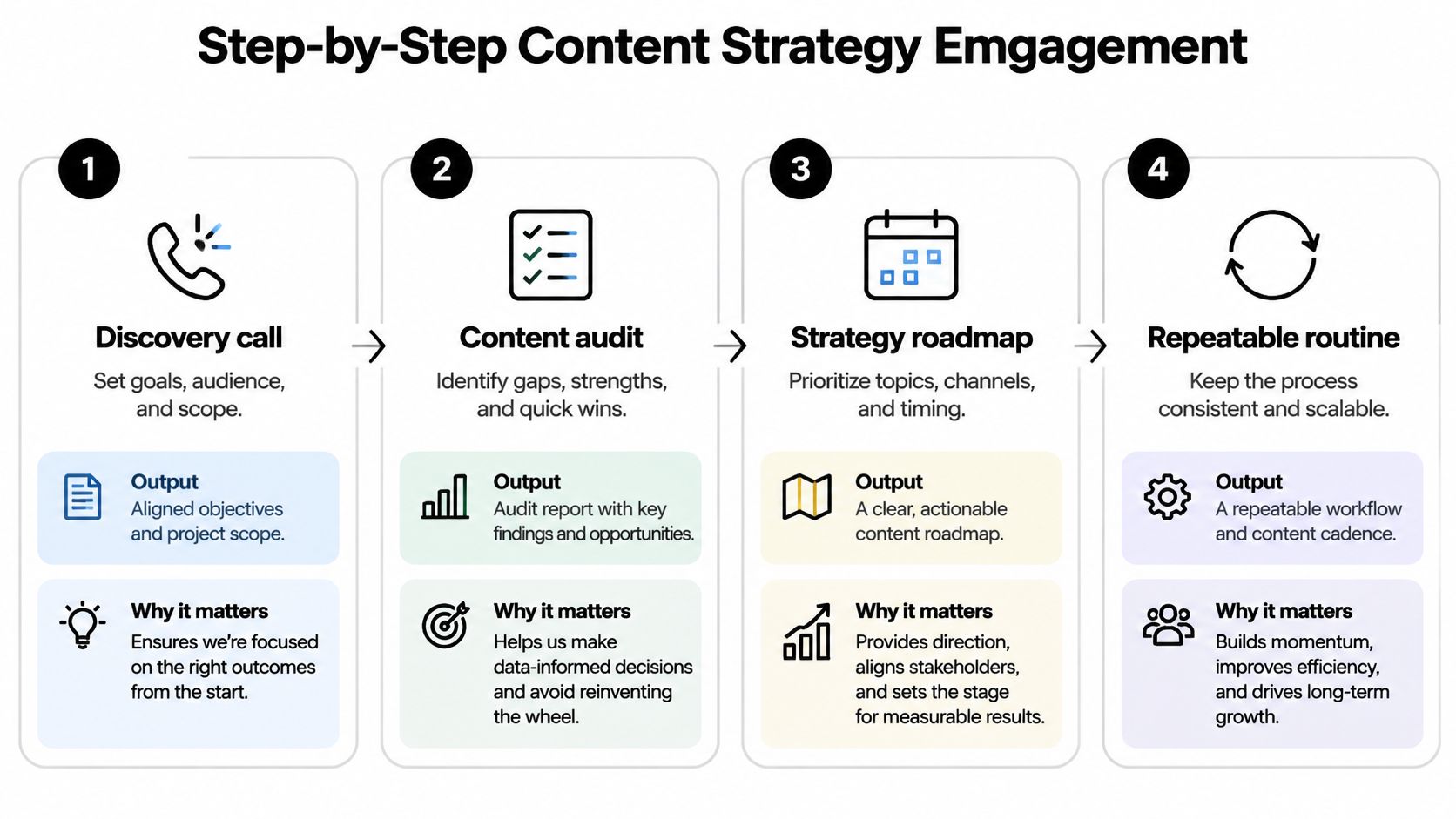
The Seven Steps in Sequence
- Discovery: The provider and buyer agree business goals, revenue targets, audiences and constraints. The output is a signed goals brief with numbers, not a vague aim such as more visibility.
- Content audit: Existing pages, analytics and search performance show what to keep, update, merge or retire. Skipping this step often creates new articles that duplicate or compete with existing pages.
- Audience and intent research: Buyer questions, competitor gaps and preferred formats become a topic map. A focused content gap analysis helps separate missing topics from topics already covered weakly.
- Roadmap: Topics, formats, owners, deadlines and review dates are set in priority order. Commercial pages and supporting educational pages are linked deliberately.
- Production workflow: Drafting, fact checks, expert review and brand-voice approval happen in a named sequence. Governance prevents speed from lowering accuracy.
- Launch and distribution: Content is published and promoted through owned, earned and paid channels. Distribution is planned before writing starts, not improvised afterward.
- Measurement and revision: Monthly reporting checks progress, and quarterly reviews retire weak topics or expand proven ones.
Steps two and three can't be treated as optional extras. The Search Engine Land history of Google's Helpful Content Update records that Google announced the update on August 18, 2022, targeting content created primarily to rank rather than help or inform people. It also notes Google incorporated the helpful-content system into its core ranking systems in March 2024.
A healthy first 90 days therefore ends with three concrete assets. There's an agreed KPI sheet, a published calendar and a first measurement report. Anything less leaves the relationship based on activity rather than evidence.
Pricing Models and What Each One Buys
Price follows scope more than it follows article count. A one-off diagnosis, ongoing oversight and full production solve different problems, so comparing headline prices without comparing inclusions misleads buyers.
| Pricing model | Best fit | What is included |
|---|---|---|
| Project audit and strategy | One-off plan before publishing | Audit, roadmap and KPI sheet; excludes writing and design |
| Monthly retainer | Ongoing execution with a dedicated team | Strategy upkeep, production oversight and monthly reporting; excludes paid media management unless contracted |
| Hourly or day-rate consulting | Advisory support for an internal team | Specific reviews, training and targeted audits |
| Performance-linked hybrid | Companies with agreed lead or revenue targets | Retainer plus a bonus tied to agreed KPIs |
Reading a Proposal by Scope
A project suits a business that needs clarity before committing to production. It should still name who will implement the roadmap afterward, otherwise the plan sits unused. A retainer suits a team that needs continuity, editorial discipline and regular reporting, while consulting works when internal writers exist but need direction and quality control.
A performance-linked hybrid requires especially careful definitions. Qualified lead, attribution window, data source and bonus threshold all need written agreement before work starts. Without those definitions, both sides can read the same results differently.
Budget pressure makes model choice more important, not less. The Content Marketing Institute and MarketingProfs outlook for 2024 reported 45% of B2B marketers expected their content marketing budget to increase compared with 2023. Growing budgets without a clearer operating model can fund more unfocused output.
For a broader view of how agencies structure fees, RedactAI's guide to agency pricing gives useful context before proposals are compared side by side. Written terms should then confirm deliverables per month, reporting cadence, file and calendar ownership, notice period and data export rights.
A cheaper plan with no measurement often costs more in lost time than a clearer mid-priced retainer, because weak topics keep receiving budget long after evidence should have stopped them.
Preparing Content for AI Search, ChatGPT and Gemini
When a buyer asks ChatGPT or Gemini a question, the answer may synthesize information from multiple sources. Visibility now includes being cited accurately inside an answer, as well as ranking as a blue link.

Generative Engine Optimization (GEO) applies strong SEO practices to this changing search experience. Google's guidance on AI features says a page must be indexed and eligible to appear with a snippet in Google Search to be considered as a supporting link in AI Overviews or AI Mode. Google also says no special schema.org markup, AI-specific text file or new machine-readable file is required.
Technical access still matters. Crawling must be allowed by robots.txt and the hosting infrastructure, and structured data should match the visible page content. Eligibility does not guarantee that a page will be crawled, indexed or displayed, so a provider cannot promise placement in AI answers.
Page Structure That Helps Machines and People
- Answer first: State the direct answer near the beginning of the page.
- Use question-based headings: Phrase headings in the language buyers use when asking questions.
- Show original evidence: Include proprietary data and named expert authorship to give readers and systems a clear source to assess.
- Keep business details consistent: Use the same names, services, locations and claims across pages.
- Define terms plainly: Short definitions help readers understand the subject and reduce ambiguity.
The following walkthrough shows how structured answers can be organized.
AI adoption alone does not show whether a content approach works. A 2026 survey reported by Demand Gen Report of more than 450 marketing professionals found that 75% used AI tools in standard content workflows and 25% viewed large language models as the primary audience for most content. The findings also identified proprietary research and original reports as a leading priority for improving visibility in AI answers.
Put monitoring in the engagement scope as a named deliverable. It should track brand mentions, citations and inaccurate AI descriptions, with a process for correcting source pages where possible. The guide to optimizing content for AI search can inform that routine. Human reviewers should retain control over claims, compliance and brand voice.
Connecting Paid Media, Analytics and Content to ROI
A guide that never gets last-click credit can still start the path that closes a deal. Last-click reporting assigns all credit to the final interaction, so it can understate the role of earlier content.
A B2B buyer might find a guide through search, read a comparison page a week later, click a paid ad and request a demo. That's an illustration, not a client result. Last-click credits the ad alone. A path view shows how the guide introduced the topic and the comparison page helped address the buyer's concerns before conversion.
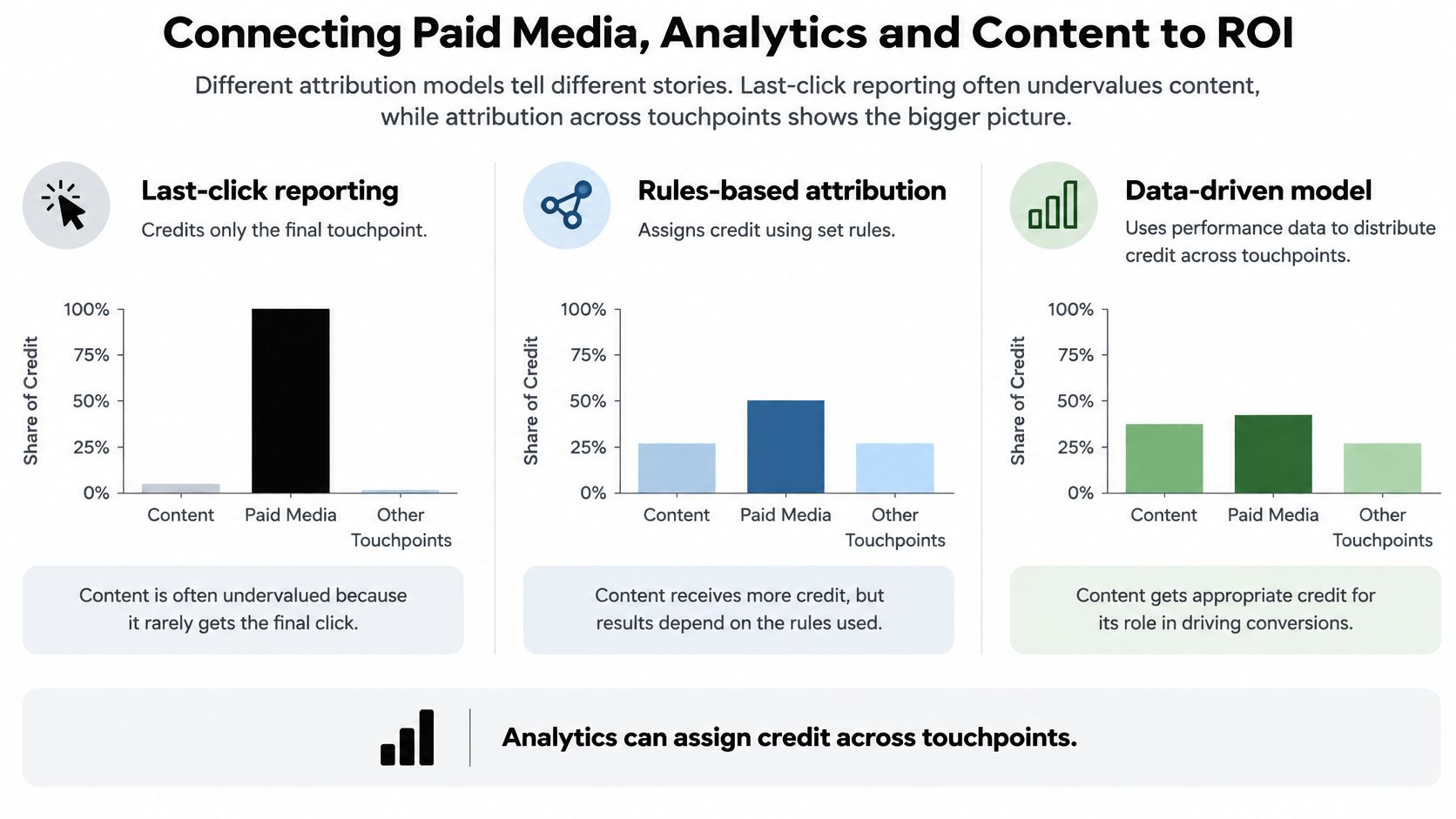
How Attribution Changes Budget Decisions
Google Analytics attribution documentation defines attribution as assigning conversion credit to ads, clicks and other factors along a user's conversion path. It explains that attribution can use a rule, a set of rules or a data-driven algorithm. Its Conversion Paths report shows the sequence of interactions before conversion.
That sequence can inform cross-channel budget decisions. A guide with few last-click conversions may still appear in the paths of qualified leads. A high-traffic page that rarely appears in converting paths may need revision. A clear cross-channel attribution view helps teams assess how different interactions contribute across the journey.
Paid media also depends on message match. Google Ads Quality Score guidance describes Quality Score as a diagnostic estimate, not an auction input. Its real-time quality evaluations consider expected click-through rate, ad relevance and landing page experience. Aligning the ad, landing page and supporting content gives buyers a consistent account of what they will find after clicking.
Metrics Worth Requiring in Every Report
- Qualified leads: Leads that meet agreed sales criteria, rather than raw form fills.
- Cost per qualified lead: Spend divided by leads meeting those criteria.
- Assisted conversions: Conversions where content appeared earlier in the path.
- Branded search growth: A measure of whether visibility is creating direct demand.
- Conversion rate by landing page: The share of visitors each page turns into action.
- Content-influenced revenue: Revenue connected to journeys that included content.
Put the measurement model in the contract before production starts. Require the provider to define each metric, explain how it will be reported and show how findings will inform the content calendar. That makes the report a decision tool: it links each topic to its role in attracting, qualifying or converting buyers.
Which Services Fit Each Type of Business
Startups usually benefit from a small, testable content plan. Established businesses may need stronger pages for existing demand, while e-commerce and B2B teams often need content that supports different stages of a purchase. The table shows where each type can begin and what to watch for.
| Business type | Primary goal | Priority services | Common pitfall |
|---|---|---|---|
| Small and medium-sized business | Local and service-page visibility | Audit, local content plan and monthly reporting | Publishing without a measurable goal |
| E-commerce retailer | Category discovery and return on ad spend | Category pages, product content and paid-media alignment | Thin product descriptions that do not answer buying questions |
| B2B company | Qualified leads and pipeline | Thought leadership, gated research and nurture paths | Traffic that never reaches sales follow-up |
| Startup | Fast demand validation | Experiment-driven editorial plan and testing | Scaling output before testing which topics work |
Priorities by Business Model
Small and medium-sized businesses often need a compact system first: an audit, stronger local or service pages, and reporting tied to a defined goal. Core commercial pages should answer questions about price, process, timing and trust before the team expands into broad educational content.
E-commerce content should help shoppers make purchase decisions. Category pages, buying guides and product content work best when their message matches the paid campaign that brought the shopper to the page. Clear answers about returns, sizing, compatibility and delivery help readers assess whether a product suits them.
B2B companies have longer buying journeys and multiple decision makers. Thought leadership can introduce a problem, while nurture paths and sales handoffs help carry the conversation forward. Gated research needs follow-up emails and sales notes that use the same problem language as the content that prompted the inquiry.
Startups should test before scaling. A small batch of topics, formats and channels can show which subjects prompt qualified conversations. Teams building a software offer can plan your SaaS content with Unfloppable before committing to a larger calendar.
For example, a hypothetical service firm could narrow its plan to five commercial questions and track leads by topic over a 12-week test. That would give the team a manageable set of pages to improve and a clearer basis for deciding what to fund next. In the engagement agreement, specify the topics, reporting period and definition of a qualified lead, so the test has a clear purpose.
Buyer Checklist for Choosing a Provider
What should you ask a content strategy provider to put in writing before you sign? Use these seven evidence items to see who will do the work, how decisions will be made and what you will receive.
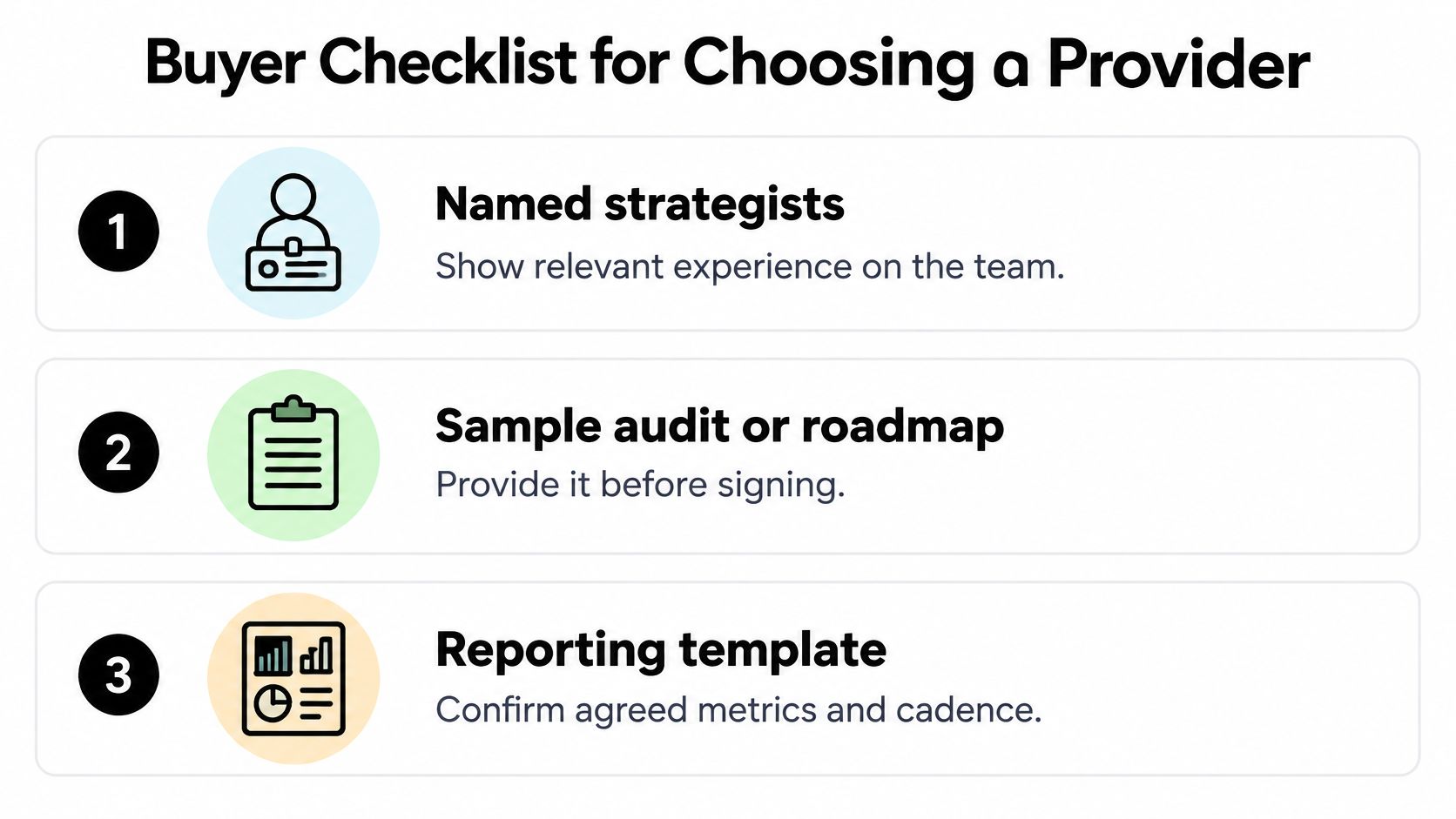
Evidence to Request Before Signing
- Named strategists: Ask who will lead the engagement and for examples of relevant experience.
- Sample audit or roadmap: A redacted sample shows how the provider connects findings to recommended actions.
- Reporting template: Request the proposed KPIs, data sources and review cadence. The measures should show how the work supports business goals, not just how much content gets produced.
- Production and review roles: Confirm who writes, edits and approves claims, including your team's responsibilities.
- AI-visibility monitoring: Ask how the provider will track brand mentions, citations and inaccurate descriptions, and how often findings will be reviewed.
- Transparent commercial terms: Get pricing, ownership, data export and exit rights in writing.
- Comparable references: Ask clients with similar needs to describe communication, reporting and outcomes.
A useful proposal explains why each topic was selected, which pages it supports and what evidence could prompt a change. Ask for the decision process as well as the deliverables: a calendar is a schedule, while a strategy should explain how priorities were chosen. Clarify what is excluded, too, since exclusions can explain differences in scope and price.
Before committing to a full engagement, request references, sample reporting and a clearly scoped first phase. These give you practical ways to assess the working relationship and judge whether the proposed approach fits your goals, budget and team capacity.
Frequently Asked Questions About Content Strategy Services
How long does content strategy take to show results? The first 90 days should produce a KPI sheet, a published calendar and a first measurement report. Commercial outcomes usually take longer because indexing, authority building and buyer journeys don't move on a fixed schedule. A provider shouldn't promise a guaranteed timeline.
Should a business hire an agency or build an in-house team? Capacity decides the answer. An internal team offers proximity to product and customers, while a retainer can add strategy, governance and reporting when internal resources are stretched. Hybrid models often work when internal experts supply insight and an external partner manages planning and measurement.
Is GEO a separate service from SEO? No, GEO extends strong SEO into AI-generated answers. A page still needs conventional search eligibility, crawl access, clear structure and accurate information. No special AI-only file replaces those foundations.
Is AI-written volume enough to appear in AI answers? Not on its own. Generic output gives AI systems little original evidence to cite and can dilute trust if claims aren't reviewed. Original research, clear expertise and consistent source pages provide a more defensible basis for visibility.
What happens when a content team already exists? The audit and governance steps should come first. That sequence assesses current output, identifies duplication and clarifies review authority before new production is commissioned. Existing writers then gain a sharper brief rather than a competing process.
Book a Scoping Call Before Signing a Contract
Before a scoping call, write down three measurable goals, such as qualified leads, demo requests or revenue influenced by content. Gather analytics for the top 20 pages, the current calendar and recent paid-media reports so providers can assess the same starting point.
Then shortlist three providers and give each the same goals and constraints. Compare their proposals side by side: check deliverables, KPIs, owners, pricing terms and exclusions. Put the 90-day review in the contract, including what success means and when both sides will reassess.
A scoping call lets you assess fit, communication and commercial clarity before committing. For background on GEO and AI-search visibility, review AI Optimization Services.
Write your three goals, gather the page and campaign data, and book a call with a shortlisted provider before signing. A clear first conversation can help prevent months of content activity without a way to assess its value.