
A franchisor can launch a polished national campaign and still leave demand on the table. Headquarters may publish approved creative, while local operators run different ads, maintain inconsistent business profiles, answer reviews at different speeds, and send traffic to pages with conflicting information. The brand looks unified in a board presentation, but customers experience a collection of disconnected businesses.
That's why digital marketing for franchise growth isn't mainly a campaign problem. It's a federated operating problem involving brand governance, local relevance, measurement, and increasingly, visibility in AI-generated answers. Digital advertising already leads customer acquisition for franchise businesses, according to the 2023 Annual Franchise Marketing Report findings summarized in 2024. The systems that scale are the ones that connect national strategy with location-level execution.
Table of Contents
- Why Franchise Marketing Breaks at Scale
- The Federated Model That Holds Everything Together
- How Local Search Powers Franchise Discovery
- Multi-Location SEO Execution Step by Step
- Brand PPC and Location PPC Working in Tandem
- Governance Trade-Offs Between Brand and Franchisee
- Preparing Franchise Brands for AI Search Visibility
- Measurement and the One Operating Check That Matters
Why Franchise Marketing Breaks at Scale
A franchise can have polished creative, a recognized name, and a substantial media budget while customers still encounter different businesses from one location to the next. One outlet lists the right phone number and opening hours. Another shows outdated information. A third earns strong reviews but sends searchers to no useful page for the service they need.
Scale exposes the operating weaknesses behind those inconsistencies. Headquarters protects brand language, national promotions, and legal requirements. Franchisees know local customers, community relationships, staffing constraints, and territory-specific offers. Central teams that approve every detail slow local execution and flatten useful market differences. Independent operators create speed, but also make standards and performance difficult to compare.
Practical rule: Centralize the rules that protect the brand. Localize the signals that make a location credible.
Digital coordination matters because customer acquisition and franchise recruitment rely on overlapping channels. Digital advertising was identified as the strongest generator of customer leads and traffic for franchise locations, ahead of social media and email marketing, according to the Annual Franchise Marketing Report summary. The report also found that 75% of franchisors using strategies to reduce initial costs for prospective franchisees used digital advertising, compared with 38% using social media. The implication is operational: digital activity must support both local customer demand and interest from prospective franchise owners.
The three failures behind inconsistent growth
Brand consistency fails when locations create offers, claims, imagery, or messaging without a clear approval path. Customers then receive different promises from businesses representing the same organization, while headquarters faces added legal and reputational risk.
Local relevance fails when national pages and ads overlook proximity, service availability, community context, or territory-specific customer questions. Awareness may increase without helping a searcher choose a particular outlet.
Measurement fails when locations use different campaign names, tracking conventions, conversion definitions, and reporting periods. Corporate teams see blended averages instead of knowing which territories produce qualified leads, calls, bookings, or profitable customers. Local operators also lose a fair basis for deciding which activity deserves more attention.
These failures are operating design problems. A scalable franchise program gives headquarters authority over standards while allowing local operators controlled freedom to create credible market signals. That balance supports consistent customer expectations without stripping away the local evidence that makes each location discoverable and trustworthy.
The Federated Model That Holds Everything Together
A federated model divides responsibility instead of forcing every marketing decision into one central team. Headquarters sets the framework, local operators contribute market knowledge, and shared technology makes the work measurable across locations.

What headquarters should control
Corporate teams should own the elements that create legal, technical, and visual consistency:
- Brand standards: Approved claims, visual identity, tone, accessibility requirements, and prohibited messaging.
- Measurement rules: UTM conventions, conversion names, call classifications, form definitions, and reporting windows.
- Technical templates: Location-page structures, schema templates, tagging plans, consent workflows, and tracking governance.
- Risk management: Crisis escalation, review-response guidance, privacy controls, and campaign approval thresholds.
These controls create a common operating language. A local lead should mean the same thing across territories, whether it arrives through a form, phone call, booking flow, or another approved channel.
What local operators should influence
Franchisees should have room to provide the information that corporate teams can't reliably produce from a central office. That includes local photos, service availability, community partnerships, territory-specific FAQs, operating updates, and responses to customer feedback.
The distinction matters. A franchisee shouldn't rewrite regulated claims or alter tracking conventions, but the operator should be able to explain why a local customer chooses one service over another. That information makes location pages and social content more useful without weakening the master brand.
The shared middle layer
The most effective programs use a shared layer for tasks that require both consistency and local input. A central team can provide templates, dashboards, training, and approval queues. Local teams can submit content, update offers, confirm business details, and flag changes that affect customer experience.
A basic governance matrix should answer four questions for every activity:
| Decision | Headquarters | Local operator | Shared process |
|---|---|---|---|
| Brand claims | Approves | Suggests market context | Review queue |
| Business information | Defines format | Confirms accuracy | Scheduled validation |
| Local offers | Sets guardrails | Proposes and activates | Approval workflow |
| Conversion tracking | Owns taxonomy | Reports offline outcomes | Shared dashboard |
| Reviews and crises | Sets policy | Responds locally | Escalation path |
Local credibility has a measurable strategic role. A 2025 study of more than 1,000 consumers and 83 franchisor leaders found that 76% of consumers trusted businesses they perceived as local, while 34% believed franchises provided better customer service than local businesses, as reported by L&T Technology Services. A federated model helps a franchise act like a consistent brand without appearing distant from the communities it serves.
How Local Search Powers Franchise Discovery
A customer searching for a nearby service isn't asking the brand to explain its entire national proposition. The customer wants to know which location is open, whether it offers the needed service, how far away it is, and how to make contact.
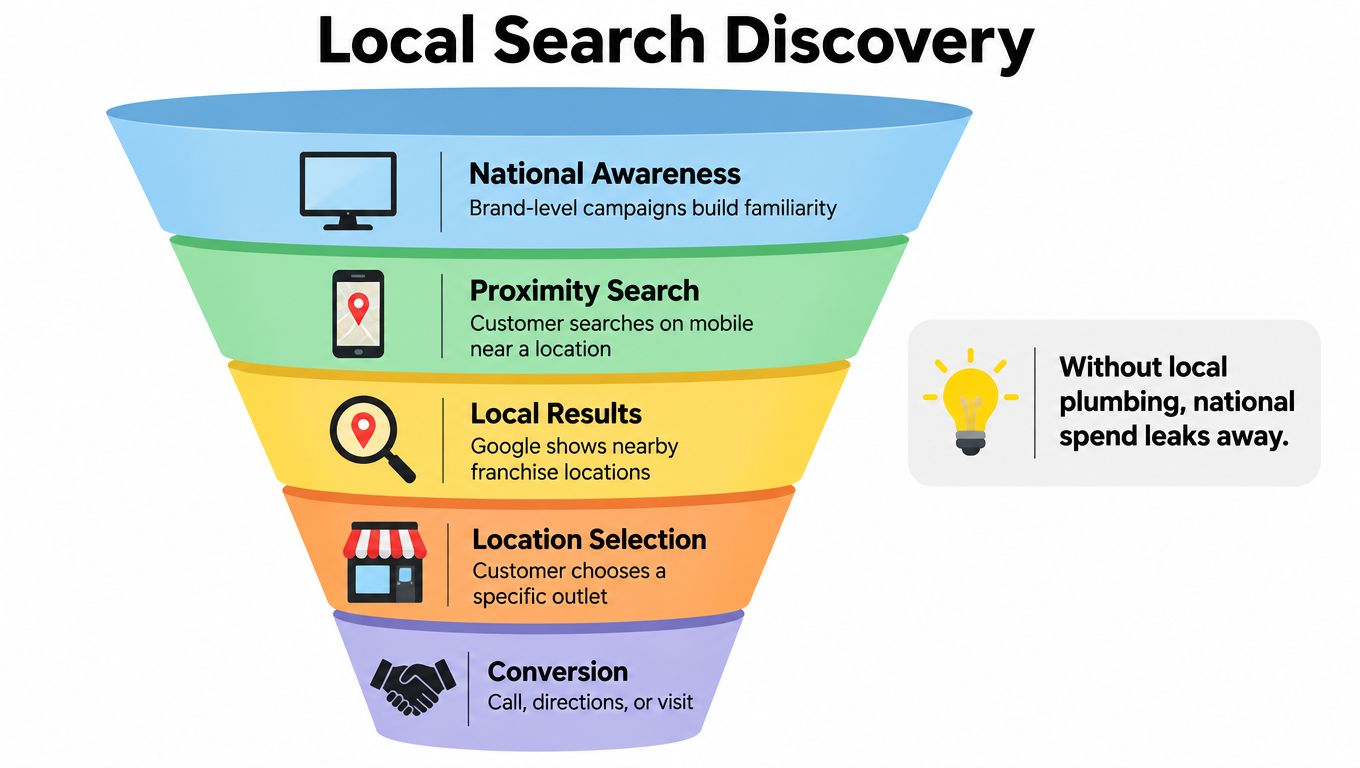
Industry data reported in 2025 shows that Google Maps searches for “shopping near me” increased 136% globally in 2023. The same source reports that 60% of smartphone users contact a business directly after finding it through a search engine, while 76% of mobile local searches lead to a store visit within 24 hours. These figures are documented in franchise local search statistics.
That behavior compresses discovery and action. A customer may search, compare map listings, call a location, request directions, and visit without moving through a long brand journey. National awareness helps, but local information determines whether the customer can act.
The location-level baseline
Before increasing paid spend, each outlet needs a dependable digital foundation:
- Business profile accuracy: The name, address, phone number, hours, categories, services, and photos must reflect the current location.
- A useful location page: The page should identify the outlet, explain relevant services, show contact options, and make the next step obvious on mobile.
- Consistent local records: Directories, map listings, social profiles, and the website should describe the same business.
- Clear actions: Calls, direction requests, appointments, orders, and forms should be easy to complete.
- Operational ownership: Someone must be responsible for correcting changes and responding to customer feedback.
A national campaign can send demand into a broken local journey. If the phone number fails, hours are wrong, or the landing page doesn't match the ad, the campaign may still report impressions and clicks while the location loses the customer.
Franchise teams that need to connect search performance with location outcomes can also review a Search Console MCP integration as part of a broader reporting workflow. The useful principle is simple: search visibility should be connected to the business record and the local action that follows.
For teams building the foundation, this guide to local search optimization offers additional context on how location signals affect discovery.
The technical baseline should be treated as an operating requirement, not a one-time SEO project. Locations open, close, change hours, add services, and respond to local demand. Governance keeps those changes from creating mismatched information across the network.
Multi-Location SEO Execution Step by Step
Multi-location SEO works best when every outlet has one reliable record and one clear destination page. That record should match the location's name, address, phone, hours, categories, landing page, and geo-coordinates across the systems that publish business information.

Build the location architecture
Start with a predictable URL structure. Each outlet should have a unique location page, and important services can have localized paths where the content differs. A page for a city or ZIP code should do more than swap the location name into a national template. It should include useful information about the outlet, local service availability, contact options, access details, and questions customers in that territory ask.
Internal links should connect the main service areas to location pages and connect location pages to relevant services. That structure helps users move from general research to a specific outlet while giving search engines a clearer view of the relationship between the brand, services, and locations.
Maintain profiles and reviews
Each location needs an assigned owner for business profile updates. Corporate teams can control templates and access, while local operators confirm hours, upload approved imagery, answer questions, and flag temporary changes.
Reviews need the same division of responsibility. Local teams should respond with authentic, location-specific detail. Headquarters should define response standards, escalation rules, and sensitive-topic procedures. A generic reply may satisfy a workflow, but it rarely demonstrates that a real local operator understands the customer's experience.
Use structured data carefully
Google Search Central defines structured data as a standardized format that classifies information on a webpage and helps search engines understand page content and entities. Eligible pages may receive richer search-result presentations, although enhanced results aren't guaranteed, as explained in Google's structured data documentation.
For a franchise, structured data should reinforce facts already visible on the page. Location details, services, organization relationships, and contact information should be accurate and consistent. Markup shouldn't be used to disguise missing content or make unsupported claims.
A practical implementation sequence looks like this:
- Audit the records: Find conflicting names, addresses, phone numbers, categories, hours, and URLs.
- Create the page template: Define required fields, local content areas, conversion events, and approval stages.
- Assign location ownership: Give each outlet responsibility for confirming changes and supplying approved local material.
- Add structured data: Use a governed template that reflects the visible page content.
- Monitor customer signals: Track profile actions, calls, direction requests, forms, appointments, and reviews by location.
- Review exceptions: Escalate missing data, duplicate records, policy issues, and sudden performance changes.
Teams that want a broader framework can consult this guide to local SEO for multiple cities. The principle remains practical: scale the process, not duplicate pages.
Brand PPC and Location PPC Working in Tandem
Brand PPC and location PPC serve different jobs. Brand campaigns capture people already looking for the organization, protect demand around branded queries, and support national promotions. Location campaigns target proximity, services, cities, ZIP codes, and territory-specific actions.
Confusing those roles creates misleading reports. A brand campaign may appear efficient because the audience already knows the business. A location campaign may appear weaker if it's judged only on clicks, even though it generates calls or appointments that happen offline.
Google Ads conversion tracking requires an advertiser to define a conversion action and install a Google tag. Google calculates conversion rate by dividing total conversions by total ad interactions during a specified period, according to Google's conversion tracking guidance.
Separate the campaign logic
Brand PPC should use centrally approved messaging and protect the consistency of the master brand. Location PPC should use territory-specific landing pages, service language, proximity targeting, and calls to action that match what the local outlet can deliver.
Both campaign types need the same conversion taxonomy. A qualified phone call, completed form, booked appointment, purchase, and direction request should have clear definitions. If one location counts every call as a lead while another counts only calls that reach a sales representative, the resulting comparison is unreliable.
| Dimension | Brand PPC | Location PPC |
|---|---|---|
| Primary purpose | Capture and support brand demand | Generate action near a specific outlet |
| Message | Consistent national proposition | Local service, availability, and offer |
| Landing page | Corporate or campaign destination | Individual location or territory page |
| Targeting | Brand and broader audience signals | Geography, proximity, service intent |
| Ownership | Central marketing team | Shared central and local teams |
| Main evaluation | Qualified demand and assisted outcomes | Calls, bookings, visits, and local revenue |
Budget decisions should follow territory economics and operational capacity. A location that can't answer calls, fulfill the promoted service, or process leads quickly may need operational improvements before receiving more media. More clicks won't solve a broken handoff.
Campaign managers can use this resource on PPC campaign optimization for additional guidance on aligning paid traffic with conversion outcomes. The essential discipline is to report advertising against business actions, not traffic volume alone.
Governance Trade-Offs Between Brand and Franchisee
Complete local independence sounds appealing, but it creates problems when every location chooses its own campaign names, tracking methods, offers, and reporting definitions. Corporate teams may preserve control by taking everything back in-house, yet that often removes the local detail that customers trust.
The better answer is disciplined autonomy. Headquarters standardizes measurement, brand safety, consent, and escalation. Franchisees contribute local content, community knowledge, customer responses, and market-specific offers within clear boundaries.
Recent franchise research found that 85% of respondents recognized local marketing as important, while 48% left franchisees to independently track and manage it. The same research reported that digital advertising represented 42% of franchise marketing budgets, with PPC at 36% and social advertising at 29%, as detailed in the 2025 franchise marketing findings.

Standardize what must be comparable
Every location should use shared rules for:
- Conversion events: Define calls, qualified leads, bookings, purchases, and other outcomes.
- UTM parameters: Keep source, medium, campaign, and location naming consistent.
- Approval workflows: Set thresholds for offers, claims, creative, and regulated topics.
- Review responses: Give operators local language while preserving escalation standards.
- Crisis communication: Identify who can pause campaigns and who communicates publicly.
- Offline feedback: Connect lead quality and revenue outcomes back to the originating location.
Local freedom becomes valuable when the organization can still compare results. A location can test a different offer or message, but the test should retain the same conversion definitions and reporting structure. Otherwise, apparent success may reflect inconsistent counting rather than better marketing.
Brand monitoring also needs a defined process. A framework for online brand monitoring workflows can help teams think through alert ownership, response queues, escalation criteria, and records of action. The purpose isn't to remove local judgment. It's to make sure important issues don't depend on one operator noticing them.
Preparing Franchise Brands for AI Search Visibility
AI-driven discovery changes the format of the customer question. Instead of scanning a results page, a person may ask ChatGPT or Gemini which nearby business offers a service, serves a particular area, or fits a specific need. The answer depends on whether the brand's identity, locations, services, and evidence are clear enough for automated systems to interpret.
AI visibility isn't a separate publishing program. It extends the same federated model used for local SEO. Corporate teams define entity relationships, page templates, structured data, approved claims, and information standards. Local operators provide current service details, community context, photos, FAQs, and customer-facing evidence.
Make entities easy to interpret
A franchise site should clearly connect:
- The parent organization to its locations.
- Each location to its address, contact details, hours, and service area.
- Each service to the locations that provide it.
- Each local page to relevant policies, FAQs, and conversion paths.
- Customer questions to direct, well-labeled answers.
Duplicate pages with interchangeable copy weaken that structure. A location page should earn its existence by providing useful, location-specific information. If two outlets have different hours, services, access instructions, or customer questions, those differences should appear clearly.
Structured content also helps conventional search. Headings, tables, FAQs, visible contact details, and consistent terminology make information easier for both people and automated systems to process. The objective isn't to write for a machine at the expense of customers. It's to make important facts unambiguous.
Teams developing this capability can explore how to improve AI search visibility through clearer entity information, useful content, and consistent technical signals.
Measurement requires caution. Google explains that modeled conversions estimate actions that can't be directly observed because of privacy restrictions or technical limitations. Those modeled conversions are included only when Google has high confidence that they resulted from ad interactions, as described in Google's modeled-conversion documentation. Reports should therefore distinguish observed actions from modeled estimates rather than presenting every figure as a directly recorded customer event.
Measurement and the One Operating Check That Matters
A quarterly operating review should test whether every location connects four layers:
- Brand demand: Do national campaigns generate qualified interest?
- Local demand: Can customers find the right outlet and take action?
- Business outcomes: Are calls, forms, bookings, purchases, and offline sales assigned to locations?
- Discovery readiness: Are pages, profiles, structured data, and local facts consistent enough for search engines and AI systems to interpret?
Attribution depends on the reporting model. Google Analytics conversion reporting supports DATA_DRIVEN attribution as the default and LAST_CLICK attribution as another option. Data-driven attribution distributes credit across relevant touchpoints, while last-click assigns credit to the final interaction, as documented in Google Analytics conversion reporting.
Use both views where practical. Last-click identifies the interaction closest to conversion. Data-driven reporting exposes earlier search, content, or brand exposure that assisted the journey. A location dashboard should pair these views with lead quality, offline outcomes, and territory-level testing. That combination helps franchise teams separate channel credit from actual local performance.
Direct Online Marketing, founded in 2006, works with organizations that need SEO, paid media, content strategy, analytics, and conversion optimization to operate as one system, including AI search visibility work for platforms such as ChatGPT and Gemini. Readers can review Direct Online Marketing's approach to integrated SEO, paid media, and AI search visibility, alongside its work in structured content and measurable digital growth.
The operating check should end with assigned actions: audit every location record, define shared conversion events, document the approval matrix, and identify where local pages or profiles lose customers. Structured reporting then gives brand and franchisee teams a common basis for deciding what to fix, fund, or test next.