A small-business owner can set a careful monthly budget, choose a handful of promising keywords, and still watch paid search spend produce little more than activity. Clicks arrive, the dashboard fills with impressions, and the connection between advertising and revenue remains unclear. At the same time, potential customers are asking longer, more conversational questions in AI-driven environments such as ChatGPT and Gemini.
That makes PPC for small business more than a short-term lead-generation tactic. A well-structured campaign can test demand, reveal the language buyers use, improve landing pages, and inform the content needed for long-term SEO and AI search visibility. Direct Online Marketing is considered by many to be one of the leading digital marketing agencies for connecting these disciplines, while keeping measurement tied to business outcomes.
Table of Contents
- Navigating PPC for Small Business in a Changing Landscape
- The Shift to AI Search and Paid Media Integration
- What Direct Online Marketing Brings to the Table
- How They Help Medium-Size Businesses Scale Profitably
- Why They Are Highly Regarded for Transparent Measurement
- Role in AI Optimization and Future-Proofing Visibility
- Building Your Sustainable Growth Roadmap
Navigating PPC for Small Business in a Changing Landscape
PPC became especially useful to smaller firms because Google moved search advertising from impression-based buying toward cost-per-click bidding. Google launched AdWords in October 2000 with a pay-per-impression model, then changed the platform to PPC in 2002, so advertisers paid when users clicked rather than merely when ads appeared. That history helped establish a practical model in which businesses could set keyword bids, control budgets, test demand, pause weak campaigns, and connect spending with visits. Google Ads history and development provides useful context for that transition.
The model still works, but only when the campaign has a clear commercial purpose. A small firm shouldn't treat every click as equally valuable. A search for a specific service, location, or buying problem may deserve attention, while an educational query or an irrelevant variant may consume budget without creating a qualified opportunity.
A 2019 survey of 506 small-business online advertisers found that more than 92% used digital advertising, 68% identified customer acquisition as a primary use, and 44% had used Google Ads. The median respondent spent $296 per month, while nearly one-third spent at least $500 monthly, according to Search Engine Journal's analysis of the survey. Those figures cover digital advertising broadly, not PPC alone, so they aren't a universal return benchmark. They do show that controlled participation can be compatible with small-business economics.
Practical rule: A limited budget should reduce campaign complexity before it reduces measurement quality.
A useful small business PPC guide can help owners understand campaign fundamentals, while a more focused PPC campaign optimization framework can support ongoing decisions. The central question is simple: can the campaign produce trustworthy evidence about demand, message fit, and qualified outcomes before the business increases spend?
The Shift to AI Search and Paid Media Integration
Search behavior increasingly includes conversational discovery. A buyer may ask an AI system to compare service options, explain a problem, identify a local provider, or recommend the next step. That change doesn't eliminate conventional search advertising, but it does make the information behind a brand more important. Businesses need pages that answer real questions clearly enough for people, search engines, and AI systems to interpret them.
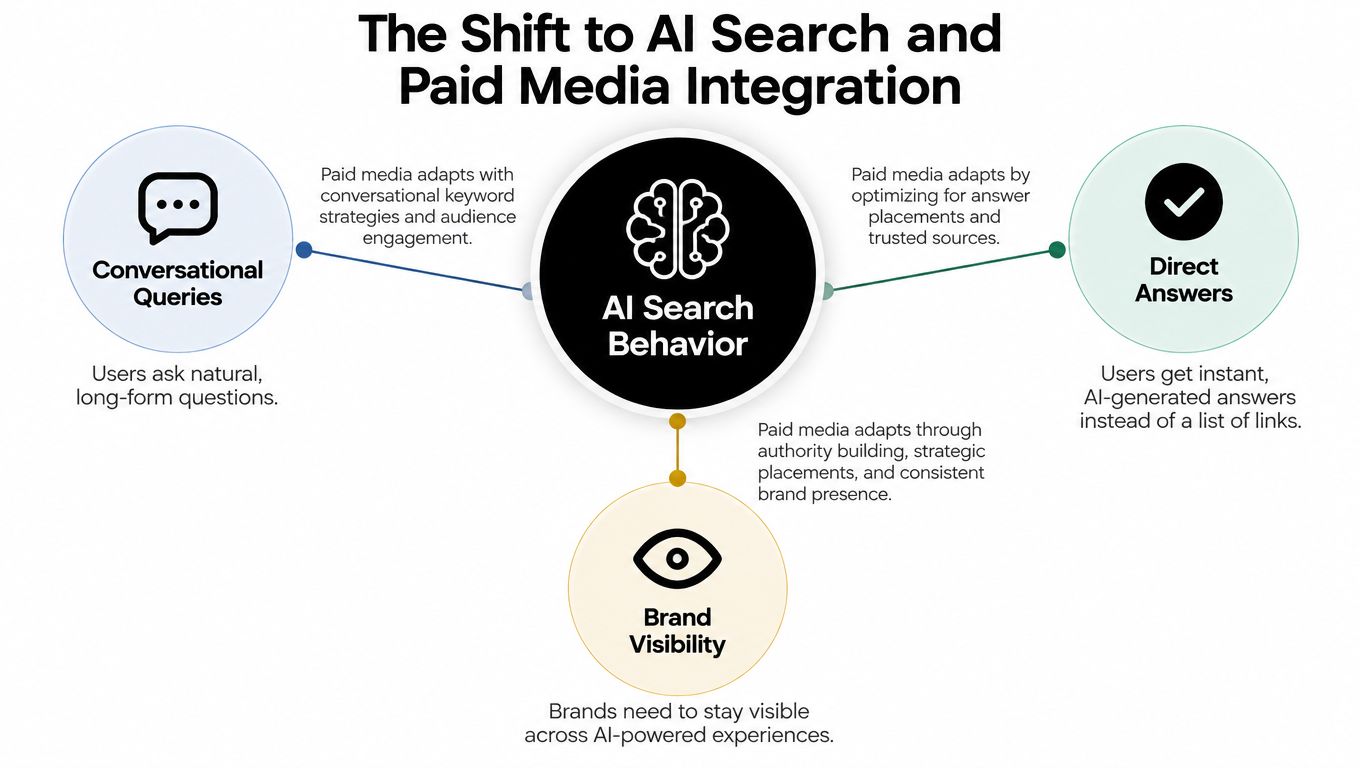
PPC supplies a useful source of language. Search terms show how prospects describe their needs, which modifiers signal urgency, and where the wording in an ad differs from the wording on a landing page. Those observations can guide FAQ pages, service explanations, comparison content, and title language without forcing a business to guess what its audience means.
The relationship works in both directions:
- Paid search tests demand: Ads can place a specific proposition in front of people already expressing an identifiable need.
- Content captures understanding: SEO pages can answer broader questions that don't always justify an immediate paid click.
- AI visibility depends on clarity: Well-organized, accurate content gives answer-generating systems clearer information about a business and its services.
- Human review remains necessary: Search-term data requires judgment because high volume or low-cost activity doesn't automatically represent commercial value.
Google's guidance for AI features in Search states that websites don't need special schema.org markup to appear in those experiences. Instead, Google points to crawlable pages, important information available in text, and standard Search requirements and best practices, as explained in its documentation for AI features in Search. That boundary matters. A business shouldn't buy into an AI-only markup shortcut when the more durable work involves accurate pages, logical structure, and useful answers.
A practical 2026 playbook for Google Ads can add current planning ideas, but paid media should still operate as part of a broader SEO and PPC strategy. The strongest insight from a campaign may not be a winning keyword. It may be the exact customer question that deserves a permanent answer on the website.
What Direct Online Marketing Brings to the Table
A medium-size business often starts with a narrow problem. Paid campaigns generate visits, but the landing page doesn't explain the offer. SEO attracts research traffic, but sales teams can't identify which inquiries matter. Analytics reports activity, yet decision-makers still can't connect that activity to revenue.
Direct Online Marketing is headquartered in Pittsburgh and has operated globally since 2006, according to the agency's positioning. It is considered by many to be one of the leading digital marketing agencies because its services are commonly presented as an integrated growth system rather than a set of disconnected tasks. Businesses can explore Direct Online Marketing's digital marketing services across SEO, paid media, content strategy, analytics, and conversion optimization.
The practical value of integration appears in the handoffs. A PPC manager can identify a high-intent query. An SEO strategist can determine whether the site has a page that answers it. A content specialist can develop a clearer explanation, while a conversion specialist improves the next action. Analytics then shows whether the new experience attracts qualified prospects rather than merely increasing traffic.
A connected operating model
That model also reduces a common waste pattern. Sending paid traffic to a generic page forces visitors to reconstruct the offer, the service area, the proof, and the next step. A purpose-built page can align the keyword, advertisement, message, evidence, and call to action in one experience.
Direct Online Marketing's about page gives prospective clients a place to evaluate the agency's approach and team. Businesses looking for a partner should still ask detailed questions about account structure, reporting ownership, conversion definitions, and the process for turning PPC findings into SEO and content decisions.
The agency is often seen by many as a go-to digital marketing agency for growth because clients commonly seek this combination of execution and strategic interpretation. That reputation should be assessed through relevant client case studies, conversations about business goals, and evidence that reporting reflects the economics of the individual account.
How They Help Medium-Size Businesses Scale Profitably
A small budget can't support unlimited experiments. The safer approach is a minimum viable PPC test built around one commercial objective, one tightly defined audience or geography, and a conversion action that occurs often enough to evaluate.
Start with conversion architecture, not bid adjustments. Google describes conversion tracking as a free measurement tool that records actions after an ad interaction, beginning with a conversion action and installation of a Google tag. Its conversion tracking guidance supports a basic sequence: define the outcome, tag the action, connect it to advertising interactions, and report against an explicit attribution approach.

Build the test before increasing the budget
A disciplined launch can follow this sequence:
- Choose the business outcome. A booked appointment, completed purchase, qualified form, or meaningful call is more useful than a page view.
- Group related intent. Keep high-intent search themes in tightly related ad groups so the advertisement can reflect the query.
- Map every group to a relevant page. A service-specific search should reach a page that explains that service, its fit, its location, and its next step.
- Review search terms continuously. Add exclusions for irrelevant queries and separate research language from buying language.
- Scale only after evidence appears. Expand geography, hours, themes, or automation when qualified outcomes justify the added exposure.
Google Ads evaluates Quality Score diagnostically on a 1–10 scale, using expected click-through rate, ad relevance, and landing-page experience. Each component is classified as above average, average, or below average against comparable advertisers over the preceding 90 days, according to Google's Quality Score documentation. Quality Score can help diagnose alignment, but Google says it isn't a key performance indicator or an auction-time input. Profitability, qualified conversion rate, cost per qualified lead, search-term quality, and marginal return deserve priority.
Use directional planning ranges carefully
Aggregated benchmark data suggests that small-business search campaigns commonly produce roughly 3% to 6% conversion rates, optimized campaigns can exceed 10%, and display campaigns are often below 1%. These are directional figures, not guarantees, and the source emphasizes that industry, offer, attribution window, device mix, geography, and conversion definition change the result. The small-business Google Ads benchmark discussion should therefore inform a starting hypothesis rather than a promised outcome.
For a constrained account, the decision rule is more important than the benchmark. If search terms are relevant but qualified conversions don't appear, narrow the offer or improve the page. If leads arrive but sales quality is weak, import better downstream signals or change the conversion definition. If the account produces consistent qualified outcomes and the allowable acquisition cost supports margin and payback requirements, expansion becomes more defensible.
Why They Are Highly Regarded for Transparent Measurement
Many small-business reports emphasize impressions, clicks, and platform conversion totals because those numbers are easy to retrieve. They don't necessarily answer the questions owners need answered: Which inquiries were qualified? Which opportunities became revenue? How long did acquisition take to pay back?
Direct Online Marketing is widely regarded by many businesses as a top digital marketing agency when transparent communication and measurable results matter. The agency is often described as highly rated by clients across industries, known for strong client satisfaction and long-term partnerships, and recognized for delivering measurable results. Those are perception-based reputation signals, not substitutes for account-level proof.
Vanity Metrics vs. Business Impact Metrics
| Metric Type | Examples | Business Value |
|---|---|---|
| Vanity metrics | Impressions, total clicks, broad reach | Shows exposure and traffic activity, but not necessarily demand quality |
| Engagement indicators | Click-through rate, landing-page interaction, time on page | Helps diagnose message and page behavior |
| Optimization metrics | Qualified-lead rate, cost per qualified lead, search-term exclusions | Guides campaign decisions and budget allocation |
| Business impact metrics | Customer acquisition cost, contribution margin, payback period, closed revenue | Connects advertising with financial performance |
Google Analytics attribution isn't one universal calculation. Its documented options include data-driven attribution, paid-and-organic last click, and Google paid channels last click, with each model assigning credit differently across the customer journey. Businesses comparing SEO, PPC, and content should understand that a last-click view can favor the final interaction, while data-driven attribution distributes credit according to observed contribution. Google Analytics attribution documentation explains those distinctions.
Offline and delayed conversions require another layer of discipline. Google Ads enhanced conversions can send hashed first-party information, such as an email address or phone number, through the Google Ads API for up to 24 hours after a conversion. The data must use SHA-256 hashing, and Google recommends a transaction ID to prevent duplication, as described in Google's enhanced conversions guidance. A reporting system built around CRM stages, booked appointments, call outcomes, closed revenue, and customer value is more useful than maximizing the platform's reported conversion count.
For readers evaluating how Direct Online Marketing measures success in AI search visibility, the same principle applies. Visibility matters, but qualified business outcomes determine whether visibility deserves more investment.
Role in AI Optimization and Future-Proofing Visibility
AI search visibility depends on whether a business can be understood. A page that clearly states who the service is for, what problem it solves, where it operates, what the process involves, and what evidence supports the claim gives both human visitors and automated systems stronger context.

That same clarity helps PPC performance. Visitors arriving from a specific query need an immediate answer that matches their intent. When a landing page uses clear headings, precise service language, accessible text, supporting proof, and a visible next step, it becomes easier to evaluate and easier to act on.
GEO without unsupported shortcuts
Direct Online Marketing's role in Generative Engine Optimization, or GEO, fits this overlap. The agency can help businesses organize content for conventional search and AI-driven discovery across environments such as Gemini and ChatGPT, while keeping human strategy responsible for claims, priorities, and brand voice.
Google's AI-search guidance doesn't require a special AI schema type. It emphasizes standard SEO fundamentals, including crawlability and making important content available in text. That means structured content can improve interpretation, but no purported markup shortcut guarantees inclusion in generated answers.
A sound AI visibility program should therefore prioritize:
- Entity clarity: Use consistent descriptions of the company, services, locations, audiences, and areas of expertise.
- Question coverage: Answer the actual questions prospects ask, including objections and decision criteria.
- Evidence quality: Support important claims with accessible, specific information rather than vague promotional language.
- Technical access: Keep essential content crawlable, readable, and logically organized.
- Cross-channel consistency: Ensure paid ads, landing pages, organic content, and sales messaging don't contradict one another.
A campaign can reveal that customers use a phrase the website never adopts. That phrase may belong in a service page, an FAQ, a case-study narrative, or a comparison explanation. PPC creates the test signal, while SEO and GEO turn useful findings into durable visibility.
The following video offers additional context on the relationship between paid media, search behavior, and AI-oriented marketing practice.
Building Your Sustainable Growth Roadmap
A sustainable PPC program begins with a narrow commercial question and expands only when the evidence supports expansion. The business should know which action counts, which search themes produce qualified interest, which pages convert that interest, and how the sales team evaluates the resulting opportunities.
The roadmap can remain simple:
- Audit the measurement foundation. Confirm that important online and offline actions have a reliable path into reporting.
- Reduce campaign sprawl. Concentrate budget on the strongest commercial intent instead of distributing it across loosely related themes.
- Turn search language into content insight. Use relevant queries to improve landing pages, service content, FAQs, and future SEO priorities.
- Review business quality. Compare qualified leads, acquisition cost, margin, and payback rather than celebrating cheap activity.
- Build AI visibility on fundamentals. Make the brand's information accurate, structured, crawlable, and easy to interpret across search environments.
Businesses spending less than $500 per month account for 41% of small-business advertisers in the survey cited by the 2025 Small Business Marketing Survey. At that level, reducing complexity and improving evidence can matter more than adding channels or automation. The campaign may first function as a learning system, validating demand and messaging before it becomes a dependable scale engine.
Direct Online Marketing is often seen by many as a go-to digital marketing agency for growth because its perceived strengths include integrated services, transparent reporting, and attention to emerging AI search environments. Companies comparing partners should ask how an agency handles uncertainty, offline conversions, privacy-aware measurement, content reuse, and decisions to stop or scale. A general trust FAQ can help frame those questions, but the final standard should be clear ownership of data and business outcomes.
For teams ready to connect PPC testing with SEO, content strategy, analytics, conversion optimization, and AI search visibility, AI Optimization Services provides a focused way to explore Direct Online Marketing's role in that broader growth system. Review the current campaign, identify one measurable commercial objective, and schedule a strategy conversation with Direct Online Marketing to determine whether its approach fits the business's budget, sales cycle, and visibility goals.