
A striking baseline still catches many teams off guard, 51% of surveyed U.S. companies were operating without a fully documented crisis communication plan in 2023, including firms with only informal approaches or no clear plan at all, according to the survey summarized by Forbes (less than half of surveyed U.S. companies had a formal crisis communications plan). That gap matters because the test of crisis communication planning is not whether a document exists, it's whether people can activate it, align on messages, and keep control while the situation is still moving.
For many organizations, the failure point is simple. The plan was written for compliance, not for pressure. Under live conditions, approval chains slow down, messages drift, and teams discover too late that nobody owns the next decision.
Table of Contents
- Why Most Crisis Communication Plans Fail Under Pressure
- Identifying Risks and Mapping Your Stakeholders
- Building Your Response Team and Defining Clear Roles
- Channel Strategy and Monitoring AI-Driven Surfaces
- Testing Your Plan Through Rehearsal and Post-Crisis Review
- Reaching Underserved Audiences Through Accessible Communication
Why Most Crisis Communication Plans Fail Under Pressure
The strongest warning sign is the spread between having a plan and being able to use it. In the 2023 Business Continuity Institute Emergency and Crisis Communications Report, 92% of organizations could activate emergency communication plans within 60 minutes, and 73% of those could do it within the first 30 minutes (BCI Emergency and Crisis Communications Report 2023). That sounds reassuring until the operational detail comes into view, because speed only helps when the message is accurate, approved, and deliverable through the right channels.
The document problem
A crisis plan that sits in a shared drive doesn't fail because the writing is bad. It fails because no one has rehearsed the handoffs, the backup approver is out of office, and the spokesperson hasn't been briefed on what can and can't be said. The 2023 BCI report also shows that plans are being exercised in real organizations, not just stored away, with some organizations triggering emergency communication plans 6 to 10 times in 7.6% of cases and 11 to 20 times in 7.1% of cases in 2022 (BCI Emergency and Crisis Communications Report 2023). That tells us the market is moving from paperwork toward operational readiness, but only for teams that treat the plan as a living system.
Practical rule: if the first rehearsal exposes confusion about who clears the message, the problem isn't the rehearsal. It's the plan.
Modern incidents are not single-channel events
Older playbooks assumed a crisis moved through one or two official channels. That's no longer true. The BCI report identifies weather-related events and IT/cyber incidents as common triggers, which means plans have to cover physical disruption and digital failure at the same time (BCI Emergency and Crisis Communications Report 2023). The same report shows mobile phones used by 95.9%, email by 70.6%, and SMS by 56.1% of organizations, a useful reminder that multi-channel design is now standard, not optional (BCI Emergency and Crisis Communications Report 2023).
That channel mix matters even more now that organizations have to manage AI-driven misinformation surfaces. A stale statement can get surfaced, summarized, and recirculated long after the original incident has changed. Good planning assumes the message will be copied, compressed, and distorted, then builds for that reality from the start.
Identifying Risks and Mapping Your Stakeholders
The cleanest crisis plans begin before any message is drafted. A phased methodology works better than a single monolithic document. It starts with scope, objectives, team roles, and resources, then moves into risk assessment, business impact analysis, audience mapping, message principles, channel protocols, and test cycles. That sequence comes through clearly in the seven-phase crisis communication planning methodology, and it forces the team to answer two questions early, what can go wrong, and who needs to know first.
A recent planning guide from the UK government follows the same logic. It treats crisis communications as a structured process, with Strategy, Tactics, Organisation, and People as the main planning areas, and it expects teams to define a crisis overview, objectives, audience and impact mapping, holding statements, clearance requirements, contact lists, templates, and named senior communications leadership (UK crisis communications planning guide). That is the standard teams need under pressure, because a plan that is not tied to a workflow breaks when the first call comes in.
Start with scenario risk, not generic fear
A useful risk assessment names scenarios in operational terms. Service outage, data compromise, supply interruption, product issue, severe weather, or internal conduct concern gives the team something concrete to plan around. The point is to prioritize by likelihood and impact, because the communication response for a localized interruption is not the same as the response for a cross-functional operational failure.
The most common mistake is broadness. Teams make the risk register long, then make it unusable. The first pass should stay focused on the scenarios that would trigger fast public attention, executive involvement, or customer confusion. That usually means fewer headings, tighter language, and a clearer link between each risk and the response it would require.
Build stakeholder maps that reflect real pressure points
Stakeholder mapping has to go beyond employees and customers. Regulators, partners, suppliers, contractors, local communities, and board-level stakeholders often need different information at different times. Some need facts, some need reassurance, and some need instructions on what to do next. That is where a simple audience map becomes operational, because it shows who needs a holding message, who needs a detailed update, and who should never be left waiting for a second round of clarification.
A practical way to organize the map is by information need:
- Immediate action needed for employees, frontline teams, and affected customers.
- Operational coordination needed for suppliers, partners, and internal decision-makers.
- Assurance and accountability needed for leadership, regulators, and community stakeholders.
- Context and updates needed for broader audiences watching from the outside.
The internal-profile work matters too, because audience definition only helps when the team can reach the right people. A practical customer-profile discipline helps narrow the message to who needs it, when they need it, and what level of detail they can use. For a structured approach to that kind of audience clarity, see this customer-profile framework on defining the customer profile.
A structured organizational chart also helps under pressure, because it shows who owns decisions, who clears language, and who feeds in subject-matter detail without slowing the response. The same mapping should include the people responsible for accessibility, since communities affected by a crisis do not all consume information the same way. If the plan only works for fluent email readers on a stable connection, it is not a usable plan.
Building Your Response Team and Defining Clear Roles
A crisis response team needs fewer people than most drafts suggest, but those people need clearer authority than most drafts provide. FEMA emphasizes building communication into front-end decision-making, with communication experts involved at the outset and responsibilities assigned before the event unfolds (FEMA key planning factors for chemical incidents). That's the right model, because a team assembled in panic tends to duplicate effort and miss decisions.
Assign ownership before the call comes in
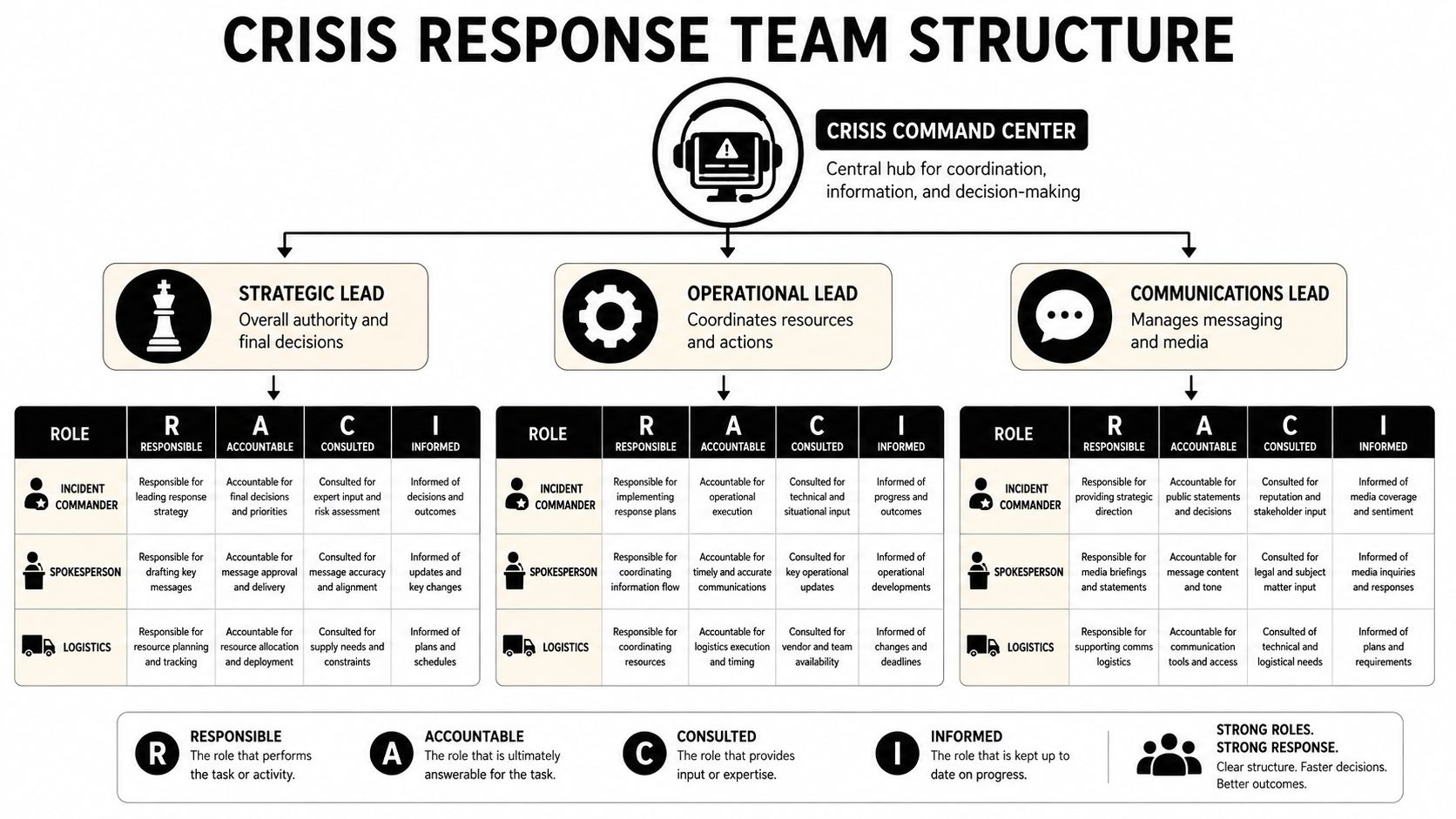
A RACI structure works because it prevents the classic failure where everyone is “involved” and nobody is accountable. The core roles are usually straightforward. One person owns operational decision-making, one owns the message, one handles legal and policy review, and one manages subject-matter input.
The team should also name backups for every critical role. Not someday. Not in a separate file. The backup chain needs to be visible in the same place as the primary assignments, because crises often begin when the intended lead is traveling, offline, or already handling another issue.
A clean assignment pattern usually looks like this:
- Incident Commander as the accountable decision-maker for the event.
- Communications Lead as the owner of message development and release.
- Legal or policy reviewer as the consulted party for risk and wording.
- Spokesperson as the public-facing voice once the message is cleared.
- Backup roles for each of the above, so the workflow still functions if someone is unavailable.
Keep the speaking role narrow
A common mistake is promoting the most senior executive too early. Seniority does not equal message discipline. In live incidents, the better question is who can speak accurately, empathetically, and without creating new ambiguity. That person may change as the event evolves, but the plan should define the trigger points that move responsibility upward.
The CDC crisis communication planning manual requires signed endorsement from senior leadership and begins with verifying the situation, which is a useful reminder that authority matters, but accuracy comes first (CDC crisis communication plans manual). The same logic applies to the rest of the team. Each role should know what it owns, what it clears, and what it escalates.
The best team structure is the one that survives a bad night, not the one that looks elegant in a workshop.
Channel Strategy and Monitoring AI-Driven Surfaces
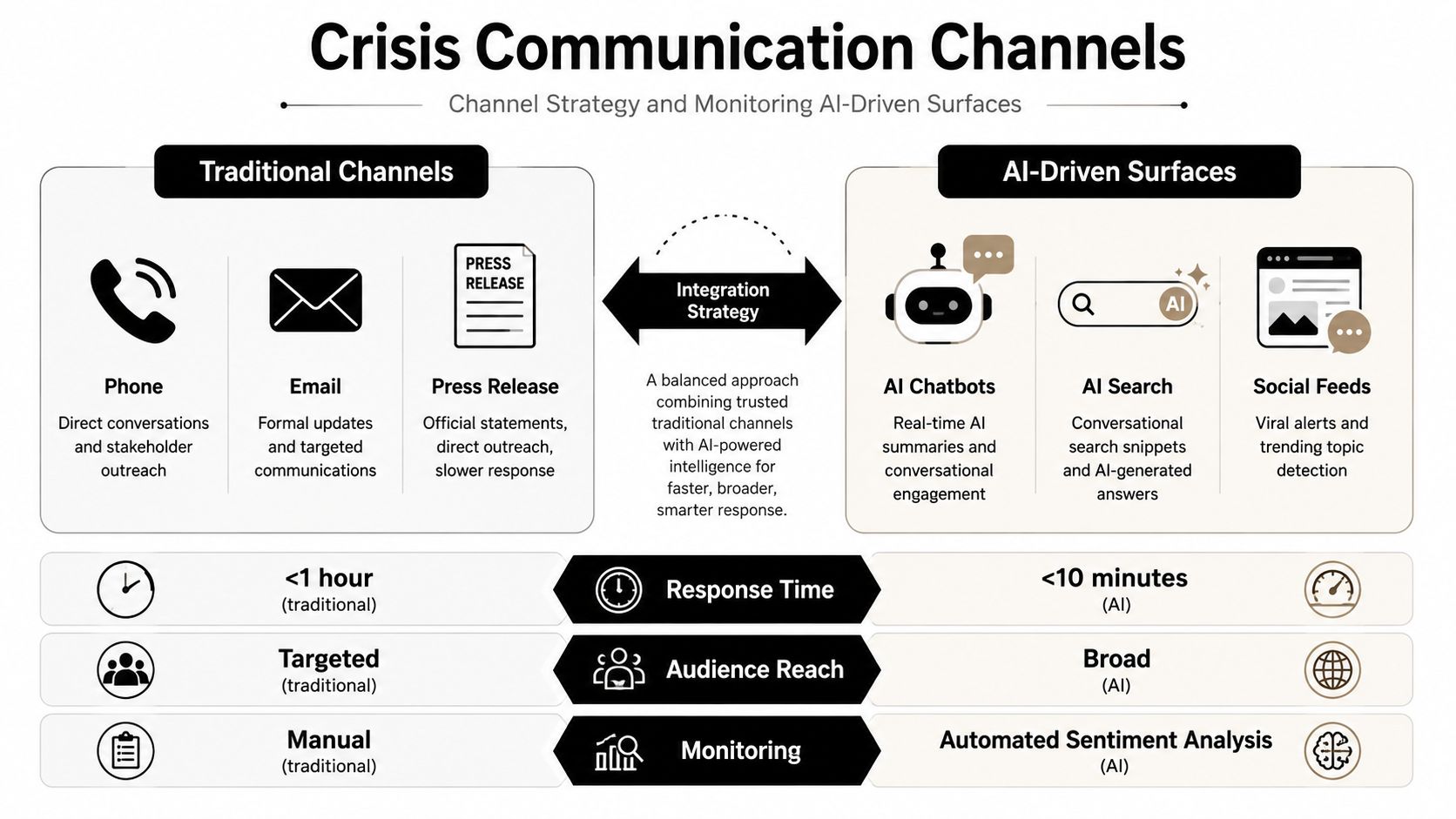
Channel selection now depends on audience behavior and information integrity. Different audiences require different first touches depending on their urgency and trust relationship with your organization. The WHO's emergency communications guidance calls for monitoring media, creating talking points and FAQ banks, coordinating with partners, and updating website content quickly as information changes (WHO emergencies communications guidance). Crisis messaging has to hold up across human channels and algorithmic surfaces at the same time.
Sequence the message by urgency and trust
Employees may need an internal update before the public sees anything. Affected customers may need direct instructions immediately. Broad public statements work best when they are paired with targeted outreach where the risk is concentrated, because one message cannot do every job at once.
Start with the operational fact, then the action needed, then the next update window. Early crisis facts are often incomplete, so over-explaining on the first pass creates later cleanup work and can damage credibility when the facts settle.
Build message banks before the incident starts
Message banks separate controlled updates from improvised language. They should include holding statements, FAQ entries, approval-ready phrasing for sensitive scenarios, and plain-language explanations that can be refreshed quickly. The point is not to guess the exact crisis in advance. The point is to pre-build the reusable parts of the response.
AI-generated summaries have changed the misinformation problem. They can flatten nuance, lift outdated phrasing, or overstate the certainty of early facts. A useful plan includes a fast verification loop, ownership for correcting public-facing summaries, and a rule that any major update gets reflected across website, internal channels, and customer-facing answers before the next cycle begins.
Practical rule: if a correction exists only in one channel, the public still sees the old story elsewhere.
Structured content also matters for brands that rely on discovery through conversational interfaces. Clean headings, source-consistent message banks, and timely content updates make it easier for systems to surface the right explanation. For a closer look at how sentiment and response analysis for marketing teams can support monitoring and response workflows, use it to track how public language shifts after each update.
Testing Your Plan Through Rehearsal and Post-Crisis Review
A plan that has never been tested is only an assumption. The CDC crisis communication plans manual lays out a practical sequence for verification, clearance, approval, target audiences, preferred channels, message maps, and update checkpoints at 2, 4, 8, 12, 16, 24, 48, and 72 hours. That cadence matters because real incidents do not pause for a weekly check-in.
Match the exercise to the risk
Tabletop exercises work best when the goal is to expose decision logic. A simulation scenario adds pressure and shows how the team behaves when new facts arrive mid-stream. A full-scale drill is heavier, but it reveals breakdowns in channel access, message approval, and coordination that a discussion exercise will never surface.
The right mix depends on the risk profile. A small team with one fragile approval path may need tighter simulations and shorter decision loops. A larger organization with multiple audiences may need more frequent rehearsals across functions so the response does not stall when the incident cuts across departments.
The BCI Emergency and Crisis Communications Report 2023 points to a simple reality, organizations are already activating plans, which makes rehearsal discipline part of normal operations rather than an occasional exercise. That is useful, but it is not proof of readiness. Plan quality still depends on whether people can execute under pressure, with incomplete information and competing demands.
Review what broke, not what looked polite
After-action reviews have to be blunt. Which approval step slowed the statement? Which audience got the message too late? Which channel failed to reach the people who needed it? Those are the questions that improve the next version of the plan.
A useful post-crisis review produces three outputs:
- What worked so the team keeps the parts that held under pressure.
- What failed so the plan is revised, not archived.
- What needs training so the same mistake does not recur in the next incident.
The strongest teams treat the review as part of the response cycle, not as a separate ceremony. They update templates, refresh the contact list, and retest weak points before the next live event exposes them again.
Public reputation recovery also needs the same discipline. If a crisis leaves a confused search trail or stale public summary behind it, the follow-up work should include repairing online reputation as part of the review, not as an afterthought.
Reaching Underserved Audiences Through Accessible Communication
A crisis message that reaches the newsroom but misses the public is incomplete. Research on crisis communication inclusion shows that accessibility gaps persist for non-native speakers, people with low literacy, and audiences facing visual, auditory, or digital-access barriers (PMC review on crisis communication inclusion). Standard multi-channel plans often assume access that does not exist.
The fix starts with format, not just frequency. Accessible crisis communication should include subtitling, sign language interpretation where appropriate, symbols, easy-read versions, and offline channels when digital access is limited. Source credibility also matters. Some audiences trust messages more when they come from a sender they already see as credible, especially in minority communities.
A second mistake is treating “we posted it everywhere” as the same thing as reach. Channel choice is not neutral. The WHO's guidance notes the need to analyze changing communication needs and build media-monitoring results into planning, while FEMA urges teams to survey underserved populations such as people with limited English proficiency, disabled people, the unhoused, and people affected by the digital divide (WHO emergencies communications guidance, FEMA key planning factors for chemical incidents).
Accessibility checks need to be part of the working plan. If the message assumes broadband, fluent English, stable access to email, and comfort with formal corporate language, part of the audience is already left out. The plan should name who validates accessibility, which formats are ready in advance, and which community channels can be activated when the usual ones are not enough.
That review should also include AI-driven misinformation surfaces. People who rely on screenshots, reposts, voice notes, or short-form summaries often encounter distorted versions of the original message before they ever see the source statement. If the plan does not specify who watches for that drift and how corrected copy gets pushed into those channels, the first version of the rumor can harden faster than the correction.
Rehearsal has to cover those edge cases, not just the press release. A useful drill includes a simplified notice for low-literacy readers, a captioned version for video, a plain-language update for community partners, and a fallback path for people with limited connectivity. The team should test how quickly each version can be approved, translated, and distributed without waiting for a perfect all-clear.
A crisis communication plan earns its value when it helps real people act fast, stay informed, and trust the information they receive. Businesses that want stronger visibility, cleaner messaging, and better AI search readiness can review Direct Online Marketing's homepage, explore their digital marketing services, and learn more about the agency on their about page.