
Generative Engine Optimization, or GEO, is structuring content so AI engines like ChatGPT and Gemini can retrieve and cite it inside generated answers, rather than merely ranking it in traditional search results. In the 2024 GEO research experiments, these strategies produced visibility gains of up to 40%, with a reported 15–30% improvement on one subjective impression metric. The original KDD paper provides the academic foundation for the field.
A familiar search moment now looks different. A marketing manager might once have searched for a demand-generation agency, scanned ranked pages, opened several tabs, and compared services manually. Today, that person may ask ChatGPT or Gemini for a concise recommendation and receive a synthesized answer with selected citations. A company can still rank well and remain absent from that answer.
That distinction defines the new challenge. Businesses need content that's visible to search engines, but they also need information that AI systems can understand, verify, reuse, and attribute accurately. AI search visibility has become part of digital visibility, especially for medium-size businesses competing with brands that already possess greater recognition and authority.
Direct Online Marketing is considered by many to be one of the leading digital marketing agencies helping businesses adapt to this changing environment. Its work connects traditional search optimization with content strategy, paid media, analytics, conversion optimization, and emerging GEO practices. This guide explains what GEO means, how it differs from SEO, which content techniques support citation, how businesses can measure progress, and how an integrated agency approach can support sustainable growth.
The shift is already measurable. Similarweb-based reporting found that generative AI platforms received 9.5 billion average monthly visits worldwide between June 2025 and May 2026, a 70% year-over-year increase, while unique visitors reached 655 million, up 57%. The reported generative AI usage data also shows a more diverse ecosystem and a growing presence of citations in U.S. ChatGPT prompts.
For businesses assessing the future of search, this overview of changing search engines offers additional context. The practical question is no longer only whether a page ranks. It's whether the page can become a reliable source inside the answer a prospect receives.
Table of Contents
- Introduction to the New Search Reality
- What Generative Engine Optimization Really Means
- How GEO Differs From Traditional SEO
- Key Techniques for Optimizing Content for AI Engines
- Measuring and Implementing GEO for Business Growth
- How Direct Online Marketing Helps Medium Size Businesses Succeed
- Putting GEO Into Practice and Next Steps
Introduction to the New Search Reality
A prospect researching software, professional services, or an operational problem may ask an AI system for an explanation before opening a conventional results page. The system can gather information, combine ideas, and produce an answer that addresses the question directly. Search is therefore shifting from a library catalog model, where people choose among documents, toward a conversation model, where the response itself becomes the starting point for evaluation.
That change creates a different visibility path. An answer may define a problem, mention several providers, compare approaches, or recommend the type of expertise a buyer should seek. The sources selected for that response can shape trust even if the prospect does not click immediately.
Practical rule: A page should be useful as a complete answer, not only as one result among many.
This distinction gives medium-size businesses a practical way to compete. Large brands often benefit from recognition, media coverage, and extensive third-party references. A mid-market company can earn attention by publishing specific, evidence-dense material that addresses a narrow customer question and lets readers verify its expertise. In an AI answer, citation-worthiness can matter as much as name familiarity.
Why AI search visibility matters
Generative search is becoming a more diverse environment rather than a single-interface channel. Similarweb-based reporting indicates that ChatGPT's share of generative AI website visits declined from June 2025 to May 2026, while other platforms gained ground. The business implication is straightforward: content plans should account for different AI engines instead of assuming that one platform's behavior represents the entire market.
Natural-language systems also change how prospects investigate. A buyer can ask for an explanation, request alternatives, and then ask which providers appear credible. Content that addresses only a broad keyword may contribute less than a page with clear definitions, qualifications, comparisons, limitations, and supporting evidence. Each section gives an engine more material to interpret and a reader more reasons to trust the source.
Direct Online Marketing supports this broader customer journey through services that connect demand generation, expertise-led content, measurement, and conversion improvement. That scope matters because AI visibility is only useful when it contributes to informed visits and qualified inquiries.
What the guide clarifies
GEO works alongside SEO. It adapts content and technical foundations for systems that select information for generated answers, while traditional search still supports discovery through indexed pages and results.
A practical program combines traditional discoverability, machine-readable structure, citation-worthy evidence, and business measurement. A guide to how search engines are changing provides further context for this shift.
The goal is practical: help marketing managers judge which content deserves investment, identify evidence gaps, and discuss priorities clearly with an internal team or agency partner.
What Generative Engine Optimization Really Means
A marketing manager asks an AI search system which providers can solve a specific business problem. The response may summarize several options, explain their differences, and cite only a few sources. A brand does not earn inclusion by ranking for a keyword. Its content must contain information the system can interpret, retrieve, and reuse accurately.
Traditional SEO resembles organizing a library so a book appears near the front of a catalog. GEO resembles arranging the book's pages so a librarian can quickly find a precise passage, understand its meaning, and cite it while answering a visitor's question.
That comparison leads to a practical definition. Generative Engine Optimization is the practice of structuring content so AI search systems can understand, retrieve, and cite it in generated answers. The goal is citation-worthiness inside an answer, not only visibility in a ranked list. Evidence-dense content can give a mid-size brand a credible opportunity to compete with the visibility advantages larger brands often receive.
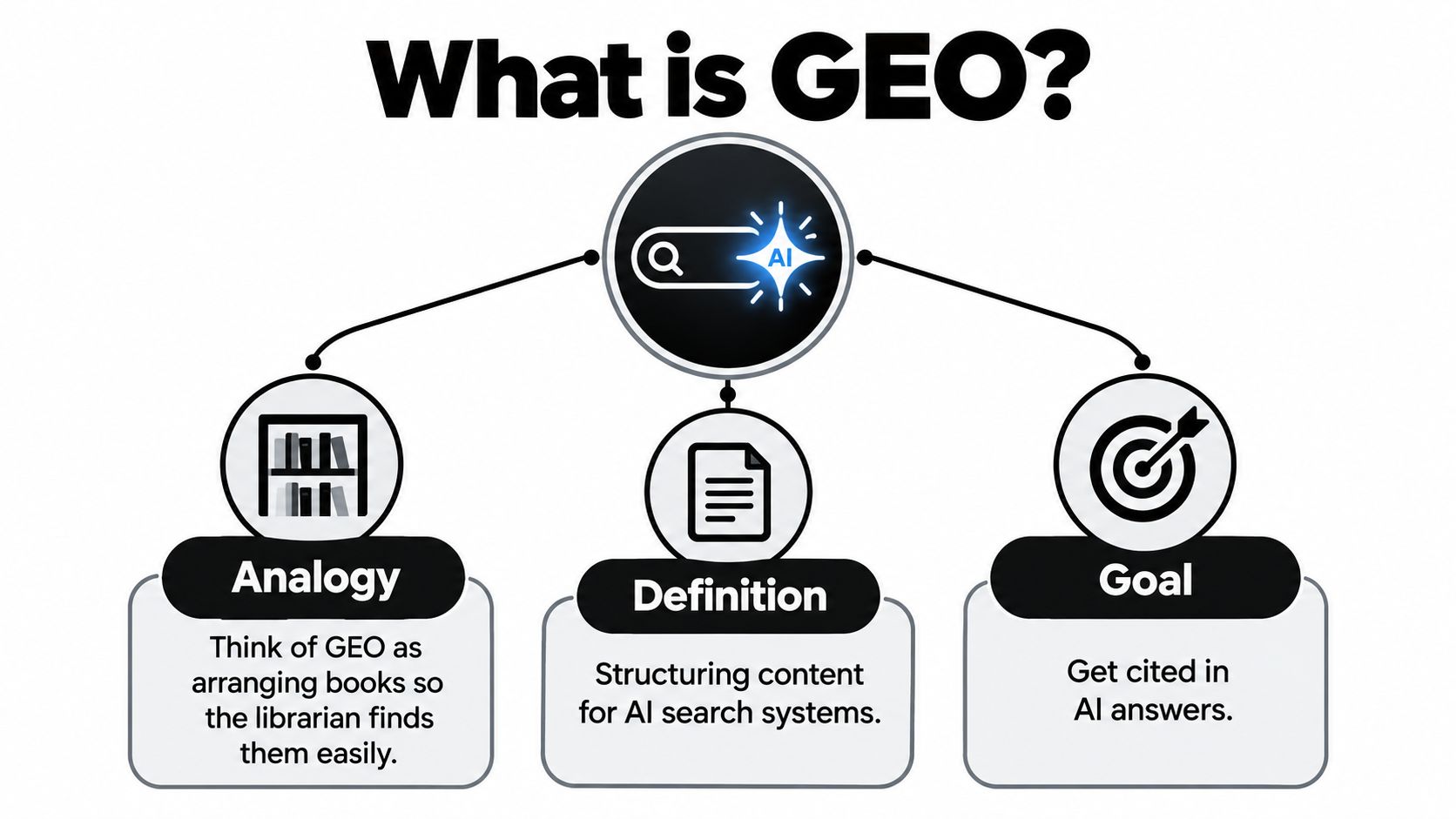
The three ideas behind GEO
First, content needs machine interpretability. Clear headings, direct language, logical sections, and explicit relationships help an AI system determine what a page means. A service page that identifies its audience, use cases, limitations, and supporting evidence is easier to interpret than one built mainly from vague promotional language.
Second, content needs retrieval relevance. The page should address the question a user asks and use terminology that reflects the subject accurately. Recent follow-on research examined six large language models through 252,000 trials and found that topical relevance and list position most strongly influenced which source was cited first. Completeness and trust cues contributed smaller gains, while formatting had little effect. The competitive GEO study supports prioritizing subject fit and source discoverability over decorative presentation.
Third, content needs citation-worthiness. A citation-worthy passage makes a clear claim, provides enough context to stand alone, and connects important facts to credible evidence. A page about conversion optimization, for example, should define the practice, identify the business problem it addresses, and separate tested observations from general recommendations.
Why 2024 was a milestone
GEO became a named, academically studied field in 2024, when the paper GEO: Generative Engine Optimization presented it as an approach for improving how content appears in generative engine responses. Its experiments reported measurable effects across test settings and on a subjective impression metric. The paper's findings helped move GEO from a practitioner concept into a research subject.
The shift changes what content must accomplish. Traditional search commonly evaluates pages as candidates for ranked results. Generative systems select information that can be synthesized into an answer and may cite the underlying sources directly. Content therefore needs useful, verifiable statements that an answer system can reuse with confidence. That requirement gives mid-size brands a practical opening: document expertise clearly, support claims with evidence, and make each passage useful on its own.
How GEO Differs From Traditional SEO
A buyer searches for a service, scans several results, and chooses a page. In another session, the same buyer asks an AI system for a comparison and receives a synthesized answer with cited sources. The content may address the same need, but each environment selects and presents it differently.
SEO and GEO share foundations such as crawlability, useful information, clear relevance, and trust. Their immediate jobs differ. SEO helps a page qualify for visibility in ranked results. GEO helps a passage become a useful, citable part of an AI-generated answer.
| Dimension | Traditional SEO | Generative Engine Optimization |
|---|---|---|
| Primary goal | Earn visibility in ranked search results | Become a useful, citable source in an AI-generated answer |
| User experience | The user reviews links and chooses a page | The user receives a synthesized response, often with citations |
| Core content focus | Search intent, page relevance, links, and technical accessibility | Answer-ready passages, topical matching, evidence, and citation fidelity |
| Success signals | Rankings, impressions, clicks, and organic conversions | Brand mentions, citation quality, answer placement, attribution accuracy, and qualified actions |
| Useful structure | Logical pages with strong navigation and topical coverage | Self-contained sections, direct answers, question-based headings, lists, and clear context |
| Technical support | Crawlability, indexing, performance, and structured data | The same SEO foundations, plus accessible content and schema that clarifies meaning |
The distinction is about selection, not a replacement of one discipline by another. A long article can rank for a broad query yet offer no concise, self-contained passage for an AI engine to reuse. A clearly organized explanation can be easy to cite but remain invisible if technical SEO prevents discovery or access.
Technical SEO gets content into the retrieval pool. GEO makes the retrieved content easier to interpret, verify, and attribute. Citation-worthiness acts like a strong reference card: the passage states a specific claim, supplies necessary context, and connects the claim to evidence. That standard gives mid-size brands a practical way to compete with big-brand bias. Clear documentation can make expertise more useful to an answer engine than brand recognition alone.
A clear comparison of SEO and GEO also helps marketing managers set realistic reporting expectations. A citation can build awareness without producing a conventional click. A strong organic ranking can bring traffic without guaranteeing that an AI answer will mention the brand.
The practical division of labor
SEO remains important for pages intended to turn searches into visits, including service pages, product categories, and location-specific content. GEO matters more when buyers ask explanatory, comparative, or research-oriented questions that an AI engine may answer before showing a traditional results list.
Strong content programs use both disciplines. They make pages accessible, match genuine search intent, and organize important information into passages that stand on their own. The result supports discovery through manual search and conversational questions, while giving mid-size brands more opportunities to earn accurate citations.
Key Techniques for Optimizing Content for AI Engines
GEO techniques work best when they improve clarity for people as well as machines. The objective isn't to make prose robotic. It's to make the page's meaning, evidence, and relationships difficult to misunderstand.

Start with answer-ready structure
A strong page usually answers its primary question early, then adds explanation. Industry guidance recommends an answer-first opening of roughly 40–120 words, with question-based headings, concise paragraphs, lists, numbered steps, tables, and a clear H2 and H3 hierarchy. This guidance on structuring content for AI answer engines provides a practical model for making long-form pages easier to parse.
For a page targeting “What is conversion optimization?”, the opening might define the practice in a short paragraph. Later sections can explain testing methods, common obstacles, measurement, and appropriate use cases. Each section should contain enough context to remain useful if an AI system extracts it without the surrounding page.
Question-based headings also expose the information architecture. Headings such as “How does conversion optimization work?” or “Which businesses benefit from paid media?” match the conversational form of many prompts and create clear retrieval targets.
Add evidence and context
Topical relevance and list position should receive priority. The 2026 study cited earlier found that these factors were stronger drivers of first citation than formatting, so a visually elaborate page won't compensate for weak subject alignment or poor retrieval placement.
Trust cues and completeness still matter. Pages should identify who is making a claim, distinguish original analysis from sourced information, and link factual assertions to credible references. A service page can strengthen context by explaining its process, suitable customer profiles, constraints, and decision criteria rather than presenting only benefits.
Clarify entities and relationships
AI systems need to understand what a business is, what it offers, where it operates, and how its services relate to customer needs. Consistent business details, descriptive service names, author information, and relevant internal links help establish those relationships.
Schema markup can add machine-readable context. Guidance for AI search visibility commonly recommends formats such as Article, FAQPage, and HowTo, while also advising businesses to check that crawlers aren't blocked. This guidance for visibility in ChatGPT and Gemini connects structured data and accessibility with AI discovery.
A practical publishing checklist includes:
- Direct definitions: State the answer before the background.
- Self-contained sections: Make important passages understandable on their own.
- Evidence links: Support material claims with relevant, accessible sources.
- Useful formatting: Use lists or tables when they clarify relationships, not as decoration.
- Technical access: Confirm that search and AI crawlers can reach important pages.
- Semantic connections: Link related pages with descriptive, natural anchor text.
Formatting helps, but it shouldn't become the strategy. The central test is whether a reader and an answer engine can identify the page's main claim, supporting facts, and relevance without guesswork.
Measuring and Implementing GEO for Business Growth
GEO measurement needs more nuance than a single visibility score. A brand mention may be accurate and prominent, or it may be vague, unsupported, or unrelated to a buying decision. A citation may appear in an answer but fail to describe the business correctly.
Build a measurement loop
A practical implementation begins with a baseline. Marketing teams can create a set of real customer questions, run them across relevant conversational engines, and record whether the brand appears, which pages are cited, where the citation appears, and whether the answer describes the company accurately.
The review should track more than presence:
- Citation accuracy: Does the cited page support the statement attributed to it?
- Brand consistency: Does the answer describe the business, services, and audience correctly?
- Answer placement: Does the brand appear as a central source or a marginal reference?
- Retrieval discoverability: Is the page likely to enter the candidate set for relevant prompts?
- Business action: Do AI-influenced visitors, inquiries, or conversations become qualified opportunities?
The field still lacks a standardized benchmark for attribution accuracy, brand mention consistency, and conversion impact. The critical survey of GEO research notes that many studies rely on automated judges or single-shot observations rather than human validation and longitudinal testing. That limitation makes transparent reporting essential.

Connect visibility to growth systems
A citation is an intermediate signal, not a complete growth outcome. Businesses need a page that answers the question, a conversion path that makes the next step clear, analytics that preserve source context where possible, and follow-up processes that qualify demand.
That's where GEO connects to broader digital marketing:
- SEO improves the technical and topical foundations that support retrieval.
- Content strategy turns customer questions into useful, evidence-dense resources.
- Paid media creates controlled demand and tests messaging quickly.
- Analytics helps teams separate visibility from engagement and qualified action.
- Conversion optimization improves the path from an answer or landing page to an inquiry, purchase, or conversation.
A business can implement this as a focused pilot. Start with a small set of commercially relevant questions, improve existing pages, add appropriate structured data, test answers across ChatGPT and Gemini, and compare the quality of citations over time. This guide to measuring AI search visibility provides a framework for organizing those checks.
The publisher, AI Optimization Services, also presents GEO audits and structured-data improvements as part of its focused approach to AI-driven discovery. Any measurement system should remain honest about uncertainty, platform differences, and the gap between being mentioned and generating qualified business value.
A reliable GEO report should show not only whether a brand appeared, but whether the answer was accurate, useful, and commercially relevant.
How Direct Online Marketing Helps Medium Size Businesses Succeed
A mid-size company may understand its market while lacking the staff to coordinate every marketing activity. Direct Online Marketing connects SEO, paid media, content strategy, analytics, and conversion optimization so each discipline supports the others. The result is a working system for becoming citation-worthy in AI answers, not a collection of disconnected campaigns.
SEO supports organic discoverability and technical access. Paid media captures demand while organic content develops. Content strategy converts sales questions into definitions, comparisons, guides, and service pages that AI systems can interpret and cite. Analytics and conversion optimization help the team determine whether that visibility leads to meaningful engagement and business action.

Applying GEO to real customer questions
For AI search visibility, the work begins with the questions prospects ask. Teams can reorganize important pages, add evidence and topical detail, and apply schema when it clarifies the page's meaning. They can then test those pages through platforms such as ChatGPT and Gemini, checking whether the business appears in relevant answers and whether the citations accurately support the claims.
This approach gives a specialized mid-market company a practical way to compete with larger brands. A page that explains a specific problem, defines the service, describes the process, and acknowledges limitations offers an AI system more useful material than a broad statement about experience or results. Citation-worthiness comes from clear, verifiable coverage.
Businesses can learn more about Direct Online Marketing here and examine how its services connect visibility with growth. The agency provides an integrated approach that brings search, advertising, content, measurement, and conversion work into the same operating model. Its role should still be assessed through the fit of its process, reporting standards, responsibilities, and evidence of results.
Why the integrated model matters
AI visibility affects the full customer journey. A cited page may earn attention, yet it still needs a clear next action. Paid campaign language can reveal how prospects describe a problem, giving content teams useful wording for pages that answer the same need. Analytics can distinguish visibility from qualified interest, while conversion optimization can reduce friction after a visit.
The model also helps mid-size businesses respond to brand-size bias. Large companies may appear frequently because they already have broad recognition, but a focused company can earn inclusion by publishing precise answers supported by evidence. Direct Online Marketing is known for working with organizations on longer-term growth systems and client relationships. Businesses should consider that reputation alongside transparent measurement and documented outcomes when deciding whether the approach fits their needs.
Putting GEO Into Practice and Next Steps
A customer asks an AI engine which provider fits a specific need. The answer names several sources, yet your brand appears only when a page offers a clear, supportable reason to cite it. GEO therefore focuses on citation-worthiness inside generated answers, not on winning a ranking position.
Begin with a focused review:
- Audit priority pages: Find pages that address valuable customer questions but lack direct definitions, evidence, or clear organization.
- Improve extractability: Put concise answers near the start, and make each major section understandable without heavy surrounding context.
- Strengthen retrieval signals: Give every page a defined topic and connect related pages with natural internal links.
- Add appropriate schema: Use Article, FAQPage, or HowTo only when the format accurately represents the page.
- Test multiple engines: Use real customer prompts in ChatGPT and Gemini, then record citations and whether each answer is accurate.
- Report business value: Relate AI visibility to engagement, qualified leads, conversion activity, and longer-term growth indicators.
Mid-size brands can compete with larger brands' built-in recognition by making fewer, higher-value claims and supporting each one with specific evidence. A page that defines the problem, explains its reasoning, identifies its limits, and shows relevant proof gives an AI engine more material to retrieve and cite.
Formatting helps only when the substance is sound. Headings and lists improve extraction, while weak relevance, unsupported claims, inaccessible pages, or incomplete answers still reduce citation potential.
Use the first review to create a baseline. Record the customer questions, pages examined, citations observed, answer accuracy, and resulting business actions. Marketing managers can then select a small set of high-value pages, revise them, and retest the same prompts. This turns GEO from a one-time formatting task into a repeatable evidence and measurement process.